



Over 100 years of Anti-urbanism in Nairobi
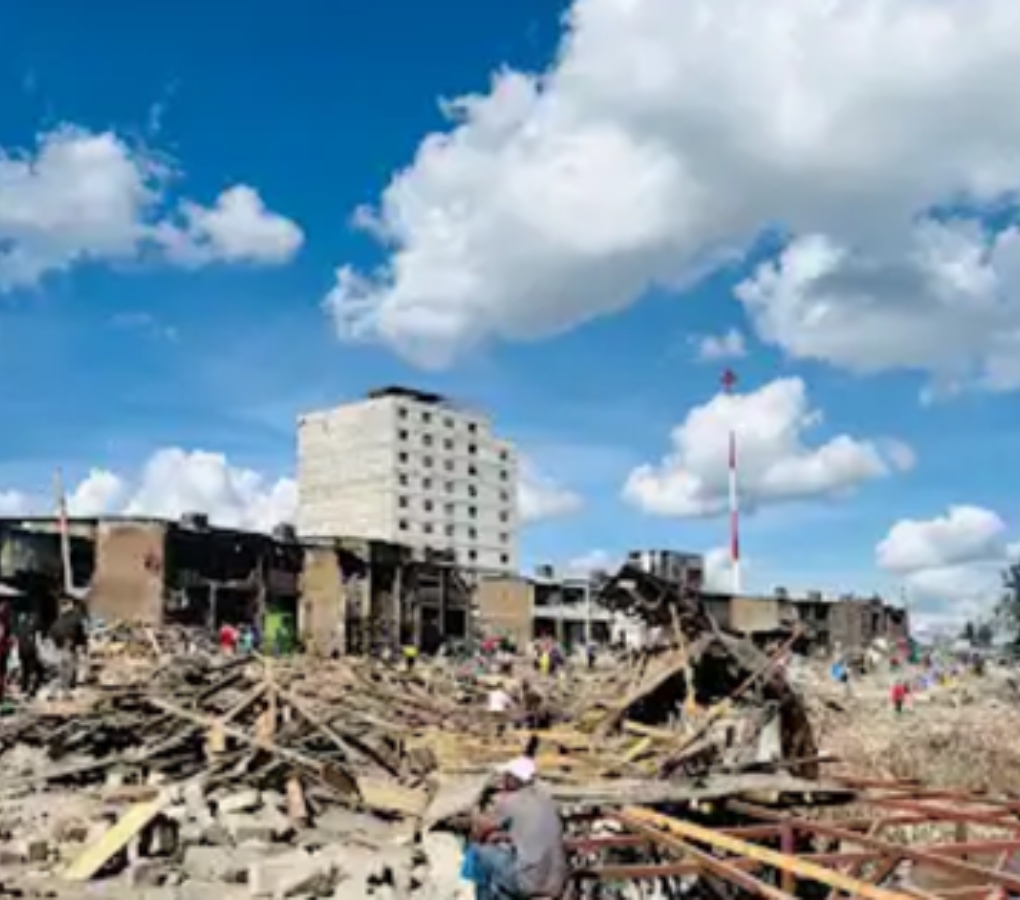
Affordable housing programmes are displacing urban residents while making housing increasingly unaffordable. In Nairobi, urban restructuring has intensified struggles over land, belonging and the meaning of home.
Speaker 1: “Munaenda kwenyu for Chrisi when?” (When are you going home for the Christmas holiday?)
Speaker 2: “Tunaikulia uku Nairobi” (We will be celebrating the holiday from here in Nairobi)
Speaker 1: “Kwa nini, mbona hamuendi ushago?” (Why? Are you not going home, upcountry?)
Speaker 2: “Ushago kwetu ni huku Nairobi” (Our home is here in Nairobi, with insistence in their voice)
Speaker 1: “No, Hakuna mtu kwao ni Nairobi” (no, no one is from Nairobi)
It is early December 2025, and for several days, bulldozers have made camp in Eastland’s Makongeni estate, demolishing Nairobian’s houses in the name of building the government's controversial affordable housing programme. It is the morning of 19th December 2025, and other bulldozers are demolishing old railway workers' houses along Ojijo road in Parklands, the other side of the city, for private developers to construct more high-rise buildings. These particular houses had been marked and gazetted as a cultural heritage site in 2021. It is 30th March 2026, and after weeks of fear of looming demolitions at the Gikomba market, located close to the CBD, government bulldozers came in with the night’s darkness and began demolishing the whole section where shoes are sold. This demolition is for the construction of the modern market, which, rumours have it, for public participation is never done here, is just the first phase of the Gikomba market demolition. Three to four other phases are to come later. It is Saturday, 11th and Sunday, 12th April, and bulldozers this time by private landowners have set camp to demolish the shirt section that neighbours the demolished and already fenced shoe section. A shopping mall is rumoured to be what will be developed in this section, taking away much-needed market space from small traders.
Demolitions, particularly in the Eastlands sides of Nairobi, are common; in fact, they date back over a hundred years. In the 1920s, for example, the colonial government demolished structures in what was then called “African villages.” The arguments of “for development and modernisation”, “reclaiming of riparian land”, and “health” are among the reasons given by the colonial and post-colonial governments of the city. Different scholars have documented how demolitions are the “foundation upon which housing, race, and urban belonging are built in Nairobi.”[1] While the violence of demolition is a visible act of what Kenyan scholar Bettina Ng’weno has termed anti-urbanism, they are just one of the many pieces of evidence of the belief, attitudes, practices and policies that dictate that cities such as Nairobi should not be a permanent home for anyone. Urbanization across the world is constantly conceptualised as a capitalist process, where homes and infrastructure are built for capital and not for people.
Ng’weno, in her new book, “No Place Like Home in a New City: Anti-Urbanism and Life in Nairobi,” defines anti-urbanism as a form of urbanism itself. That is, “a form of knowing, imagining, planning, designing, and administering cities,” whose “organising principle maintains that the majority of people cannot, should not, and must not be permanent residents of a city. It is a refusal of the idea that the city can be home” (p.3).[2] Cities across the world have long been planned through this logic. In Addis Ababa, for example, the ‘soul’ of the city has, in the last few years, been razed for the development of shiny mega infrastructures.[3]
In Nairobi,it is quite common to be in or to overhear conversations that fall in line with the one I started this essay with. A simple back and forth pushing against the idea that anyone can and should be allowed to claim Nairobi as their home. Kenya’s first president, Jomo Kenyatta, popularised the slogan turudi mashambani (let’s go back to the rural areas). He went further and called those moving from rural areas to settle in Nairobi “enemies of the nation.”[4] These are evidence of the ingrained anti-urbanism attitude in post-independence Kenya.
In her book, Ng’weno traces this attitude, anti-urbanism, across different registers. We follow Ngweno’s father, the late journalist Hilary Ng’weno and the grandparents before him as they grew up and established a life respectively. We experience life in the railway neighbourhood, constructed for railway workers, seeing how it was designed for single men. The houses were not family housing; they were for workers who were expected to work in their energetic years and retire back to their families in the countryside, to their homes. We experience how life in this neighbourhood was governed by a time and labour governance instrument, king’ora (Siren), that dictated work shifts. Later on, when the workers revolted and established families, the social life of the homestead ended up being governed by the same instrument.
Ng’weno’s other register is the archive where she documents the over 100 years of racial segregation in neighbourhoods like Parklands that had been designated as a white-only area. Ng’weno follows the story of A.C.L. de Souza, an Asian doctor who challenged the racial restriction that he could not live in the Parklands area on land he had bought through the courts in 1924. The case was judged in his favour in 1928, allowing the entry of Asians into the neighbourhoods. Whiteness, however, morphed through the introduction of special covenants and conditions that would ensure continued racial segregation against Black Kenyans, which had to be adhered to as they were written on land deeds and licenses. The racial anti-urbanism segregation of the city extends to cemeteries, and Ng’weno explores this in the story of the first post-independence political assassination, Pio Gama Pinto, and his close friend and second vice-president, Joseph Murumbi, whose burial site tells the story.
As Ng’weno traces the attitudes, beliefs, laws, policies and practices through which over 100 years of anti-urbanism have been enacted, she also centres on how Nairobians have maintained a spirited insistence on their habitation and full articulation of Nairobi as home. We learn of dances in the 70s to 90s in socials across Eastlands that set forth urban cultures that transcended Nairobi into the East African region. At present, as bulldozers demolish houses and markets across the city, Nairobians continue to fight this “demolition colonialism” through protests, court cases and other forms of organising.[5]
Ng’weno’s book is among a rising number of academic books on Nairobi that have come out in the last few years. Its beauty is how personal it is, written by a Nairobian with stories of growing up and living in Nairobi. The book’s writing style also makes it readable beyond the academy, which means its dedication to “all of you who also love being from Nairobi” is appropriate. With access, it can travel to most.
Mwangi Mwaura is a DPhil (PhD) student in the School of Geography and the Environment at the University of Oxford.
Endnotes
[1] Bettina Ng’weno. No Place Like Home in a New City: Anti-Urbanism and Life in Nairobi. University of California Press, 2025
[2] ibid
[3]Mahder Habtemariam Serekberhan. አዲስ አበባ ቤቴ: Reflections on the Violent Restructuring of Addis Ababa. Pambazuka News, 2025, February 20. https://www.pambazuka.org/Violent-Restructuring-of-Addis-Ababa; The Guardian. Dismay in Addis Ababa as ‘the soul of the city’ is razed for development. 2024, April 4. https://www.theguardian.com/global-development/2024/apr/04/dismay-in-addis-ababa-as-the-soul-of-the-city-is-razed-for-development-ethiopia
[4] Kenda Mutongi. Matatu: A History of popular transportation in Nairobi. University of Chicago Press, 2017
[5] Mwangi Mwaura. Demolition colonialism in Nairobi. ROAPE. 2022, November 1. https://roape.net/2022/11/01/demolition-colonialism-in-nairobi/