



Colin Clarke, Racist Regimes, Forced Labour and Death: British Slavery in the Caribbean and the Holocaust in Germany and the Occupied Europe (2024, Palgrave Macmillan)
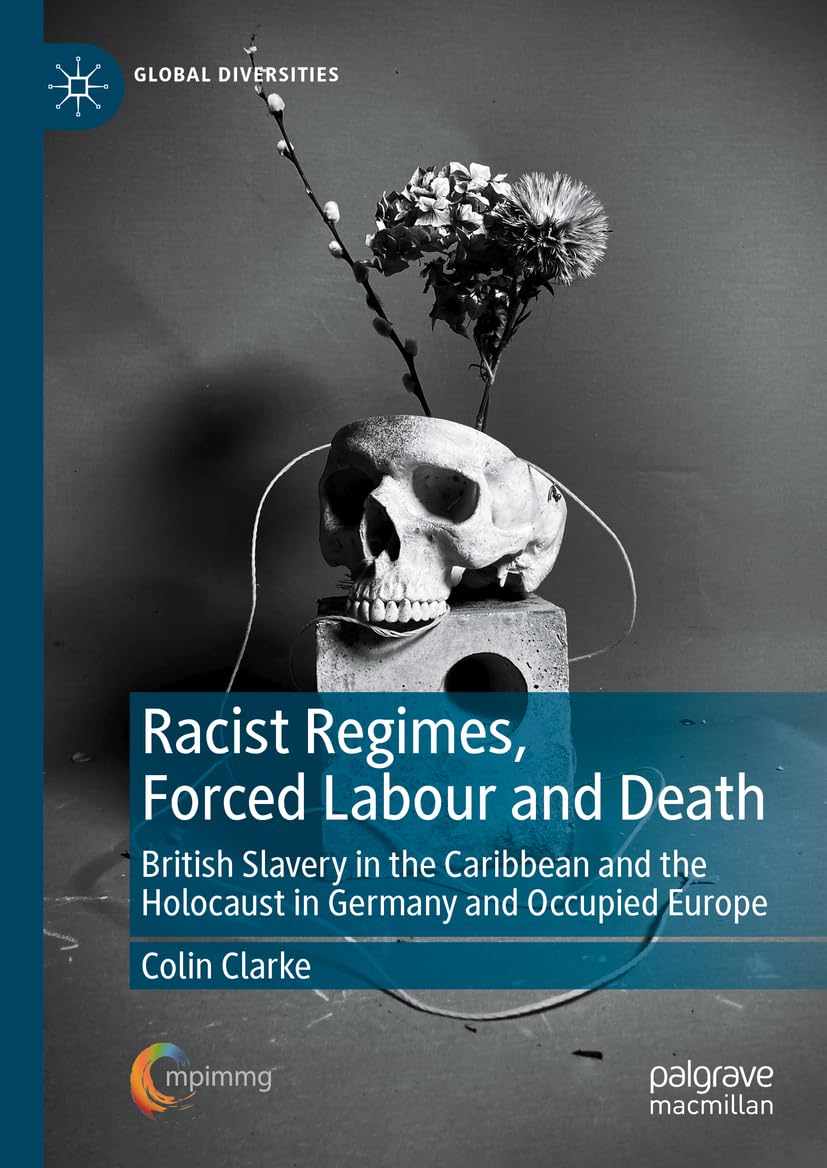
A review of a book challenging selective restitution that sidelines Global Africa.
In the UK, the issue of reparations for the Transatlantic slave trade of Africans and their enslavement in the Caribbean has been framed as a matter of concern only to descendants of slavery. In fact, the Nigerian heritage leader of the Conservative Party in the UK sees the debate as an imposition on the UK government and people to even bring up the question of reparations (see Wambu in this issue), even though it was only in 2015 that the government finished paying of the money that it borrowed to compensate the slave owners. It is well-known that after the institution of slavery ended, the ex-slaves were expected to give their labour to the plantations freely under the apprenticeship scheme. Many fled to the hills, to the free villages, to eke out a living from subsistence agriculture, and continued the fight for their freedom against colonial exploitation.
Colin Clarke, a white Englishman, first visited the Caribbean, Jamaica in fact, in the early 1960s as a doctoral student seeking to carry out geographical research on the capital city of Kingston. The execution of this project drew him to the slum areas of downtown Kingston. The young Clarke was shocked by the destitution that he encountered, more so because these people were considered British subjects. Some 60 years later, he decided to conduct a comparative study of the Jewish Holocaust and that of slavery in the Caribbean. He summarizes the background for the book as such:
Both British and German Nazi empires used slavery and forced labour to target and persecute their racial and ethnic victims, having determined the outcome – often death – by denying them any semblance of civil liberties. Each system was introduced by an expansionist European power, through racist enslavement, transportation, dehumanisation and the destruction of human life.
However, the construction and operation of Caribbean sugar plantations by African and Creole slave labour in the 17th and 18th centuries was different from the mass murder of Jewish and Gypsy civilians in Europe (the Holocaust) and their use as forced labour to manufacture armaments during the Second World War. The contrast is expressed in the following trajectories: for the Caribbean, slave capture in Africa, forced migration across the Middle Passage, sale, seasoning, and being worked to an early death in the gang system of the sugar plantations; and for Occupied Europe, forced migration and forced labour for Jews and Gypsies, where the majority died in work ghettos, or by shooting or gassing, and the remainder were subjected to industrial forced labour in SS concentration camps engaged on Nazi ‘miracle projects.’
Differentiated, as these two events are, however, there is a basis – even a moral need – for comparison. Comparison in this instance rests on four common denominators — racism, colonialism/occupation, forced labour and death. Combined, all four elements in common led inexorably to crimes against humanity and genocide. The juxtaposition of these two historical cases has deep political implications. Both British Caribbean slavery and the Holocaust have given rise to appeals for reparations. But only the Caribbean planters of the post-emancipation era and the victims of the Holocaust since the Second World War have so far received compensation.
Clarke meticulously presented the case for reparation documenting the sums paid to Israel, in contrast to the absence of the survivors and descendants of European enslavement. As I wrote in an earlier issue of Pambazuka News, Clarke notes that, in 1951, Western Germany agreed to pay $3 billion over the next 14 years to the state of Israel, where 500,000 Jews were resettled. By the 2000s, over $110 billion had been paid by Germany in reparations, indemnification, and restitution. In 2019, Germany paid $564 million to the Claims Conference which supports medical and cultural charities germane to the holocaust and its survivors. Clarke argues that reparation has been a successful symbolic gesture of benefit to surviving European Jews of the Holocaust generation.
Contrast this to the treatment of the enslaved African peoples and their descendants. Clarke estimated that 2.7 million Africans were shipped to the Caribbean, 350,000 died enroute and that the conditions of slavery were extreme violence and sexual slavery. The most graphic of the latter were documented in the diaries (covering 37 years) of an Englishman Thomas Thistlewood, who was an estate overseer in western Jamaica in the late 18th century.[1] It is because Thistlewood gleefully recorded his obscene sexual abuse of women that we know the enormity of the extreme violence that enslaved women were subjected to at the whim of a plantation manager.
In the UK, people take pride in the fact that the UK ended slavery in 1834 but refused to consider that the dehumanized way in which the British state perceived those enslaved people, continued after the ending of slavery. With regards to the owners of enslaved Africans, in 1834, the British government agreed to pay them £20 million in compensation. That £20 million that the government borrowed in 1834, was finally paid off in 2015. At University College in London, the Legacies of British Slavery Database contains the list of all those slaveowners who received compensation.[2] Some British families continue to benefit from that payout up to today.
In contrast, the enslaved people and their descendants received nothing and have continued to suffer from the legacies of slavery. Hilary Beckles, in How Britain Underdeveloped the Caribbean: A Reparation Response to Europe’s Legacy of Plunder and Poverty[3], shows how, after the ending of slavery, British officials in the Caribbean ensured that Black people could not progress by ‘freezing freedom’, through legislation that prevented any economic advancement. The remaining period of British colonization was dominated by wealth extraction and neglect of the Black and impoverished population of the island. At the time of political independence from British rule, in the 1950s, efforts were made to undermine the newly-formed Federation of the West Indies (1958–62) as it demanded reparations and saw Caribbean–wide collective action as the only way to foster development in the region. Then, the UK refused to provide the £200 million development support requested by its Caribbean colonies. In the Caribbean, poor black people are amongst the most deprived, whilst descendants of slave owners and colonizers continue to enjoy the privileges of the inherited colonial racialized economic hierarchies.
Clarke’s book provides the intellectual resources that campaigners need when UK politicians and others downplay the human impact of slavery and the continued impoverishment and racism faced by Black survivors and descendants of enslavement, whilst unquestionably accepting the debt Europe, especially Germany, owed to the survivors of the Jewish Holocaust and their descendants.
Patricia Daley is a Professor of Human Geography of Africa in the School of Geography and the Environment.
Endnotes
[1] Burnard, Trevor (2004) Mastery, Tyranny, and Desire: Thomas Thistlewood and His Slaves in the Anglo-Jamaican World. University of North Carolina Press.
[3] Hilary McD. Beckles, How Britain Underdeveloped the Caribbean: A Reparation Response to Europe’s Legacy of Plunder and Poverty. Kingston: University of the West Indies Press