



Book Review: Community Policing in Nigeria: Rationale, Principles, and Practice Authors: Emmanuel C. Onyeozili, Biko Agozino, Augustine Agu, and Patrick Ibe Publisher: Virginia Tech Publishing (USA) and Fourth Dimension Publishing (Nigeria), 2021.
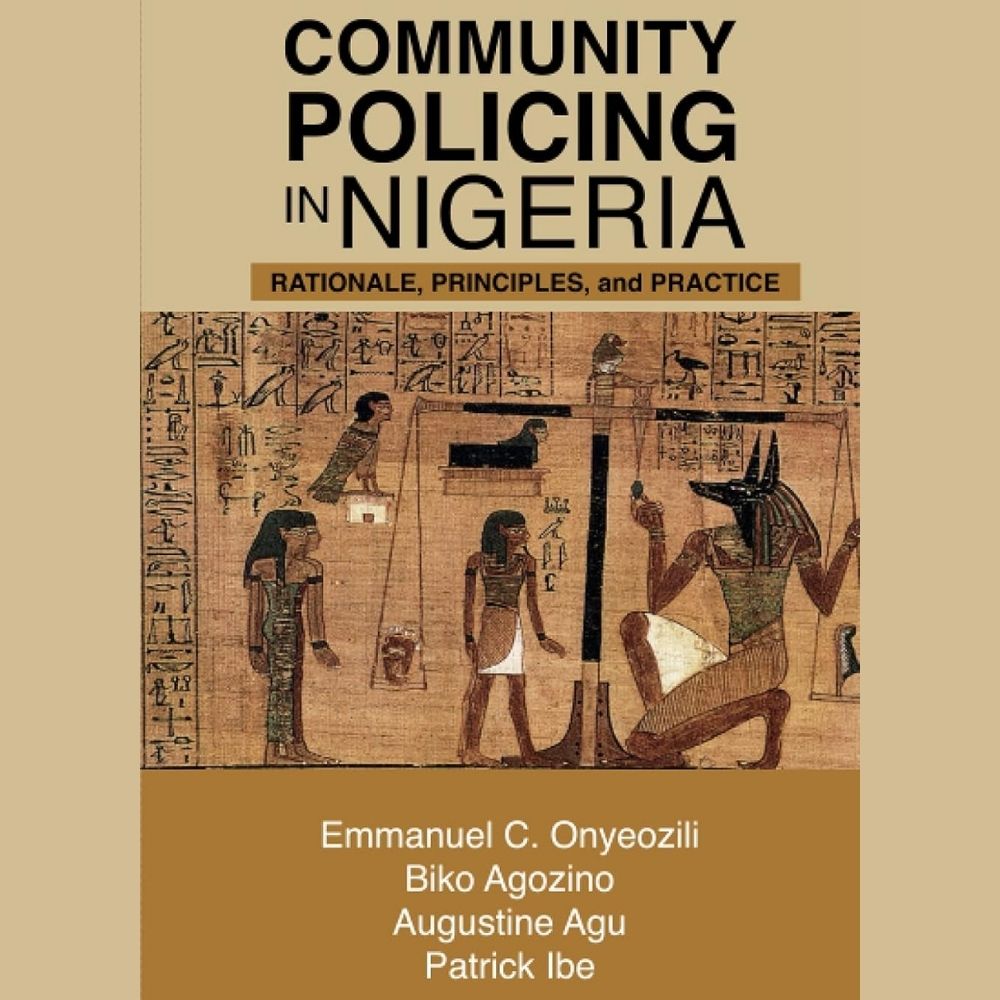
A review of Community Policing in Nigeria highlights how true safety is people-driven, exposing the failures of state-centered security.
This is a book review of Community Policing in Nigeria: Rationale, Principles, and Practice, which highlights how true safety is people-driven while exposing the failures of state-centred security. Using Nigeria as the primary case and linking it to wider African struggles for justice, the book challenges us to rethink policing as service with the people rather than power over them.
Community Policing in Nigeria: Rationale, Principles, and Practice, authored by Emmanuel C. Onyeozili, Biko Agozino, Augustine Agu, and Patrick Ibe, brings together seasoned scholars in criminology, sociology, and criminal justice, with years of teaching, policy research, and publications focused on policing, security, and governance in Nigeria and the wider African context. In this work, they turn their collective expertise toward Nigeria, offering a sober reflection on justice and security in Nigeria and across Africa. The book does not shy away from the hard truth that the systems we inherited from colonial powers, such as the native authority police and militarized constabulary forces created to protect colonial administrators and secure economic resources, were never designed to protect ordinary people (Chapter 2, pp. 23–31). Instead, they were built to guard rulers, their interests, and the resources they controlled. The tragedy is that decades after independence, many of those systems still serve the same purpose.
The authors show clearly that the police solve less than five percent of crime, while more than ninety percent of safety is maintained within communities themselves (Introduction, p. xvii). This tells us that true security does not come from the top. It comes from the daily efforts of people working together to protect one another. Nigerians witnessed this reality during the EndSARS lockdown in 2020, when residents across neighbourhoods organized themselves after trust in the police collapsed. In my own community, elders stayed awake through the night guarding the streets while families slept peacefully. Their presence gave us a sense of safety that the police had long failed to provide. This story was repeated across the country, proving that the people were the real producers of security.
But the book also cautions us against confusing community policing with vigilantism. It notes that state failure often creates space for self-help groups, which may begin with strong community support but soon slide into abuse and illegality (Chapter 2, pp. 56–61). Although the authors do not name them directly, Nigeria’s history of groups such as the Bakassi Boys in Abia and Anambra in the late 1990s and the Oodua People’s Congress (OPC) in the South West after the annulled June 12 elections of 1993 illustrates this point. Both movements began with public legitimacy but later became infamous for brutality, extrajudicial killings, and ethnic profiling, precisely the dangers the authors warn against when community policing is distorted into vigilantism.
Reading the book, one cannot help but notice how closely policing reflects governance itself. From the beginning, police forces in Nigeria were created to serve the state, not the people. This painful truth was laid bare again during EndSARS, a nationwide youth-led protest against police brutality that quickly became a symbol of wider frustrations with governance. On 20 October 2020, peaceful protesters at the Lekki Toll Gate in Lagos were fired upon. Soldiers and police were sent not to listen to citizens but to silence them. Who ordered the shooting that night at Lekki Toll Gate? Although official accounts remain contested, Amnesty International and multiple eyewitnesses documented that security forces opened fire, killing and injuring civilians, yet no official has taken responsibility. That moment revealed where the loyalty of the state truly lies: with those in power rather than the people who cry out for justice.
The same pattern appears in the way insurgencies are handled. In the North East, Boko Haram continues to terrorize communities. In the South East, “unknown gunmen” attack citizens. Across the country, clashes with armed herdsmen have destroyed livelihoods. Many Nigerians believe that these groups are, at times, enabled or ignored by the state. Whether true or not, this perception leaves citizens feeling abandoned, trapped between armed groups on one side and state forces on the other. Both seem to work against them. It is in this climate that the authors’ reminder becomes urgent: safety cannot come from above. It must be rooted in the people themselves.
What gives the book its strength is that it does not leave us with despair. In Chapter 3 (74-77), the authors offer a way forward by urging Nigeria to devolve authority, embed officers within communities, and create advisory boards where citizens themselves hold power. This is not a strange idea in the Nigerian context. Town unions, residents’ associations, and market groups already play central roles in dispute resolution and community safety. If these structures were formally recognized and supported with transparency, they could provide the true foundation for policing that serves, rather than policing that controls. For example, Kenya’s Nyumba Kumi initiative, introduced in 2013, encourages groups of ten households to monitor security collectively, promoting trust and accountability at the grassroots. By situating Nigeria’s experience alongside such African innovations, the book strengthens the case for community policing as a continental strategy of empowerment.
In my view, this is exactly what Nigeria needs today. When citizens see their representatives sitting on advisory boards of the police, trust will begin to return. People will see policing not as an imposition from outside, but as a shared duty. Communities could handle everyday safety concerns, leaving the police to face serious crime. Vigilante groups would lose their appeal, and insurgent groups would lose their hold, because people would no longer feel abandoned. This is how policing can be reframed as service with the people, rather than power over the people.
A critical weakness of the book is its limited engagement with the political economy of policing. Chapter 5 presents an action plan and practical steps for implementation (pp. 115–130), including the embedding of officers within communities and the creation of citizen advisory boards. However, the authors give little attention to how ruling elites and entrenched interests might resist such decentralisation. Across Africa, from Nigeria to Kenya and South Africa, political leaders have consistently been reluctant to cede the coercive power of centralised police forces. By not engaging in detail with this dynamic of elite resistance, the book risks underestimating the political obstacles that could derail even the most well-designed reforms. A fuller discussion of this challenge would have strengthened the book’s utility for policymakers and reform advocates.
Community Policing in Nigeria: Rationale, Principles, and Practice is not just a book for scholars. It is for anyone who cares about security, justice, and democracy in Africa. It forces us to ask hard questions: Who is justice really serving? Whose safety is being protected? And what can communities do to reclaim power from systems that have long ignored them? In a time when Nigerians are still reeling from the failures of policing and governance, this book could not be more relevant. It is a call to reclaim justice, not as a tool for rulers, but as a right that belongs to the people.
Chinenye Cynthia Izuchukwu is a prospective graduate student in Sociology with interests in social inequality, justice, race, and organizational leadership. She has experience in talent management and social research, and her work explores how communities confront inequality and power.
References
1. Emmanuel C. Onyeozili, Biko Agozino, Augustine Agu, and Patrick Ibe, Community Policing in Nigeria: Rationale, Principles, and Practice (Virginia Tech Publishing and Fourth Dimension Publishing, 2021).
2. EndSARS reflections are based on the author’s personal experience and media coverage widely reported in October 2020.
3. Amnesty International, Nigeria: Authorities must end their cover-up of the Lekki Toll Gate massacre – new report (2020).