



Shut It All Down: Young, African, and Unwilling to Wait
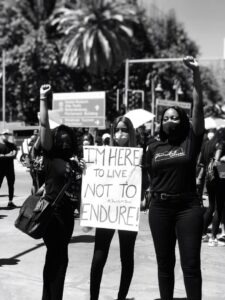
Bertha Tobias challenges the silences and highlights young African women’s Pan-African political resistance against femicide, gender based violence, and demands for bodily autonomy in reflective homage to the #ShutItAllDown campaign in Namibia
Namibia is silently gripped by a femicide crisis that is often swept under the rug. In Namibia, a significant portion of women experience gender-based violence (GBV), with 32% of adolescent girls aged 15-19 and 35% of young girls aged 20-24 reporting physical violence from a partner. The numbers don’t capture the reality that the victims of GBV are real people with hopes, dreams, and favourite colours, just like you and I. The death of Shannon Wasserfall, whose remains were found on the outskirts of the coastal town Walvis Bay, reminded us of this fact and nationwide protests ensued in 2020.
#ShutItAllDown, despite having taken place in Namibia, represents a small part of a larger continental reckoning led by young African women who are demanding that post-independence states account for the structural violence they have failed to dismantle. From South Africa’s Not In My Name SA to Nigeria’s Document Our History (DOHS), young African women insist that state power cannot be separated from bodily autonomy. They are refusing to inherit silence. In this way, #ShutItAllDown was foregrounded by pre-existing Pan-African political resistance.
I remember where I was when I read the news about Shannon. I remember the tightness in my chest and the dizzying familiarity. We know this feeling. Shannon’s killing held up a mirror which reflected the worst in all of us. For many young people, this felt like a climax of a silent war that had been waged on young Namibian women. The collective grief was personal, generational and a traumatic reminder that the illusion of safety could be pulled from under our feet without warning. It was the grief of knowing that Shannon could have been any one of us. It was also the realisation that our silence would never protect us. In protest, we shut it all down. I was one of the leaders of those protests as a stubborn 20-year old.
In October of 2020, a friend and I sat at a rustling café in Namibia's central business district expressing our horror at Shannon’s killing. As young, bright-eyed patriots often do, we extensively discussed the failures of government, after which I proposed that we do something. We compiled a petition, social media accounts and sent emails to student groups calling for a nationwide protest against femicide under the name #ShutItAllDown. These efforts culminated in the gathering of approximately 1500 youth protestors and a summon to the Office of the President. The Namibian government committed to instituting 24/7 armed patrols in high crime areas and the integration of gender based violence sensitivity training into the national curriculum. The government issued statements, promised sexual offenders’ registers and special courts, and committed to timelines. But words are not policies.
Weeks after the protests, another woman’s throat was slit by her partner. Her name was Gwashiti Tomas. Even in our collective grief, the violence continued. #ShutItAllDown was an articulation of the rage long suppressed in the psyche of every woman in every classroom, workplace and/or household who has had to negotiate her dignity. It was the refusal to perform peace and coherent nation-building for a state that had failed to protect women.
The philosophical underpinning to #ShutItAllDown was that if Namibian women cannot live safely, no one should. Shutting down the central business district in the country’s capital city of Windhoek, and later the main campus of the University of Namibia, replicated a fraction of the inconvenience that Namibian GBV victims were facing on a daily basis.
In an interview with CNN, I expressed that “If women can’t live their lives properly in Namibia, then nobody should.” Despite the then-joyful naivety of youth, I meant every word. In time, I have come to learn how heavy that weight is. Protest, I’ve since learned, is continuous, tiring confrontation with a faceless system, with indifference and above all with the best in all of us.
While NGOs like Sister Namibia, OutRight Namibia, Power Pad Girls, and the Slut Shame Movement provided critical support and solidarity, they served as midwives to a protest that was primarily led by young women from public universities, working-class students, unemployed graduates, artists, street vendors, school learners, and even passersby who joined once they saw what the protests were about. The crowds were diverse (and chaotic!) but wholly reflective of the reality that this was the people’s protest, born out of the people’s anger.
As someone who had been active in youth advocacy and policy commentary, I found myself thrust into a new kind of responsibility, one that I hadn’t entirely signed up for. I gave interviews, drafted open letters, met with government officials, and helped coordinate public messaging. But I was also crying in the bathrooms between speeches. I was deathly afraid. I was exhausted. And like everyone else, I was grieving.
This reflection revisits those days, filled with palpable hope for better, the desperate belief that better is possible. This reflection pays homage to those protests, known as the #ShutitAllDown protests, as a sweet memory of what it means to rise, to resist, and to reclaim. It is about the never-ending messiness of protest, how hearts break when we stop believing and the magic that unfolds when young people stop asking for permission.
Lessons from the Streets
Participating in #ShutItAllDown taught me more about power, politics, and people than any policy paper ever could. Here are some lessons that continue to shape me:
-
The power of the people is not in our numbers but in our refusal to wait. We did not ask for seats at the table. We built our own tables, and sometimes flipped over existing tables in the process.
-
Visibility is not victory. Premature media attention can amplify a cause but also exhaust it. Sustained change requires offline organizing, and sustained stamina.
-
State institutions respond to disruption. We were heard not because we asked politely, but because we made it impossible for business as usual to continue.
-
Self-preservation is political. Activism without community and care becomes self-destruction. Rest, or even resignation, is also resistance. Across Pan-African feminist spaces, from Accra to Windhoek, the decision to step back has often been a refusal to be exploited by movements that rely on the unpaid, emotional labour of young Black women. Resignation does not always signal disengagement. Sometimes, it is how we name the absence of care within our own ranks. Not all protests look like marching. Sometimes, it looks like deliberate survival.
Four years later, I am now a student of environmental sustainability. From where I sit, the movement looks both miraculous and immensely unfinished. Writing this reflection is difficult as it requires picking at a wound that never quite healed. It evokes a sense of failed mission to Namibian women as I sit, writing about it in a quaint coffee shop in the United Kingdom, insulated by the luxury and privilege of being educated at the best university in the world. Indeed, the protests led to increased visibility of femicide and sexual violence. But the deeper systems, the cultural norms, the resource allocations, and the judicial bottlenecks, remain largely intact.
I’d be lying if I said that a group of haphazardly organised 800 protesters over 24 hours knew exactly what the goal of their protest was. What we did know was that we had seen enough hashtags. Our fatigue was expressed as a demand for a state of emergency on gender-based violence. We wanted resignations, deadlines, and accountability, which were detailed in the petition we handed over to the Namibian government. We wanted to mirror, even slightly, the daily disruption GBV victims live with and compel the state to feel, even briefly, what it often ignores. Protest was the only tool we had. In hindsight, we mistook visibility for change. But silence wasn’t an option. We chose disruption because it was all we had.
What changed most profoundly, perhaps, was us. The work worked on us more than we worked on it. Does that count?
Bertha Tobias is a Rhodes Scholar currently pursuing an MSc in Sustainability, Enterprise & Environment at the University of Oxford. Bertha is also the creator and host of Spotlight by Bertha Tobias (www.spotlightbybt.com), a podcast which showcases the journeys of young African entrepreneurs.