



African Liberation Day 2026: International Solidarity is Not an Option
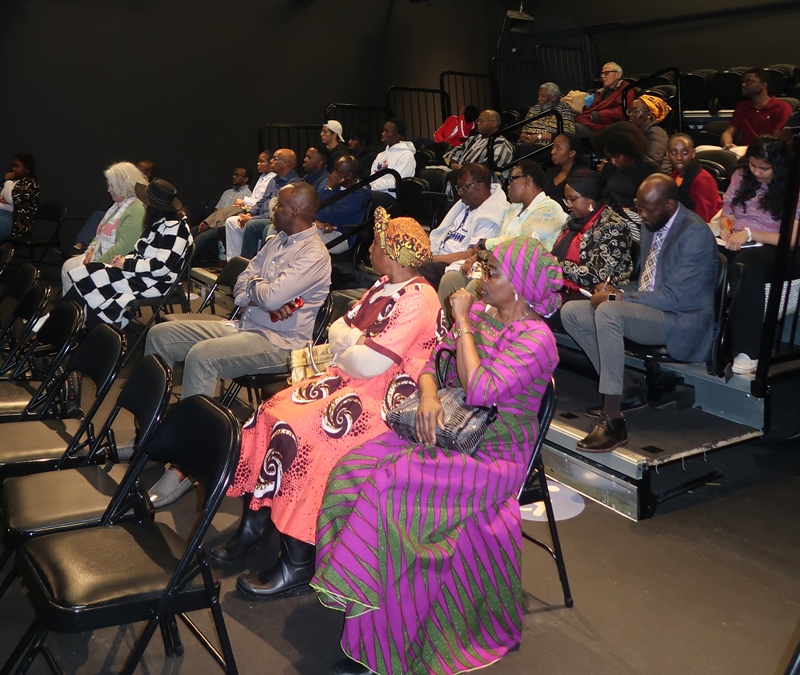
Report on African Liberation Day celebration on May 23, 2026, held in Syracuse, New York, themed Haiti & Cuba: Defending Pan-African Unity Against Imperialism.
On a rainy day in Syracuse, New York, at the Community Folk Art Center, the Global Pan African Movement (North America Delegation) (GPAM) partnered with the Pan African Community of Central New York (PACCNY) and the Africa Initiative at Syracuse University, to celebrate Africa Liberation Day 2026. At a time where the rights and dignity of African descendants, immigrants, Muslims, women, and so many other communities are being threatened by the full force of U.S. state power, the celebration held on May 23, 2026 marked that no amount of repression and intimidation will stop those committed to liberation from congregating to align their priorities and struggles. Beyond honoring the legacy of liberation we have inherited, the celebration allowed attendees to ponder the question, what do the frontiers of falling empires reveal about today’s struggles for Global African Liberation?
The celebration began with a powerful message from one of the main organizers and the Program Chair, Terese Millet Joseph, a Psychologist, PhD candidate, and member of GPAM. Sister Terese opened by clarifying why we were gathered for Africa Liberation Day under the theme of Defending Cuba and Haiti:
African Liberation Day emerged from the global struggles against colonialism, imperialism, apartheid, racial domination, and economic exploitation. It was born from the recognition that African people, both on the continent and throughout Global Africa, share linked histories, linked struggles, and linked futures.
As Pan-Africanists, we understand that the liberation of Africa is inseparable from the liberation of African people everywhere. We believe deeply in the political, economic, cultural, and spiritual unity of Global Africa.
Sister Terese further grounded the audience by reminding us that though Pan Africanism was created through the solidarity of Global Africans, it has always been about the responsibility of humans to one another.
Pan-Africanism, at its highest expression, is not rooted in domination, exclusion, or narrow nationalism. It is rooted in human liberation. It is rooted in the belief that no people should live under systems of exploitation, occupation, dispossession, dehumanization, or violence.
We stand against slavery in all its forms.
We stand against colonialism and neo-colonialism.
We stand against imperialism and racial capitalism.
We stand against apartheid, genocide, displacement, and the destruction of human dignity.
We stand against all systems that reduce human beings to profit, power, or political convenience.
And because of that, we affirm that none of us are truly free until all of us are free.
We recognize our shared responsibility to stand in solidarity not only with African people, but with oppressed and struggling peoples everywhere — from Haiti to Cuba, from Palestine to the Congo, from Sudan to communities here in the United States confronting racism, inequality, state violence, and economic injustice.
Following the opening remarks, where co-organizers from the Africa Initiative and the Pan African Association of Central New York (PACCNY) also welcomed the audience, members of GPAM joined the stage to pour libations to our ancestors, and an artistic performance by Sister Vanessa Johnson, entitled “All I Have Is My Voice, My Spirit, and The Will To Tell The Truth!,” followed. Sister Vanessa shared with us about the life of Assata Shakur and proceeded to enact Assata Shakur’s 1998 letter to the Pope that asserted what the revolutionary stood for and what she was struggling against.[1] The words of the American revolutionary that found refuge in Cuba helped us double down on why we were gathered in upstate New York to discuss about Africa ala Cuba and Haiti:
“I am not writing to ask you to intercede on my behalf. I ask nothing for myself. I only ask you to examine the social reality of the United States and to speak out against the human rights violations that are taking place…Most of the people who live on this planet are still not free. I ask only that you continue to work and pray to end oppression and political repression. It is my heartfelt belief that all the people on this earth deserve justice: social justice, political justice, and economic justice. I believe it is the only way that we will ever achieve peace and prosperity on earth. I hope that you enjoy your visit to Cuba. This is not a country that is rich in material wealth, but it is a country that is rich in human wealth, spiritual wealth and moral wealth.”
Before the panel discussion that outlined the spiritual, moral, and human wealth of Cuba and Haiti that Sister Assata references, solidarity statements from organizations in Syracuse demonstrated that even in a rustle belt city like Syracuse, the brimming energy of Global Africa is alive and well. We exist across the world in numbers and with enough capacity to come together to ensure liberation remains a living project, especially when considering exploitation and oppression are alive and well. President of the Rwandan Community Abroad, Dr. Viateur Nkurunziza, reminded the audience that we stand in the shadows of those who struggled for “a right to determine their own future,” from the Haitian revolution to the anti-colonial movements. He called for a Pan Africanism that is a living commitment to unity and dignity; a Pan Africanism that deals with how African communities globally experience violence, lack of social justice, and a system that dehumanises them; and a liberation concerned with not only political independence but also “opportunity, safety, and ability to live with respect and hope”. The President concluded his statement with a call for Pan African unity of future generations, and for continued “building [of] bridges with Africans outside of the continent,” as “we cannot afford division amongst ourselves when unity has always been our strength.”
One Struggle, Many Fronts
The panel discussion set the stage for what is expected from Global Africa. The four powerful speakers not only gave us the historical context and contemporary information necessary to build a clear political consciousness, but they challenged us on where our commitments and energy is expended in this moment. Except for Dr. Rosemari Mealy’s speech, the transcripts of each speaker’s statement is included in the Pambazuka News special issue on Africa Liberation Day, but their sentiments are worth summarizing here.
The first speaker, Dr. Jemima Pierre, Distinguished Faculty of Arts Professor of African and African Diaspora Studies in the Social Justice Institute (GRSJ) at the University of British Columbia, began with a discussion on Haiti. Dr. Pierre opened with the history of Haiti and the US-orchestrated removal of Jean-Bernard Aristide, situating the current crisis as a continuation of a long pattern of imperial destruction of the Haitian state dating back to 1991. She argued that what is unfolding today is distinct in its mechanisms: the US-installed Prime Minister commands a private army, and last year signed an agreement bringing in Erik Prince's Blackwater, whose mercenary forces and military equipment are to operate alongside a UN-authorized "gang suppression force" — the UN itself, she noted, has enabled occupation and reinforced violent solutions in Haiti since 2004. She alerted us that Kenyan soldiers were first deployed, and now there are Chadian soldiers, whom she described as "the new Blackface of US imperialism" in the country. While indiscriminate drone violence has skyrocketed from this increased militarization, none of the forces that pushed for military occupation — including the OAS, the Congressional Black Caucus, and various NGOs — have issued condemnation. Meanwhile, mining laws have been rewritten and the US has converted Haiti's airport into a military base, which she fears may be intended as a staging ground for military action against Cuba. All of this, she emphasized, is occurring without any say from the Haitian people. She characterized the US imperial project in Haiti as one of "perpetual but controlled chaos," and closed with a charge to Pan-Africanists and internationalists: the Haitian revolution and Haitian sovereignty must be understood as Black liberation, supported unconditionally, and met with unwavering solidarity.
Dr. Pierre was followed by Dr. Rosemari Mealy, an activist-educator, author, and longstanding Cuba solidarity organizer, who took up the question of our responsibility to Cuba and the urgent need to change the narrative surrounding it. She opened by showing a video of thousands of Cubans filling the streets in response to the most recent US aggression, and directly countering the “failed state” narrative.[2] Drawing on Malcolm X, she emphasized the necessity of linking struggles in the US with those globally, and underscored the historical significance of Malcolm's 1960 meeting with Fidel Castro in New York — a meeting so embedded in Cuban political memory, she noted, that any Cuban child could recount it, in sharp contrast to its erasure in US public consciousness. She connected this to the role of media in manufacturing consent, invoking Malcolm's teaching that media has the power to make the innocent guilty and the guilty innocent. She identified US-Israeli media companies, such as AXIOS, as actively fabricating narratives — including concocted reports of Cuban military drones — to build a pretext for further military escalation in Haiti and the Caribbean. Cuba, she argued, is not the problem but the resolution, and the US campaign against it constitutes "an unprovoked racist war." She then offered the following testimony on the facts behind the ongoing undeclared war:
“These coercive measures, and what we call, and we have to call it what it is, it's economic genocide of the Cuban people. Through the 60-plus year blockade it's really to set the pretext for an unprovoked, racist, imperialist military intervention against Cuba. And we must face the lies that this empire is spewing with the truth. So I want to just kind of give you some facts you know, that the U.S.-Israeli media hides.
In 1959, if you know and you study the history of the Cuban Revolution, Cuba overthrew a U.S.-backed dictatorship.It redistributes the national resources of the country. And it established a socialist government.And Cuba went on to provide an exemplary, an exemplary socialist model of life to the world. A free, quality healthcare for all, a national commitment to combat racism. Accessible housing for all of its people. It had one of the highest literacy rates in the Western Hemisphere. An unwavering internationalist solidarity…And this solidarity has often come in the form of Education. And it's incredible, it's magnificent healthcare, international healthcare brigades. So with its socialist revolution, Cuba stood up. And it refused to kneel to the United States Empire. And it has never bowed since. So the U.S. has used these endless tactics of imperialist aggression. That some of the speakers have mentioned here today. And what we call Collective Punishment. Much like what we saw and what we see as we watch the genocide that's occurring in Gaza. And now we see the attempts to do the same thing in Iran [and] Lebanon. So one of the first things that it does is cuts the food supply of the country, the medicine, and more importantly, the fuel. Cuba has not had fuel for almost 4 months. 4 months. The blackouts. Right? The lack of medicines, More than 100,000 people are awaiting surgeries. When we know that Cuba has the highest standard of healthcare for its people in the world. So, by cutting off the food supply, the medicine, and the fuel. The CIA is attempting now to reinstate and reinforce even more so these coercive measures.
And again, it harks back to 1961 at Play Hiron when hundreds of terrorist attacks and attempts by CIA death squads failed. Failed attempts over the years, more than 638 failed CIA attempts to assassinate President Fidel Castro. The introduction of germ warfare into the country, right? Trying to poison Cuban livestock in 1977.
And this has been and this is important for people in this country to understand. The attacks against Cuba and what we see happening in Cuba is actually codified by U.S. law. It's called the Helms-Burton Law.And with this extraterritorial reach to other countries, telling other countries that it cannot trade with Cuba unless it suffers reprisals, such as tariffs. And the folks from the Caribbean, you know this: the first thing that [Marco] Rubio did when Trump came back into office, was strutting into the Caribbean and bullying Caribbean countries to withdraw the Cuban health brigades. Which has been so important to stabilizing some of those economies in the Caribbean, as a matter of fact, because if you have health, if you have a healthy population, you have a healthy community, [and] you have a healthy society.
None of these attempts at Cuba and attacking its internationalism worked. So the next best thing, then, that this empire is seeking to do is to first, destabilize the country, which it is attempting to do now, but on the bright side, and you need to know this, [Cuba] it's not a failed state. If it was a failed state, 3 or 4 months ago, it would not have announced a cure for Alzheimer's, which we don't have access to. If it was a failed state, it would not have found a cure for vitiligo. The disease that many of our people suffer from [and results in the] discoloration of the skin. If it was a failed state. It would not have a literacy rate that's almost 99%. If it was a failed state. It would not have found a cure for folks who are suffering from diabetes, and in Cuba, no one gets amputated. Because it's found a cure for it, right? And as Amilcar Cabral said, we tell no lies to claim no easy victories.
But getting back to the point that I wanted to make, when we talk about bipartisanship, the Democratic Party has been just as guilty as the Republican Party is now, by implementing these coercive measures against Cuba when Bill Clinton, in 1996, legitimized the policies known, as I mentioned earlier, the Helms-Burton Act. But yet, Cuba still stands.
So what are we asking people to do now?
I was speaking to the Cuban ambassador to the UN, to the United Nations yesterday. And, you know, we looked at each other and we said, I said to them, where are your friends? Where are your friends now? Where are our friends on the continent who have come to Cuba's aid? Who dares challenge the bully who says that if you trade with Cuba, we'll take away your visas, we'll put tariffs on you?
So this is a momentous time, brothers and sisters, right now. When a lot of the solidarity that's necessary will have to come from us. And we have to commit ourselves, this African Liberation Day, this African Liberation Month, to support Cuba.
And we can do that, we can still travel there. We need to be organizing delegations to go to Cuba. We need to be taking suitcases of personal items and things that they need. We need to support projects like IFCO/Pastors for Peace here in New York, who will be taking 60 tons of material aid to Cuba in August.[3] And most importantly, we need to be organizing our communities to go to Cuba to celebrate the centennial of Fidel's anniversary in August. We need to be showing up to Cuba now by physically traveling there if we can, and for those of us who are unable to travel, then we need to be providing resources to ensure that those projects, like what I named, are funded.
And there are a lot of things that we need to do. I'll put in the chat some ways in which you can contact, but more importantly, Cuba still stands today, despite the blackouts. They're finding creative ways to survive because they have a socialist society, and they were able to create a new order where, unfortunately, many of our brothers and sisters who emerged from colonialism instituted the capitalist road to development. And that's why it's so easy now for them to be bullied and not support the country that has provided so much to them in terms of international solidarity.
…And let's remember, what Malcolm said, as I started out. He says, our problem is your problem…He said, then it's not a Negro problem, nor an American problem. This is a world problem. A problem for humanity. It's not a problem of civil rights. But a problem of human rights.
And that's how we must emerge now to defend Cuba, in the interests of all of humanity.”
After sobering reminders anchored in the present from Dr. Mealy, the next speaker took us back a hundred years. Dr. Zophia Edwards, Assistant Professor of Sociology at Johns Hopkins University, opened with a striking image: she appeared on the panel rocking her daughter to sleep, a gesture we must understand as inseparable from the political questions at hand — that liberation in the 21st century cannot be cordoned off from the realities of the household and the politics of care. Her speech drew a sustained parallel between the Italian invasion of Ethiopia roughly a century ago and the imperial aggression faced by Haiti and Cuba today, returning throughout to the question: what are we doing now, as our ancestors did then for Abyssinia/Ethiopia? Much like Ethiopia in the 20th century, she positioned Haiti and Cuba as central to the imaginations necessary for our liberation — a north star for how peoples have escaped and resisted militarism, racism, and imperialism. And it is precisely because their revolutions challenged profit-making and shattered assumptions of inferiority that both countries continue to be punished.
From the history of Caribbean workers' response to the Ethiopian invasion, she drew four lessons for the present. First, the question of where trade unions are today: in Trinidad and Tobago, she argued, unions have lost the autonomy they once had, and co-opted trade unionists must be challenged and replaced in order to rebuild the kind of multiracial worker movement that mobilized in defense of Abyssinia. Second, the necessity of fighting on all fronts. Third, a reckoning with neocolonial rulers from Africa to the Americas, as she called out CARICOM's betrayal of Haiti in supporting the most recent invasion, and the current Trinidad and Tobago regime's attacks on Cuba and support for US militarism in the region. Fourth, the histories of interracial solidarity — Afro and Indo-Caribbean workers thinking and acting together — as a model that must be recovered. She reminded the panel that Cuba and Haiti have not only been sources of inspiration but have provided material support for African liberation, from independence movements in Latin America to abolitionist movements across the Americas. She closed by insisting that Pan-Africanism today means rejecting the idea that empires are inevitable, and that the lessons of the past — labor autonomy, multiracial internationalist movements, and the understanding that all struggles are interconnected — remain as necessary now as they were then.
Dr. Edwards was followed by the last speaker, Dr. Horace Campbell, Professor of African American Studies and Political Science at Syracuse University, who grounded the discussion in the local history of Africa Liberation Day itself, tracing its emergence in New York City through the organizing of those like Carlos Cooks, a tradition he connected forward to Malcolm X, Dr. Mealy, and the radical internationalist lineage represented on the panel. He widened the call to solidarity — for Haiti, Iran, Palestine, Sudan — while insisting that solidarity abroad cannot be separated from confronting oppression at home. He spoke directly to what is happening in Syracuse: the deportation of John Bol Ajak, a basketball player who grew up in Kenya, had lived in the United States since age thirteen, and was deported by ICE in 2026 without the community rising in his defense. The point was clear: we cannot speak of liberating Haiti, Cuba, or Africa if we cannot organize solidarity in our own communities.
"Liberation starts where you live," he said, and where we live, African, Caribbean, and African American communities must work together against their shared oppressions. He identified the same forces seeking to destroy Cuba as those working to divide Black unity at home, through formations such as the African Descendants of Slaves (ADOS) and the Foundational Black Americans (FBA). On reparations, he challenged institutions like Syracuse University to go beyond land acknowledgments and ensure that curricula honestly reckon with the roles of figures like Jefferson and Columbus in genocide. He called for sober reflection on the African nations that received Cuban solidarity in the struggle to end apartheid, urging a shift in focus from the liberation of states to the liberation of people. He closed by naming ongoing colonial occupations — Denmark's colonies in the Caribbean in the context of its opposition to US claims on Greenland, Morocco's colonization of Western Sahara, Puerto Rico, Martinique, Mayotte, Palestine, etc. — as reminders that the panel's collective message was one struggle across many fronts.
As Margaret Mandeya had shared opening remarks, another graduate student at Syracuse University and member of Africa Initiative, Valarie Bundi, closed out the event by asserting “African Liberation Day reminds us that as long as oppression exists anywhere, the responsibility to stand against it belongs to all of us.” Before Sister Valarie directed the audience to the food in the next room, she gave us a task: “So let us leave here not only inspired by the past, but committed to the present, committed to justice, committed to solidarity, and committed to liberation in our own time, which is now.”
Across four speeches, solidarity statements, and throughout the afternoon, the event wove a single thread: that Haiti, Cuba, Ethiopia, Palestine, Sudan, Congo, Western Sahara, Puerto Rico, and the streets of Syracuse are not separate struggles requiring separate solidarities, but one struggle expressed across many fronts. The imperial forces devastating Cuba's fuel supply and flooding Haiti with mercenaries are the same forces dividing Black communities at home and bullying Caribbean nations into withdrawing Cuban health brigades. What the panel demanded was not merely awareness but commitment to travel, to organize, to teach, to show up where we live. As the whole celebration affirmed, liberation is not a matter of distant states but of people, and it begins exactly where we stand. Blackness and Africanness, and therefore, African liberation, we were reminded, are not measured by mere skin color or superficial alliance, but through a powerful unity anchored by generations of struggle across the world. And it is that unity, tested and renewed in this moment, that the enemies of liberation most fear.
Mahder Habtemariam Serekberhan is the vice chairperson of the Global Pan African Movement (GPAM). She is a PhD candidate in political science at Syracuse University, New York, and serves on the editorial board of Pambazuka News.
Endnote