



Michael Parenti, Leading Anti-Imperialist Scholar, Dies at 92
A tribute to an anti-imperialist scholar.
The Death of Michael Parenti
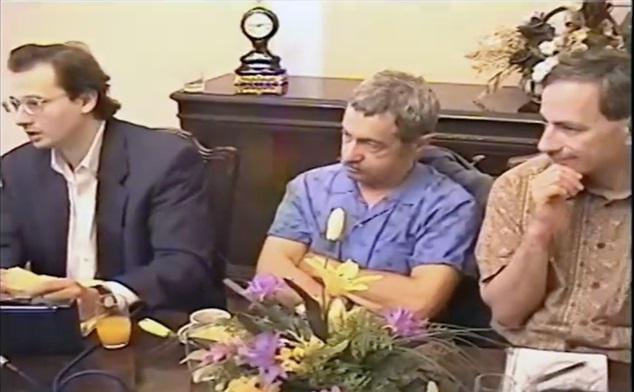
In 1999, within two months of NATO's criminal bombing campaign of Yugoslavia, a group of about twenty anti-imperialist peace activists led by Michael Parenti and Barry Lituchy, and funded by the Jasenovac Research Institute (JRI), travelled to Yugoslavia on a human rights and fact-finding mission.[1] While most members self-financed their trip, JRI paid entirely for several participants including Michael. Michael was our fearless comrade then, and he will always remain so in our hearts.
The question then is, how is it that such a scintillating thinker, author, speaker, analyst and professor in the US needs financial help to travel? This is not about charity, this is about a man who spoke and taught against the system that banished him from its intellectual industry because he stood out as a pariah due to his unabashed analysis and criticism of imperialism and US policies, domestic and otherwise.
On the 24th of January, the renowned political analyst, public intellectual, influential historian, and political scientist, Michael Parenti, passed away. Those who knew Parenti personally, spoke about his kindness, wit, humor and an unabashed hatred for oppression and injustice caused by imperialism. His death leaves behind a body of literature and a public record that shaped and continues to shape students, scholars, organizers, political activists and historians of the anti-imperialist tendency.
As a friend, a travel partner, and a teacher, Michael Parenti’s death is not only our loss. It is the global left’s too.
Who was Michael Parenti?
Michael Parenti was born in New York City in 1933, to an Italian-American family. Growing up in a world of Cold War politics and visible inequality exacerbated by Jim Crow laws of racial segregation, Parenti’s intellectual journey emanated from that experience of societal injustice, locally and globally, as detailed in his memoir Waiting for Yesterday: Pages from a Street Kid’s Life (2013). He obtained his BA at City College of New York, followed by an MA from Brown University, and a PhD in Political Science from Yale (1962).
But Michael Parenti was not just an armchair leftist who simply wrote and thought that the power of discursivity will translate to revolutionary progress. He was materialist in words and actions. After receiving his PhD, he had numerous stints teaching at various universities, while being proactive against US involvement in Vietnam. In fact, in one of the anti-war demonstrations, he was battered not only by the police but by stooges who found joy in siding with the police state that the US is presently notorious for and batter protests. Because of that altercation, he served two days in jail and had 12 stitches on his head. Simply, Parenti’s anti-war and anti-imperialism was more than just orations in lecture halls but was grounded in praxis.
He famously wrote, “you will have no sensation of a leash around your neck if you sit by the peg. It is only when you stray that you feel the restraining tug.” Parenti experienced academia’s restraining tug. His initial intellectual production focused on the politics of cultural integration of his Italian and working-class background. But then it developed, as racial antagonisms exacerbated by racist Jim Crow laws and segregation saw his growth from integration-centric analysis toward a solid class analysis of American society and culture. He then grew his oeuvre by writing ground-breaking analysis of the dominant US ideology: Anti-Communism. His book, The Anti-Communist Impulse, published in 1968, was the first of the many books that he wrote to analyse “the irrational rationality” of anti-communist ideology in the US and Western Europe. This book preceded more than 15 others he published in his career. But it was the first to get him the attention of staunch Marxists.
In the following years, the combination of his politics and intellectual production on how the corporate media, politics, and US foreign policy operated did not win him prestigious awards or glamorous department chair positions. Sadly, the opposite happened. It is the restraining tug of the political economy of knowledge production, in which stirring the pot overwhelmingly leads to a more fierce restraining and containment of intellectual resistance to the status quo.
Having not secured an academic job, Parenti found the time to write what was his most important book on the US political system, Democracy for the Few. Published in 1974, this book’s fame made it a foundational textbook in many college political science courses. As Michael’s son, Christian Parenti, has pointed out, this book’s royalties provided a lifeline for the family, and this book helped put a roof on his son’s head.[2] Ultimately, Michael Parenti relied on non-tenure track positions and giving public lectures - as feisty as they were - that gave him an income to sustain himself.
Below are some of his most famous works, reflecting his intellect and timeless analysis of power, propaganda, and imperialism.
Some Notable Publications:
A Critique of Liberal Democracy
In 1974, Parenti published what became a textbook for understanding how American politics works, Democracy for the Few. For any follower of American politics, one would ask, whose democracy is this really if the same interests keep winning? This book, through its nine editions, gave students their first real tool for dissent. Democracy for the Few is a perennial antidote to the pablum of standard civics. It is a must for anyone who is interested in power, politics and democracy (beyond the electoral ballot box).
A Precocious Intellectual
It is well-known and widely celebrated to hear people speak about and cite Noam Chomsky and Edward Herman’s Manufacturing Consent. However, the precocious intellect of Michael Parenti produced Inventing Reality two years prior to Chomsky and Hermann. Published in 1986, this book is a go-to to understanding mass media and how it operates, financially, cognitively and politically. It gifts the readers the tools to see through the veneer of the so-called “free press”, and how the creation of real censorship as a disguised tool and not dramatic; it is the quiet, structural filtering of reality that protects the powerful while journalists can maintain the alleged guide of neutrality. This book shows how the media clandestinely sides with the powerful (corporate-government interests) against the powerless (workers and disenfranchised peoples).
His precocious analysis of the US empire also preceded how everyone began calling the US an empire after 2001. In 1995, he published Against Empire, in which he explained what empire is and what is imperialism, how there is only one empire today that is the US.
Similarly, everyone in political science and international relations knows the term Soft Power, which is the various cultural and economic tools the US employs to win hearts and minds without firing a bullet. But the publishing world, especially with its connection to the CIA's “theory industrial complex” (as named by Gabriel Rockhill’s most recent book, Who Paid the Pipers of Western Marxism?), critics of the system who stray from the imperialist talking points will not be rewarded by the system. In other words, knowledge production about the term ‘soft power’ has been wrongfully disregarding Marxist thinkers on the matter. Parenti wrote The Sword and the Dollar: Imperialism, Revolution and the Arms Race in 1988 to show how the US uses its military power to exert influence and expand its capitalist accumulation (the Sword), but in other suitable contexts it relies on the hegemony of the US dollar to bankroll various cultural projects (the Dollar). He notes the smart power of the US, devising which power to use and when is predicated on intelligence’s conjunctural analysis.
Yet, Parenti’s work has been disregarded in the field of international relations and political science, arguably due to its Marxist tendencies, only decades later for people to be amazed by Nye’s ‘soft power’ and later on ‘smart power’ which relies on hard and soft power, ergo sword and dollar. It is truly a testament how the intellectuals of empire, like Nye, the so-called coiner of “soft power” and “smart power” terms, have been celebrated by the establishment, by getting tenures at Massachusetts Institute of Technology and Harvard University.
A Defender of Existing Socialism
If we communists, if we leftists, if we Marxists, if we revolutionaries, if we progressives, if all we want is to hunger for power, then why do we side with the powerless? — Michael Parenti
Contemporary Right-Wing fascists, with their online universities portray socialism as “totalitarian,” suggesting that because Hitler was a national socialist, and having socialist in the name makes him one (see lectures by Prager U).[3] But one does not have to be a right-winger to equate existing socialism with Hitler’s fascism — again, as the recent work of Rockhill shows, where ideas of totalitarianism merged together as an umbrella term for communism and Nazism.[4] So, what is the relationship between totalitarianism and the mode of production?
In his book, Blackshirts & Red: Rational Fascism and the Overthrow of Communism (1997), Michael Parenti explains how the relationship between the capitalist class and fascism was actually consolidated under fascism, such that the owners of corporations and mega businesses amalgamated their efforts to suppress the working class, remove the organizing power of unions, and stifle dissent. Something the communists negated, which led to worker-owned production. This book came at a time when decades of self-proclaimed leftist writers joined forces to fight any socialist society, by redbaiting and defaming those who defend existing socialism as apologists for so-called authoritarianism.
In fact, it is arguably suitable to not only cite Parenti himself, but to watch a segment of his lecture defending socialism and bashing liberals for siding with imperialism.
Do you know what it means to be able to read? Do you know what it means to be able not to read? I remember when I gave my book to my father. I dedicated a book of mine, “Power and the Powerless” to my father. I said “To my father, with my love” [as] gave him a copy of the book. He opened it up, looked at it; he’d only gone to the seventh grade. He was a son of an immigrant, a working-class Italian, and he opens the book and he starts looking through it and he gets misty-eyed. Very misty-eyed, and I thought because he was so touched that his son had dedicated a book to him. That wasn’t the reason. He looks up to me and says, “Can’t read this, kid.” I said, “That’s okay, Dad. Neither can the students.” I mean, don’t worry about that. I wrote it for you. I mean, it’s your book and you don’t have to read it. You know, it’s a very complicated book, an academic book. He says, “I can’t read this book”, and the defeat he felt, that’s what illiteracy is about. That’s what the joy of literacy programs is [about]. That’s why, in Nicaragua, you got people walking proud now for the first time. They were animals before; they weren’t allowed to read. They weren’t taught to read. So you compare a country to what it came from, with all its imperfections, and those who demand instant perfection, the day after the revolution, they get up and say, “Are there civil liberties for the fascists? Are they going to be allowed to have their newspapers and their radio program? Are they going to be able to keep all their farms?”. The passion that some of our liberals feel, the day after the revolution, the passion and concern they feel for the fascists, the civil rights and civil liberties of those fascists who were dumping and destroying and murdering people before. Now, the revolution has got to be perfect. It’s got to be flawless. Well, that isn’t my criteria. My criteria is what happens to those people who couldn’t read, what happens to those babies that couldn’t eat, that died of hunger. And there, that’s why I support revolution. The revolution that feeds the children gets my support. And the Reaganite government that tries to stop that kind of process that tries to keep those people in poverty in the literacy and hunger that gets my undiluted animosity and opposition. [5]
Last seeing beyond the fog of humanitarian intervention’s propaganda
In 1999, NATO, without United Nations Security Council authorization, undertook a vicious bombing campaign against Yugoslavia. Amid the bombing, he gave a lecture at the University of Washington (Seattle) that cuts through the propaganda and the role of the media in destroying the last remaining communist country in Europe.[6] In the lecture, Parenti asked:
Why is the US National Security State involved in acts of destabilization, sabotage, propaganda, terror, drug trafficking, torture, and death squads in Latin America, Asia, Africa, and Europe?
Is it now suddenly so impelled by humanitarian concerns for the Albanians in Kosovo? Is that why we’re in Yugoslavia? Is it humanitarian compassion that compels US forces to be bombing, to have bombed four countries in the last six months? Is it a humanitarian concern that the US is involved in proxy wars in Angola, Colombia, and various other countries? If it’s suppressed minorities US leaders are worried about, why doesn’t Clinton bomb the Turkish people for what their leaders have been doing to the Kurds? I mean, it would be crazy and irrational to bomb people in Turkey, to bomb the ordinary people because of what they’re doing. But that’s what we’re doing. That’s what is going to happen in Yugoslavia. Why don’t we bomb the Indonesians because their generals killed over 200,000 East Timorese? What about bombing Israel for what it has done to the Palestinians? What about bombing the Czech Republic for the way it has mistreated the Romani, or called Gypsies here in our country? What about bombing the Guatemalan people, bomb, let’s go bomb Guatemala City, for the systematic slaughter of tens of thousands of Mayan villages all over Guatemala.
In fact, the US wouldn’t ever think of bombing them; the US, in most of those cases—Turkey, Indonesia, Guatemala—gave them aid, gave them guns, gave them training; it’s totally complicit with those horrible atrocities.
Why doesn’t he bomb Great Britain for oppressing the Catholic minority in Northern Ireland? Go bomb his girlfriend, Tony Blair.
… Why doesn’t he bomb the Hutu for the mass murder of half a million Tutsis in Rwanda and bomb the French imperialist force that went in and was totally complicit in that massacre? In fact, Bill Clinton didn’t even want to discuss it; he didn’t even want to apply the name genocide to that. … While Clinton is at it, why doesn’t he bomb himself for the treatment of Native American Indians, African-Americans, and working people in general? [7]
Throughout the bombing campaign, in which social democrats (like Bernie Sanders) and anarchists supported the imperialist bombing of Yugoslavia, and regurgitated mainstream media’s goals of dismantling the country, Parenti upheld the position of multinational unity under socialism in the country and against its division, which sadly today is divided into smaller, weaker nation states. The people’s power has been weakened, through division and decreasing population and deindustrialization. However, following the trip Michael undertook to Yugoslavia in August 1999 (just weeks after the 78-day bombing campaign ended), he wrote the book that received the most backlash from mainstream academia and politics: To Kill a Nation: The Attack on Yugoslavia (2001). This book, arguably the most critical of western propaganda, can be used as a blueprint to understand how a “reality” gets “invented” to legitimize western, imperialist intervention. This is not hyperbolic; the same recipe was used in Libya and might as well be used in Iran today. The book is not about who killed whom, but about how imperialism intervenes through media lies, financial coercions, and military intervention to Third Worldize countries in order to make them consumer hubs and reserve army of labor.
Between the end of a journey and the permanence of its legacy
One of the greatest gifts one can leave behind is knowledge that enriches generations to come — Islamic proverb[8]
As Michael Parenti passes on to the great lecture hall in the sky, we are left behind not only with books. We are left behind with a culture of followers of Michael Parenti. Folks who loved his passionate defense of the defenseless, his bashing of the powerful, and his wit in delivering his ferocious critiques, have been re-editing his lectures and sharing them on social media long before his death. Parenti’s work, written and orated, is timeless and a living artifact of history. While we mourn his passing, we also hope that one will continue to engage with his opus, be it the books and articles he left behind, the lectures across major video streaming outlets, or the memes that we leave our audience with below.
To our friend, to our comrade-teacher, to our travel partner, to Michael Parenti (1933-2026).

 |
|||
 |
|||
Acknowledgement:
We are extremely indebted to Gregory Elich for his comments and feedback
Essam Abdelrasul Bubaker Elkorghli is a Libyan doctoral researcher at the University of Illinois at Urbana-Champaign, researching imperialism, ideology and education with a primary focus on Libya. He serves on the International Advisory Board of Pambazuka News, as assistant editor to the Middle East Critique Journal, and member of the Global Pan-African Movement. He writes frequently for the Black Agenda Report.
Barry Lituchy: Born in New York City, Lituchy has taught history and political science at the City University of New York for forty years, and is currently teaching at Medgar Evers College and Brooklyn College. Over the past thirty plus years Lituchy has written on the politics and history of the Balkans, the Ukraine, human rights, war crimes, and the Holocaust. He is the editor and co-author of the book Jasenovac and the Holocaust in Yugoslavia: Analyses and Survivor Testimonies (2006). He is the founder and CEO of the Jasenovac Research Institute and for many years has been Co-President of the Holocaust Memorial Committee of Brooklyn, NY. In July 1999 he co-led a human rights delegation with Michael Parenti to Yugoslavia following the NATO bombing which collected data on war crimes. In 2005, Lituchy was asked to testify for the defense of President Milosevic at the International Criminal Tribunal for the Former Yugoslavia at The Hague on the persecution of Romas and Albanians by Albanian terrorists. He was the only American called to testify by the defense. In 2013 Lituchy was primarily responsible for the suspension by FIFA of the Croatian soccer player Josip Simunic for his use of Neo-Nazi and racist hate speech during league play.
Endnotes
[1] For Michael Parenti’s notes on the delegation, see: https://www.michael-parenti.org/article-yugoslav-sojourn
[4] Gabriel Rockhill, Who Paid the Pipers of Western Marxism? (2025). Monthly Review. https://monthlyreview.org/9781685901349/
[6] Lecture can be watched here: https://www.youtube.com/watch?v=QCDriBM72J8
[8] The actual language is: The Prophet (peace and blessings be upon him) said: "When a person dies, all their deeds cease except for three: ongoing charity, knowledge that benefits others, or a righteous child who prays for them."