



Finding Frantz Fanon in Ferguson, Missouri
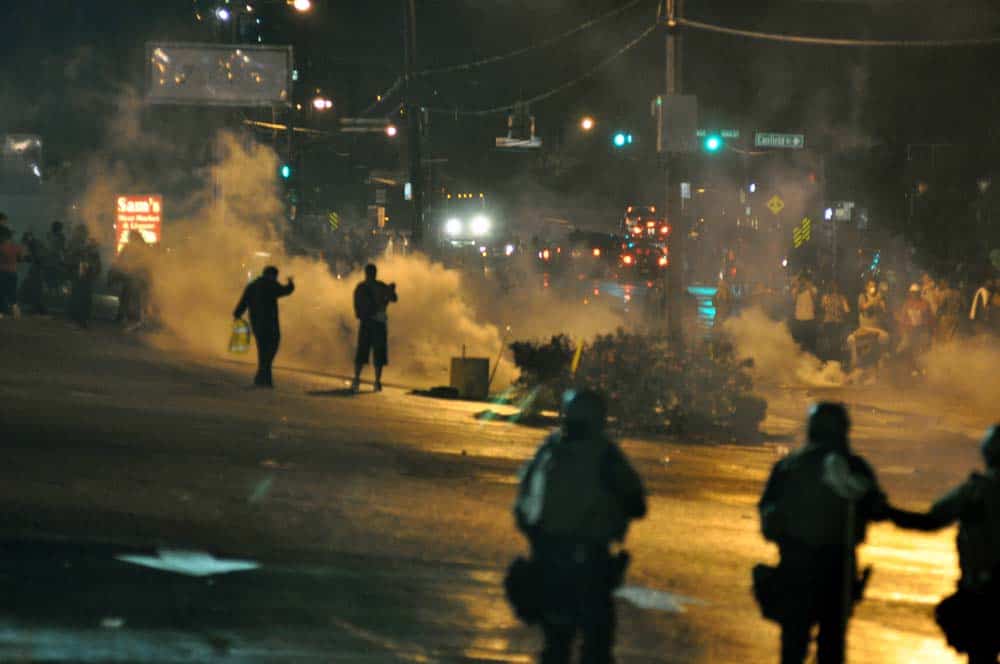
Chelsea analyzes the 2014 Ferguson uprising as Black working-class rebellion against internal (neo)colonialism using the theoretical and methodological tools Frantz Fanon offers in The Wretched of the Earth.
The year 2025 ushered in the centennial of Frantz Fanon’s birth and the 60th anniversary of the publication of Fanon’s The Wretched of the Earth in the U.S., where Wretched found its “ideological home” among Black Power revolutionaries.[1] The year 2024 marked another anniversary: ten years since white police officer Darren Wilson murdered Black teenager Michael Brown in Ferguson, Missouri, on Aug. 9th, 2014, sparking the first major Black (sub)urban rebellion in 21st century U.S., with seismic impacts. Scholars have analyzed the Ferguson uprising from a range of frameworks—Black feminism, intersectionality, police reform, abolition, anti-capitalism. However, these perspectives have minimized the historical lens of Black rebellion as a working-class tactic and a form of national liberation struggle. To re-animate this lens, I build on Fanon’s theories and methods in Wretched, analyzing Ferguson as a Black, working-class rebellion against internal colonial conditions and situating it within neocolonial development in St. Louis, Missouri.
Internal Colonialism, Super-Exploitation, and Ferguson’s Racial Taxation Regime
Theorists of internal colonialism, like Robert L. Allen, discerned the relevance of Fanon’s Wretched to Black rebellion. Allen quotes Fanon at length in Black Awakening in Capitalist America on the context of Black Power. He provides insight into various positions on internal colonialism ranging from Harold Cruse, who argued that slavery coincided with colonial expansion, to Malcolm X, who connected Black and global decolonization struggles, Stokely Carmichael who emphasized Black spatial concentration and lack of control over resources, and Jack O’Dell, who identified processes like super-exploitation at the heart of internal colonialism. Super-exploitation, in which a segment of workers who are not freely mobile because they are concentrated into specific occupations, industries, and residences produce a greater surplus value, imposes a “racial tax” on the movement of Black workers.[2] Building on these theorists of internal colonialism, Allen argues that the Black internal colony in the U.S. is constituted by super-exploitation, political subjugation, and cultural degradation, and his central thesis posits that the domestic colony was transforming into a domestic neocolony.[3]
Ferguson reflected the former, a more classical internal colony, a “world divided into compartments.”[4] In 2014, Ferguson’s mayor, city manager, municipal judge, five of six city council members, police chief, and 50 of 54 police officers were white. Ferguson’s lily-white city leadership and police force ruled over a 67 percent Black municipality with impunity. They funded the municipality’s property and sales tax shortfalls through the extraction of excessive fines and fees for municipal code violations. Ferguson’s Police Department slapped Ferguson’s population of 21,203 with 90,000 citations between July 2010-14, with a 50 percent increase from 2013 to 14. The citations ranged from violations mirroring state statutes like “Manner of Walking in Roadway,” to novel codes like “High Grass and Weeds” and “Barking Dog.” These citations were not issued uniformly: 90 percent of citations were issued to Black residents of Ferguson.[5] Ferguson’s extraction of fines and fees constituted a special form of super-exploitative racial tax that targeted Black workers. As one suburban resident reflected: “That’s what St. Louis is all about, trying to get the people that’s working.”[6]
While the Ferguson rebellion responded to hyper-local conditions, it also reflected deep-seated indignation about the balkanized configuration of St. Louis as a whole. The cleavage of the City of St. Louis from St. Louis County in 1876 permanently froze the boundaries of the city, and in the 1950s, accelerated the flight of capital from the shrinking city into the growing county, fracturing the city’s relative Black political power and creating a parasitic county-city relationship.[7] Combined with urban renewal, the relocation of jobs forced Black workers to the suburbs in the 1980s and 90s. Previously, Kinloch, which neighboured the former sundown town of Ferguson, had served as the only all-Black town in St. Louis County, with its own schools, post office, and theatre. As Black workers migrated from city to county, developers were demolishing Kinloch homes and institutions to make way for the expansion of the Lambert Airport.
As Kinloch was dismantled, formerly white municipalities like Ferguson rapidly transformed into Black working-class enclaves in north St. Louis County. A physical boundary, Olive Boulevard, separated mostly Black municipalities in the north from predominantly white municipalities, like Clayton, the county’s financial seat and central business district. As policy scholar Richard Rothstein demonstrates, local, state, federal and real estate institutions, policies, and practices consolidated residential apartheid in northern municipalities.[8] Black residents became increasingly concentrated into formerly white suburbs that fought to maintain their racial character. When they could not, white leaders chose to manage their populations via essentially colonial administrations propped up by excessive fine and fee extraction.
In 2014, St. Louis County was fragmented into 90 municipalities, 81 courts, and 63 municipal police departments, which meant that municipalities like Ferguson were able to, in the words of long-time St. Louis Black liberation and labor activist Percy Green II, “rob Peter to pay Paul” without accountability or oversight.[9] These conditions created an oppressive climate where it became impossible to breathe.[10] Brown’s former classmate, 17-year-old Kevin Black, could not count how many times he had been stopped by Ferguson police, and neighbor, 18-year-old Marlon Hampton, avoided going outside as much as possible in the months prior to Brown’s death because “I don’t want to see the police. I get harassed. They search me, say I look like someone in a crime.”[11] Like the protagonists of Wretched, Ferguson residents experienced vigilance, tensed muscles, and presumed guilt hanging over them like the sword of Damocles. The constant police presence did not signify “‘Don’t dare to budge,’” but rather, “‘Get ready to attack.’”[12]
Barriers prevented the exercise of change through institutional channels. Only six percent of African Americans voted in Ferguson’s 2013 municipal elections. As historian Ashley Howard demonstrated in Black urban rebellions that took place in mid-sized Midwestern cities in the 1960s, a lack of political efficacy necessitated that Black workers address their grievances through an alternative channels like Black rebellion, which, following Fanon, opens up when the violence which “ruled over the ordering of the colonial world” is seized by the colonized who, “deciding to embody history in his own person…surges into the forbidden quarters.”[13] However, as I will discuss, Black Ferguson was not able to launch a sustained attack without support from organized Black communities based in the City of St. Louis.
Grasping Fanon’s Dialectical Method in Ferguson: Sub-proletarian Class Formation and Struggle
Fanon’s dialectical method, tracing back to his clinical work, is both deductive, involving a theoretically informed assessment, and inductive, involving a bottom-up analysis of people’s political economic conditions and cultures in relation to struggle.[14] This method led Fanon to insist that a Marxist analysis should be “slightly stretched” on the colonial question.[15] It also allowed Fanon to recognize the lumpenproletariat, dispossessed peasants from the countryside who found themselves in the city without jobs, had revolutionary capacity because they had nothing to lose and everything to gain, as opposed to the small urban working class. Given these conditions, for Fanon, only the peasantry was revolutionary. However, Fanon also saw the counter-revolutionary potential of the lumpen, whom, for example the CIA co-opted to “organize ‘spontaneous’ mass meetings against Lumumba” in the Congo.[16] It is precisely for this reason that Fanon argued for the urgent necessity of organizing and educating the peasant masses rather than dismissing them.
Wretched evoked debate on the revolutionary capacity of the lumpenproletariat among Black Power architects. The lumpenproletarianization thesis was central to Black Panther Party theories and strategies, which Huey P. Newton and Bobby Seale would later revise, and Eldridge Cleaver would continue to support. In Nigel Gibson’s edited volume Fanon Today, Lou Turner and Kurtis Kelley highlight a rare talk by James Forman in 1971 Detroit. Forman identified similarities between the nationalist leaders from Fanon’s second chapter of Wretched, “Spontaneity: Its Strengths and Weaknesses,” and Black reformist leaders who misled the masses. He argued that revolutionaries must turn away from these counter-revolutionary forces and instead organize the Black working class, the greatest segment of colonized people in the U.S. While Forman saw that a lumpenproletariat “forced into robbery and vandalism as a way of life” would rise with deindustrialization and automation, he argued that unemployed Black workers should not be analyzed as lumpen but as a potentially revolutionary working class.[17]
Grasping Fanon’s method in the contemporary moment, I argue that the class formation which today characterizes the Black internal (neo)colony is the subproletariat. While all workers have been subjected to sub-proletarianization, or transformation into unstable, low-wage, part-time, non-union labor, the current financialized global neoliberal capitalist structure and concomitant expansion of service and distribution sectors have disproportionately marginalized African American labor, establishing what historian Sundiata Cha-Jua calls the “New Nadir” as the contemporary Black racial formation.[18] Building on Marxist scholar-activist Harold Baron, historian Augustus Wood argues that Black containment within sub-proletarian jobs underlies super-exploitation. This sub-proletarianization occurs one, through un- and underemployment, via the category of “discouraged workers” who leave the labor market because they cannot find stable employment and are not included in unemployment estimates; two, dual markets for Black and white workers. Within this dual market structure, the Black surplus sector includes workers who are unemployed, discouraged, and employed in the lowest-paid, dirtiest, most unsafe, lowest occupational rung, non-union jobs.[19]
Early theorist of the expanding subproletariat Clarence J. Munford argues that the Black worker is “reduced to subhumanity” through sub-proletarianization, which couples her wages to the minimum.[20] The subproletariat, “legitimate offspring of U.S. monopoly capitalism, wage workers whose cheap, unskilled and simple labor has been rendered superfluous” are “set aside for capital’s future needs…as a vast reservoir of dirt cheap occasional labor power.”[21] Munford builds from Karl Marx’s general law of capitalist accumulation, in which a reserve army of labor creates a “mass of human material always ready for exploitation by capital in the interests of capital's own changing valorization requirements” and “depends on the constant transformation of a part of the working population into unemployed or semi-employed ‘hands.’”[22] Munford, however, dismisses the relevance of Fanon to Black working-class struggle. I suggest, in contrast, that Fanon’s revolutionary theory and method are necessary to analyze the contours of sub-proletarianization as a dehumanizing dynamic of contemporary internal colonialism.
The identity of economic base and superstructure Fanon observes in the colonies is reflected in Ferguson. The top occupation for Black Ferguson workers was service (29 percent) and the top occupation for white Ferguson workers was management (41 percent). The 16 percent unemployment rate for Black workers (24 percent for Black men) ages 16-64 was more than double the white 6 percent rate, signifying a sizeable reserve army Black labor. If discouraged workers among the 27 percent of Black workers not in the labor force and involuntarily underemployed workers within the 63 percent of Black part-time workers were counted, then Ferguson’s Black unemployment rivaled Global South rates. Black workers in Ferguson earned about 64 cents to the white worker’s dollar, $34,103 to the white median income of $53,289. The white bourgeoisie in St. Louis lived at a distance from Ferguson, in Ladue, Frontenac, and Town and County, three of the wealthiest suburbs in the US, with median incomes ranging from $127–$162,000.[23] Meanwhile, Ferguson’s white managerial class was responsible for managing, administering, and containing Ferguson’s Black working classes. They achieved this through the extraction of fines and fees as a super-exploitative racial tax.
Because of underemployment, low wages, and excessive citations traveling to and from work, Black Ferguson workers were forced to take on multiple jobs. In 2013, 19-year-old Doneshia Babbitt had been working at the Ferguson McDonald’s, where her sister also worked, since she was 16 years old. She was earning $7.55 an hour, just 20 cents above Missouri’s $7.35 minimum wage. By 2015, she was working two jobs and only taking home $600 a week, forcing her to drop out of school:
“My mom sits me and my big sister down. That’s when she said, hey I need help. So, if the bills are $1600 dollars, rent $500…what you supposed to do? It was either drop out of school or help her with these bills. What else was I supposed to do? So, I dropped out of school, fell behind, so far behind that I only had five credits when I got out.”
These conditions motivated Babbitt to join and become a leader within the Fight for $15 (FF$15) fast-food workers’ movement, because their “voices need[ed] to be heard not only for ourselves but for our children.”[25] FF$15 created one of the few opportunities for Black workers in Ferguson to participate in organized labor given their exclusion from trade union jobs. Fast-food workers from FF$15, particularly from the Ferguson McDonald’s, would play a central role in the Ferguson uprising.
The Pitfalls of National Consciousness in the Heartland
In Wretched’s Chapter Three, “The Pitfalls of National Consciousness,” Fanon theorizes the formation of a national bourgeoisie which acts as a neocolonial “intermediary” between global capital and the newly independent African nation.[26] In Black Awakening, Allen illustrates how Black rebels and revolutionaries found themselves at precisely the juncture elucidated by Fanon. The ruling class strategically disarmed the Black power movement by uplifting a stratum of Black managers, technicians, and small business owners who identified Black power as Black capitalism.[27] On the labor front, interdisciplinary scholar Lou Turner demonstrates how militant Black auto workers were disciplined by capital.[28] These strategies paved the way for the transformations in capitalism that would strip Black working-class power via neoliberalization, financialization, and sub-proletarianization.
In St. Louis, these transformations resulted in a shift in the terrain of Black liberation movements. In 1999, Black contractors in St. Louis used the tactic of militant disruption instead of Civil Rights-era symbolic marches, blocking I-70 highway to demand a higher percentage of contracts for Black contractors in highway construction. Because militant disruption requires a mass base, Black contractors united with Black workers who hoped to win jobs in addition to contracts. Cha-Jua argues that the mobilization of a working-class base and the militant disruption tactic contributed to the success of this protest compared to a campaign in Decatur, Illinois, against the expulsion of six Black students. However, he points out that since the goal was to increase Black-owned businesses rather than Black jobs, Black workers ultimately did not benefit from this win. Historian Clarence Lang juxtaposes this to 1964, when ACTION, CORE and other civil rights organizations picketed the St. Louis arch, and two activists—Percy Green II and Richard Daly—climbed the arch to demand jobs for Black workers to construct Jefferson National Expansion Memorial. This contrast reflects a shift to the prioritization of Black professionals in community building and a decline in working-class agendas shaping Black movement activity.[29]
Exploring Fanon’s analysis of neocolonialism in light of these transformations offers insights into the landscape of St. Louis, Missouri which made Ferguson possible. To give one example, in the early 2000s, developer Paul McKee secretly bought up land dispossessing North St. Louis City residents for the Northside Regeneration project under various shell companies. When he was exposed and forced to seek public input in 2009, he promised jobs and housing for local workers. McKee worked with Missouri State Representative Rodney Hubbard, Jr., who represented parts of the North St. Louis district and would later work as paid lobbyist for McKee, to pass the Distressed Areas Land Assemblage Tax Credit in 2007, which reimbursed McKee for land grabs. Hubbard’s father, Rodney Hubbard, Sr., owned Carr Square Tenant Corp., which held stake in Northside Regeneration. In 2010, the St. Louis City Circuit Court struck down the redevelopment agreement the Board of Alderman had approved in 2009, but Missouri Supreme Court reversed the decision. By 2013, no housing had been developed and the first retail development planned was a Dollar General, far from the promised high-quality jobs. Nonetheless, the Board of Aldermen voted in 2013 to approve a bill sponsored by the sister of State Rep. Rodney Hubbard, 5th ward alderwoman Tammika Hubbard. The bill provided Northside Regeneration with a $390 million TIF (tax increment financing) as part of an $8.1 billion redevelopment plan.[30] The intermediary role of the Hubbard family in the Northside Regeneration development project is just one example of the corrupt neocolonial governance which forced Black workers out of the City of St. Louis into municipalities like Ferguson. Mainstream media appointed some of these leaders who leased out the people to capital as heroes of Ferguson uprising.
Despite the city’s neocolonial forces, Black St. Louisans were able to build on community resources and institutions that largely did not exist in St. Louis County after the destruction of Kinloch. Black organizations like the Organization for Black Struggle (OBS), Universal African People’s Organization (UAPO), and the Coalition Against Police Crimes and Repression (CAPCR) were built in the 1980s, and multiracial organizations like the Anti-Racist Collective (ARC), the Justice Institute, and Missourians Organizing for Reform and Empowerment (MORE) formed in the early 2000s in close relation with these longstanding Black organizations. Alongside the FF$15 movement waged by low-wage workers, these organizations waged struggles in the realms of jobs, housing, education, policing, and politics in the City of St. Louis which prepared them to contribute organizational capacity, resources, discipline, and consciousness to support and sustain Black rebellion in Ferguson, forming in part the “forces which in the colonial period open up new outlets.” [31]
Conclusion: Toward Setting Afoot a New Human
Fanon’s studies cannot be mechanically applied to the current moment nor lifelessly trapped in the past. Rather, through praxis, we re-discover Fanon’s dialectical method in the current moment. Fanon’s Wretched provides the tools to analyze the interrelated colonial and neocolonial formations in Ferguson and St. Louis, Missouri and how they facilitated and constrained Black rebellion. In furnishing a method which ties racial class analysis to revolutionary praxis, Fanon allows us to see how subproletarian workers, stripped of their humanity, are today at the heart of the struggle to “set afoot a new [hu]man.”[32]
Chelsea Birchmier is a graduate student in Community Psychology at the University of Illinois Urbana-Champaign.
Endnotes
[1] Lou Turner and Kurtis Kelley, “When Black Liberation Mattered: Frantz Fanon in the Theory and Practice of Pan-Africanism in the Black Power Era, 1965-1975,” 316, in Fanon Today: Reason and Revolt of the Wretched of the Earth, ed. Nigel C. Gibson (Daraja Press, 2021).
[2] Sundiata Keita Cha-Jua, America’s First Black Town: Brooklyn, Illinois, 1830-1915 (Urbana: University of Illinois Press, 2000), 58-9; Child Hill, “Race, Class and the State.”
[3] Robert L. Allen, Black Awakening in Capitalist America; an Analytic History, [1st ed.]., Anchor Books (Garden City, N.Y: Doubleday, 1969).
[4] Frantz Fanon, The Wretched of the Earth, trans. Constance Farrington (New York: Grove Press, 1963), 39.
[5] US Department of Justice, Investigation of the Ferguson Police Department, 2015.
[6] ArchCity Defenders, ArchCity Defenders: Muncipal Courts White Paper, 2014.
[7] Colin Gordon, Mapping Decline: St. Louis and the Fate of the American City, Politics and Culture in Modern America (Philadelphia: University of Pennsylvania Press, 2008), https://doi.org/10.9783/9780812291506.
[8] Richard Rothstein, “The Making of Ferguson,” Journal of Affordable Housing & Community Development Law 24, no. 2 (2015): 165–204.
[9] Percy Green II, interview with the author, 2020.
[10] Frantz Fanon, Black Skin, White Masks, trans. Constance Farrington (London: Pluto Press, 1986), 26.
[11] “Michael Brown’s Former High School Resumes Classes Amid Ferguson Chaos,” NBC News, August 19, 2014, https://www.nbcnews.com/feature/in-plain-sight/michael-browns-former-hi….
[12] Fanon, 53.
[13] Ashley M. Howard, “Then the Burnings Began: Omaha’s Urban Revolts and the Meaning of Political Violence,” Nebraska History Magazine, Summer 2017, 82–97; Ashley Howard, “Whose Streets? Wielding Urban Revolts as Political Tools,” The Journal of African American History 107, no. 2 (March 1, 2022): 238–65, https://doi.org/10.1086/719000; Fanon, The Wretched of the Earth, 40.
[14] Lou Turner, “’Psychiatry Has to Be Political’: The Preterrain to a New Fanon,” in Frantz Fanon’s Psychotherapeutic Approaches to Clinical Work, ed. Lou Turner and Helen A. Neville, Explorations in Mental Health (New York: Routledge, 2020).
[15] Fanon, The Wretched of the Earth, 40.
[16] Fanon, 137.
[17] Lou Turner and Kurtis Kelley, “When Black Liberation Mattered: Frantz Fanon in the Theory and Practice of Pan-Africanism in the Black Power Era, 1965-1975,” in Fanon Today: Reason and Revolt of the Wretched of the Earth, ed. Nigel C. Gibson (Daraja Press, 2021), 337.
[18] Sundiata Keita Cha-Jua, “The New Nadir: The Contemporary Black Racial Formation,” The Black Scholar 40, no. 1 (March 1, 2010): 38–58, https://doi.org/10.1080/00064246.2010.11413508; Sundiata Keita Cha-Jua, “Racial Formation and Transformation: Toward a Theory of Black Racial Oppression,” Souls 3, no. 1 (January 1, 2001): 25–60, https://doi.org/10.1080/10999949.2001.12098156.
[19] Augustus C. Wood, “Toward a Theory of Super-Exploitation: The Subproletariat, Harold ‘Hal’ Baron, and the Crisis of the Political Economy of Black Labor,” Labor Studies Journal 47, no. 4 (December 1, 2022): 462–87, https://doi.org/10.1177/0160449X221123534.
[20] Clarence J. Munford, Production Relations, Class and Black Liberation: A Marxist Perspective in Afro-American Studies, Philosophical Currents ; v. 24 (Amsterdam: Grüner, 1978), 71.
[21] Munford, 76.
[22] Karl Marx, Capital Volume I, trans. Ben Fowkes (London: Penguin Books, 1976), 784–86.
[23] U.S. Census Bureau, "Sex By Occupation For The Civilian Employed Population 16 Years And Over," American Community Survey, ACS 5-Year Estimates Detailed Tables, 2014; U.S. Census Bureau, "Sex By Age By Employment Status For The Population 16 Years And Over," ACS 5-Year Estimates Detailed Tables, 2014; "Sex By Work Experience In The Past 12 Months By Earnings In The Past 12 Months (In 2014 Inflation-Adjusted Dollars) For The Population 16 Years And Over," ACS 5-Year Estimates Detailed Tables, 2014; "Median Household Income In The Past 12 Months (In 2014 Inflation-Adjusted Dollars)," ACS 5-Year Estimates Detailed Tables, 2014; "Median Household Income In The Past 12 Months (In 2015 Inflation-Adjusted Dollars)," ACS 5-Year Estimates Selected Population Detailed Tables, 2015.
[24] ArchCity Defenders, ArchCity Defenders: Muncipal Courts White Paper.
[25] Tim Rowden, “McDonald’s Tells Workers to Budget by Getting a Second Job,” The Labor Tribune, July 31, 2013, https://labortribune.com/mcdonalds-tells-workers-to-budget-by-getting-a…. Doneshia Babbitt, “Show Me 15 Testimonial,” A People’s History of Washington University, Oct. 8, 2015, https://wupeopleshistory.weebly.com/show-me-15-testimonials.html.
[26] Fanon, The Wretched of the Earth, 152.
[27] Allen, Black Awakening in Capitalist America; an Analytic History.
[28] Lou Turner, “Toward a Black Radical Critique of Political Economy,” The Black Scholar 40, no. 1 (March 1, 2010): 7–19, https://doi.org/10.1080/00064246.2010.11413506.
[29] Sundiata K. Cha-Jua, “Like A Raging River: The Resurgence of Militant Black Activism” (Unpublished paper delivered at the Twenty-Third Annual Meeting of the Midwest Sociological Society, Chicago, 2000); Clarence Lang, Grassroots at the Gateway: Class Politics and Black Freedom Struggle in St. Louis, 1936-75, Class, Culture (Ann Arbor: University of Michigan Press, 2009).
[30] Chris King, “First Steps for NorthSide Regeneration,” St. Louis American (blog), February 3, 2011, http://stlouisamerican-newspack.newspackstaging.com/business/first-step…; Jason Rosenbaum, “Board of Aldermen Gives Initial Passage to NorthSide TIF Bills,” STLPR, October 11, 2013, sec. Government, Politics & Issues, https://www.stlpr.org/government-politics-issues/2013-10-11/board-of-al…; “Special Report: North Side Story,” St. Louis Magazine, October 27, 2009, https://www.stlmag.com/Special-Report-North-Side-Story/; Michael R. Allen, “The Sisyphean Footsteps of Northside Regeneration,” NextSTL (blog), September 12, 2013, https://nextstl.com/2013/09/the-sisyphean-footsteps-of-northside-regene….
[31] Fanon, The Wretched of the Earth, 59.
[32] Fanon, 316.