



After Durban: CAIS at UCC and the Work of Repair

The work on reparative justice is occurring in classrooms, in the community, in public squares, across the oceans, following the archives, forging collaborations, facilitating return to Africa, and providing a global research and education base for reparations work. The Centre for African and International Studies, at the University of Cape Coast, is working from Ghana to realise the principles of the Durban Conference and the gains in the reparative struggles in Ghana and other parts of Global Africa.
After Durban
Twenty-five years ago, the World Conference Against Racism in Durban declared that slavery and the slave trade are a crime against humanity. It was a hard-won recognition, the product of generations of African resistance and decades of organising across the continent and the diaspora. This year, the United Nations General Assembly went further. Following President John Dramani Mahama’s address on 25 March 2026, it adopted Resolution A/RES/80/250, championed by Ghana, naming the transatlantic slave trade and the racialised chattel enslavement of Africans the gravest crime against humanity.
The distance between those two moments is instructive. Durban’s demands did not simply fade. After September 2001, they were contained. The language of structural injustice was steadily converted into the language of diversity and inclusion, and the question of repair was narrowed into a question of access. Racism came to be managed as a problem of representation rather than confronted as a system rooted in enslavement, colonialism and racial capitalism. Yet contained is not defeated. Durban established the principle and gave movements a shared international framework. Its demands were carried forward in Africa, the Caribbean and the diaspora, through the CARICOM Reparations Commission, the African Union’s commitment to a decade of reparations, and now the 2026 resolution, which stands on the ground Durban cleared.
That history also carries a warning. The new moment can be absorbed and softened just as Durban’s demands were. On 25 September 2026, I gave opening remarks online from Cape Coast to “From Durban to Now: 25 Years of Struggle for Reparative Justice,” a symposium held in Syracuse, New York, and streamed online. It was co-hosted by the Pan African Community of Central New York, the Africa Initiative and the African Graduate Student Network at Syracuse University. Many of the speakers, myself included, are members of the Global Pan-African Movement (GPAM), North American Delegation. Whether the conversation takes place in Accra, Kingston, Albany or Syracuse, I argued, it is the same conversation. How do we move from acknowledgement to accountability, and from memory to material repair?
My answer, from Cape Coast, is that repair must be built into institutions that do the work daily and outlast any single political moment, and that no institution can do it alone. In what follows, I describe that work as the Centre for African and International Studies (CAIS) at the University of Cape Coast (UCC) carries it out with its partners: in the classroom, in the community, in the archive, in the public square and across Global Africa.
Cape Coast Is Not a Postcard
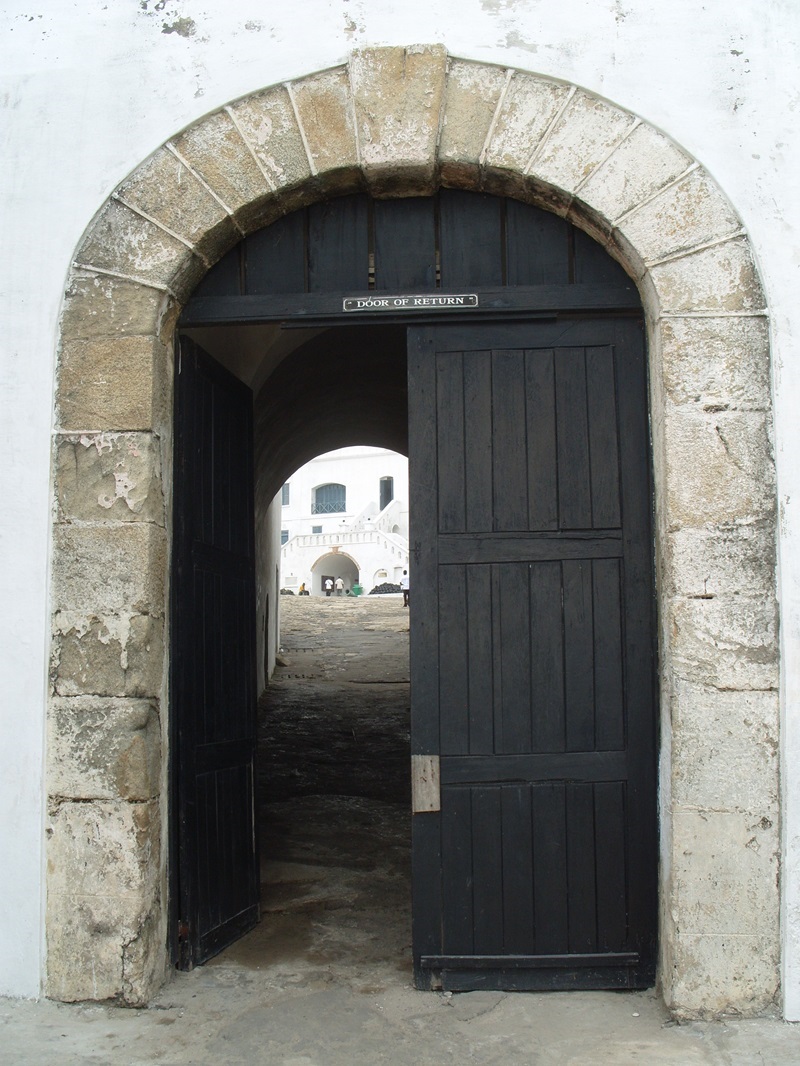
CAIS sits between two of the most notorious monuments of the Atlantic slave trade: Cape Coast Castle to the east and Elmina Castle to the west. In both, men, women and children were held in dungeons beneath the rooms where merchants and governors lived, traded and worshipped. In both, a narrow door opened onto the sea and the waiting ships. Visitors today call each the Door of No Return.
For many, Cape Coast is first met as a postcard. Presidents, prime ministers and ordinary travellers walk the ramparts, take photographs and move on. Heritage tourism matters, and it brings the diaspora home. But it can do to the castle-dungeons what the years after Durban did to its demands: turn a structural crime into a moving experience, and leave the structures untouched.
Cape Coast is not a postcard. It is the place where people were stripped of family, town and nation and made into cargo. At CAIS, we hold that its significance should be measured not only in visitor numbers, but in the seriousness of the work done in its name.
Repair in the Classroom
The slave trade took people. Colonialism then took the story. For generations, Africans were taught their own history through the eyes of those who had enslaved and ruled them. Africa appeared as a place without a past worth studying, and the diaspora as a people without a home to remember. Any serious programme of repair has to begin by undoing that teaching.
This is where CAIS does much of its daily work. Through the African Studies Programme, CAIS teaches more than 10,000 UCC students every year, across 20 to 24 courses each semester. That makes it one of the largest teaching units in the University. Its students come from every faculty: future nurses, engineers, teachers, accountants and lawyers. For many, this is their only sustained encounter with African history and thought at university level.
We insist that these courses are taught from an African-centred perspective. That does not mean replacing one narrow story with another. It means placing African people, knowledge systems and experiences at the centre of inquiry, and reading the wider world from there. A student who leaves UCC understanding how the wealth of the modern world was built on African labour, and how Africans resisted at every stage, carries a different sense of what is owed and why. This teaching is also an answer to Afrophobia. Students who understand how colonial borders and extraction set African peoples against one another are better placed to see other Africans as kin, not competitors.
From the 2026/2027 academic year, CAIS’s new curriculum carries this work into the degree programmes. A new African Diaspora and Slavery Studies concentration runs from the bachelor’s degree to the doctorate. Undergraduates take courses such as Reparations and Global Africa; History, Memory and Slavery in Africa; Black Europe: From Prehistory to the Present; and Postcolonial Caribbean. At the postgraduate level, Global Africa and Reparative Justice examines the political economy of reparations, the Caribbean reparations movement and the futures of reparative justice, alongside courses on African Diaspora Studies and African Return Movements. A new Gender Studies section recognises that enslavement and colonialism fell differently on women and men.
This is not inclusion in someone else’s curriculum. It is a change in who defines knowledge. Repair of the mind is slow work, carried out one cohort at a time.
Repair in the Community
The trade did not carry away “Africans” in the abstract. It carried away a daughter from a particular family, a young man from a particular town, an elder from a particular lineage. Repair that speaks only of Africa in general misses the scale of the loss. It has to reach down to the level at which the damage was done.
Consider Kormantse, a coastal community in Ghana’s Central Region, a short distance east of Cape Coast. Its name crossed the Atlantic. In the British and Dutch colonies of the Americas, every African shipped from anywhere on the Gold Coast was called “Kromanti” or “Coromantee,” whether they were Akan, Ga or Ewe, or had been marched down from the north. A single coastal town lent its name to all of them. Over time the name became an identity, and for planters a byword for resistance. It survived in the language, music and memory of people who had never seen the place.
CAIS has begun to walk that name back home. Our students have carried out fieldwork in Kormantse, and more fieldwork is planned this year. The Centre has taken part in naming ceremonies and has engaged with chiefs and elders. It is also exploring how members of the diaspora might be welcomed back as development chiefs, with a recognised place in community life. These are not symbolic gestures. They are the rebuilding of ties between specific descendants and the specific families, communities and ethnic groups from which their ancestors were taken. Inclusion would welcome descendants as visitors. Repair restores them to a lineage.
Kormantse is a beginning, not the whole map. The work will extend to Denkyira, to Twifo Hemang, where CAIS is establishing an office, and to communities as far as northern Ghana, from which captives were also marched to the coast. Each community holds part of the story. Each descendant who returns deserves more than a tour. They deserve a route to the people they came from. This matters all the more as borders harden against African people across the world. The same order that moves capital freely restricts the movement of Africans. Return, grounded in knowledge and community, runs against that logic.
To give this work a permanent home, CAIS is building the Heritage Research Centre, due to open on 1 August 2027. It will be a place where descendants, researchers, students and community members meet, where records and testimony are kept, and where return is supported by knowledge.
Repair in the Archive
The written record of the slave trade was created largely by those who ran it. Ship logs, ledgers, company correspondence and plantation inventories count captives, record prices and note deaths. They are indispensable evidence, and the archives that hold them today make much of this history knowable. But they rarely record a name as a person’s own family would have spoken it, or say where in Africa that family lived. Repair requires filling those silences.
CAIS approaches this in two ways. The first is to listen. Oral history with elders and families in communities such as Kormantse records what the written archive left out: memories of loss, of raids and of those who never came back, passed down across generations. This testimony is not a supplement to the documents. It is evidence in its own right, and often the only evidence the descendants of the enslaved will ever have of where they came from.
The second is to read the colonial record closely for what it reveals. CAIS has compiled bibliographies tracing the Kormantse name through its many spellings in European and Caribbean sources: Kormantin, Kromanti, Coromantee, Coromantin and others still to be catalogued. Every variant is a trail left by a clerk, a planter or a traveller. Followed carefully, those trails lead back to the coast, and to the people behind the label.
This work is increasingly shared. CAIS is in early conversations with community archives of Black history in Europe about sharing material, and is building relationships with other archival and heritage partners abroad. The aim is simple: records about this coast, scattered across Europe and the Americas, should also be read and interpreted here, beside the communities they describe. A place in someone else’s archive is not the same as authority over one’s own history. Sovereignty over historical memory is part of sovereignty itself.
Repair in the Public Square
There is a gap between the rooms where reparations are negotiated and the streets where most people live. Many Ghanaians, and many in the diaspora, are unsure what reparatory justice means. Some assume it is only about money; others see it as a matter for diplomats. A claim the public does not understand cannot be sustained, so closing that gap is itself a form of repair.
CAIS takes this work into public space. On 23 May 2026, ahead of African Liberation Day on 25 May, the Centre held its commemoration at UCC under the theme “Global Africa, Reparative Justice and International Law.” It was organised with GPAM, the Central Region African Ascendants Association of Ghana (CRAAAG) and the Real Ghana Foundation. It drew more than 500 people in person and 600 online, from Ghana, the United States, the Caribbean and Europe, linking international law to lived history. The event was covered by TV UCC and other media outlets, carrying the conversation well beyond the auditorium.
CAIS’s Reparations Seminar Series continues the conversation through the year, and the Centre has compiled reparations bibliographies, including reading lists for Ghana’s senior high schools, so that students meet this history before they reach university.
CAIS has also started a Reparative Justice channel and group on WhatsApp. The channel carries news and readings, while the group opens space for discussion. Together they reach people who will never sit in a lecture hall, on the device most of them already hold. Every African Studies student is invited to join, so that learning continues long after the semester ends.
CAIS transcribed President Mahama’s address to the UN General Assembly, printed it and distributed copies at the Centre’s African Liberation Day commemoration on 23 May 2026. The Centre continues to share it with students, visitors and the wider public. Working with interns from Burkina Faso, the Centre has translated the address into French, so that it can reach francophone Africa and its diaspora. Reparative justice has to cross the language divides that colonialism left behind.
The next major moment is PANAFEST, from 28 July to 1 August 2027. CAIS will host the Secretariat for the PANAFEST Colloquium, bringing the question of repair into one of the largest Pan-African gatherings on the continent.
Repair Through Collaboration
The trade was global, and so is the work of undoing its harm. Much of what CAIS does would not be possible without partners. At home, this work rests on the support of the University of Cape Coast, whose leadership has backed CAIS’s growth and its engagement with Ghana’s reparatory justice agenda.
Beyond the University, no partner has done more than GPAM. It has supported just about every part of CAIS’s work with material, resources and expertise: donating laptops, providing programme funding, helping equip the Centre’s offices and sharing the advice of the scholars among its members.
This is what repair after Durban requires. Durban’s demands were carried for 25 years by movements. Movements supply conviction and reach, but they depend on the energy of their members. Universities supply continuity, but they can drift from the urgency of the struggle. When the two work together, each supplies what the other lacks. CAIS’s partnership with GPAM is one working model of how the demands Durban named can be kept from being contained again.
CRAAAG brings another kind of partnership. Its members are mainly people of African descent who have made the Central Region their home, joined by Ghanaians. They have provided speakers for CAIS events, streamed them to audiences online and supplied meals on at least six occasions. Their presence is itself a form of repair: descendants of those who left through these castle-dungeons, now helping to build the work of return from Cape Coast.
Ghana’s leadership gives this work its national frame. Beyond the UN resolution, Accra hosted the High-Level Next Steps Conference on Reparatory Justice in June 2026, with the Ministry of Foreign Affairs under Hon. Samuel Okudzeto Ablakwa carrying the national agenda forward. In March, Ghana received Dr Terrance Drew, Prime Minister of St. Kitts and Nevis and Chairman of CARICOM, at Jubilee House. It was a reminder that the African and Caribbean struggles for repair are one struggle, waged from two shores.
That link is personal for me. I was born in Nevis, have lived and taught in the United States, and became a Ghanaian citizen in 2024. At CAIS, we also follow closely the reparations efforts taking shape in New York State, which press the same demands.
Members of CAIS work with the Bonn Centre for Dependency and Slavery Studies in Germany, and the Centre has opened conversations with the University of Buenos Aires, a reminder that the African presence in South America belongs to this history too. Within CAIS, these threads are drawn together in the Global Reparative Justice Centre Initiative, which gathers the Centre’s research, public education and international links on reparations into a single, growing effort.
What Repair Still Requires
Repair after Durban cannot mean inclusion within the same order that produced the harm. Repair that leaves in place the structures built on enslavement, colonial extraction and the destruction of Indigenous peoples, including the debts, unequal trade and ecological damage that still drain Global Africa, is not yet repair.
Institutions, in turn, need support. Sustaining this work will require long-term commitment from states, the African Union and CARICOM, from diaspora movements, and from universities, which are increasingly recognising reparative work as part of their mission. The harm was done over four centuries. It will not be repaired within one electoral cycle.
The horizon CAIS is working towards is a Global Centre for Reparatory Justice for Global Africa, grounded in the Durban Declaration and serving Africans on the continent and people of African descent everywhere. It is not yet realised. But its foundations are being laid.
From Acknowledgement to Accountability
Durban named the crime and set out a programme of action. The 2026 resolution raised that recognition to its highest standing yet. What remains is to make sure this moment is not contained as Durban’s demands were, and that recognition becomes repair.
That is the work CAIS has taken on with its partners, from the classroom to the castle towns and across the Atlantic.
The doors at Cape Coast and Elmina once marked the end of belonging. Twenty-five years after Durban, our task, as scholars and as Pan-Africanists, is to make them places where accountability begins and belonging is restored. I invite all who share that task to join us in it.
Dr Mario Nisbett is Director of the Centre for African and International Studies (CAIS) and Senior Lecturer in Global African Studies at the University of Cape Coast, Ghana. He is the author of The Workings of Diaspora: Jamaican Maroons and the Claims to Sovereignty (Lexington Books, 2021).
References
Bembir, Peter. 2026 African Liberation Day Commemoration in Cape Coast: Global Africa, Reparative Justice and International Law. Pambazuka News, May 30, 2026. https://www.pambazuka.org/ALD-Cape-Coast
GBC Ghana (2025) ‘AU extends reparations theme to 2036; Ghana to lead as champion’, 14 July. https://www.gbcghanaonline.com/general/au-extends/2025/
United Nations (2001) World Conference Against Racism, Racial Discrimination, Xenophobia and Related Intolerance, Durban, 31 August–7 September.
https://www.un.org/en/conferences/racism/durban2001
UN News (2026) ‘UN resolution urges reparations for slavery’s “historical wrongs”’, 25 March. https://news.un.org/en/story/2026/03/1167199