



Uniting the Working Class in SADC: A Pan-African Fight for Liberation.
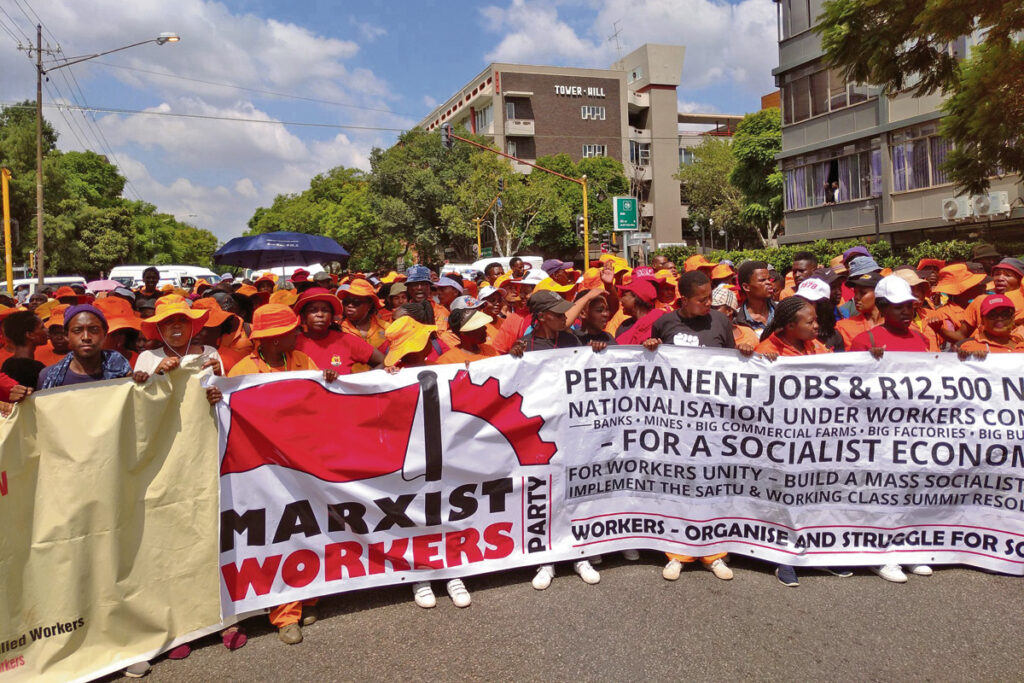
Aaron Maselwane argues for uniting SADC workers against colonial and capitalist oppression to forge a Pan-African class consciousness for liberation and justice.
Across the Southern African Development Community (SADC)[1], Black workers often see themselves as employees—temporary, precarious, replaceable—rather than a unified working class. This disconnect forged by colonial conquest, apartheid’s racial capitalism, and neoliberal fragmentation, fractures solidarity, entrenches exploitation, and stalls Pan-African liberation. To build a just Global Africa, SADC workers must forge a transnational class consciousness, rooted in collective resistance, to dismantle imperialist and capitalist oppression and reclaim their humanity.
Colonial Roots of a Divided Class
Colonialism and apartheid crafted racial and economic hierarchies that still dominate SADC’s labor landscape. Black workers—whether street vendors in Harare, mineworkers in Rustenburg, domestic workers in Manzini, or fishers in Walvis Bay—are concentrated in informal, low-wage, or precarious jobs. Over 70% of the region’s workforce operates outside formal protections, scraping by in sectors like petty trade or seasonal agriculture[2]. Women workers face a triple burden: waged labor, unpaid care work, and social marginalization. In Eswatini, colonial policies devalued women’s domestic roles, a legacy that persists in their overrepresentation in underpaid sectors like cleaning. This gendered exploitation, rarely centered in labor narratives, fragments class unity.
During the colonial and apartheid eras, long-distance and cross-border labor migration in Southern Africa, driven by coercive systems like the Witwatersrand Native Labour Association and passed laws, recruited Black workers from SADC regions such as Lesotho, Mozambique, and Malawi to South Africa’s mines and farms, creating a fragmented working class. These systems, supported by colonial agreements and taxes, funneled over 150,000 migrant workers annually into hazardous, low-wage jobs, while job segmentation—enforced through racial laws like the 1911 Mines and Works Act and ethnic divisions in mine compounds—reserved skilled roles for whites and relegated Black workers, especially migrants and women, to unskilled labor, fostering rivalries that undermined solidarity. This historical division, continues to hinder trade unions’ efforts to organize a unified, Pan-African working-class movement to overcome colonial legacies of exploitation and fragmentation.
Inangwe Moyo argues SADC’s “open” borders serve multinational capital—think mining conglomerates in Botswana—while criminalizing informal traders and migrants, like Malawian laborers in South Africa. These borders, arbitrary lines drawn by empires, pit citizens against migrants, formal against informal, which weakens collective resistance. Neoliberal ideology compounds this, glorifying the “enterpreneur/hustler” over the comrade. Mosa Phadi traces this individualism to apartheid’s labor strategies, which used controlled competition to fracture Black solidarity, a tactic echoed in today’s gig economy[3]. Post-independence elites, from Lusaka to Pretoria, often replicate these dynamics, co-opting labor struggles to maintain power. The result is a working class dispersed, disconnected, and disempowered.
The Heavy Toll of Fragmentation
A fragmented working class cannot confront systemic exploitation. Trade unions, once militant—like the Zambian Congress of Trade Unions (ZCTU) in the 1980s—struggle to organize informal workers, women, or migrants. South Africa’s Congress of South African Trade Unions (COSATU), despite its history, faces declining influence as informal sectors grow. The decline of unions in South Africa and the SADC region is driven by falling formal employment and rising informal work. SA lost 194,000 formal jobs in Q4 2023, with youth unemployment over 60% (Stats SA, AP News), while informal work now makes up 42% of jobs and 25% of GDP (Daily Investor). Unions are struggling to organize in this shifting, precarious landscape. The 2012 Marikana massacre, where 34 striking miners were killed by police, laid bare the stakes: isolated labor action holds power but risks brutal repression without broader solidarity[4]. The National Union of Mineworkers (NUM) distanced itself from the strikers, partly due to tensions over informal leadership and the involvement of migrant workers, many from Lesotho and Mozambique, highlighting how union fragmentation undermines collective action. Xenophobic attacks on Mozambican and Zimbabwean workers in South Africa, often fueled by economic desperation, show how nationalism divides the class, serving capital’s interests.
Politically, disunity cripples workers. SADC governments, under pressure from foreign investors and institutions like the International Monetary Fund (IMF), prioritize extractive industries—copper in Zambia, diamonds in Botswana—over labor rights. Policies like the SADC Labour Migration Action Plan 2020-2025 and the SADC Employment and Labour Sector Strategic Plan 2020-2030 aim to improve worker conditions, but their weak enforcement reflects a bias toward corporate interests. SADC’s Regional Migration Policy Framework was included as a developing framework to promote safe migration, but noted as incomplete and lacking full ratification, reflecting the article’s point about governments’ failure to prioritize workers. SADC Guidelines on Portability of Social Security Benefits was added to show efforts to ensure cross-border workers retain benefits, but critiqued for uneven adoption, which fragments migrant workers’ protections.
In Lesotho, textile workers, mostly women, earn poverty wages for global brands while state policies favor corporate tax breaks. Kerr and others note[5] that collective resistance grows when oppressed groups recognize systemic illegitimacy, as Black workers did under apartheid. Yet today’s fragmentation dulls this awareness, letting economic violence—a colonial residue—persist unchecked. Without a unified class identity, workers lack the leverage to demand justice or reshape governance.
Lessons from Burkina Faso’s Pragmatic Resistance
Burkina Faso’s recent navigation of IMF relations under President Ibrahim Traoré offers a lens for SADC’s labor struggles. In April 2025, the IMF approved a $32 million disbursement under the Extended Credit Facility, a deal inherited from pre-Traoré regimes. Critics call this a betrayal of Pan-African ideals, but such views oversimplify revolutionary governance. Traoré’s administration has channeled funds into education, health, and anti-corruption measures, alongside domestic revenue reforms to reduce aid dependency. This isn’t neoliberal surrender—it’s tactical engagement with imperial institutions to rebuild a broken state.
For SADC workers, Burkina Faso illustrates a truth: revolution requires both vision and pragmatism. Global systems like the IMF are sites of struggle, not just rejection. Labor movements must similarly contest power within unions, governments, and borders, while building structures for self-determination. The question isn’t whether to engage global capital, but how to bend it toward workers’ interests, a lesson SADC unions can apply in resisting austerity or trade deals.
Forging a Radical Working-Class Movement
A unified, Pan-African working-class movement is within reach if SADC workers reclaim their collective power. Five strategies chart the path:
- Revitalize Labor Movements: Unions must bridge race, gender, and sectoral divides, organizing informal workers—vendors in Maputo, caregivers in Gaborone—alongside formal ones. Zambia’s unions, often tied to ruling parties, show the risk of elite capture. Phadi’s call for grassroots activism warns against co-optation, urging democratic, worker-led unions. The Southern Africa Trade Union Coordination Council (SATUCC) must expand to represent all workers, formal and informal, across borders.
- Educate for Liberation: Paulo Freire’s pedagogy—dialogue rooted in lived oppression—can guide workshops on class, colonialism, and capitalism. In Namibia, community radio has spread labor rights awareness; SADC unions could replicate this. Kerr’s social identity theory shows that recognizing injustice fuels resistance, as in apartheid-era strikes. Ujamaa-style learning, drawing on Tanzania’s collective ethos, can rebuild solidarity against neoliberal individualism.
- Embrace Collective Action: Strikes, boycotts, and cooperatives harness unity’s power. The 2018 South African farmworkers’ strike, securing wage hikes, proves collective bargaining’s impact. In Zimbabwe, informal traders’ associations have resisted market evictions, showing grassroots potential.
- Daniel Chigudu’s Ubuntu framework, which applies the Bantu philosophy of interconnectedness to foster mutual respect and collective struggle, can unify workers across ethnic and national divides, rejecting the capitalist competition entrenched by colonial labor divisions
- Demand Political Power: Workers must push for laws on living wages, social protections, and informal workers’ rights. Moyo’s border decolonization demands policies recognizing migrant labor, like Angolan traders in Namibia. Alliances with Pan-African movements can resist IMF-driven austerity, as seen in Malawi’s 2023 protests against currency devaluation. SADC’s regional bodies must prioritize workers over corporations.
- Build Cross-Border Solidarity: With millions migrating—Congolese in Angola, Mozambicans in South Africa—unions must counter xenophobia. SATUCC’s regional networks are a start, but they exclude many informal workers. Hlengiwe Portia Dlamini, a historian and senior lecturer at the University of Eswatini, advances a Pan-African vision that frames solidarity as a decolonial act, uniting workers across SADC’s colonial borders by dismantling the ethnic and national divisions perpetuated by imperialist labor systems
- Zambia’s National Labour Migration Strategy 2024–2028, designed to protect migrant workers’ rights and promote regional cooperation, provides a model for cross-border solidarity, though weak enforcement limits its impact
A Pan-African Future
SADC workers face a colonial legacy of division—racial, gendered, bordered. Yet their power lies in unity. By organizing across differences, they can dismantle capitalist and imperialist systems, not just for wages but for dignity and self-determination. This is Pan-Africanism reborn: not elite summits, but a working-class movement grounded in Ubuntu, Ujamaa, and Freire’s liberatory vision.
Education, action, and advocacy will forge a class consciousness that challenges economic violence. From Marikana’s scars to Harare’s markets, workers hold the key to a liberated Global Africa. Let us rise, organize, and build a future where labor’s power reshapes the continent.
Aaron Maselwane is a Johannesburg-based development worker and writer, rooted in Global South traditions like Ujamaa and the organizing frameworks of Clodomir de Morais and Paulo Freire. His work centers on grassroots transformation, Pan-Africanism, and anti-colonial resistance.
End notes
[1] SADC comprises 16 member states: Angola, Botswana, Comoros, Democratic Republic of Congo, Eswatini, Lesotho, Madagascar, Malawi, Mauritius, Mozambique, Namibia, Seychelles, South Africa, Tanzania, Zambia, Zimbabwe. Southern African Development Community, About SADC, 2023.
[2] International Labour Organization, Employment in Southern Africa: Trends and Challenges, 2023.
[3] Phadi, Mosa, et al., Racial Capitalism in South Africa, 2023.
[4] Kerr, et al., Social Identity Theory in South Africa, 2024.
[5] Kerr, et al., Social Identity Theory in South Africa, 2024.
Additional References
- Dlamini, Hlengiwe Portia, The Constitutional History of Eswatini, 2019.
- Moyo, Inangwe, Decolonising Borders: Open or Closed, 2020.
- Alexander, Peter, Marikana: A View from the Mountain and a Case to Answer, Jacana Media, 2013.
- Lesotho Times, “Textile Workers’ Wages Stagnate,” 2024.
- IMF Staff Mission Statement, Burkina Faso ECF Review, April 2025.
- Zambia Daily Mail, “Unions and Political Ties,” 2023.
- Freire, Paulo, Pedagogy of the Oppressed, Continuum, 1970.
- Namibia Community Radio Network, Labor Rights Broadcasts, 2022.
- South African Labour Bulletin, “Farmworkers’ Strike: A Victory for Collective Action,” 2018.
- Zimbabwe Independent, “Traders Resist Evictions,” 2023.
- Chigudu, Daniel, Cultural Diversity in African Organizations, 2019.
- Malawi News, “Protests Against Devaluation,” 2023.
- Southern Africa Trade Union Coordination Council, Regional Labour Report, 2022.
- Zambia Labour Commission, Migrant Worker Policy, 2024.