



US Policies at Home and Abroad: What Malcolm X Has Taught Us
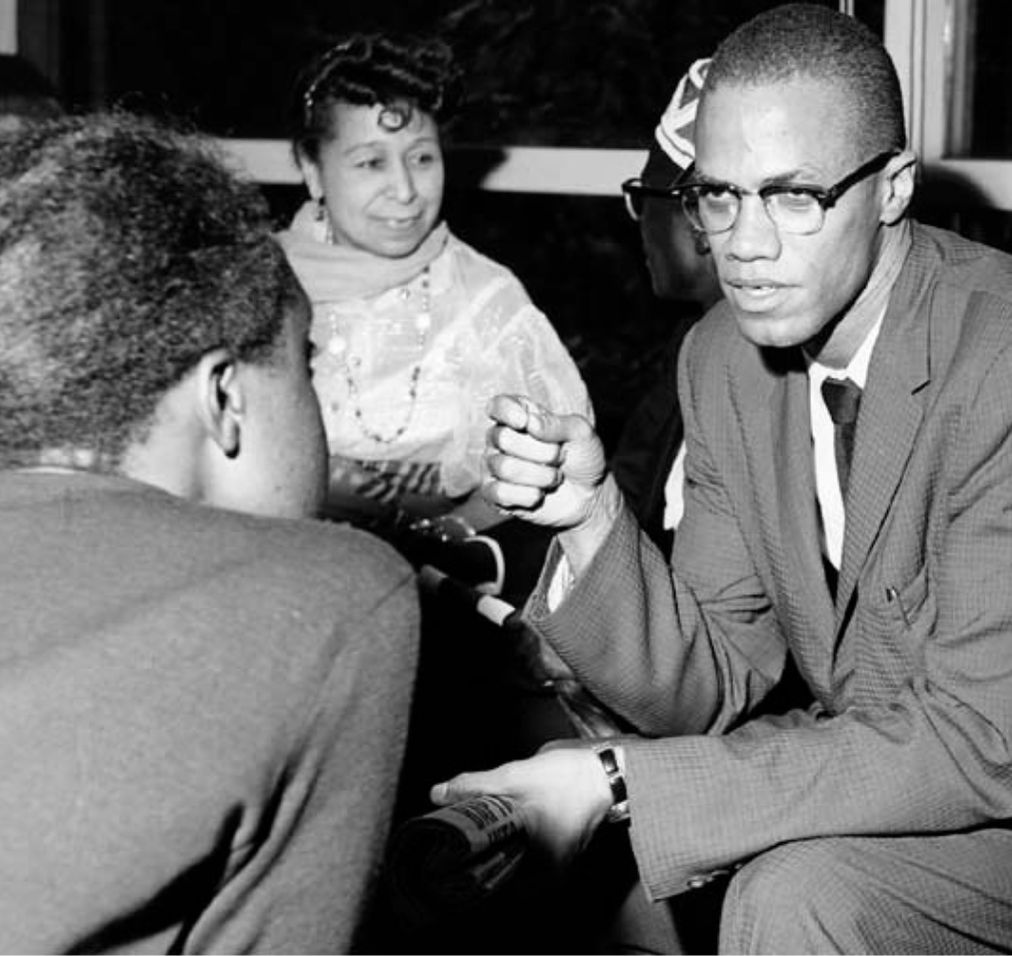
Elkorghli offers thought provoking examination of the utility of Malcolm X’s revolutionary ideas and practice for forging unity among peoples oppressed by unified networks of imperialism and repression.
Malcolm X’s legacy transcends time and borders, offering a piercing lens through which to examine the interconnected machinery of U.S. imperialism—both at home and abroad. He taught us that the oppression of Black Americans in Mississippi cannot be divorced from the exploitation of the Congo, just as the militarization of police in Atlanta mirrors the surveillance technologies deployed against Palestinians, migrants in the Mediterranean, and dissidents in the Global South. This essay traces Malcolm X’s revolutionary growth—from his awakening to systemic racism to his Pan-Africanist and anti-imperialist clarity—revealing how the U.S. empire sustains itself through a unified network of repression while sowing division among the oppressed. By exposing the Zionist-imperialist nexus behind technologies of control, the economic stranglehold on Africa, and the propaganda warfare waged against global solidarity, we confront a vital truth: liberation demands not just geographically-fixed resistance, but an internationalist reimagining of power itself. As Malcolm X insisted, the struggle is one—and only by seeing the system whole can we dismantle it.
Malcolm X’s life demonstrates that revolutionaries are not born—they are shaped by their conditions and develop through deep introspection and rising consciousness. His journey epitomized true political maturation. He was not born a Pan-Africanist, nor was he inherently critical of the oppressive power structures targeting Black people, nor an anti-imperialist from birth. Rather, the revolutionary Malcolm X emerged from the struggles around him, compelling him to reflect on the plight of his people within the imperialist core and across Global Africa. Malcolm X’s ideological trajectory underscores the dialectical relationship between lived oppression and revolutionary consciousness, illustrating how systemic violence engenders resistance. His analysis extended to identifying the forces suppressing liberation, both domestically and globally.
In his speeches, Malcolm X consistently drew connections between oppressive policies worldwide and the forces enabling systematic dehumanization. He emphasized the relationship between domestic and global oppression, striving to awaken an internationalist consciousness among the masses. His goal was for people to recognize that their fight for freedom, equality, and liberation was inseparable from the struggles of others around the world. He famously articulated the purpose of his oratory by declaring:
“To show the relationship between the struggle that is going on on the African continent and the struggle that’s going on among the Afro- Americans here in this country. I … would like to impress… the importance of realizing the direct connection between the struggle of the Afro-American in this country and the struggle of our people all over the world. As long as we think … that we should get Mississippi straightened out before we worry about the Congo, you’ll never get Mississippi straightened out. Not until you start realizing your connection with the Congo.”[1]
Instead of seeing the people’s struggles as discrete, he taught us to think through systematic and methodological analysis so we understand how to combat the barbarity of the system and how to perform solidarity with peoples across the world.
Seeing Connections: The Politics of Identification in Our Time
The post-WWII era revealed a grim pattern in the Global South: wherever mass suffering erupted, the fingerprints of U.S. imperialism were often visible. Noam Chomsky later termed this phenomenon The Washington Connection and Third World Fascism—a system where the "CIA-Pentagon Archipelago" propped up brutal client regimes that enforced repression on Washington’s behalf. These atrocities were routinely portrayed in Western media as isolated tragedies, stripped of their connection to American power. But Malcolm X saw the truth earlier and more clearly. He exposed how imperialism outsourced violence to local puppets, rewarding them with trade deals and political support in exchange for enforcing oppression. His genius lay in connecting the dots: he forced audiences to recognize the machinery of global exploitation, revealing how client states served as instruments of U.S.-backed fascism. Most crucially, Malcolm taught us that resistance must be equally international. Since oppression operates globally, solidarity must too. To dismantle the system, the people must first learn to see it.
Take the following essentialized examples and how they seem to be discrete and separate from one another if they are presented as disconnected events. But we can begin to identify how they are in fact all interconnected:
-
The building of a police training station in the imperialist core to suppress the local population through racialized criminality enhanced by security technologies. In Atlanta, Georgia, there is the Atlanta Public Safety Training Center, which is being built to train American police officers on how to impose systems of militarized control on the Black communities of the city. The GILEE (Georgia International Law Enforcement Exchange) program’s graduates are practicing in Georgia’s Cop City using the Zionist Defense Forces (ZDF) experiences with what they do to the Palestinian population in Palestine and its occupied territories.[2]
-
This training and the technology used is produced by the same body that provides the technologies of surveillance in the Mediterranean Sea to prevent migrants, detain them, and force them to be put in near concentration camp conditions. The North Atlantic Treaty Organization (NATO) and the European Union (EU) employ the border control regime in the Mediterranean through operation Frontex, whose key objective is to heavily police what NATO in 2022 began calling its “southern neighborhood”. As Mullin details, “Through its Horizon Europe program, Frontex aims to develop various technological instruments, including remotely piloted platforms, biometric data-gathering equipment, and three-dimensional face- and iris-scanning tools.” These tools, according to Mullin, were contracted through a multi-million euro contract to the Zionist army and military industry to operate “unmanned drones to monitor and intercept refugees and migrants attempting to cross the Mediterranean… [by carrying out] reconnaissance in the “pre-frontier” area off Tunisia, Libya and Egypt’ … helping to market Israeli drone technology”.[3]
-
The very surveillance technologies outlined above are being used to spy on minorities within an African country. The Moroccan monarchy established formal relations with the Zionist entity, and, following the so-called Abraham Accords, has benefitted from the Zionist entity’s technologies of surveillance. The NSO Group, with its Pegasus spyware, is being used by the Moroccan regime to spy on the people of Western Sahara and imprison political dissidents in Morocco itself who are against the normalization of relations.[4]
-
The technologies were developed and experimented on the Palestinian people as they are treated like a “human laboratory”. And based on such experiments are exports of these technologies of drones, surveillance, facial recognition, automated automatic machine guns and much more to the aforementioned bodies (Cop City, NATO, EU, Frontex, Moroccan government).[5]
-
And this very entity and its technologies are being used to criminalize a whole population such that it is becoming a textbook example of transnational imprisonment system, supplanting the people, incarcerating them, and creating a globalized regime of panoptic terror, like the one exercised by the Nayib Bukele regime in El Salvador. Bukele relies heavily on Zionist weapons and technology. Thanks to that technology, since 2022, he has declared State of Exception (likened to a martial law) which suspended any civil liberties and has cracked down on social and political activists, transforming his country from anti-imperialist nation to a right-wing crypto-fascist aligned with transnational capital.[6]
And ultimately, this cycle of transnational techno-fascism boomerangs to the imperialist core. The “Zionist connection” between the forces of genocide and imperialism is based on an interlinked system of oppression predicated on techno-fascism that sustains late capitalist accumulation while supplanting dissent and popular mobilizing. These examples highlight the connection between a system of oppression that is enabled through an international imperialist system that seeks its own unity and imposes disunity.
The Unity of Imperialism and Imperialism’s Divisiveness
The examples given above offer many lessons, but a key one is worth highlighting and that is how the imperialist system seeks unity under its hegemonic order, while wreaking division in any order that unites against it.
Unity of Imperialism
What we notice is that there is a unipolar imperialist system, dominated by the United States and the hegemony of the US dollar, which is highlighted in Malcolm X’s essay on “The Zionist Logic”. In this essay, Malcolm articulates how division is exacerbated by imperialism-zionism nexus, such that most of the spending of the region where the settler-colonial entity is implanted is plagued with war and militarized accumulation that results in de-development as opposed to human development[7] (as US trade with the Gulf monarchies show — $26 billion with Qatar, $23 billion with United Arab Emirates, and $142 billion with Saudi Arabia — only in arms).[8] Malcolm writes, “Zionist Israel's occupation of Arab Palestine has forced the Arab world to waste billions of precious dollars on armaments, making it impossible for these … nations to concentrate on strengthening the economies of their countries and elevate the living standard of their people”. Because of this war economy, “the Zionist propagandists [utilize it] to make it appear to the Africans that the Arab leaders are not intellectually or technically qualified to lift the living standard of their people ... thus, indirectly "inducing" Africans to turn away from the Arabs and towards the Israelis for teachers and technical assistance”.[9]
For imperialism to sustain its tentacles, it must be very inclusive. It creates economic, military and security agreements to bolster its hegemony. For example, imperialists, not satisfied with solely the NATO alliance, created a sub-NATO where select countries become Non-NATO Major Allies (like Egypt, the Zionist entity and Kenya, where the latter sent its troops thousands of kilometers to Haiti). Through AFRICOM, the US has created a military command for its operations in the African continent and built bases and alliances with reactionary governments that allegedly fight terrorism, with its drone warfare killing a number of civilians with impunity.[10] This imperialist inclusivity then invites non-African entities to begin operating and training in Africa. Like Morocco hosting the “African Lion” military exercises,[11] where Zionist soldiers that committed war crimes against Palestinians in Gaza, with the Golani Brigade, which committed the nefarious crime of massacring 15 ambulance paramedics and burying them in mass graves, also being in attendance.[12] So, imperialism does not discriminate when it comes to including any reactionary and obedient states into its orbit, even if those regimes and entities are in Africa, Latin America, Asia or Europe; even if they are Muslim, Catholic, Eastern Orthodox, Jewish, … etc.
Imperialism’s Divisiveness
As it performs imperialist inclusivity, the empire seeks to cause so much division amongst the forces fighting it. When Patrice Lumumba was elected, the CIA operatives cooperated with the Belgians to assassinate the Congolese leader because he threatened the imperialist system with anti-imperialist unity predicated on Pan-Africanism.[13] Malcolm said on the Zionists, “they dread Gamal Abdul Nasser's call for African-Arab Unity under Socialism.” When Libya pursued African unity by proposing a unified continental monetary system— the African Dinar, the African Development Bank and African Monetary Fund — it got de-Africanized by the racist Atlanticists and NATO by claiming that Libyans were being killed by “African mercenaries” (as if Libyans are not African).[14] Imperial inclusivity couped Kwame Nkrumah because of his staunch position on Pan-African unity. And this list is long.
But to analyze imperialism one must be self-critical. In order for imperialism to operate at home and abroad it necessitates a local national bourgeois and a comprador capital-centric class that enable and perform imperialism’s local functions. In his critiques, Malcolm noted how “Uncle Tom” and the “House” Black man upheld the imperialist system. These pawns, regardless if they are functioning out of their own volition or being paid agents, still perform the necessary functions of imperialism thanks to the imperialist propaganda. And there is no region wrought with such propaganda than where Palestine lays. And the imperialist goal is to make the masses to politically disidentify with Palestine, such that we begin thinking what is happening in Cop City is purely an Atlanta, Georgia issue; what is happening in the Mediterranean is exclusively a maritime issue; what is happening in El Salvador is merely an internal issue, and so forth.
Cognitive Warfare, Empire’s Decline and African Liberation
Campaigns of ambiguating people’s struggles of liberation are being performed in struggles across the African continent. The events in Sudan are framed as civil war or tribalism without a mention of the role of Libya’s CIA man, Khalifa Haftar, and the UAE in funnelling weapons to Sudan’s Rapid Support Forces.[15] The war in Congo is oddly scripted by mainstream media as “Rwanda does a Putin in Congo”[16] without mentioning the systems behind the Rwandan reactionary government — US, UK — who happen to be the same ones that are standing against Russia at the moment; instead of system analysis they use nation-to-nation analysis. And the Alliance of Sahel States, which has angered the imperialists[17] due to its revolutionary path of sovereign national development, is merely framed as pro-Russia military juntas.
Every year, Africans across the world commemorate Africa Liberation Day. But some confine this day’s commemoration through cultural celebrations that ceremonialize diversities of clothes, food and music, neglecting the materiality of production out of question. Across much of Africa, the conditions of material liberation are nowhere to be found because whenever a unity-forging attempt takes place, it is couped, sanctioned and bombed by imperialism. But what is meant by material liberation? The words of Malcolm X 60 years ago still ring true today where he distinctly lays the foundation of not mere independence but an African liberation:
As these African nations get in a position to increase their own power and to industrialize, what does it mean? It means that where they now are a market for American goods and America's finished products, and a market for European finished products, when they’re able to finish their own products, they will be able to get their products cheaper because they' re putting their own raw materials into the finished products. Now the raw materials are taken from Africa, shipped all the way to Europe, used to feed the machines of the Europeans, and make jobs for them, and then turned around and sold back to the Africans as finished products. But when the African nations become industrialized, they can take their own products and stick them in the machines and finish them into whatever they want. Then they can live cheaper. The whole system will be a system with a high standard of living but a cheaper standard of living.[18]
Despite attempts to dismiss the theory of imperialism—reducing it to outdated rhetoric or populist sloganeering—its material reality remains undeniable. Beyond overt violence like bombardments and genocidal campaigns, imperialism thrives through the economic subjugation of the periphery. Malcolm X, alongside later theorists like Ruy Mauro Marini, Immanuel Wallerstein, Samir Amin, and Utsa Patnaik, exposed this structural domination and charted the only viable path to African liberation: the radical transformation of economic relations.
True emancipation demands more than cultural reclamation—it requires the conjuring of productive forces to break from cyclic dependency. Shifting from raw material exportation to domestic industrialization would not only halt the drainage of surplus value; it would redefine liberation itself, moving beyond symbolic gestures of resistance (dance, music, and performative nationalism) toward material sovereignty. Malcolm’s internationalism taught us that imperialism operates as a total system, infiltrating every corner of the globe. To fight it, we must confront not only its militarized and securitized forms but also its economic architecture.
Essam Abdelrasul Bubaker Elkorghliis a Libyan doctoral researcher at the University of Illinois at Urbana-Champaign, researching imperialism, ideology and education with a primary focus on Libya. He serves on the International Advisory Board of Pambazuka News, assistant editor to the Middle East Critique Journal, and member of the Global Pan-African Movement. He writes frequently for the Black Agenda Report.
Endnotes
[1] Malcolm X Speaks, 1989, p. 90.
[2] Black Alliance for Peace. https://blackallianceforpeace.com/bapstatements/abolishgileeprogramstop… the GILEE program
[3] Corinna Mullin, The NATO-Imperialist-Zionist Nexus: Settler Colonialism and the Global War Economy. Pambazuka News. https://www.pambazuka.org/index.php/The-NATO-Imperialist-Zionist-Nexus#…
[5] Antony Loewenstein. The Palestine Laboratory: How Israel Exports the Technology of Occupation Around the World. Verso Books
[6] Alan Macleod, Nayib Bukele’s El Salvador Dictatorship: Made in Israel. MintPress News. https://www.mintpressnews.com/bukele-israel-dictatorship-surveillance/2…
[7] Ali Kadri, Accumulation by Waste (2023). Brill.
[8] https://www.whitehouse.gov/fact-sheets/2025/05/fact-sheet-president-donald-j-trump-secures-historic-1-2-trillion-economic-commitment-in-qatar/ ; https://www.reuters.com/business/aerospace-defense/exclusive-biden-administration-proceeding-with-23-billion-weapon-sales-uae-2021-04-13/ ; https://www.reuters.com/world/us-saudi-arabia-have-discussed-riyadhs-potential-purchase-f-35-jets-2025-05-13
[9] Malcolm X, Zionist Logic (1964). https://www.marxists.org/history/etol/newspape/socialist-viewpoint-us/m…
[12] https://www.theguardian.com/world/2025/apr/12/idf-unit-killing-palestinian-paramedics-golani-brigade ; https://militarywatchmagazine.com/article/israeli-deploys-controversial-medic-massacre-special-forces-unit-to-morocco-for-exercises
[13] Susan Williams, White Malice: The CIA and the Neocolonization of Africa (2022). Hurst Publishers.
[14] Essam Elkorghli, The de-Africanization and re-Europeanization of Libya: The Political Economy of NATO’s Legacy in Libya. Black Agenda Report. https://www.blackagendareport.com/de-africanization-and-re-europeanization-libya-political-economy-natos-legacy-libya
[17] https://www.pambazuka.org/General-Langley’s Accusations
[18] Malcolm X Speaks, 1989, p. 128