



Fight Like Hell! A Century of Pan African Struggle
.jpg)
Address on May 23, 2026, delivered at the African Liberation Day celebration in Syracuse, New York, themed Haiti & Cuba: Defending Pan-African Unity Against Imperialism, and organized by the Global Pan African Movement and the Pan African Community of Central New York.
Give thanks.
I want to travel back almost 100 years to 1935, 91 years ago to be exact.We are going back to get some tools to move forward – SANKOFA.
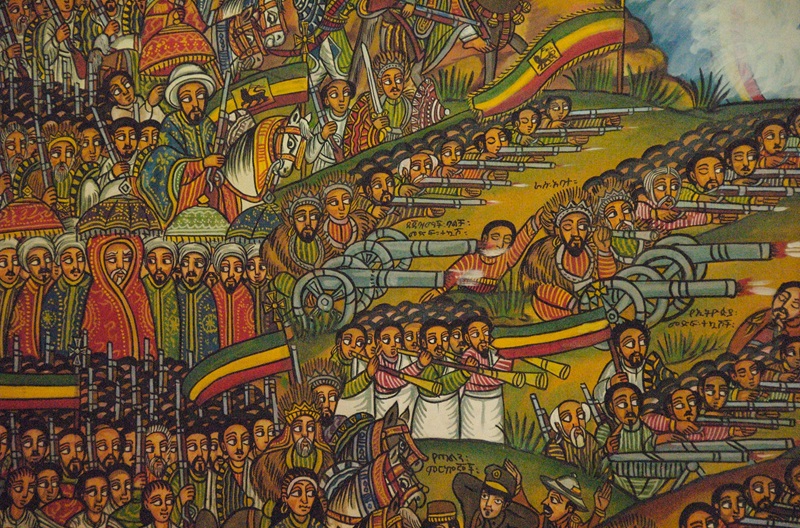
So in 1935, when fascist Italy invaded Abyssinia/Ethiopia, it catalyzed forces that were certainly unintended and, perhaps to Europeans, unimaginable. Global Africans, that is the worldwide population of Africans and their descendants, organized resistance to Italian aggression at the international scale and mass uprisings for freedom and Black sovereignty erupted. Ethiopia, as we know, was of particular significance and pride to Global Africans as it had successfully resisted European colonizing efforts in the late 19th century, and it stood as proof that Black people could govern themselves amidst European domination. From Freetown, Lagos and across West Africa, to Cape Town, the US, and across the Caribbean, Black colonial toilers sprung into action to coordinate mass resistance to Benito Mussolini’s empire-building ambitions.[1] According to Pan-Africanist Marxist revolutionary George Padmore, this period was “one of the most stimulating and constructive in the history of Pan- Africanism.”[2]It enlivened the belief that Global Africans have a shared history, purpose, and destiny, and should unite for their collective economic, political, social, and cultural liberation.
The response was extraordinary. Black newspapers mobilized outrage. Local organizations passed resolutions condemning the invasion, and organized the “Hand off Abyssinia” campaign. Pan-Africanists wrote letters and articles, held mass meetings to educate the public, called for boycotts of Italian companies and products, and fundraised to send aid to Ethiopia. Pan-African organizations expanded. Caribbean radicals deepened connections with African struggles. Even Marcus Garvey – head of the largest international organized mass movement of Black people in the twentieth century – with all his might and his towering figure was not big enough to hold back these flood gates. Garvey himself, while initially campaigning against Italian invasion, expressed sharp criticism of Emperor Haile Selassie, blaming him for the invasion. Many of Garvey’s remaining followers would repudiate him and keep alive the intense support and coordinating efforts of solidarity in defense of Ethiopia. What emerged was not simply sympathy. It was solidarity rooted in a shared understanding of the interconnected -isms: racism, colonialism, imperialism, fascism, and capitalism.
And I want to suggest today that Haiti and Cuba must occupy a similar place in our political imagination today. Because just as Abyssinia represented 1930s Black independence under siege, Haiti and Cuba today represent nations continuously punished for refusing full submission to imperial power. And the question before us is whether we still possess the political imagination—and the courage—to respond with the same Pan-African internationalist spirit.
Haiti as the first Black republic where enslaved Africans defeated the French empire and Cuba after the revolution which overthrew a dictatorship deeply tied to U.S. political and economic interests, are “problems” for imperial powers. Haitians and Cubans not only challenged profit-making and the global economic order, they shattered the ideological foundations of slavery and white supremacy. They proved through their revolutions that they are political actors capable of revolution, statecraft, and military victory, and that people racialized as inferior can govern themselves and use their own resources to pursue development visions that lie outside direct imperial control [and imagination]. And the imperial powers never forgave them for that. Haiti is being isolated diplomatically, crushed economically through the French indemnity debt, and repeatedly occupied and manipulated by foreign powers. Cuba is facing blockade, sanctions, attempted invasions, and decades of economic warfare. And these repeated invasions and attempted invasions are disguised in lies. In Haiti, intervention is framed as humanitarian rescue, stabilization, or democracy promotion. In Cuba, economic warfare is framed as promoting freedom and human rights. But in both cases, outside powers are trying to reserve for themselves the authority to decide what legitimate sovereignty looks like in the Caribbean.
Lessons from the Pan-African response to the Italian invasion of Ethiopia for the imperial aggressions toward Haiti and Cuba
The Italian invasion of Ethiopia not only aroused a global Pan-African fervor of which I spoke about before, but Trinbagonian, and Caribbean labor more broadly, also articulated class with race through the Italian aggression. In other words, working people linked up calls for racial solidarity with class-based grievances. According to one activist with one local organization during that time, the “Abyssinian War awakened the consciousness of the Trinidad working class” (from the speaker’s archival material). “Trinidad Negro Workers Arise!” was a rallying cry. One of the most prominent labor organizers of the 1930s Tubal Uriah “Buzz” Butler - “My dear Fellow-Workers & Citizens: Greetings! This is an invitation…Already hundreds of loyal liberty-loving Britons in whose veins flow generations of incomparably Ancient Ethiopian Warrior blood have accepted the Fascist-Imperialist-Capitalist challenge to war and have sworn to fight under black leadership …for “Black Shirt” and Capitalist-Imperialist defeat and extermination” (Join the Home Rule Party Pamphlet, 1937, CO 295/608/5).
Pan-Africanism among the ordinary toiler is offended by US aggression today. Today’s trade unions in Trinidad and Tobago are quiet. Where is the outcry? Where is the solidarity? Unfortunately, the Trinidad and Tobago trade union movement is so wrapped up in the arms of a government that is fiercely US-aligned. They either have abandoned solidarity with Haiti and Cuba or have no capacity in their partnership with the ruling party to hold an autonomous position. We must return to the fiery Pan-African working-class consciousness that is independent of co-opted trade unionists.
Not only did imperial aggression in the 1930s heighten Pan-African and working-class consciousness, but also became a soldier for a multiracial worker movement. Throughout the mid-1930s, both African and Indian labor leaders mobilized workers around the defense of Ethiopia. In writings and in public meetings, they emphasized shared experiences of imperial domination and racial subjugation, and deep long histories of interracial collaboration. The revolutionary Pan-African energy generated from the invasion of Ethiopia helped propel one of the most vibrant insurrectionary multiracial mass movements in the history of Trinidad and Tobago.
In one such meeting called “A new movement for Afro-Indian unity,” prominent labor African and Indian labor leaders, both Hindus and Muslims alike, speaking in English and Urdu, addressed crowds about the need to be united for Ethiopian freedom. Adrian Cola Rienzi, and Indian organizer, when interviewed by The People at the event is quoted saying that,
“…[he] hoped that the campaign waged in Trinidad against Italian aggression would unite Afro-West Indians and East Indians. The issues of their unity would result in the independence of Africa and India…When they met to protest against Italian imperialism they protested against all kinds of imperialistic exploitation and pressure.” (from the speaker’s archival material)
To Rienzi, connecting Ethiopia to local conditions was crucial to building interracial solidarity.
Trade unionists of the 1930s also recognized the interconnected parts of the whole of the white capitalist system – the imperial governments who help each other and the colonial governments who carry out the local oppression – and the need to attack all fronts. Butler, for instance, in a public speech bellowed:
“The present British Government is not a working Government. England today is spat upon for her criminal actions and dirty slackness in assisting Mussolini in conquering Abyssinia. The British Government is the worst Government in the Empire…we are going to fight and fight like hell against the white men… who are oppressors of this colony. We demand tonight that we are going to stand up and fight like hell against Colonel Hickling and most of these white English men. We are prepared to shed blood.” (from the speaker’s archival material)
Today, this would mean we need to recognize the ways imperial powers collaborate and work through neocolonial rulers to wage war on Haitian and Cuban people. Caribbean governments, which are neocolonial and neoliberal, are helping advance imperial interests in the region. Jemima Pierre has written extensively about how CARICOM has betrayed Haiti by supporting the most recent incursion by France-US-Canada[3]. And Trinidad and Tobago’s Prime Minister Kamla Persad-Bissessar has declared that her government does not support Cuba's “dictatorial” “regime”[4] ; her support for the US military aggression in the region has led to the US invasion of Venezuela and kidnapping of Nicolas Maduro and Cilia Flores. Butler would say we have to fight against not just one of these elements, but all of them – the local and global - and fight like hell, if we are to restore all of our dignity.
Finally, 1930s Pan-Africanists emphasized histories of inter-racial collaboration and solidarity to build the movement to support Ethiopia and, by extension, their own liberation. For example, at the same Afro-Indian Unity for Ethiopia meeting, labor leaders all spoke of the connections between Afro-Trinbagonians, Ethiopians, and Indo-Trinbagonians.
“One and all must help Ethiopia…our Moslem friends… the great historic association between Ethiopians and the land of Mohammed’s right hand man, Bilal… remember the butchery of the Mohammedan members of my race (Berbers, Hausas, and Arab Negroids) in Tripoli when the Italians conquered it from the Turks; to recall Kafur, one of the greatest Black Mohammedan rulers of Egypt …We, Trinidad Africans and our fellow Indians, must play our part.” (from the speaker’s archival material)
The parallel for today is recognizing, voicing, and reminding our-collective-selves of the ways in which Cuba and Haiti have not only provided inspiration for oppressed people worldwide, but they have materially supported anti-colonial struggles all around the world – in the Americas and in Africa. Haiti supported rebellions across Latin America, intercepted ships that were trafficking people for enslavement and freed them. Cuba sends doctors and teachers in support of liberation movements. Cuba has also received students from all over the world seeking an education. Both Cuba and Haiti supplied freedom fighters with arms, soldiers, and safe harbor for revolutionaries – remember Simon Bolívar sought political asylum in Haiti, Assata Shakur in Cuba.
Pan-African unity is a material political project here again…
It means defending Haitian and Cuban sovereignty against endless foreign intervention. It means opposing sanctions and blockades designed to suffocate and genocide entire populations. It means building stronger political and economic relationships across the Caribbean, Africa, and the broader Global South. It means labor movements reclaiming an internationalist politics instead of narrowing themselves to purely national and wage concerns. And perhaps most importantly, it means rejecting the idea that empire is inevitable [likkle but we tallawah – small countries that successfully beat some of the mightiest, most militarily strong imperial powers].
In 1935, Black people across the world understood that the invasion of Abyssinia was a warning. They understood that fascism abroad and racial domination at home were interconnected.
But they also understood something else: that solidarity was not optional. It was necessary for survival. And that lesson remains urgent today. The Pan-African spirit that emerged in defense of Abyssinia must live again—not as nostalgia, but as political practice.
Give thanks.
Zophia Edwards is an Assistant Professor of Sociology at Johns Hopkins University. She is the author of Fueling Development: How Black Radical Trade Unionism Transformed Trinidad and Tobago (Duke University Press). Her work has also been published in Political Power and Social Theory, Sociological Review, and others. She is also a member of the Global Pan-African Movement North America.
Endnotes
[1] James, C. L. R., and Robin D. G. Kelley. 2013. A History of Pan-African Revolt. PM Press.
[2] George Padmore. 1956. Pan-Africanism or Communism, p. 151. New York: Roy Publishers.
[3] Pierre, Jemima. 2024. Why is CARICOM Betraying Haiti on Behalf of the U.S.?. Black Agenda Report. https://www.blackagendareport.com/why-caricom-betraying-haiti-behalf-us
[4] CiberCuba Editorial Team. 2026. Prime Minister of Trinidad and Tobago denounces the lack of free elections in Cuba: "We will not support a dictatorship”. Ciber Cuba. https://en.cibercuba.com/noticias/2026-02-27-u1-e208574-s27061-nid321833-primera-ministra-trinidad-tobago-denuncia-falta