



Somalia’s New Speaker Was Built by Turkey. His First Call Proved It.
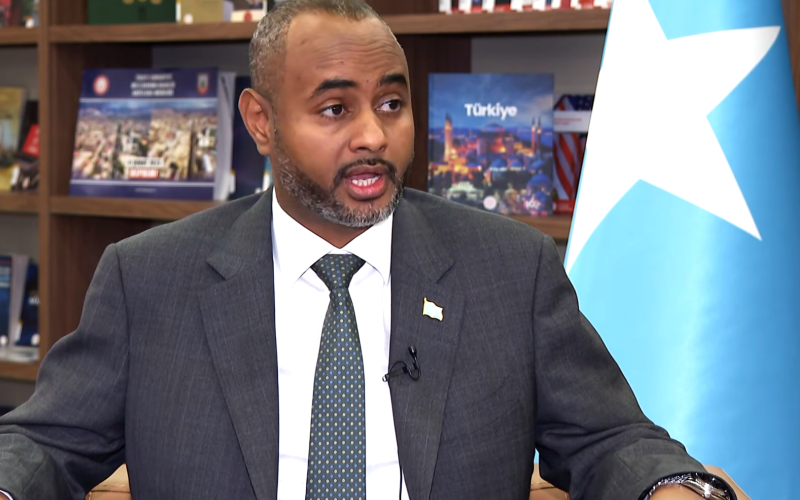
The United States had helped force out Somalia’s most Turkey-aligned minister. He recently came back as Speaker of parliament. The day after his confirmation, he called Ankara - not Washington or the African Union.
On August 11, 2026, the day after Somalia confirmed its new Speaker of parliament, Abdulkadir Mohamed Nur Jaamac made two phone calls. The first was to the Speaker of Turkey’s Grand National Assembly, to discuss advancing parliamentary cooperation between Somalia and Turkey. The second was to the President of the Arab Parliament. He did not call Washington. His first act as Speaker was to signal where his loyalties lie.
This is not surprising to anyone who has followed Jaamac’s career. What is surprising, and what African policymakers and observers need to understand, is how he got to the Speaker’s chair in the first place, and what it reveals about the limits of external pressure on African political systems.
Jaamac served as Somalia’s Defense Minister from December 2021 to March 2025. During that period he personally signed the February 2024 Defense and Economic Cooperation Framework Agreement with Turkey — an arrangement giving Turkey responsibility for protecting Somalia’s entire maritime territory, a 30 percent share of marine revenue from Somalia’s Exclusive Economic Zone, and a joint venture through Turkey’s Armed Forces pension fund, OYAK, to manage Somali waters through a company called SOMTURK. His career was built in Turkey: eight years in Ankara on a Turkish government scholarship, seven years as Somalia’s diplomat in Ankara, and the most significant military agreement in Somalia’s history signed personally with Turkish Defense Minister Yaşar Güler. He publicly describes Turkey as his second home. This agreement was not merely a bilateral security arrangement — it embedded a foreign military institution’s commercial interests in Somalia’s maritime economy, giving Turkey structural leverage that would outlast any individual minister or government.
In March 2025, the United States forced him out. Washington had pressured President Hassan Sheikh Mohamud repeatedly[1] — threatening to cut funding for Somalia’s U.S.-trained and U.S.-funded elite counterterrorism unit, the Danab force, which conducts direct action missions against al-Shabaab and whose soldiers’ salaries Washington substantially covers. The specific concerns: the February 2024 agreement, which U.S. military officers asked to see and were refused; Turkey’s plans to build a spaceport in Somalia; Ankara’s oil and gas exploration in Somali territory; and the deployment of Turkish-made Bayraktar Akinci armed drones to Mogadishu. Hassan Sheikh complied. Jaamac was reassigned to the Ministry of Ports.
What happened next is the lesson. Hassan Sheikh transferred Jaamac — he did not dismiss him. The February 2024 agreement remained in force. The Turkish military base remained operational. Ten days after his official reassignment, Jaamac was in Hassan Sheikh’s presidential delegation on a state visit to Turkey. On June 26, 2025, still serving as Ports Minister, he met personally with President Erdogan in Ankara. On April 10, 2026, a Turkish drilling vessel docked at Mogadishu port — the port under his ministry’s oversight — to begin oil exploration in Somali waters. Washington had moved the minister. The architecture he built was untouched.
Meanwhile, Jaamac had unfinished business. During Somalia’s 2021 to 2022 parliamentary elections, the president of Southwest State — one of Somalia’s six federal member states — had blocked him from a parliamentary seat. After his removal from Defense, Jaamac became the loudest public voice demanding the regional president’s removal. Somali media, including Five Somali TV, documented public threats by Jaamac that Baidoa “will be taken, and it is being attacked every morning.” On March 30, 2026, federal troops reinforced by Turkish-trained units entered Baidoa. The regional president fled. Within ten days, a parliamentary seat had been reassigned to Jaamac without competition, by-election, or any democratic procedure. Five months later he was Speaker.
On August 10, 2026, Jaamac won the Speakership with 142 votes against his opponent’s 30, in a contest that lawmakers from Puntland and Jubaland, two of Somalia’s semi-autonomous federal member states, boycotted as constitutionally illegitimate. The Somali Future Council, an opposition grouping, rejected the election on the grounds that parliament’s mandate had expired on April 14, 2026. The next day, Jaamac called Ankara.
He now chairs the institution that must ratify every defense agreement Somalia enters into with any foreign power, including the February 2024 Turkey deal that U.S. officers were refused access to. He oversees parliamentary review of the OYAK joint venture that gives Turkey’s military pension fund exclusive rights to Somalia’s maritime economic zone. He controls which future Turkish agreements on naval basing, oil drilling, and the proposed spaceport reach the floor.
The lesson for African governance is direct. External pressure alone does not change the underlying political relationships that shape a country’s direction, particularly when those relationships are reinforced by a competing external power. Washington pressed Hassan Sheikh to remove Jaamac. Turkey pressed Hassan Sheikh to protect him. The politician at the centre understood both pressures and used them. He moved from ministry to ministry, building institutional power at each step, until he reached a position that neither Washington’s leverage nor Turkey’s patronage needed to deliver. He delivered it himself. The relationship between Hassan Sheikh and Jaamac — personal, political, and built on a shared investment in the Turkish partnership — proved more durable than any single application of external pressure.
Somalia’s international partners — the African Union, the United Nations, the United States, the European Union — all treat the formal institutions of Somalia’s government as the legitimate expression of Somali democratic will. The new Speaker of Somalia’s parliament acquired his parliamentary seat through a military operation. He was confirmed in a vote two federal member states boycotted. And his first call was to Ankara.
That is the institution they are being asked to endorse. And the Speaker has already told the world where his priorities lie.
Ismail Abukar is a Somali investigative journalist and Co-founder and Chairperson of the Organization for Prisoners’ Rights (OPR), a civil society organization based in Mogadishu, Somalia, whose research has been cited by Amnesty International, Human Rights Watch, and the United States State Department. He has conducted primary field research in Somalia for seven years. He is currently based in Honolulu, Hawaii. His investigations have been published internationally. [email protected] | opr.org.so | ORCID: 0009-0003-1435-3691
Endnotes
[1] Ragip Soylu, "Somalia Sacks Defence Minister amid US Pressure over His Turkey Ties," Middle East Eye, March 18, 2025, https://www.middleeasteye.net/news/somalia-sacks-defence-minister-amid-us-pressure-over-his-turkey-ties.https://www.middleeasteye.net/news/somalia-sacks-defence-minister-amid-us-pressure-over-his-turkey-ties