



Patriarchy, Care and the Limits of ‘Empowerment’ in African Artisanal Mining
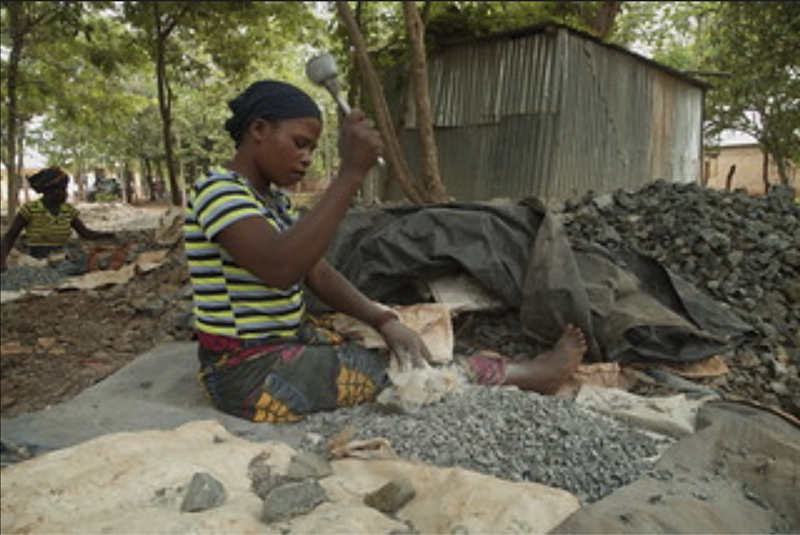
Women artisanal miners in Tanzania and across Africa reveal gender as a structural location, not merely an identity. Elite “empowerment” and boardroom gains leave grassroots women crushing ore and absorbing care costs. Materialist womanist analysis demands structural accountability beyond representation, formal equality or scandal. Women’s subordinated position in artisanal and small-scale mining (ASM) is no reason to normalise the sector: ASM injures workers, contaminates communities and dumps health costs onto the households that depend on it.
Five years after the COVID-19 pandemic of 2020 – 2022, whose recovery slogans from governments, donors and institutions promised to “reset” or “build back better”,[1] daily survival for many Global African women has grown crueller, not kinder. In Tanzania’s gold fields in Mwakitolyo (Shinyanga), tanzanite workings in Mirerani (Manyara) and gemstone areas in Kalalani (Tanga), women crush ore, wash mercury-laden slurry, sort stones, carry loads and sell food while unpaid care intensifies. Inflation erodes meagre earnings; the women who hold households together remain at the bottom of the extractive hierarchy.[2]
That promised reset was never designed around grassroots women in artisanal and small-scale mining (ASMers). Before 2020, they already occupied the least-profitable, highest-risk processing roles. During the first pandemic year, Tanzania avoided a nationwide lockdown and many sites kept working, but buyers vanished and field prices collapsed. In May 2020 the average price for a gram of gold in northern Tanzania was about 22 percent below pre-outbreak levels; diamond and tanzanite prices were reported down 60-70 per cent.[3] Across the continent women were often first to lose mine-site work because washing, sorting, carrying and vending were treated as peripheral.[4] School closures intensified unpaid care; women were more likely than men to report skipped meals.[5] After trade resumed, inflation and the same gendered division of labour left them further behind. COVID-19 did not invent precarity; it showed how little protection stood between ASM households and hunger.
The hierarchy sits inside a sector dangerous for workers and residents generally. Pit collapses, carbon monoxide in Tanzanite workings, silica dust, open-air mercury burning and contaminated water are documented features of Tanzanian and continental ASM.[6] Framing women’s struggle as a fairer share of an unchanged pit misses the point. Liberation cannot mean equal access to toxic processing or collapsing shafts.
Gender as a Structural Location
Women constitute a significant share of Tanzania’s ASM workforce, about 27 per cent overall and 30-40 per cent in sites such as Mirerani, yet they are relegated to the least profitable, highest-risk roles.[7] This is not “men versus women” as two uniform blocs, and not only a story of elite men. Most men in ASM are also exploited workers. They make up the remaining roughly 60-73 per cent of the site workforce and concentrate in digging, blasting and hoisting. A thinner male layer owns pits, licences, sponsorship, equipment and buying. Women are rarely either diggers or owners. They are channelled into crushing, panning, mercury washing, sorting, carrying and vending because underground work is coded male, because capital and licences are harder for women to obtain, and because owners prefer men for excavation.[8]
The income ladder follows that hierarchy. Owners, sponsors and traders sit at the top. Male diggers earn more than processors because they take a share of the pit. Women processors and vendors earn the least, in some surveys around two-thirds less than an average miner, and less than men doing similar processing.[9] In Mirerani, nearly all surveyed women miners earned less than 200,000 Tanzanian shillings (about 66 euros) a month. Access to equipment, capital, training and licences remains severely restricted; women’s licence ownership is rare and often comes through inheritance.[10]After the 2018 wall and permit regime around official tanzanite workings, women clustered in sorting, carrying and vending and tended to earn less than half of what men in the area made.[11] Grassroots men and women share precarity and harm; they do not share control of the stone or the cash.
A decade of empowerment programming has produced association seats, formalised licences and donor-project participation, largely for a connected minority. Across Tanzania, Ghana and the Democratic Republic of the Congo (DRC), elite capture means leadership is often held by those with networks and literacy, while women who crush and wash face the same barriers, and sometimes new ones created by formalisation that favours capital or patronage.[12] Data that count attendance rather than control of resources mask the gap.
Mining Masculinities
Mining masculinity treats the pit as a man’s place: strength, endurance, risk-taking, command of ore and the right to decide who may approach the gold.[13] It organises who digs, who owns, who is named a miner and whose body is framed as polluting. Economic pressure has often reasserted rather than eroded these norms. In Mwakitolyo, Sukuma myths frame menstruating or pregnant women as “bad luck” who can “chase away the gold.” Stereotypes of physical weakness and the expectation that “good women” remain primary caregivers exclude women from higher-value work.[14] Dependence on male pit owners or brokers exposes those who persist to stigma and, in many sites, sexual exploitation.[15]
Toxic masculinity, here, does not mean that manhood is poison or that every male miner is an abuser. It means the strand of mining masculinity that turns male authority into a licence to exclude and intimidate. When programming elevates a connected few without redistributing control of extraction, a thin layer of female representation can sit above an unchanged hierarchy and even stabilise it.
The Political Economy of Care
When states and markets fail to provide social protection or safe conditions, women absorb the costs. They combine low-paid processing with unpaid childcare, provisioning and care for the sick and injured. Mercury processing often continues at home.[16] Musculoskeletal pain, respiratory illness, injuries and stress are commonly reported; widowhood from mining accidents leaves many women as sole providers. During COVID-19 that subsidy grew as schools closed and mineral cash shrank; afterwards it did not recede, because care was still treated as a private duty and processing as a woman’s sideline.
Those deaths are not only a “women’s issue.” They follow informal excavation, poor ventilation and a weak occupational health regime.[17] Silica exposure raises risks of silicosis and tuberculosis; a respiratory pandemic landed on already damaged lungs.[18] Care is the unpaid subsidy of the pit. Celebrations of motherhood sit beside the abandonment of clean water, mercury-free processing, childcare, living incomes and health protections that make mothering possible.
African Feminisms and Extractive Economies
Eurocentric gender frameworks often miss African relations of production and reproduction. Women have long mined; the problem is hierarchical incorporation, not absence. The larger problem is the extractive economy itself. Gold and gemstones are among the world’s expensive commodities, yet much African supply is still won under collapsing shafts and open-air mercury amalgamation so that metal can leave the site cheaply.[19] Women are already “included,” as the lowest-paid processors of a luxury good produced through bodily and ecological damage.
Pan-African and womanist traditions,[20] emphasising material conditions, collective survival and interdependence, are firmer starting points than individual empowerment or paper equality. They ask who captures the value of gold, who burns the amalgam and who pays with lungs and unpaid care. Even well-intentioned projects often reproduce class splits among women: educated or urban leaders speak for associations while processors remain outside control of resources.[21]
Similar patterns appear across the continent. In Ghana’s Talensi gold fields, informal women cooperatives organise as collective resistance. Shanking cooperatives gather women who sieve crushed ore; sambalga cooperatives gather women who dig along riverbanks, streams or uplands.[22] They pursue welfare, recognition and security, yet internal divisions and conflict with male diggers limit their reach. In the DRC, women grind, wash, crush and carry cobalt and gold ore but remain shut out of leadership, fair pricing and safety. Formalisation through approved cooperatives has often reinforced male gatekeeping rather than redistributing power.[23] Parallel dynamics appear in Mozambique, Zambia and other ASM zones.
Recent occupational health work makes the same point. In Mirerani, women report dust, musculoskeletal pain and almost no issued personal protective equipment (PPE); they buy cheap masks outside the gate when they can.[24] Underground tanzanite workings show respirable crystalline silica far above occupational limits; about three in ten sampled miners had evidence of silicosis.[25] In Mwakitolyo, processing is combined with caregiving on sites unfriendly to women with children.[26] In Kalalani, gemstone processors face the same pattern of heavy, poorly paid work without childcare or issued protective gear.[[27]] Safety that lives in association minutes does not reach those yards.
Structural Accountability
Scandal and media gender talk are a poor substitute for accountability. Liberation is not more women on boards, a few extra licences or formal equality on paper. It requires dismantling the location that assigns women the hardest labour and most unpaid care, confronting elite capture in women’s organising, and refusing a script in which empowerment means recruiting women into a sector left toxic and accident-prone.
Formalisation must be redesigned for those without capital, literacy or patronage. Data must measure agency, income control and access to pits, not attendance. Grassroots women need genuine representation in associations, cooperatives and policy forums. PPE, silica controls and mercury-free technologies must reach processing sites and homes, and must protect the whole workforce and neighbouring residents.
That duty is not the extra unpaid job of women already crushing ore. Ministries of minerals, labour and health, the Mining Commission and occupational safety authorities design licences, inspect sites and enforce dust and mercury rules; if enforcement stops at the association office, the state has failed.[28] Donors must stop treating elite attendance as success.[29] Buyers and refiners who profit from cheap ASM gold, tanzanite and cobalt have a due-diligence duty to finance safer processing.[30] Associations must open leadership to women who sieve and wash. Women’s organising is necessary; it does not replace public enforcement or the firms that capture the finished commodity.
Continental experience shows both the necessity and the difficulty of the shift. Ghana’s informal cooperatives organise for security yet bump into male control of discoveries.[31] In the DRC, women dominate hazardous processing but remain excluded as formalisation expands.[32] In Tanzania, government efforts to issue licences to women and youth groups are real openings: Primary Mining Licences and trading licences under Mining for a Better Tomorrow programmes, reserved blocks for women, youth and persons with disabilities, and group licensing in places such as Lemshuku, Simanjiro.[33]Licence paper without equipment, water, childcare or enforceable safety can still leave grassroots women washing ore for others. Without design against elite capture, and without care infrastructure, safe technology and enforcement against gender-based violence, those gains risk remaining representational.[34]
A non-normalising agenda pairs redistribution inside ASM with investment that reduces forced dependence on the most dangerous tasks, such as, mercury-free processing, childcare and water in mining settlements, accident prevention, and livelihoods so that “choice” is not a euphemism for hunger. From Tanzania’s pits and across Global Africa, the demand is materialist accountability that reaches past the boardroom, and refuses to manage gender as discourse while shafts collapse, mercury burns and conditions stay unchanged.
Evans Rubara is a Tanzania-based natural resource management specialist, and sociopolitical analyst. He is available at [email protected] or on X as @PunditParadox.
Endnotes
[1] United Nations. (2020). UN research roadmap for the COVID-19 recovery. https://www.un.org/en/coronavirus/communication-resources;
World Bank. (2020, October 7). COVID-19 to add as many as 150 million extreme poor by 2021 [Press release]. https://www.worldbank.org/en/news/press-release/2020/10/07/covid-19-to-add-as-many-as-150-million-extreme-poor-by-2021
[2] CSPF. (2025). Voices from Tanzania: Well-being and economic mobility of women in the Mirerani tanzanite mining area, Manyara. IPIS. https://ipisresearch.be/publication/voices-from-tanzania-well-being-and-economic-mobility-of-women-in-the-mirerani-tanzanite-mining-area-manyara/
TAI. (2025). Voices from Tanzania: Exploring cultural norms limiting women’s participation in artisanal and small-scale gold mining activities in Mwakitolyo, Shinyanga region. IPIS. https://ipisresearch.be/wp-content/uploads/2025/09/20250916_Voices-from-Tanzania-TAI.pdf
[3] Thierens, M., & Mawala, E. (2020). The impact of Covid-19 on artisanal mining communities in northern Tanzania. IPIS. https://ipisresearch.be/publication/impact-covid-19-artisanal-mining-communities-northern-tanzania/
[4] Delve. (2020). Impacts of COVID-19 on women in ASM. https://www.delvedatabase.org/news/impacts-of-covid-19-on-women-in-asm
IGF. (2022). The gendered impacts of the COVID-19 pandemic on women in the artisanal and small-scale mining sector. IISD. https://www.iisd.org/publications/report/gendered-impacts-covid-19-women-asm
[5] Delve, 2020.
Hilson, G. et al. (2021). Artisanal and small-scale mining, and COVID-19 in sub-Saharan Africa: A preliminary analysis. World Development, 139, 105315. https://doi.org/10.1016/j.worlddev.2020.105315
[6] IPIS. (2019). Mapping artisanal and small-scale mining in northwest Tanzania. https://ipisresearch.be/publication/mapping-artisanal-small-scale-mining-northwest-tanzania/
Human Rights Watch. (2013). Toxic toil: Child labor and mercury exposure in Tanzania’s small-scale gold mines. https://www.hrw.org/report/2013/08/28/toxic-toil/child-labor-and-mercury-exposure-tanzanias-small-scale-gold-mines
Collegium Ramazzini/Landrigan, P., et al. (2022). Reducing disease and death from artisanal and small-scale mining (ASM). Environmental Health, 21, 78. https://doi.org/10.1186/s12940-022-00877-5
Gottesfeld, P. et al. (2015). Silica exposures in artisanal small-scale gold mining in Tanzania and implications for tuberculosis prevention. Journal of Occupational and Environmental Hygiene, 12(9), 647-653. https://doi.org/10.1080/15459624.2015.1029617
[7] World Bank. (2023). 2023 state of the artisanal and small-scale mining sector. https://documents.worldbank.org/en/publication/documents-reports/documentdetail/099092225121558277
HakiMadini, & IPIS. (2025). Voices from Tanzania: Her place in the mine – Women’s struggles and aspirations in the gemstone sector of Kalalani, Tanga. https://ipisresearch.be/publication/voices-from-tanzania-her-place-in-the-mine-womens-struggles-and-aspirations-in-the-gemstone-sector-of-kalalani-tanga/
[8] IPIS, 2019; CSP, 2025
[9] IPIS, 2019
[10] IPIS. (2024). Unearthing equality: Women’s empowerment in Tanzania’s extractive sector (Darubini briefing). https://ipisresearch.be/wp-content/uploads/2024/04/20240411_Darubini-briefing_Unearthing-Equality_-Womens-Empowerment-in-Tanzanias-Extractive-Sector.pdf
[11] CSPF, 2025
[12] AfriMali Insight. (2026, June 17). Beyond boardroom gains: Women in artisanal mining. https://afrimaliinsight.org/beyond-boardroom-gains-women-in-artisanal-mining/
[13] Cuvelier, J. (2014). Work and masculinity in Katanga’s artisanal mines. Africa Spectrum, 49(2), 3-26. https://doi.org/10.1177/000203971404900201;
Danielsen, K., & Hinton, J. (2020). A social relations of gender analysis of artisanal and small-scale mining in Africa’s Great Lakes Region. Canadian Journal of African Studies, 54(1), 17-36.
[14] TAI, 2025
[15] Makoye, K. (2025, April 29). Tanzania’s women miners digging for equality in a male-dominated industry. Inter Press Service/Global Issues. https://www.globalissues.org/news/2025/04/29/39723
[16] Human Rights Watch, 2013
[17] IPIS, 2019
[18] Gottesfeld et al., 2015; Collegium Ramazzini, 2022
[19] Human Rights Watch, 2013; Collegium Ramazzini, 2022
[20] Tamale, S. (2020). Decolonization and Afro-Feminism. Ottawa: Daraja Press.
Oyewumi, O. (1997). The Invention of Women: Making an African Sense of Western Gender Discourses. Minneapolis: University of Minnesota Press.
Sankara, T. (1990). Women's Liberation and the African Freedom Struggle. New York: Pathfinder Press.
Amadiume, I. (1987). Male daughters, female husbands. Zed Books.
[21] AfriMali Insight, 2026
[22] Arthur-Holmes, F., & Mengba, J. D. (2024). Conceptualizing collective action and informal women cooperatives in Africa’s artisanal and small-scale mining sector: The case of Northern Ghana. The Extractive Industries and Society, 20, 101558. https://doi.org/10.1016/j.exis.2024.101558
[23] Bashwira, M.-R. et al. (2014). Not only a man’s world: Women’s involvement in artisanal mining in eastern DRC. Resources Policy, 40, 109-116. https://doi.org/10.1016/j.resourpol.2013.11.002
Geenen, S. (2012). A dangerous bet: The challenges of formalizing artisanal mining in the Democratic Republic of Congo. Resources Policy, 37(3), 322-330. https://doi.org/10.1016/j.resourpol.2012.02.004;
IPIS. (2023). Gender equality in artisanal and small-scale mining (DRC field evidence). Related briefing: https://tenuresecurity.org/wp-content/uploads/2023/12/IPIS-Gender-equality-in-ASM-508.pdf;
UNCTAD. (2025). The implications of critical energy transition minerals for women’s participation in the mining sector. https://unctad.org/system/files/official-document/ditc2025d1_en.pdf
[24] CSPF, 2025
[25] Mbuya, A. W. et al. (2024). Prevalence and determinants of evidence of silicosis and impaired lung function among small-scale tanzanite miners and the peri-mining community in northern Tanzania. PLOS Global Public Health, 4(9), e0002770. https://doi.org/10.1371/journal.pgph.0002770;
Nota, M. M., et al. (2024). Feasibility of respirable crystalline silica exposure reduction in small-scale tanzanite mining in Tanzania. Annals of Work Exposures and Health. https://doi.org/10.1093/annweh/wxae060;
Mumba, E. J. (2025). Dust exposure and its health implications to miners in Mererani artisanal and small-scale mining industry. International Journal of Environmental Analytical Chemistry. https://doi.org/10.1080/03067319.2024.2448546
[26] TAI, 2025
[27] HakiMadini & IPIS, 2025
[28] Mbuya et al., 2024
[29] World Bank, 2023
[30] UNEP. (2013). Minamata Convention on Mercury. https://minamataconvention.org/en/resources/minamata-convention-mercury-text-and-annexes;
Collegium Ramazzini/Landrigan, P., et al. (2022)
[31] Arthur-Holmes & Mengba, 2024
[32] Bashwira et al., 2014; UNCTAD, 2025
[33] URT. (2026, March 16). Mining Commission announces projects, mining areas and investment financing for the 2026/2027 financial year. https://www.tumemadini.go.tz/;
The Citizen. (2025, November 30). Tanzania puts youth at the centre of gemstone mining with new licences and buying centre in Lemshuku. https://www.thecitizen.co.tz/tanzania/business/tanzania-puts-youth-at-the-centre-of-gemstone-mining-with-new-licences-and-buying-centre-in-lemshuku-5282416;
The Citizen. (2026, August 31). Tanzania Minerals Minister directs mining blocks reserved for youth, women. https://www.thecitizen.co.tz/tanzania/news/national/tanzania-minerals-minister-directs-mining-blocks-reserved-for-youth-women-5577554
[34] IPIS, 2024; AfriMali Insight, 2026