



Coerced Movements of Global Africans: From the World Cup to The Book of Shame
Contrasting observations of the ongoing world cup with the Book of Shame, the article tells two different stories made possible through a similar process of coerced movement. The contradiction of European states that benefit from Global African migration yet seek to criminalize those very bodies en masse is even more disturbing when we consider how despite facing exploitation, the experiences of athletes represent a minority of those that migrate.
As we watch one of the most securitized world cups of our time, and we see people of African descent playing for national teams whose state officials are openly denouncing migration and immigrant populations, we are forced to think about how coerced movement of Global Africans not only continues to benefit the economy and politics of advanced capitalist countries, but also their culture and capacity. Watching games like that of Panama with Ghana, or Colombia with Uzbekistan, where Afro-Colombians and Afro-Panamanians shined, one cannot avoid the history of the transatlantic slave trade and coerced labor movements (such as for the building of the Panama Canal) that indirectly produced Global Africans as a dominant force on the world scale. Romelu Luakau, son to Congolese parents, and a consequential striker for Belgium’s national team, further highlights the relevance of colonial relations to the 2026 FIFA world cup. From Folarin Balogun, son to Nigerian parents, that scored two goals for the United States team, to Alexander Isak, son to Eritrean parents, that scored a goal for Sweden, and Jonathan Christian David, son to Haitian parents, that scored a hat-trick for Canada, there can be no equivocation that the coerced movement of Global Africans has been and continues to be beneficial to the relevance and cultural significance of North America and Europe.
Perhaps the most evident portrayal of how Global Africans make European football relevant was the Senegal and France game where not only 9 out of 11 of France’s opening lineup were descendants of Africans, but much of the Senegalese national team players themselves play for European teams during the regular season. There has been much analysis on France’s geopolitical losses on the continent, and its attempt to create new fronts via Kenya, but perhaps the clearest depiction of the French empire’s demise and the emergence of a new society in France is their world cup team. From France’s star player Kylian Mbappé with a Cameroonian father and Algerian mother, to their newest star Désiré Doué who has an Ivorian father and a French mother, France’s dependence on Africa is undoubtable and multidimensional.
When we turn to the Senegalese team, the goal scorer Ibrahim Mbaye is a Forward in the Paris Saint Germain (PSG) team that won the 2026 Champion’s League. From the goalkeepers, defenders, midfielders, and forwards, almost each of the Senegalese players are playing for leagues in imperial countries, begging the question what would Europe be without Africa. For instance, six of the Senegal’s players play in Ligue 1 of France – Nice (Diouf, Antoine Mendy), Le Havre (Mory Diaw), Monaco (Diatta, Lamine Camara), Lyon (Niakhaté), Lorient (Bamba Dieng), PSG (Ibrahim Mbaye) – whereas another six play for the Premier League of England – Chelsea (Mamadou Sarr), West Ham (El Hadji Malick Diouf), Everton (Idrissa Gueye, Iliman Ndiaye), Tottenham (Pape Matar Sarr), Crystal Palace (Ismaïla Sarr), Sunderland (Habib Diarra). About 10 of the other players also play for other leagues including the Saudi Pro League[1], Bundesliga (Germany)[2], La Liga (Spain)[3], Süper Lig (Turkey)[4], Israeli Premier League[5], and Serie A (Italy)[6].
The anti-black statehood and forms of social relations in many of these countries is not the only contradiction of having Black and African players represent their national teams and provide them with diplomatic currency and economic revenue. Even more egregious is the ongoing anti-immigration violence-rhetoric in many of these countries, which this special issue of Pambazuka covers. Just last week, the EU government and European parliament passed one of the harshest immigration policies (Return Regulation), which is now set for a vote in the European Council before the Regulation enters into law in September. “Send them back”[7] EU parliamentarians chanted in the same breath they likely use to support their national teams (and internal development) predicated on the very people they seek to send back.
This new law not only includes offshore deportation prisons (including for children), Member state cooperation with Frontex[8], and increased data extraction from immigrants, but also permits American style home raids and seizure of electronic devices. Although led by right-wing parties, the abstentions of lawmakers from center and left parties depicts the overwhelming racism anchoring European politics. With the offshore deportation prisons inspired by immigration policies in the US, EU countries will be allowed to send migrants to prisons (called “return hubs”) located in third countries outside the EU and beyond the migrant’s country of origin, and conduct raids in “places of residence or other relevant premises” [9] in a practice that resembles that of the U.S. Immigration and Customs Enforcement, better known as ICE. With proposed extended detention periods (maximum legal detention period for irregular migrants awaiting return will increase from six months to two years, with unlimited duration for those considered a security risk), the prison industrial complex seems to be the ultimate beneficiary.
Clearly, the Euro-American immigration policies do not reflect the reality of their popular culture or their national teams in the world cup and olympics. The contradiction of depending on African labor and capacity but rejecting African humanity and dignity is as old as the creation of Europe, which is why the story of the Kylian Mbappé’s and Nicholas Jackson’s is a story of the minority. For much of Global Africa never reaches the world cup and instead must face militarized borders, inhumane slave-like treatment, and raw violence that characterizes movement of impoverished and racialized peoples under racial capitalism.
The Book of Shame: The Lack of Humanitarianism and Care in Humanitarian Organizations
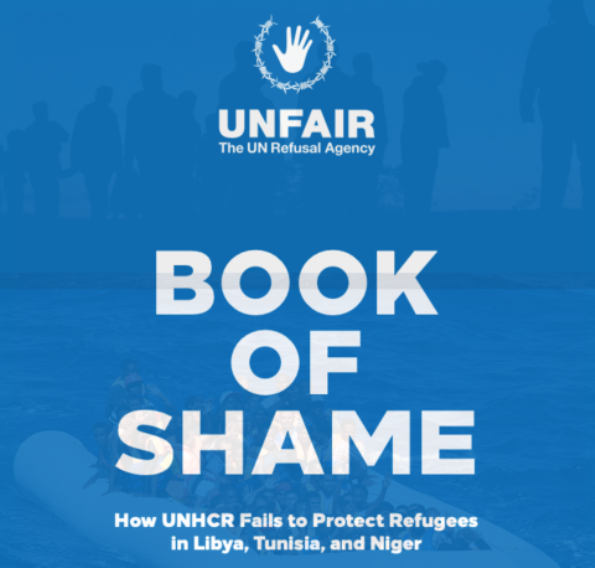
The second story in this article, one that speaks to the majority experiences of those that migrate, is encapsulated in The Book of Shame – a 2025 publication authored by African migrants (and their allies) that experienced firsthand the consequences of the Global North’s dependence on devalued labor justified and organized in the 21st century through racial hierarchies and “humanitarian” multilateral organizations. With a total of 264 pages, the introduction of the book states how it was “born from rage, from grief, and from the refusal to remain silent” about the experiences of people from the hands of not only “militias, traffickers, and governments but of the very institution that claimed it was there to offer protection: the United Nations High Commissioner for Refugees (UNHCR)”[10] (p.15). The scathing critique not only demonstrates how African migrants are self-organized peoples who can speak to the failures of existing policies and offer the necessary systemic solutions, but it names the UNHCR as a border externalization[11] actor that lacks independence and exhibits systemic dysfunction. The authors state without equivocation:
We do not offer this book to gain pity or charity. We do not write as victims waiting to be rescued. We write as people who have organized, who have resisted, who have dared to name the machinery of abandonment, and who will continue to do so. The Book of Shame is not neutral. It is not balanced. It is not written in the language of polite advocacy. It is what must be said, by those who have been ignored for too long. To those who work in or with UNHCR: read this and reckon with it. To journalists and policy makers: do not look away. And to those who are fighting with us, or who have yet to speak up: this book is also yours. May it be a weapon, a record, a fire. May it burn away the silence. And may it clear the ground for something just to grow.[12]
This timely book not only serves as an archive of testimonies from refugees in Tunisia, Niger, and Libya, but it offers insight into how migrants have been self-organizing to advocate for themselves including by challenging non-governmental organizations such as the UNHCR, which has faced multiple protests since at least 2005 across Egypt, Morocco, Kenya, and Libya. In the chapter following the Introduction, entitled, The Witness Must Speak: On the UNHCR in Libya and Beyond, David Yamibo, a South Sudanese brother whose family was forced into exile since he was an infant, details the experiences of those like him. Yamibo begins by addressing the criticism refugees face for their decision to speak out against aid organizations as “A considerable amount of unwritten rules seem to govern the relationship between those who suffer and those who offer aid: the one who gives should not be questioned, and the one who receives must remain thankful, silent, and abiding.”[13] But it is precisely because of the asymmetrical relations that are the basis for aid organizations that Yamibo urges us to ask “What if, behind the language of care, lies a logic of control; one that decides who is worthy of protection, who must wait indefinitely, and who should simply dwell in despair or vanish from sight forever?”[14]
“What if the system, dressed in the language of salvation, was never built to save, but to contain.”[15] Yamibo asks necessary questions that lead us to the ultimate contradiction of “humanitarian aid [that] walks hand in hand with human containment. The food is real, the services exist, but the door that leads to freedom remains locked.” And the “false shepherd” in this story of human containment is the UNHCR, which sustains a “system designed to bind the refugee(s) to a path with no destination, to offer water, but never relief, bread, but never strength, a promise, but never freedom.”[16]
Their care, if it deserves that name, was divorced from challenging our captivity. Their humanitarianism was practiced without questioning why our suffering existed in the first place.[17]
So while the African football stars playing for Europe reflect the stories of a minority that continues to be exploited but has managed to escape containment, for those like Yamibo, they are faced with a “humanitarian” system that works in tandem with economic, political, and cultural structures that benefit from Black labor devaluation and the dehumanization of the Global South. Yamibo’s chapter further shows the clarity of understating how anti-Blackness and internalized social hierarchies amongst Africans serve as conducive conditions for sustaining this system, yet his analysis still locates the migrant condition as a consequence of Europe’s desire in making countries like Libya tools for the commodification of Black bodies. The cruel irony lies in the fact that the very forces that caused so much destruction to Libya[18] are the same forces that continue to make it a living nightmare for other Africans on the move.
In Libya, there lies a strong Arab anti-blackness, a racism older than many of us who suffer it. There is Islamic indifference in the sense that solidarity between believers does not cross the colour line. And there is Europe’s hand, stretched over the Mediterranean Sea, making Libya and neighbouring countries its tools, its second hand that carries out torture, extortion and massacre. A Black person cannot walk the streets without the perpetual fear of being attacked, just for being Black, for being a refugee, for being a migrant. Attacked in order to be enslaved and used. Unable to obtain transfer to a hospital, whether a child, a pregnant woman or a man bleeding near death. Unable to access schools, or simply to board public transport, to walk into a grocery store and pay for what you want without being mocked or intimidated. This remains Libya to this day. I learned almost immediately upon arriving in Libya that I carried a body that could generate thousands of dollars. On the very evening I arrived, I was captured and locked into a warehouse in southern Libya. I was stripped naked, tortured, hung upside down, and starved for weeks. Exposed to torture I had not yet encountered in my wretched refugee life, I was terrified to the core.[19]
It isn’t just Europe’s externalized system in Libya, or the UNHCR that sustains a system that deems which lives are worthy of saving and which are not. There are numerous African countries now enlisted – including Tunisia, Morocco and others party to the 2015 Valetta Summit and beholden to the EU Emergency Trust Fund (EUTF) for Africa – to become Europe’s destination for border externalization and migration policy. It is also a network of organizations like the International Organization of Migration (IOM), Médecins Sans Frontières (MSF), International Rescue Committee (IRC), etc. that work with the UNHCR and Europe.
IOM came often, always with the same offer: so-called Voluntary Humanitarian Return, to the countries we had escaped at the risk of death, to the places where our miseries had all begun. UNHCR came only for those they deemed worthy of protection. A checklist of nationalities, only nine out of the more than twenty detained. They laid bare a hierarchy of suffering and those of us who fell outside it were told, quietly, to disappear under the pretext that Libya did not recognize our right to seek asylum.[20]
We must remember that the hierarchy of suffering and the institutions that uphold it are not a new creation. The IOM's founding was shaped by colonial and racial interests, as settler colonial states like Australia deliberately pushed for an organization outside the ILO to protect their racially exclusionary immigration policies from international challenge. The founding documents institutionalized this agenda by deferring entirely to state sovereignty over admissions, including overtly racist policies, while removing earlier references to human rights from the organization's Constitution. Intergovernmental Committee for European Migration (ICEM) – IOM’s predecessor – then actively facilitated white European migration to apartheid South Africa and the Federation of Rhodesia and Nyasaland, while providing no equivalent assistance to non-white migrants in the same regions.[21] The IOM has not only obscured this history, but its current role and contemporary claims to be a human rights-centered organization alongside UNHCR must be questioned.
The numerous testimonies, including Yamibo’s, not only detail how such organizations deter, avoid, and neglect the very people they are meant to protect and serve to the extent where there are more deaths from neglect rather than injury, but they also expose how “The so-called durable solutions — resettlement, evacuation, relocation”[22] are never extended to those most in need like “the man burned with melted plastic, nor to the woman raped to the brink of death, nor to the abandoned children left defenseless at Libyan check-points.” In fact, Yamibo explains how lifelines such as resettlement, evacuation, and relocation are themselves commodified: “Yes, sold — for up to 5,000 US dollars, a price whispered and negotiated inside UNHCR offices.”[23] Such testaments are too many to capture in this short article but is worth any readers’ time to uncover a humanitarian system that does the opposite of what it claims.
The self-organized protest of migrants to such realities not only faced pressure from countries hosting detention centers on behalf of Europe, but the UNHCR itself facilitated violent repression, including calling militias on protestors and labeling them as “threats” and “troublemakers”. Yamibo clarifies, “To ourselves, we were simply human beings: people with bodies, with needs, with desires, with the will to live.”[24]
For those of us in Libya, and for brothers and sisters from Cairo to Pretoria, Tunis to Ankara, the experience has been the same: of being processed but not protected, of being silenced when we scream, of being punished when we demand to live. UNHCR pretends to care, but the reality is reports, numbers and excuses.[25]
Echoing (Autonomous) Self-Organized Movements
The Book of Shame concludes with a Manifesto written by three refugee movements in Libya, Tunisia and Niger, in relation to their UNHCR is UNFAIR campaign. In addition to calling out the crimes against humanity against refugees, the Manifesto demonstrates the immediate and long-term changes necessary to ensure the safety and protection of peoples on the move.
Since 2021 we, refugees, have been protesting against UNHCR in Tripoli, Tunis and Agadez, calling the agency to recognize our humanity, to listen to our voices and to provide us real protection. But instead of understanding we found denial and paternalistic contempt. Since 2021, UNHCR’s negligence and disrespect towards refugees has all but increased. We denounce lack of basic support, a system of appointments and hotlines that is utterly broken and humiliating treatment and threats from UNHCR staff towards refugees. We also denounce the UNHCR so-called “route-based approach” as nothing more than an attempt to whitewash border externalisation policies with the only aim to keep refugees away from Europe on behalf of the EU. The list of cases of neglect and disrespect is long, and we are determined to expose them all for the world to see that the UNHCR is UNFAIR.[26]
The manifesto also clearly outlines the main demands of migrants: recognition, denunciation of abuses, improved services, transparency, and respect.
Refugees want the UNHCR to treat their self-organized collectives as legitimate voices, not passive recipients of aid. This means regular meetings with refugee representatives, consulting them before making policy changes, and ensuring refugees are meaningfully integrated as part of UNHCR’s advocacy system. Refugees also want the UNHCR to stop staying silent about documented abuses in Libya, Tunisia, and Niger, and to actively and publicly condemn collective expulsions, arbitrary arrests, attacks on refugee activists, and European support for harmful forces in the region — while pushing for more resettlement options and safe legal pathways.
Having escaped unlivable conditions only to be met with more scarcity, refugees also want improved material aid (food, medicine, shelter), healthcare, and education, along with UNHCR offices opened beyond capital cities so people don’t have to travel long distances to register or renew documents — including urgently in Agadez — and rescue services in desert border zones.
Last but not least, refugees assert their humanity and dignity in their demand to end violence, intimidation, and paternalistic behavior by UNHCR staff, along with greater transparency about wait times, better responsiveness, and an independent complaints office that refugees can actually access and that has real power to act.
We are not silent victims of our situation. We raise our voices against injustices. We demand the rights that are ours. We are human rights defenders. We are Refugees in Libya, Refugees in Tunisia and Refugees in Niger, three self-organized refugee movements demanding our basic human rights and struggling against injustices experienced in the treatment by UNHCR.[27]
Our brothers and sisters are not calling on those of us with privilege to save them, but they need allies in their struggle and solidarity that can reinforce their self-organized movement. As we watch a world cup filled with contradictions, and perhaps indicating a new world, we must hold close the reality of the majority that can become Mbappé, Lukaku,[28]and so many other Global Africans beyond football that have provided a glimpse of African capacity, but instead languish across seas and deserts, and in prisons and containment camps.
Mahder Habtemariam Serekberhan is the Vice Chairperson of the Global Pan African Movement (GPAM). She is a PhD candidate in political science at Syracuse University, New York, and serves on the editorial board of Pambazuka News.
Endnotes
[1] Al-Ahli (Édouard Mendy), Al-Hilal (Koulibaly), Al-Nassr (Sadio Mané)
[2] Bayern Munich (Bara Sapoko Ndiaye, Nicolas Jackson)
[3] Rayo Vallecano (Pathé Ciss), Villarreal (Pape Gueye)
[4] Galatasaray (Ismail Jakobs), Samsunspor (Cherif Ndiaye)
[5] Maccabi Haifa (Abdoulaye Seck)
[6] Como (Assane Diao)
[7] Guardian News. (2026, June 18). Rightwing MEPs chant 'send them back' after controversial deportation plans are passed [Video]. YouTube. https://www.youtube.com/watch?v=RkxAlKdClyE
[8] Frontex is the European Union’s border control agency and has been implicated in directly contributing to the horrendous conditions faced by migrants. See Reports and Analysis: Sunderland, J., & Pezzani, L. (2022, December 8). Airborne complicity: Frontex aerial surveillance enables abuse. Human Rights Watch. https://www.hrw.org/video-photos/interactive/2022/12/08/airborne-complicity-frontex-aerial-surveillance-enables-abuse; Human Rights Watch. (2022, December 14). Frontex delivers cruelty from the skies. Human Rights Watch. https://www.hrw.org/news/2022/12/14/frontex-delivers-cruelty-skies; The Left. (2025, July 11). Frontex-Europol collusion in targeting migrants. The Left. https://left.eu/frontex-europol-collusion-in-targeting-migrants/
[9] Genovese, V. (2026, June 1). EU set to back return hubs in toughest migration crackdown yet. Euronews. https://www.euronews.com/my-europe/2026/06/01/eu-set-to-back-return-hubs-in-toughest-migration-crackdown-yet
[10] Introduction. 2025. In V. Castellano, D. Yambio, R. Cohen, S. Spasiano, J. Fahr, A. Montesi, S. Igel, A. West, & M. M. Daufí (Eds.), The book of shame: How UNHCR fails to protect refugees in Libya, Tunisia, and Niger (Vol. 1). Refugees in Libya. https://www.refugeesinlibya.org/book-of-shame
[11] See both Patricia Daley and Danielle Smith’s articles in this same Pambazuka News Special Issue on Migration (June 2025) for details on Europe’s migration policies and externalization frameworks.
[12] Introduction, “The Book of Shame,” p. 16-17.
[13] Yambio, D. (2025). The witness must speak: On the UNHCR in Libya and beyond. In V. Castellano, D. Yambio, R. Cohen, S. Spasiano, J. Fahr, A. Montesi, S. Igel, A. West, & M. M. Daufí (Eds.), The book of shame: How UNHCR fails to protect refugees in Libya, Tunisia, and Niger (Vol. 1). Refugees in Libya. https://www.refugeesinlibya.org/book-of-shame
[14] Yambio, D, “The Book of Shame,” p.20.
[15] Yambio, D, “The Book of Shame,” p.20.
[16] Yambio, D, “The Book of Shame,” p.20.
[17] Yambio, D, “The Book of Shame,” p.22.
[18] Campbell, H. (2013). Global NATO and the catastrophic failure in Libya : lessons for Africa in the forging of African unity. Monthly Review Press.
[19] Yambio, D, “The Book of Shame,” p.21.
[20] Yambio, D, “The Book of Shame,” p.22.
[21] Bradley, M. (2023). Colonial continuities and colonial unknowing in international migration management: the International Organization for Migration reconsidered. Journal of Ethnic and Migration Studies, 49(1), 22–42. https://doi.org/10.1080/1369183X.2022.2127407
[22] Yambio, D, “The Book of Shame,” p.27.
[23] Yambio, D, “The Book of Shame,” p.27.
[24] Yambio, D, “The Book of Shame,” p.29.
[25] Yambio, D, “The Book of Shame,” p.33.
[26] UNHCR is UNFAIR: Manifesto of the UNFAIR Campaign. (September 2025). In V. Castellano, D. Yambio, R. Cohen, S. Spasiano, J. Fahr, A. Montesi, S. Igel, A. West, & M. M. Daufí (Eds.), The book of shame: How UNHCR fails to protect refugees in Libya, Tunisia, and Niger (Vol. 1). Refugees in Libya. https://www.refugeesinlibya.org/book-of-shame
[27] UNHCR is UNFAIR: Manifesto of the UNFAIR Campaign, September 2025.
[28] Romelu Luakau, son to Congolese parents, has been a consequential striker for Belgium’s national team. Lukaku ranks in the top 5 for the all-time “European” men's top goal scorers in international football, with 90 goals.