



The Gravest Crime Against Humanity
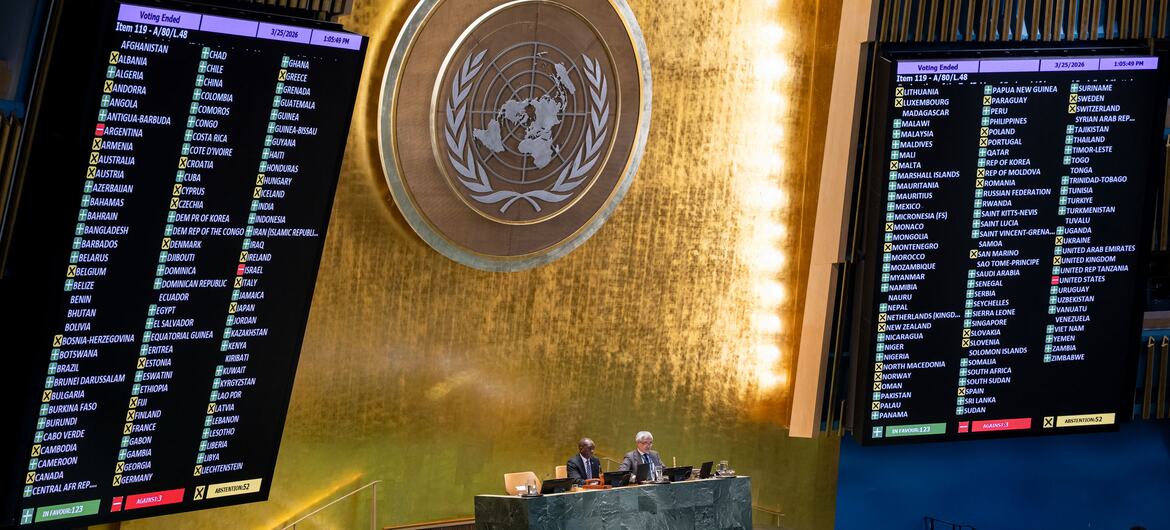
Pambazuka celebrates the passing of the United Nations General Assembly ResolutionA/80/L.48 on the Declaration of the Trafficking of Enslaved Africans and Racialized Chattel Enslavement of Africans as the Gravest Crime against Humanity. Acknowledgement of the most heinous crime committed against Global Africans has been long overdue.
The Transatlantic Slave Trade was the largest forced migration in human history and had no parallel in terms of the duration and man’s inhumanity to human beings. In this crime, wealth accumulation, raw materials, and consumer markets for European goods were built on the body and life of enslaved Africans. These Africans were shipped into plantations, and their descendants became European commodities auctioned without regard for life, human dignity, and basic family relations. The consequences of the 400-year-long transatlantic and racialized chattel slave trade continue to be experienced across the world through entrenched exploitation, racism, colourism, discrimination, genocidal violence, and deliberate underdevelopment through resource extraction.
Walter Rodney’s History of the Upper Guinea Coast[1] demonstrates that the transatlantic slave trade was not accidental, peripheral, or culturally driven. It was foundational to the emergence of racial capitalism itself. Capitalism did not merely exploit existing social differences. It actively produced racial hierarchies as a material and ideological necessity in order to justify extreme violence, mass dispossession, and coerced labor on a global scale. Europeans did not arrive on the Upper Guinea Coast seeking exchange among equals. Europeans were initially attracted to West Africa because of the importance of gold. They could not enter Africa from the North so they arrived on what they called the Gold Coast. They arrived backed by oceanic dominance, superior military technology, and a growing demand for labor generated by plantation capitalism in the Americas. This was itself a process that lasted for about one hundred years.
In this period, there were sharp transitions that ensured that by the beginning of the 18th century African societies were drawn into this system not through free choice or mutual benefit, but because an expanding capitalist world economy imposed itself through military technologies of the gun and biological warfare. Human capture became a central commodity in a system of accumulation that depended on forced labor, territorial conquest, and racial domination.
Rodney makes clear that African participation in the slave trade must be understood as participation under siege. European control over shipping, trade routes, prices, and firearms created conditions in which African societies faced impossible alternatives. To resist the trade was to risk military defeat by better armed rivals whose power was reinforced by European commerce. To participate was to secure short-term survival within a violent system that Africans neither designed nor controlled. Agency alone cannot explain this dynamic. Structure, force, and systemic constraint mattered far more than individual choice.
This history exposes a core truth about capitalism itself. Capitalism expands not primarily through peaceful markets or voluntary exchange, but through organized violence. Racial capitalism required the systematic creation of disposable populations, the transformation of human beings into extractable resources, and the normalization of terror as a method of economic rule. The invention of whiteness was not a byproduct of capitalism. It was one of its governing logics.
Joseph Inikori further demonstrates that the Atlantic slave trade was not only destructive to Africa but also transformative for Europe.[2] By 1750, the immense wealth generated by enslaved labor undermined feudal relations and dismantled feudal economic institutions, especially in England and the Netherlands. The slave trade was central to the transition to capitalism in Europe, linking African dispossession directly to European development.
Once established, the slave trade consumed African societies from within. It militarized political life, destroyed productive economies, and fractured long standing social bonds. States were reorganized around raiding rather than cultivation. Political authority depended increasingly on access to European weapons rather than social legitimacy. Everyday life was marked by the constant threat of capture, betrayal, and flight. The reproduction of society itself became precarious.
Rodney insists that the depopulation of Africa, the consolidation of capitalism in the Americas, and the genocidal destruction of First Nation peoples must be understood together as a single historical process. These were not separate tragedies. They were interconnected moments in the violent birth of racial capitalism. The modern world was built through this trilogy of expropriation, enslavement, and genocide, organized by capital and justified through race.
African Resistance to Slavery and The Long Struggle for Reparations
From the outset of the enslavement processes, African peoples have fought to maintain human dignity and organized in groups or worked in individual capacities to overthrow the chains that continued to primitively create wealth for European slave owners, banks, and industrialists. Needless to say, there were Africans who collaborated with the enslavers just as the comprador elements who collaborate with imperialism today. In many parts of West Africa, the families remain the same.
UNGA A/80/L.48 is a momentous recognition of the hundreds of years of struggle by African peoples: from the captives who died in the middle passage, the enslaved who suffered lifetimes of abuse, those who escaped to freedom - the Palmares, Maroons, and other groups in the Caribbean, who fought against the better equipped enslavers.
The struggles during the period of enslavement involved resistance through escapes, armed battles, and in some cases denying the enslaver the physical body he sought to extract wealth from through unpaid dehumanizing labour. Before official proscription of transatlantic enslavement occurred from 1807 in the United Kingdom, enslaved African peoples in St Domingue had overthrown any remaining myths of enslaver invincibility through the Haitian Revolution of 1791-1804.
Following the official end of the transatlantic chattel enslavement, the struggle focussed attention on recognition of and accountability for this crime by the enslaver and various beneficiaries. The United Nations General Assembly Resolution (UNGA) A/80/L.48 is a necessary moral awakening in the efforts towards reparations and reparatory justice for enslaved Africans and peoples of African descent.
For almost two hundred years, and with increasing momentum, various campaigning groups, activists, and intergovernmental organizations throughout Global Africa have voiced the need for reparations, including taking the issue to the seat of the British parliament, the Commonwealth Heads of Governments meetings, the Caribbean Community (CARICOM), the African Union, and to the United Nations, where Resolution A/80/L.48, by recognizing that the Trans Atlantic Slave Trade constituted a crime against humanity, reinforces the demand for reparations.
The Irrelevance of Europe in the Decision-making of Global Politics
It is not surprising that the countries of the former enslavers either abstained or voted against the Resolution. These are countries that have fought against the demands for reparative justice, whilst claiming to be the height and models of civilization. All 27 members of the European Union, including Eire that suffered from colonialism, and the United Kingdom abstained from voting, which essentially is a no. They continued to demonstrate their lack of morality and human decency when it comes to the lives of African peoples. The solidarity amongst Africans and the majority of formerly colonized territories neutralized the power of the Europeans and the USA and Israel to control the vote, sealing their historical record as perpetrators and tolerators of crimes against humanity.
One hundred and twenty-three countries voted in favour of the resolution, three countries (USA, Israel and Argentina) voted against the resolution, and 52 countries abstained. The resolution was adopted on a 123-3- 52 vote.
The Institutional Struggle Against Racism and Discrimination
This UN Resolution A/80/L.48 arises 25 years after the 2001 Durban Declaration committing the United Nations to a Programme of Action against Racism, Racial Discrimination, Xenophobia and Related Intolerance. Ghana was at the forefront of tabling the Resolution A/80/L.48. The draft resolution was, however, co-sponsored by nearly 60 countries from Africa, the Caribbean and Latin American region, and Eastern Europe. The co-sponsors comprised, in alphabetical order:
Algeria, Angola, Barbados, Belarus, Benin, Botswana, Burkina Faso, Burundi, Cabo Verde, Cameroon, Central African Republic, Chad, Comoros, Congo, Côte d’Ivoire, Democratic Republic of the Congo, Djibouti, Egypt, Equatorial Guinea, Eritrea, Eswatini, Ethiopia, Gabon, Gambia, Ghana, Guinea, Guinea-Bissau, Kenya, Lesotho, Liberia, Libya, Madagascar, Malawi, Mali, Mauritania, Mauritius, Morocco, Mozambique, Namibia, Niger, Nigeria, Rwanda, Saint Kitts and Nevis, Sao Tome and Principe, Senegal, Seychelles, Sierra Leone, Somalia, South Africa, South Sudan, Sudan, Togo, Tunisia, Uganda, United Republic of Tanzania, Venezuela (Bolivarian Republic of), Zambia and Zimbabwe.
The efforts of the 59 sponsors reflected solidarity across Africa and the Caribbean and other regions. Together, they marshalled the majority vote outside of those countries in the western world that perpetrated and benefited from the crime in question.
A Symbol of Pan-African Unity
The passing of the Resolution is also a win for the processes to unite the peoples of Africa and peoples of African descent outside the African continent. In the United Nations General Assembly, African countries in many cases align with geopolitical interests and respective erstwhile colonizers in casting vote. The UN African Group acted together in the passing of this landmark resolution. All African countries supported the Resolution through their votes or the African Union representative for reparative justice, Ghana’s President.[3]
The Caribbean Community (CARICOM) Reparation Commission produced the ten-point plan for reparative justice listed below.
-
Full formal apology
-
Repatriation
-
Indigenous peoples development programme
-
Cultural institutions
-
Public health crisis
-
Illiteracy eradication
-
African knowledge programme
-
Psychological rehabilitation
-
Technology transfer
-
Debt cancellation
To these 10 points must be added Climate Justice. The processes of industrialization and the continuing dependence on fossil fuels have left in their wake destruction of the natural environment and the changes in climatic conditions that are immensely warming the earth. The burning of natural gas deemed as excess, and not of high economic value has resulted in continuing release of greenhouse gases such as CO2 and methane gas key in the climate change process. The environmental, social, spiritual, and material destructions from gas flaring in Nigeria and extractive industries across Africa and Global Africa leave behind a major reparative question that the world will need to grapple with. Reparative justice would mean that the corporations and their host states end polluting activities, such as gas flaring, and provide the US $1bn, estimated by the UN in 2011, that is needed to clean up the Niger Delta.
The spirituality and cultural relations that exist among humans and the rest of nature will need to be harnessed in the situation of reparation and required healing of the environment in the collective moral awakening of the world. For peoples of African descent, there must be re-membering with nature and return to the respect for ecosystems and nature away from the present fossil-derived energy economy and forms of industrialization that continue to threaten human survival.
Endnotes
[1] Rodney, Walter (1970) A History of the Upper Guinea Coast 1545-1800. Oxford: Clarendon Press.
[2] Inikori, Joseph E. (2002) Africans and the Industrial Revolution in England: A Study in International
Trade and Economic Development. Cambridge: University of Cambridge Press.
[3] Three African countries - Benin, Madagascar, and São Tomé and Príncipe - were absent at the time of the vote and could not cast their votes. ‘Not present’ did not constitute abstention.