



Default Mothers, Doubted Wives: Patriarchy’s Legal Architecture in Kenya
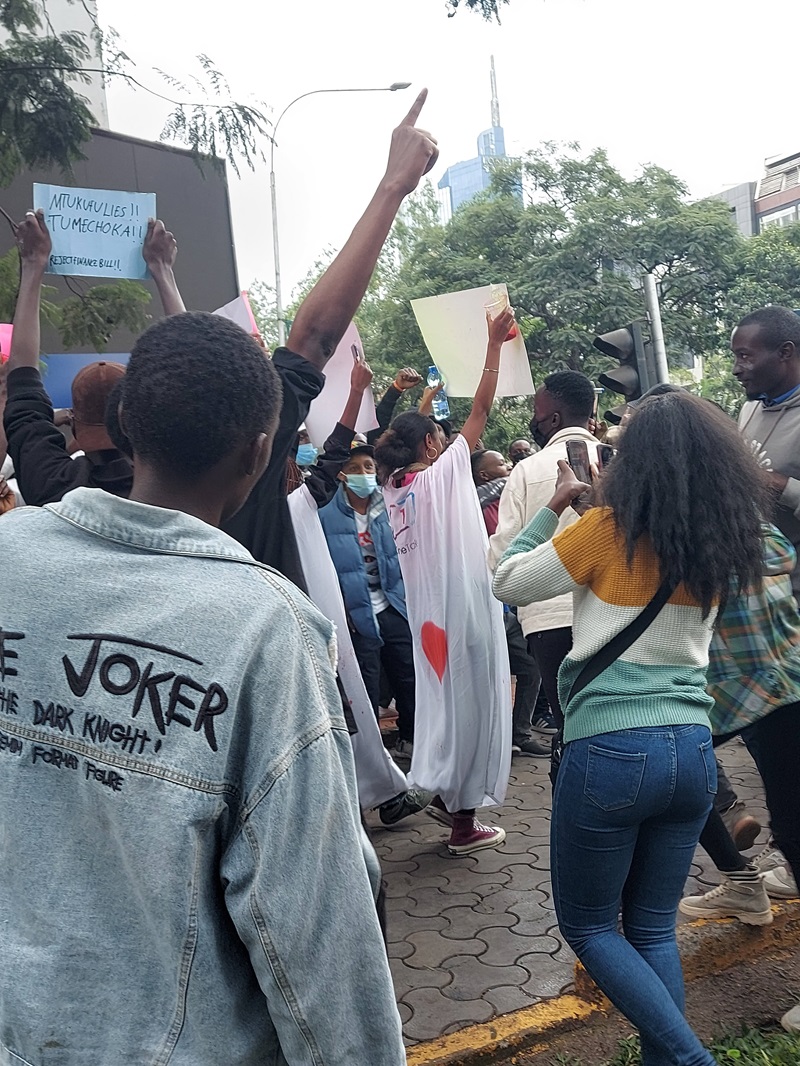

Examining how patriarchal assumptions continue to shape Kenya’s legal system and gaps in laws intended to protect and advance women’s rights.
“My own definition of a feminist is a man or a woman who says, yes, there’s a problem with gender as it is today and we must fix it, we must do better. (All of us, women and men, must do better).” - Chimamanda Ngozi Adichie [1]
For much of Kenya’s post-independence history, the “rules” governing family, sexuality, property, and morality were, where they existed, authored from a male standpoint, and enforced through institutions overwhelmingly controlled by men. Women married without statutory protection of their property[2], and a woman’s contribution to a marriage was whatever her husband, or the courts chose to recognise.[3] Violence within a home was treated as a domestic matter rather than a crime,[4] and a woman’s claim over her own body, her own marriage, even her own husband’s burial[5] could be set aside in favour of custom or kin. Where formal rights did not exist, the absence itself was the message: that these were not questions requiring the state’s attention.
Patriarchal control over women’s domestic labour in Kenya has re-formed itself across successive economic orders such as the slave society, colonial indirect rule, the post-colonial state, each finding a new reason to treat women’s unpaid labour as beneath the law’s notice.[6] Prof. Maria Nzomo helps trace how that re-formation actually happened and locates the origin further back than colonialism, and in slave-owning economies themselves.[7] She observes that the slave society split along class lines: masters and slaves where a woman still carried further exploitation in her own household, ‘pushed in a second position behind her husband’.[8] She further highlights that the domestic labour of women had “ceased to have the importance it held in communal society”, lowered to a position of ‘invisible, unproductive labour, as it was oriented toward direct consumption, rather than production’.[9] Basically, the enslaved woman bore the weight of slavery while also occupying a subordinate position within patriarchal households.
Mahmood Mamdani, described how the British colonial government governed their African colonies through a bifurcated state.[10] He gives an example of South Africa, where General Jan Smuts’[11] advocated preserving the “native institutions” while meeting the labour demands of a growing economy, through the institution of migrant labour. Under this arrangement, men were drawn out as migrant wage labourers while women and children were left in the “reserves”.[12] By directing men into the urban wage economy while locating women within the rural “customary” sphere, colonial authority produced a gendered geography in which male authority was reproduced across both spaces. This thus created a mechanism where women’s lives remained more directly subject to customary institutions and patriarchal authority in the reserves. Ali Mazrui, in his documentary, The Africans: A Triple Heritage, presented African women not merely as domestic figures but as providers and protectors within the family and community.[13] He situated them within a longer indigenous heritage in which women held real standing and authority, a heritage preceding the colonial and postcolonial constitutions that would later formalise, and narrow, what counted as women’s rights.
Ama Ata Aidoo names this long history as a riddle: the African woman as an unresolved contradiction, someone neither social convention nor progressive rhetoric has ever managed to pin down. She does not fit the old image of a silent, burden-bearing figure; “muted beasts of burden”,[14] yet the equality some men claim already exists, especially men who see themselves as enlightened or modern, has never actually reached her. The woman sits in the gap between those two claims, a gap that African societies have never bothered to properly define. Aidoo traced this unease into everyday language: the warning passed down to boys to “fear women,” the sayings that hold women responsible for human failing, the humour men trade among themselves at women’s expense.[15]
What Kenyan Women Actually Built
It would be dishonest to write about the gaps that remain without first naming what Kenyan women fought for, and won. The Sexual Offences Act, 2006 pushed by Justice Njoki Ndung’u, was Kenya’s first legal recognition that sexual violence was a crime the state had an obligation to name and punish, rather than a private matter to be absorbed by families.[16] The Protection Against Domestic Violence Act marked a further recognition that the law could intervene in and challenge patriarchal power within the family.[17] And the Matrimonial Property Act, (2013) wrote into statute, for the first time, that a woman’s unpaid labour; her housework, her childcare, her “companionship”, could count as a legal contribution to a marriage.[18]
The significance of these laws, then, lies not in creating women’s capacity to lead, provide, or contribute, but in forcing the formal legal order to recognise capacities and forms of labour that African social life has long known and valued. Mazrui’s cultural acknowledgment is therefore worth holding alongside this legal record: African societies had long recognised that women could lead and provide, even where colonial and post-colonial[19] law was slow, or unwilling, to translate that recognition into enforceable rights.[20]
And Yet
Yet the formal recognition of women’s rights within Kenya’s family law does not always translate into protection in practice. Customary and informal unions have traditionally been common forms of marriage in many African societies and often exist away from the modern or more formal requirements of statutory marriage law. While these unions may be recognised in many Kenyan communities, the law has sometimes struggled to recognise and adequately protect the rights of women and children exposing them to uncertainty over marital status, maintenance, and inheritance,[21] especially when men withdraw from their familial responsibilities or when a marriage comes to an end. In the Mary Wanjuhi case,[22] Justice Mumbi observed that the absence of registration of customary marriages had created uncertainty, particularly upon the death of a husband, when courts were required to determine whether women claiming to be wives were in fact entitled to inherit. The requirement for registration under the Marriage Act was intended to cure this mischief by introducing certainty into marital relationships that had long operated outside formal legal regulation.[23] The case illustrated an important limitation of legal reform: recognising rights in law is one thing; ensuring that women can establish the relationships through which those rights become enforceable is another. Where marital status remains uncertain, women and children may find themselves having to prove the very relationships upon which their claims to maintenance, inheritance, and protection depend.[24]
In the Cradle Case,[25] although decided before the promulgation of the 2010 Constitution, the court’s treatment of parental responsibility offers a revealing illustration of the legal assumptions surrounding motherhood. The Court was tasked with determining how parental responsibility should be allocated for a child born out of wedlock and, in applying the law then in force, noted that the law[26] provided that ‘where the parents are not married, the mother shall have parental responsibility of the child.’ The Court further recognised the mother’s responsibility to the child, observing that this reflected ‘social realities and serves the best interest of the child’; making a distinction between children born within marriage and those born outside which was termed as objectively justified and not discriminatory as this ‘reflected realities of the relationship’.[27] The provision therefore automatically made the mother the holder of parental responsibility by virtue of motherhood, while the father’s responsibility was not similarly presumed. The mother, in other words, became the default parent, entering parenthood already carrying the legal responsibility for the child.
Even the Protection Against Domestic Violence Act, built to protect women and children from abuse, does not guarantee consistent paternal involvement once the immediate threat has passed. Its importance lies in recognising domestic violence as a matter requiring legal intervention rather than leaving it entirely within the private sphere of the family.[28] Yet protection from violence and the redistribution of familial responsibility are not the same thing. A woman may obtain protection from an abusive partner and still remain solely responsible for feeding, raising, educating, and caring for the children. The law may restrain the violence without necessarily compelling the absent father to participate in the ordinary, often invisible labour of parenting. In this sense, legal protection can stop short of addressing the deeper gendered structure of family life: who stays, who leaves, who provides, and who continues caring when the relationship itself has broken down.
Article 53(1)(b) of the 2010 Constitution guarantees every child the right ‘to family care or parental care, which includes equal responsibility of the mother and father to provide for the child.’ In practice, however, mothers have continued to bear the greater share of caregivingwhile fathers increasingly act as ghost parents, absent from financial, emotional, and social responsibilities.[29] Kenya’s 2019 census bears this out at scale: the share of single-parent households rose sharply, from 25.1 per cent in 2009 to 38.2% in 2019, and in the overwhelming majority of these households, that single parent is the mother.[30] The Children Act, 2022 outlines parental responsibilities, including maintenance and care, yet enforcement is largely ineffective, mothers seeking maintenance orders face long delays, costly processes, and fathers who refuse compliance.
Across all of these statutes, the pattern is the same: the law assumes a mother’s labour so thoroughly that it never has to value it, because her presence was never in question. The law increasingly recognises the harms women experience and provides mechanisms through which they can seek protection, maintenance, or property rights. Yet beneath these reforms sits an older assumption that women will continue to perform the everyday work of care regardless of whether the law recognises its value. A mother’s labour is assumed so thoroughly that it rarely needs to be named before it becomes a legal claim.
Doubted, the Moment It Counts
If parenthood shows a woman’s labour being assumed, divorce shows the same labour suddenly disputed. In Echaria v Echaria (2007), the Court of Appeal held that non-monetary contributions (domestic work, child-rearing, the daily maintenance of a household), could not count toward a wife’s share of matrimonial property; only proven monetary contribution qualified. A woman who raised children, ran a home, and enabled her husband’s economic life for decades could leave that marriage with nothing, because her labour had no receipt.
Article 45(3) of the 2010 Constitution, then guaranteed spouses ‘equal rights at the time of marriage, during the marriage, and at the dissolution of the marriage.’ The Matrimonial Property Act, 2013, sought to give this guarantee practical effect by providing that ownership of matrimonial property vests according to each spouse’s contribution.[31] Contribution is defined to include both monetary and non-monetary forms, including domestic work, childcare, companionship.[32]
On paper, this closed the Echaria gap. In practice, it reopened it in a different form where a party has to prove monetary or non-monetary contribution.[33] Courts still require a woman to prove that contribution, case by case, with no settled formula for what a decade of child-rearing or “companionship” is worth in shillings. Fathers may legally divide property yet remain absent from their children’s lives, while mothers must first litigate the value of the life they built at home before they can even begin to claim a share of it. The woman who was, without question, the caregiver for fifteen years must now demonstrate, with evidence, that this counted for something.
The hinge between these two pillars is that the law rarely doubts a mother’s labour while she is providing it, it only doubts it once she tries to leave with something for it. Assumption during the marriage; suspicion at the exit. That inversion is what makes “shared responsibility” and “equal contribution” hollow phrases rather than enforceable guarantees.
Where the Riddle Was Answered
Nowhere was this pattern exposed more starkly than in the Wambui Otieno matter.[34] The case was not an isolated struggle. Even decades later, women have continued to turn to the courts to assert their right to bury their husbands and to establish their status as wives. Wambui Otieno stood against her husband’s entire clan over a single question: who has the right to bury him, his wife, or his kin? The Court of Appeal answered in the clan’s favour, treating Luo customary law as the binding authority in matters of burial, and ordering the body handed over according to that custom rather than the widow’s own wishes. A similar question of burial recognition arose again before the High Court, where wives were required to establish the existence of their marriages in order to assert their rights in relation to the burial of the deceased. [35] Along similar lines, a case involving Kikuyu customary law reaffirmed the central role of the eldest son in burial matters. Although the deceased had expressed a wish to be cremated, the Court observed the importance of the Kikuyu tradition recognising that the responsibility for disposing of the body rests primarily with the eldest son, or in his absence, the brothers of the deceased. [36]
Even in death, the one moment a marriage might be assumed to belong most fully to the two people inside it, the law has time and again reached past the wife and found a patriarchal custom more legitimate than her claim. If a woman’s voice can be set aside at her husband’s graveside, it should not surprise us that her voice carries just as little weight when his estate is divided, or when she is asked to prove, years into a marriage, what her labour there was worth. The riddle Aidoo named, neither beast of burden nor equal, is the same riddle Kenyan family law has never fully solved. It assumes a woman’s presence when convenient, and disputes her claim the moment that presence might cost something.
Conclusion
None of this is an argument against the wins Kenyan women have secured. The Sexual Offences Act, the Protection Against Domestic Violence Act, and the Matrimonial Property Act are real achievements, hard-won by organising, and by women who occupied rooms they were not supposed to enter. But representation in those rooms was always a means, not the end. It got women a seat at the table where these Acts were drafted; it did not, by itself, value a mother’s labour, or relieve her of the burden of proving that her presence in the home was worth something.
The entry of women into Parliament, the judiciary, and other spaces of political and institutional power has often been presented as one of the clearest measures of women’s liberation. But liberation cannot be measured only by the number of women in Parliament or in the judiciary. It must also be measured by whether the law recognises domestic labour, mothering, housework, and care, as labour in its own right: work that is routinely assumed, undervalued when it matters, and rarely compensated in full.
Lawless and Fox reached a similar conclusion in a study of Women candidates in Kenya, when they concluded that:
“The suggestion that electing women candidates would generate a woman’s agenda is precarious in the Kenyan case. The 19 women candidates interviewed demonstrate neither fervour, nor an affinity, for forwarding women’s issues.”[37]
The point is not that women in positions of power are incapable of advancing women’s interests, but that representation alone cannot guarantee transformation. Liberation requires more than placing women within institutions shaped by patriarchal histories. It requires changing the laws, practices, and assumptions through which women’s labour, care, authority, and claims to equality are understood.
Chimamanda Ngozi Adichie’s simple definition of feminism offers an appropriate place to return: “there’s a problem with gender as it is today and we must fix it, we must do better.”[38] In Kenya, there is a problem with gender. It is visible not only in who holds power, but in whose labour is assumed, whose care is expected, whose contribution must be proved, and whose responsibility can be contested.
The Kenyan woman therefore remains in a peculiar position in law: as a mother, her responsibility is assumed; as a wife, her contribution is often something she must prove. Until the law stops assuming her care and legalizing the appropriation of her labor while doubting its value, the architecture of equality remains unfinished.
Carolyn W. Gatonye is a Pan-Africanist and legal researcher whose work interrogates the intersections of law and governance, with a particular interest in regional integration, protest cultures and human rights in the Global South.
Endnotes
[1] Chimamanda Ngozi Adichie, TEDxEuston, ‘We should all be feminists’ 2013 at 29:30
[2] Kamau Muthoni, Standard Media, ‘The rise of Kenya’s matrimonial property sharing law’, -2017 <https://www.standardmedia.co.ke/nairobi/article/2001231875/the-rise-of-…;
[3] See Ogentoto v Ogentoto (2023) where the Supreme Court held that the equality provision in Article 45(3) of the Constitution does not entitle any court to vary existing proprietary rights of parties and take away what belongs to one spouse and award half of it to another that has contributed nothing to its acquisition merely because they were married https://supremecourt.judiciary.go.ke/wp-content/uploads/2026/07/Joseph-Ombogi-Ogentoto-v-Martha-Bosibori-Ogentoto-SC-Petition-No.-11-of-2020-Judgment-27-January-2023-1.pdf
“Dissecting the Impact of “Ogentoto”: Equality in Marriage vs Proving Contribution in Matrimonial Property” <https://mmcasafo.com/news/dissecting-the-impact-of-ogentoto-equality-in…;
[4] The Protection Against Domestic Violence Act (PADV) was not implemented until 2015
[5] See Wambui Otieno case.
[6] Maria Nzomo, Women, Democracy, and Development in Africa (1988)
[7] Maria Nzomo, Women, Democracy, and Development in Africa (1988) 113
[8] Maria Nzomo, Women, Democracy, and Development in Africa (1988) 113
[9] Ibid
[10] Mahmood Mamdani, Citizen and Subject: Contemporary Africa and the Legacy of Late Colonialism (Princeton University Press 1996) 6.
[11] General Jan Smuts twice served as South Africa’s Prime Minister. Mamdani describes him as having achieved an “international renown rare for a South African prime minister”, noting that he was invited to deliver the prestigious Rhodes Memorial Lectures at Oxford in 1929, where the “native question” formed the core of his deliberation.
See Mahmood Mamdani, Citizen and Subject: Contemporary Africa and the Legacy of Late Colonialism (Princeton University Press) 4
[12] Mahmood Mamdani, Citizen and Subject: Contemporary Africa and the Legacy of Late Colonialism (Princeton University Press 1996) 5-6 On Smuts, “And it is this migration of the native family, of the females and children, to the farms and the towns which should be prevented. As soon as this migration is permitted the process commences which ends in the urbanized detribalized native and the disappearance of the native organization. It is not white employment of native males that works the mischief, but the abandonment of the native tribal home by the women and children.”
[13] The Africans: A Triple Heritage - Program 2: A Legacy of Lifestyles, <https://www.youtube.com/watch?v=fByaUQppoGs&t=951s>
[14] Ama Ata Aidoo, ‘The African Woman Today’, (1992) <https://www.blackagendareport.com/essay-african-woman-today-ama-ata-aid…;
[15] Ibid
[16] Onyango-Ouma, Washington, Njoki Ndung’u, Nancy Baraza, and Harriet Birungi. 2009. “The making of the
Kenya sexual offenses act, 2006: Behind the scenes.” Nairobi: Kwani Trust <https://knowledgecommons.popcouncil.org/cgi/viewcontent.cgi?article=216…;
[17] Heinrich Boll Stiftung, ‘The Protection Against Domestic Violence Act (PADV) 2015’
<https://ke.boell.org/en/2015/08/27/protection-against-domestic-violence…;
[18] Matrimonial Property Act (2013), Section 2 “contribution” means monetary and non-monetary contribution and includes- (a)domestic work and management of the matrimonial home;(b) child care;(c) companionship; (d)management of family business or property; and(e)farm work;
[19] Post-colonial law here describes the condition of the African societies’ legal law after colonial domination (the legal order of the independent states), which still exhibited patriarchal norms. This should not be confused with neo-colonialism which involves the continued domination/exercise of external economic or political influence over independent African states.
[20] The Africans: A Triple Heritage - Program 2: A Legacy of Lifestyles, https://www.youtube.com/watch?v=fByaUQppoGs&t=951s , Ali Mazrui presents African women as providers and in some societies, as protectors.
[21] Agnes Meroka, ‘From relegation to elevation: The place of customary marriages
under Kenya’s matrimonial law’, Oñati International Institute for the Sociology of Law, 2024
[22] In Mary Wanjuhi Muigai v Attorney General & another [2015] eKLR.
[23] Ibid
[24] Women married under a monogamous system of law are protected, while women subsequently married under
customary law would not be recognised as wives for purposes of succession. Also, in succession matters where a deceased man had contracted several marriages under different and sometimes conflicting legal systems, the courts were faced with a difficult choice: whether to uphold the rights of wives married under monogamous systems to the detriment of wives married under customary law. See Agnes Meroka, ‘From relegation to elevation: The place of customary marriages under Kenya’s matrimonial law’, Oñati International Institute for the Sociology of Law, 2024
[25] RM Suing Thro Next Friend JK & 2 others v Attorney General (Civil Case 1351 of 2002) [2006] KEHC 3485 (KLR) (1 December 2006) (Judgment)
[26] Children Act (2001), Section 23(4)
[27] RM Suing Thro Next Friend JK & 2 others v Attorney General (Civil Case 1351 of 2002) [2006] KEHC 3485 (KLR) (1 December 2006) (Judgment)
[28] Rahab Wakuraya, Challenges in Litigating under Kenya’s Protection from Domestic Violence Act 2015. Vol 3 (2018)
[29] Oyunga Pala, The Making of a Fatherless Nation, (2018) <https://www.theelephant.info/reflections/2018/12/28/the-making-of-fathe…
[30] Paul Ilado, The Star Newspaper, ‘Absent fathers have contributed to dysfunctional childhood’, 2023
<https://www.the-star.co.ke/counties/nyanza/2023-06-16-paul-ilado-absent…;
[31] Matrimonial Property Act (2013), Section 7
[32] Matrimonial Property Act (2013), Section 2
[33] The Supreme Court confirmed as much in Joseph Ombogi Ogentoto v Martha Bosibori Ogentoto & 2 Others, SC Petition No. 11 of 2020 (27 January 2023), holding that Article 45(3) does not entitle a spouse to an automatic 50% share of matrimonial property merely by virtue of the marriage; a party must still prove their monetary or non-monetary contribution, with each case turning on its own facts.
[34] S.M. Otieno v Joash Ochieng Ougo and Omolo Siranga (1987).
[35] See In re Burial of Musa Magodo Keya (Deceased) [2021] KEHC 5262 (KLR)
[36] Janet Ngubia Githieya v Wairimu Gitau [2004] eKLR; The litigation in this case demonstrated that women, despite being close family members (daughters or wives) may lack locus standi in cultural matters unless supported by male family members.
[37] Jill Lawless and Richard Fox, ‘Women Candidates in Kenya’ (2001) 20(4) Women and Politics 49, 70.
[38] Chimamanda Ngozi Adichie, TEDxEuston, ‘We should all be feminists’ 2013 at 29:30