



The Influence of the Media on South African Masculinity: Exploring the Red Pill Ideology
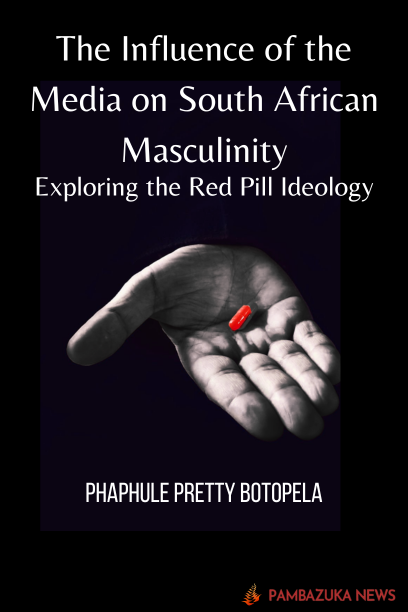
The piece is centred around masculinity, media, violence and gender representation within South African context – exploring how media representation and culture influences and reconstructs our understanding of power and identity and can prompt violence and inequality.
Media systems - through digital media and popular culture - contribute to the construction and normalisation of toxic masculinity and misogyny in South Africa, increasingly through the rise of the manosphere and the Red Pill ideology. Although the Red Pill ideology has not revealed or identified itself in South African mainstream media, its characteristics are evidently present in the media content we consume via magazines, social media platforms, movies and websites etc. This essay will analyse how shared red-pilled influenced media content of violent and aggressive masculine behaviour is presented in a way that seems empowering, desirable, inevitable, and normal to young men, and how it contributes to men’s acquiring a positive sense of sexual and social power in society. This opens the ground to a bigger question: is it about empowering young men, or is it capitalising on their insecurities, vulnerability, and their desire for a (problematic) fatherly and brotherly community?
In exploring these broader questions, I examine how the Red Pill ideology promotes anti-feminism as a way to reclaim the so-called “real manhood”, ignoring men’s diverse sexualities and non-hegemonic forms of masculinities. By delving into the complexities of the manosphere, we unmask the dangers of many men’s “rights” movements, which reinforce patriarchal norms and male supremacy while undermining feminist thoughts. The manosphere targets young men into its network and makes the idea of acquiring sexual and social power appealing to these young men at the expense of the LGBTQI+ community, and vulnerable men and boys.
Understanding the Manosphere and Red Pill Language: Blue Pill versus Red Pill theory
The theory of “Blue Pill versus Red Pill” was inspired by the American movie series (1999 -2003), The Matrix. In the early 2000s, this movie series was popular amongst many internationally, and the storyline within the movie series was an eye-opener about the true nature of our surroundings, raising a question that could be understood from the social constructivism[1] lens – the red pill represents what is real (the truth) and the blue represents what is fake (the lie) about the society we live in.[2]
According to the manosphere ideology, their community has chosen to take the red pill. Their so-called “truth” or exploring the depth of the red pill rabbit hole is that ideologies such as feminism are built to destroy real manhood and to oppress men, and mask that “men are superior to women because patriarchy favours men over women”, and the lie (blue pill) is that men benefit from patriarchy and women’s lives are more valuable than men’s lives.
This perspective is highlighted in “The Red Pill - Men’s Rights” a 2022 documentary on YouTube whereby feminist filmmaker Cassie Jaye engages with leaders and members of the Men’s Rights Movement (MRM) to gain understanding of their beliefs and perspectives. Throughout the documentary, these red pilled participants challenge the feminist thinking of inequality and express how feminism is misrepresenting and/or dismissing the lived experiences of men.
Red Pill Table: Spreading of Conservative and Extremist ideas in Media
The failure of the early Men’s Rights Movement (MRM) in the 1970s marked the rise of the manosphere in the United States.[3] In the early stages of the MRM, men and men’s activists criticised patriarchy and acknowledged how its practices and beliefs are problematic and lethal towards men and women at large.[4] The rise of the manosphere reflects the system of patriarchy renewing itself and marking its territory through the ideology of Red Pill.
According to Van Valkenburgh[5], the manosphere emerged as a subforum of Reddit.com, a website where individuals share their thoughts, ideas, and political views. The subscribed users of the Red Pill subforum are anonymous and make use of fake usernames. Individuals here can build communities with people who share their similar views with them about politics and everything, but the common ideas these individuals share is the distrust in feminism and negative generalisation of women (misogynism). Through the Red Pill ideology, the manosphere masks its community and ideology as a safe space to advocate for men’s rights and believes that men are oppressed by women and/or feminism and that the “proper and real” masculinity should be reclaimed.[6] It aims to reclaim “real manhood” by discrediting feminism, arguing against men who embrace feminine or soft masculinity instead of traditional masculinity, and disapproving of the notion that “men have more power”.[7]
To spread its conservative and extremist ideas, the Red Pill Community (RPC)[8] and Red Pilled influencers utilise digital media platforms such as Youtube, Tiktok and X (formerly known as Twitter) to post podcast episodes and self-empowerment motivational videos.[9] These media platforms mentioned above become a conservative tool for sending out dominant messages and creating narratives of what masculinity should be and should not be. The dismissal of non-hegemonic senses of masculinity is rooted in reinforcing patriarchal norms. These narratives contribute to extremism, where individuals build parasocial relationships with others in the manosphere and feel a sense of belonging with those who share their beliefs.
The manosphere and the Red Pill ideology reinforce the concept of hegemonic masculinity,[10] although they claim that they are all for advocating for all men and addressing the inequalities that “men in general” face in this society. Fundamentally, however, it is evident that it is non-egalitarian and functions according to the principle that “power rules.” The term ‘hegemonic masculinity’ was coined by Australian feminist Raewyn Connell, and in her book titled Masculinities (1995), she elaborates on how less powerful masculine men have to submit to other men in the Australian context. This term is useful in identifying the norm of masculinity that red pill content celebrates. Within the manosphere, there are two types of men identified: the Alpha male and the Beta male. This can be categorised as the sexual class hierarchy.[11]
They fit the societal beauty standards and masculine hegemonic standards of being attractive, assertive, financially stable and athletic. Beta males are the opposite of what Alpha males represent, and although they are at the lowest ranking of the sexual class hierarchy, they still benefit from patriarchy and still uphold the conservative views of feminism being a disruptive tool against the so-called “real manhood”. Mateo Valdivia[12] further defines beta males as non-hegemonic men who are rather shy, weird, and less confident. A typical example of how South African men would fit in these categories is that an alpha male would be a man known as a blesser, baller, grootman or “magudzumela”[13] and a beta male would be called as an “ice boy”[14]. There is a significant financial gap between the two masculine categories, which reflects on broader historical and socio-economic inequalities in South Africa, and this intersects with racial and class privilege.
Power, Bodies and Sexualities: Man-Made Bodies
Holmes (2009) argues that it is important to note that not all men have the same privileges in society; therefore, the distribution of political power or influence will differ based on their race, social status, ethnicity, and geolocation. She further states that privileged and powerful men who have the power to control and spread dominant ideas of what a man is are usually middle and upper-class men. These ideas of what a man is include ideas around the control over men’s bodies and emotions. She refers to Connell’s work (1995) to highlight that masculinity is performative, and this is seen through a man’s body. If a man is unable to control his body and cannot perform sexually and/or physically, it is believed that this threatens his identity of masculinity.
To fully understand this narrative, we reflect on front covers of South African digital magazines, movies and the media coverage of men’s sports and fitness.[15] Men who aspire to hegemonic masculinity achieve their political power and gain sexual power when their bodies are associated with monetary profits, being seen as sexy and appealing to women. This boosts their ego, and they can use that to show off their power to other men, which then helps them to climb the ladder in the hierarchy of masculinity. Magazines, movies and media coverage of men’s sports and fitness offers a pathway for the monetization of men’s bodies and the desired sexual appeal of the hegemonic masculine.
From the selected media mentioned above, alpha males – men who hold a vulnerable social status in the world, have control over their bodies and physical appearance, and are wealthy are constantly displayed in the fixed idea of being a “manly man”, and these are red pill-coded attributes of what a man is. The media is used as a tool to demonstrate and control the representation of men in this manner and reinforces the physical stereotypes around masculinity and manhood, reducing men’s humanity to physical attributes.
Movies and drama series also contribute to how bodies are seen and regarded. Although this is generally discussed in relation to stereotyping women’s bodies, the stereotyping of men in terms of their bodies is strongly emphasised in media culture. For example, in movies, the plus-sized or fat person is either bullied and made a mockery of, or always the funniest in the group, and typically lonely (no friends), financially struggling, and disorganised (clothes not fitted properly) – what a beta male is described to be. However, a muscular or slender character will be associated with being sexy, healthy, and heroic, the perfect image of an alpha male.
This storyline is also shown in the South African lokshin bioskop drama ‘Mampara’ [16] (2016) where two high school boys, Vukani (fat friend) and Mampara (average friend) were bullied. However, they managed to stand up against their bully, Tshepo, the popular guy (alpha male), and exposed the fact that he was poor and homeless. Afterwards Tshepo was demoted as the popular and sexy guy to “nobody” due to his financial situation, Mampara became the new popular guy (alpha male) and finally got a chance to date the school queen, whom he had always had a crush on, something he had always wanted but also turned away from his friend, Vukani (beta male) - the ‘fat friend’ without any friends. Even though this is not presented as red pill content, it echoes and reinforces the fundamental idea that men today must physically defend and maintain their superior status in groups and in relation to women, even in an age when popular culture also promotes other messages about democratic belonging and equality.
The same pattern is seen with sportsmen and the fitness industry. Their bodies and performance are termed as “money maker”; therefore, their bodies have to be maintained to keep up with performance. In the BBC Sports (2019) conversation, the sportsmen also shared their thoughts on the intense pressure they receive in the sports and fitness industry.[17] In relation to South African sports and fitness, Mashasha (2021:128) explored in his thesis titled “Steroids in the Gym: The law, strong bodies and masculinity in South Africa” that powerful bodies, such of sportsmen’s, are influential in weighing the societal view of being a man and masculinity, and the control over their bodies contributes to the constructed idea that a muscular/gym body equates to be a confident and a “real man” and being fat equates to being a loser and a “bum.” Such ideas pressurise these men to consume drugs such as steroids to boost their performance. Men acquire a sense of power and dominance through sex and money, and these two elements are used as a language and tools to boost men’s egos. However, if there is an insufficient performance to show up sexually or financially, then this is seen as a weak point.
From Gender Oppression to Sexuality: “Straight Talks, No Homo”
It is believed within the manosphere that homosexuality is also a threat to masculinity and compromises the idea of a “real man” and believes that under masculinity, women subordinate heterosexuality is the face of “real manhood”, whereas homosexuality is seen as men cosplaying as women, and feminism is encouraging and enabling that behaviour.[18]
We see the narrative of “straight talk only, no homo” in most of the movies we watch. This controversial phrase is a New York hip hop street slang popularised by rapper Cam’ron in the early 2000s and used by straight men to indicate that they are not gay.[19] The exclusionist and derogatory remarks are not stationed or produced in New York only. There are South African variants. “Moffie” is an Afrikaans term used loosely in many South African communities, and it is a derogatory term used to humiliate and mock gay men. In 2019, the movie “Moffie” was released, and it featured Nicholas van der Swart playing a white Afrikaner gay man who hadn’t disclosed his sexuality but found love interests with another man during his military service training. Their lives were in danger once it was known to others that they were intimate with one another.
In one of the scenes, the Lieutenant tells the young white men in the military base that they are scabs, but the goal of this military training is to turn them from scabs to men. Although this is not termed as red pill content, it shares the same beliefs and can be used to reinforce the red pill ideology. The context is the military, a prime site of hegemonic masculine performance. To go against the grain of being heterosexual is therefore seen to betray the physical fundamentals of hegemonic masculinity and that same sex relationships are forbidden, regarded as taboo, and a threat to masculinity. In simple terms, any non-heterosexual man is not a man but a “moffie”.
Although the LGBTQI+ community often uses social media platforms such as Tiktok and Facebook as a “safe” haven to share their stories and create awareness. Many films, magazines, and online media representations of gay men often counter this. The idea of “straight talk only, no homo” is starting to dominate through this new pattern, especially with reference to how gay men are frequently portrayed as hypersexual beings, as is commonly seen in mainstream movies. This perceived hypersexualisation of gay men creates a pathologizing certain narrative about men’s sexualities, and this narrative informs the manosphere and Red Pilled men to prove their ideas about homosexuality being deviant and anti-social, whereas heterosexuality is the true reflection of “real masculinity”.
Coating men’s homosexuality as demonic and taboo is strategic and a common tactic generally used within the manosphere to reclaim “real manhood”. The careless use of religious beliefs and cultural practices promotes the idea of heteronormativity and it strengthens patriarchal beliefs that there are only two genders (male and female); that these are linked to heterosexual masculinity and femininity, and that any other gender and sexualities are to be dismissed and regarded as a stage, or rather, performative.
The backlash that the 2017 South African movie, “Inxeba: The Wound” received on social media is a good example of how culture is also used to justify hatred towards marginalised groups of men - non-hegemonic or non-conforming men. The comments were masked as “misinformation about the Xhosa culture” and dismissed the existence of homosexuality within the Xhosa culture and other cultures.[20] Many South African young boys and men are forced and pressured to go to the mountains to “get rid” of their sexuality and “to become a man and tighten up”.[21] This creates narratives that mask aggressive and conservative masculine behaviour as normal to these young boys and men, which is problematic, especially because neither masculinity nor sexuality is fixated or singular; therefore, no human should dismiss such diversity.
Conclusion
Throughout this essay, I analysed the red pill language definition of a “real man” as when men can acquire political, financial and sexual power through their bodies, and the inability to do so deems these men as “weak.” The media content seen in magazines and movies, present men in a so-called self-respecting manner as Alpha-males.
The demonisation of sexualities makes it less appealing, and this corners many young men to do away with their sexuality and emotions. Sports are meant to be fun; however, it is seen as performative, and the idea of masculinity is reshaped to fit the sports and fitness standards. The constant reminder in the media that a man outside the frame of Alpha male is a disgrace keeps these men in a place to be aggressive so that they do not get demoted from their position in the hierarchy.
Although the media space serves as a tool for sharing and learning, it is obvious that much of the content we consume in the mainstream media is more than just fun and entertainment but an agenda to spread conservative narratives that strengthen the system of patriarchy and manifest itself as “Red Pill ideology”. “It is not all men, but it is always men” is what is reflected throughout this essay, the media plays as an agent to reaffirm and assist the Red Pill ideology and manosphere to coat its toxic and aggressive masculine behaviour teachings as the true form of masculinity and manhood towards young boys and men, and channel their anger and hatred towards feminism – a “disruptive system” built for women to challenge the real idea of real manhood.
Phaphule Pretty Botopela, a proud feminist and a MA student majoring in Women’s and Gender Studies at the University of the Western Cape and a Political Science alumna of the University of Limpopo. Her broader academic interests include Feminist theory, Social justice and human rights, Security studies and African history and politics.
Endnotes
[1] Our perceptions and beliefs as individuals are influenced and shaped by the interactions with have with both our primary and secondary socialising agents
[2] Ramos, Caroline. The Redpill Movement in Brazil: Straining a Re-Thinking of Identity Politics under Neoliberalism. Al-Raida, Vol 49, No 1, Special Issue (2025). https://alraidajournal.lau.edu.lb/images/4%20The%20Redpill%20Movement.p…
[3]Marwick, A.E. and Caplan, R. (2018). Drinking Male Tears: Language, The Manosphere and Networked Harassment, Feminist Media Studies. 18(4) 543-559, DOI: 10.1080/14680777.2018.1450568
Ging, D. (2019). “Alphas, Betas, and Incels: Theorizing the Masculinities of the Manosphere.” Men and Masculinities, 22(4), pp. 638–57. doi: 10.1177/1097184X17706401;
Lilly, M. (2016). "'The World is Not a Safe Place for Men': The Representational Politics Of The Manosphere." PhD diss., Université d'Ottawa/University of Ottawa. https://ruor.uottawa.ca/items/6c39e6fd-bf3c-44a8-b6ce-6a824728d6cc
[4] See Howard, F. and Brown, P. (August 31, 2025). Red Pilled and Black Listed: The Merits & Misconceptions of the Men's Rights Movement. Available at SSRN: https://ssrn.com/abstract=5425354 or http://dx.doi.org/10.2139/ssrn.5425354
Marwick, A.E. and Caplan, R. (2018). Drinking Male Tears: Language, The Manosphere and Networked Harassment, Feminist Media Studies. 18(4) 543-559, DOI: 10.1080/14680777.2018.1450568
[5] Van Valkenburgh, S.P. (2021). Digesting the Red Pill: Masculinity and Neoliberalism in the Manosphere Abstract Men and Masculinities, Vol. 24(1) 84-103 DOI: 10.1177/1097184X18816118 (Accessed: 17 September 2025)
[6] Mountford, Joseph B. "Topic modeling the red pill." Social Sciences 7, no. 3 (2018): 42.
[7] ibid
[8] A system or a community of red pilled individuals under the manosphere who uphold red pill ideologies
[9] Howard, F. and Brown, P. (August 31, 2025). Red Pilled and Black Listed: The Merits & Misconceptions of the Men's Rights Movement. Available at SSRN: https://ssrn.com/abstract=5425354 or http://dx.doi.org/10.2139/ssrn.5425354; See also Mountford, Joseph B. "Topic modeling the red pill." Social Sciences 7, no. 3 (2018): 42.
[10] It is gender practices that legitimises patriarchy and maintain domination over women/marginalised groups (Connell, 1995)
[11] Valdivia, M. (2023). Alpha, Beta, Sigma: A Critical Analysis of Sigma Male Ideology. Department of Communication, Media and Film: University of Windsor. Available on: https://hdl.handle.net/20.500.14776/10047 (Accessed: 12 September 2025)
[12] ibid
[13] South African slang (sepitori/from Pretoria) used to describe a man with a risky and unknown source of income (usually a gangster, corrupt official, criminal etc.)
[14] Street slang for a boy/man who gets sent around to run errands for “ballers” and “grootman”. Usually, a man who is not financially stable as his peers/alphas
[15] Front covers of these magazines have not been placed in this article to avoid copyright and related challenges in spite of fair use. Google-generated images of the front cover of these magazines are available here.
[16] South African slang term describing one as stupid and a fool
[17] BBC Sport. (2019). Man Up Part 1: What Does Masculinity Mean To Modern Men. [YouTube] 13 May. Available on: https://youtu.be/z7t19NWJ85A?si=2x_LTW0L_227cVoL (Accessed: 14 October 2025)
[18] Hackney, P. (2026). ‘The Manosphere – And Why It Hates The Gays’. DNA Magazine, 22 June. [Online] Available on: https://www.dnamagazine.com.au/the-manosphere-316/ (Accessed: 1 September 2026)
[19] LGBTQ Nation. (2022). ‘Is “No Homo” Homophobic?’. LGBTQNATION, 18 April. [Online] Available on: https://www.lgbtqnation.com/2022/04/no-homo-homophobic/ (Accessed: 1 September 2026)
[20] Mabasa, N. (2018). ‘Analysis: The Wounded Push Back Against The Movie Inxeba’. Daily Maverick, 16 Feb. [Online] Available on: https://www.dailymaverick.co.za/article/2018-02-16-analysis-the-wounded-push-back-against-the-movie-inxeba/ (Accessed: 1 September 2026)
[21] Nicolson, G. (2015). ‘South Africa Initiation Schools: Botched Circumcisions, Kidnap and Death Threats’. The Guardian, 25 Sept. Available on: https://www.theguardian.com/global-development-professionals-network/2015/sep/25/south-africa-initiation-schools-botched-circumcisions-kidnap-death-threats (Accessed: 1 September 2026)
References and Suggested Readings
Connell, R. (1995). Masculinities. Polity Press and University of California Press: Berkeley and Los Angeles
Hackney, P. (2026). ‘The Manosphere – And Why It Hates The Gays’. DNA Magazine, 22 June. [Online] Available on: https://www.dnamagazine.com.au/the-manosphere-316/ (Accessed: 1 September 2026)
Holmes, M. (2007). What Is Gender?: Sociological Approaches. SAGE: Los Angeles
Jaye, C. (2022). The Red Pill – Men’s Rights Documentary. [YouTube]. Available on: https://youtu.be/Q7MkSpJk5tM?si=bjbpH8gibjRvaXSa (Accessed: 1 September 2026)
Mashasha, T.M. (2021). Steroids in the Gym. The law, strong bodies and masculinity in South Africa. pp. 128. Department of Public Law: University of Cape. Available on: http://hdl.handle.net/11427/35857 (Accessed: 12 September 2025)
Vyomakesisir, T., Sonu, T., and Srikanth, D. (2020). Pop Culture: Interaction of and Influence On The Youth, IJELS, Vol. 5 (1). DOI: 10.22161/ijels.51.2 (Accessed: 8 July 2025)