



Turkey’s New Turn in Africa: Alternative trade relations, a search for relevance and African resources?
What is in it for Turkey? An examination of Turkey’s growing interests and activities in Africa.
Over the last two decades, Turkey has increased its presence in Africa and expanded its influence on the continent through economic, security, religious, cultural, and diplomatic cooperation with some countries in Africa. The increase in Turkish engagement is occurring at a time when Africa is increasingly becoming the focus of emerging economies in their search for international relevance.[1]
Turkey’s role in the Syrian crisis, and rapprochement with the Russian Federation, while its Bayraktar drones were a major weapon in Ukrainian arsenals at the outset of the Russia-Ukraine war, partly explains the options Ankara is willing to employ to its benefit in the search for international resurgence.
At home, the political leadership of Ankara is one of oppressive conservative forces at the intersection of Europe and Asia. In Africa, Türkiye has engaged in duplicitous activities in Libya that serve to advance its goals of search for relevance, influence, and access to resources in Africa. It is under these two pillars that we examine Turkey's presence in Africa. We will argue that while the forging of new trade relations between African countries and nations in the Global South is necessary, Africa and its peoples should be vigilant about the patterns of oppression, desire for control, and duplicity that are exhibited by defunct empires seeking to reinvent themselves or expand their economies through the exploitation of African resources.
Education, language, and culture.
Across Africa, the period of flag independence has seen the emergence of institutions established by emerging economies to spread their languages and culture. These inroads are ongoing vis-à-vis the desires of African peoples for decolonization and the reclaiming of African roots, African culture, and African epistemologies.
Education abroad has expanded from a pre- and post-independence focus on erstwhile European colonizers and America to Asia. Turkey is employing this old tool to acculturate many Africans and build a population that is sympathetic to its course on the continent. Ankara utilizes its Yunus Emre Institute and Maarif Foundation in disseminating the Turkish language, culture, and arts. Since its establishment in June 2016 up to July 2024, the Maarif Foundation is estimated to have educated about 20,000 school children in 191 educational institutions in 25 countries[2], with about 1000 of the recipients of Turkish education furthering their studies in Türkiye.[3] By 2023, the Maarif (Ottoman-Turkish for education) Foundation ran 10 schools in Tanzania with about 2000 students, and 7 schools in Somalia, among the about 118 schools it took over from 16 African countries in 2016.[4]
The history of the liberation struggle offers a lesson about the acquisition of foreign education. It was clear from that moment that the nationalists had a form of consciousness that ensured that the education they received awakened their drive to free their country from the hold of imperialism. It is also clear from the compradorial relations that developed between the educators, assassins, and coup d'état that foreign education also has the potential to build traitors who build on the least grievance of the people to set African nations backward, or at least stagnate in development for several years. Togo, Ghana, and Burkina Faso are among the countries that witnessed counter-revolutionary forces that were allied with foreign countries to overthrow progressive and transformative African leaders.
It remains to be seen what form of education Turkey offers and the impact it will have on the consciousness of the Africans who are initiated in the Turkish form of imperialism. Some might argue that cultural engagement is necessary for cooperation. That will be true. The question, however, is why Turkey is not learning African language(s) to relate with Africans, but Africans have to learn Turkish for the cooperation to be workable.
Defence and Military Presence
Turkey’s military activities are highlighted more in the news and academic texts on its involvement in the Syrian civil war. What has not gained much traction is the duplicitous engagement of Ankara in bringing about and sustaining the crisis in Libya. At the outset of the inter-faction conflict, Turkey had supported Tripoli against Benghazi. Turkey’s military intervention in Libya contributed to Tripoli gaining some ground against the Benghazi faction.[5] Ankara has, however, recently joined forces with Benghazi, employing an international playbook that ensures that Turkish influence and access to resources are guaranteed whichever force or group emerges victorious from the conflict. While the anti-peace military activities in Libya remain, Turkey has made other military entrées into East and West Africa.
In July 2024, the Turkish Parliament approved the Navy deployment off the coast of Somalia.[6] Turkish Syrian auxiliaries are also reportedly deployed to secure mining infrastructure in Niger.[7] In East Africa, Turkey is involved in security deals with Rwanda, Uganda, Somalia, Kenya, Ethiopia, South Sudan, Sudan, and Djibouti.[8]
Africans in the various security deals with Turkey will not be ignorant of the role of Turkish Bayraktar drones in the Russia-Ukraine war, while Ankara hosted peace talks between the two countries.
Diplomacy
Ankara has also increased its diplomatic presence in Africa. The rise in diplomatic efforts is more obvious in the increase in the number of Turkish embassies across the continent. Within two decades, Turkey added 32 more embassies to the 12 it had had by 2002.[9]
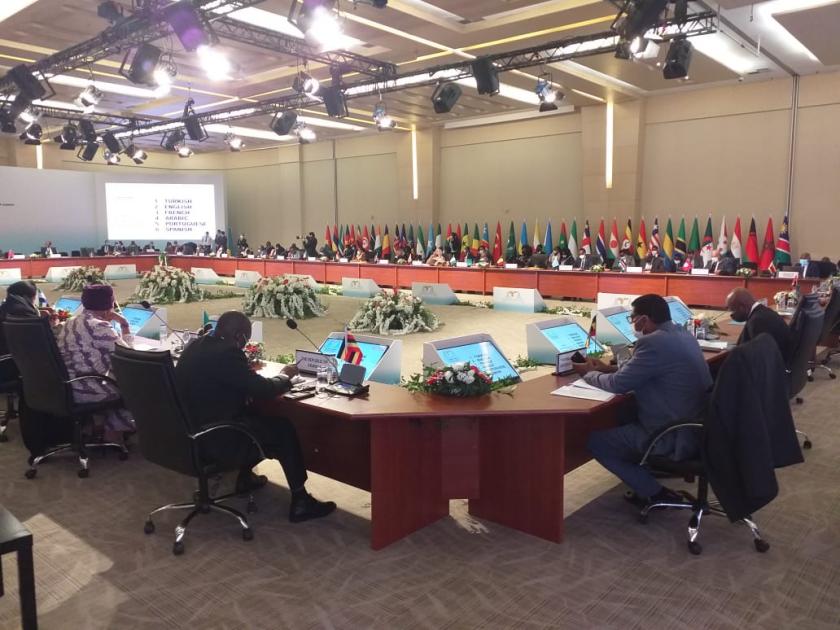
In 2005, Turkey became an observer member of the African Union (AU). Its relations with and presence in the AU were further strengthened when it became a strategic partner of the Union in 2008.[10] The same year, it organised its first Türkiye-Africa summit in Istanbul, which was repeated in 2014 in Malabo, Equatorial Guinea, and then again in Istanbul in 2021.[11] [12] The Africa-Turkey 5-year common action from the last meeting revolves around: Peace, security, and justice; Human-focused development; and Strong and sustainable growth. The African Union and Turkey identified 5 strategic cooperation areas comprising:
-
Peace, Security and Governance;
-
Trade, Investment and Industry;
-
Education, STI skills, Youth and Women Development;
-
Infrastructure Development and Agriculture; and
-
Promoting Resilient Health Systems.
Seemingly, Africa is increasingly treated as if it were a tiny country with local governments whose heads can be easily summoned by leaders of single and mostly smaller countries such as France, the UK, the USA, China, Russia, and now Turkey. The continent, however, is yet to increase the momentum in becoming ‘one country’ indeed, but one which will be treated as a powerful force with resources. In such realisation, countries such as Turkey, who need the continent's resources, will not be summoning leaders in Africa but will come before these leaders in humbling terms for mutually beneficial exchange of resources and trade.
Building of Mosques and the Search for Religious Relevance
Ankara has also instrumentalized religion as another soft power version of the search for relevance on the African continent. The African continent is home to adherents of different forms of faith. Though predominantly practicing forms of African traditional worship, such as ancestral veneration, Arab colonization, which went hand in hand with the spread of Islam and conversion (reversion) of Africans to the religion, makes the continent one of the main centres for the expression of the Islamic faith. Islam and Christianity are currently two major religions on the continent that trace their origins to the Middle East and spread to most parts of the continent through the agency of colonialism.
Unsurprisingly, countries utilize religion as a tool whenever it might suit their quest for relevance, resources, trade, international support, or partnership with African countries with considerable populations that adhere to the belief being weaponized. For several decades, Saudi Arabia has been the major face in religious diplomacy across the Islamic world. It has built mosques in Mauritania, Niger, Nigeria, and Mali. Iran has also built mosques in Senegal, the Ivory Coast, and Guinea.
Turkey, however, is reasserting itself as an Islamic power by engaging in the building of Mosques and the renovation of others. The highest religious authority of Ankara, Diyanet and its Foundation, serves as the vanguard in building a Turkish presence in the Islamic religious space dominated by Saudi Arabia, other Arab countries, Morocco, and Iran. These activities have been visible in Burkina Faso, Chad, Djibouti, Ghana, and Mali. In 2021, Turkey built the Ghana Millet Mosque and Complex in Accra.[13] In November 2019,
the largest mosque in Djibouti, the Abdulhamid II Mosque, was inaugurated. At 13,000 square meters (140,000 square feet) and 6,000 seats, the mosque in Djibouti City is a colossus. Two minarets rise 46 meters (152 feet). The walls are decorated with classic Ottoman calligraphy. The dome is covered with gilded copper lamellas, and a huge chandelier in the inside evokes the illuminations of Turkish mosques. Djibouti's new landmark was financed by Turkey's Directorate of Religious Affairs. Diyanet, as the authority is called, considers the mosque a sign of the strengthening bond between Djibouti and Turkey. Most of the material was imported from Turkey, including the cream-colored natural stone in the prayer room.[14]
The mosques thus carry with them Ottoman footprints or replicate architectural designs and symbolisms of Turkish mosques. The Nizamiya Mosque in South Africa, for instance, is a replica of the Selimiye Mosque in Turkey. To what extent can these Ottoman/Turkish footprints and similar versions become Africanized? Does Africanness have a space in the religious expressions on the continent, wherever the source of the religions? There are many other questions surrounding the competition in Mosque building among Turkey, the Gulf States, Saudi Arabia, and Morocco.
Mosques as religious spaces are sacred for worship, fellowship, and peaceful coexistence, but can also be a space where radicalization and various ideologies can spread.[15] The people of Africa will have to watch out against any form of religious indoctrination in the context of the competition in mosque diplomacy and reject any teachings from any versions of the various faiths that can disturb peaceful coexistence and tolerance among Africans. The religious suppression that works against minorities in Turkey cannot be imported onto the continent that houses hundreds of faiths beyond Abrahamic beliefs and differing forms of the Abrahamic faiths.
Humanitarian Aid
Turkey has been a major donor in the international aid community. It has assisted many countries that have suffered from various human and natural disasters. In Africa, Ankara uses its aid activities in the search for relevance and increased presence on the continent. In 2019 following cyclone Idai, Turkey provided humanitarian assistance to Mozambique in the form of a rescue team, boats, and vehicles.[16]
Infrastructure
Turkish contractors executed more than $85 billion in infrastructure projects across Africa in sectors such as transportation (airports, roads, railways), energy (power plants), and urban development (hospitals, public buildings). Its energy companies like Aksa and Karpowership have been key in the energy sector of some of the African countries. Karpowership is present in hydrocarbon (oil and natural gas) industry in Senegal, Gambia, Guinea Bissau, Guinea Conakry, Gabon, Sierra Leone, the Ivory Coast, Ghana, Gabon, and Mozambique where it engages in exploration and electricity supply.[17] In Ghana, it supplies 12 per cent (450MW) of the country’s total energy demand in a 470MW installed capacity which operates on natural gas (Ghana Gas Atuabo) in the Western Region.[18] Since its presence in 2015, the company has recorded a total supply of 23 per cent of Ghana’s electricity needs.
In East Africa, Turkey has active projects in 9 out of 12 countries in critical infrastructure (Kenya, Uganda, Tanzania, Somalia, Rwanda, Ethiopia), energy (Somalia, Rwanda), ports (Djibouti, Somalia, Sudan), mining (Sudan), and agriculture (South Sudan, Sudan, Djibouti).[19] In Tanzania and Uganda, Turkey is challenging the dominance of Chinese firms in the construction sector. Ankara’s Yapı Merkezi, in a joint venture with Mota-Engil, won Tanzania’s $1.9bn medium-speed rail system.[20] The company is also building a rail system in Uganda to connect with Kenya[21]
What is in it for Turkey?
Very few might see Turkey’s activities as altruistic and so benign to the point of missing the quid pro quo, and the exploitative relationship that underlie aid, humanitarian interventions, diplomatic inroads, and strategic partnerships.
Aside from the search for relevance through humanitarian, religious, and diplomatic avenues, Ankara’s presence in the African infrastructural sector, for instance, mostly benefits its contractors. Africa will need to increase its capacity building and utilize contractors from the continent to execute developmental projects while exchanging and acquiring expertise from professionals with advanced technologies and insights.
A key area that will not be missed in the calculus of the Turkish drive for relevance in Africa is Ankara’s search for critical minerals from the mineral-rich continent. Domestic demand and strategic need to diversify supply chains “amid global competition and geopolitical volatility” have required Ankara’s turn to Africa to secure critical minerals such as uranium and gold to support its energy transition, industrial development, technological innovation, and defence sector autonomy.[22] Turkish ventures directly extract African minerals for export to address shortfalls in Ankara’s domestic supply of rare earth minerals and other resources. The table below lists some of the Turkish companies and minerals they extract or explore and the African country where these activities have been recorded.
|
Select Mining Activities of Turkey in Africa |
||
|
Turkish Company |
Mineral Extracted/Explored |
African Country of Operation |
|
CTC Mining |
Aluminium ore (mine/exploration) |
Sierra Leone Burkina Faso, Guinea, Mali |
|
Turkish MNG Gold |
Gold |
Liberia |
|
Hacıoğlu Gold Mining |
Gold |
Kenya |
|
MTA International Company |
Gold |
Niger |
|
Oruc Reis (Exploration vessel) |
Oil and natural gas |
Somalia |
|
Tosyalı Iron and Steel Angola (TISA) |
Iron ore |
Angola |
Sources: Energy Terminal,[23] APRI[24] TISA[25]
In the beneficiation process, Turkish firms operate in the upstream and downstream production of minerals. Ankara operates a $200 million steel and rolling mill in Senegal.[26] In Angola, Tosyalı Iron and Steel Angola (TISA) has been operating in the 2 billion tons iron ore reserve in the Kassinga Region since 2020.[27] TISA has an annual target of producing 5 million tons of concentrated high grade iron ore and an annual processing capacity of 10 million tons. In Algeria, Tosyalı Holding processes raw ore into forms readily exportable to Turkey to meet industrial needs.[28]
Various deals with African countries have mining or mineral components. Turkish operations therefore occur within the playbook of deals that is gaining more prominence in the last few years. Arms deal in Ethiopia has corresponding mining deals, as did the supply of drones to the Sudan Armed Forces and the delivery of Bayraktar TB2 drones to Niger.
Collaborations that transform the material and productive conditions of African peoples in a south-south context are a welcoming development for Africa and the countries involved. Vigilance is, however, required in ensuring that exploitative relations and imperialistic tendencies are not reinvented, whether the countries involved in such relations are from the global south or the global north, whether they are from Europe, Asia, or in-between, the Gulf, the Saudi Peninsula, or the Levant.
Peter Bembir is a postdoctoral fellow at the University of Ghana and an Associate Editor of Pambazuka News.
Endnotes
[1] Donelli, Federico and Gonzalez-Levaggi, Ariel, Becoming Global Actor: The Turkish Agenda for the Global South (December 1, 2016). Rising Powers Quarterly, Volume 1, Issue 2, 2016, 93-115., Available at SSRN: https://ssrn.com/abstract=3462255 or http://dx.doi.org/10.2139/ssrn.3462255
[2] https://www.dailysabah.com/turkiye/maarif-foundation-expands-global-reach-with-new-school-in-zambia/news
[3] https://trtafrika.com/turkey/how-maarif-foundation-helps-cement-turkiyes-place-in-africas-heart-14049698
[9] TÜRKİYE-AFRICA RELATIONS, https://www.mfa.gov.tr/turkiye-africa-relations.en.mfa
[11] ÖZKAN, Mehmet. Turkey’s African Experience: From Venture to Normalisation. Istituto Affari Internazionali, 2016.
[18] https://gridcogh.com/takoradi-area-visits-karpowership-site/; https://citinewsroom.com/2025/05/karpowership-in-ghana-delivering-relia…
[23] https://www.aa.com.tr/en/energy/coal/turkiye-to-begin-1st-gold-production-in-niger-in-2025/46121; https://www.aa.com.tr/en/energy/coal/highlights-of-turkiyes-energy-mark…
[24] African Policy Research Institute, https://afripoli.org/turkeys-strategic-push-for-africas-minerals-and-po…
[26] https://www.turkishminute.com/2024/05/23/turkeys-steelmaker-tosyali-plan-1-5-2-billion-annual-global-expansion-report/;
[28] Tanchum, M. (2021). Turkey's Maghreb–West Africa Economic Architecture: Challenges and Opportunities for the European Union. Working Paper, WN Pr3 Centre for Applied Turkish Studies (CATS), https://www.swp-berlin.org/publications/products/arbeitspapiere/CATS_Working_Paper_Nr_3_Michael_Tanchum_Turkeys_Maghreb_West_Africa_Economic_Architecture.pdf; https://afripoli.org/turkeys-strategic-push-for-africas-minerals-and-po…