



50 Years Since International Symposium on Zionism and Racism: Reflections on Reparative Justice and the Pan-African Struggle Against Racism
Zionism has discriminatory and racist roots that manifests in its treatment of Palestinians and other races. Elkorghli offers a historicity of the international recognition of the links between racism and zionism, and precedence and Pan-African solidarity for reparative justice.
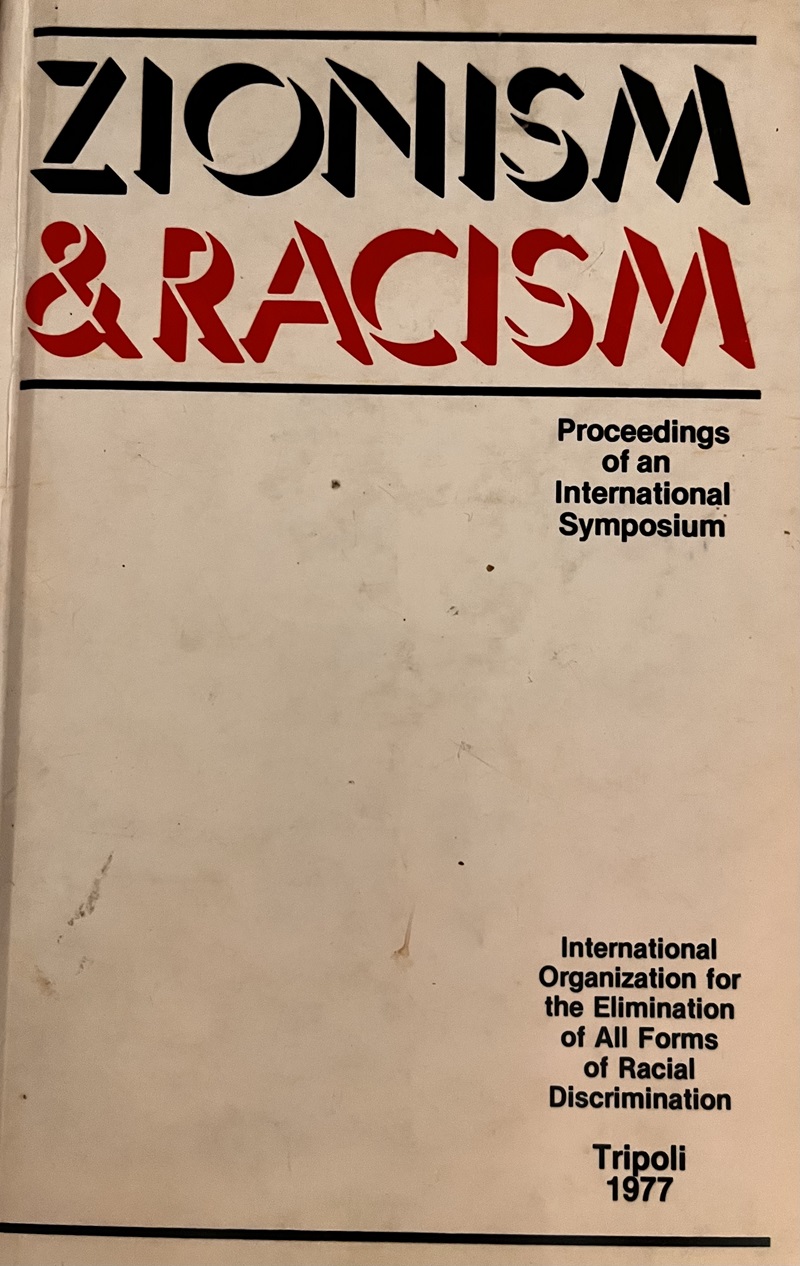
In 1976, one year after the United Nations General Assembly adopted Resolution 3379 declaring Zionism a form of racism and racial discrimination, an international symposium convened in Tripoli, Libya. Five hundred participants from eighty countries gathered to discuss Zionism within the framework of the International Convention on the Elimination of All Forms of Racial Discrimination. The proceedings, published in a volume titled Zionism and Racism, now sit in the University of Illinois library—one of the world's largest—because the original archives were destroyed when NATO bombed the conference hall, Ouagadougou Hall in Sirte, Libya in 2011 — the very site of the 1999 declaration initiating the transformation of the Organization of African Unity into the African Union. This is the story of how empire manages knowledge: it bombs production sites in the periphery and accumulates the remains in the imperial core. The British did it. The French did it.[1] And NATO did it to Libya. That conference, organized by the Libyan state, was part of a long Pan-African struggle to connect the dots: Zionism is a manifestation of settler colonialism in western Asia, apartheid is a manifestation of settler colonialism in southern Africa, and the powers backing them are the same — an imperialist power with reactionary Gulf and northern African monarchies acting as puppets.
Nearly three decades later, in September 2001, a few years after South Africa’s apartheid regime was toppled, scholars, unions, activists, states, and organizations conglomerated in Durban, South Africa, for the World Conference on Racism, Racial Discrimination, Xenophobia and Related Intolerance (WCAR). Throughout the conference, the usual proponents of xenophobia, exclusion, and racial supremacy attempted to tone down the language when it comes to issues of caste and the Palestinian struggle for liberation. The US and its military outpost in the western Asia have been a stumbling block to a progressive final declaration of the conference. The wrongs that have been done and continue to be done by major western powers, colonialism, slavery, and settler colonialism, despite their clear consequential impact on the people, have been lobbied by these powers to relegate them to a secondary issue if not even neglected at all.
This year, on March 25, 2026, the UN General Assembly adopted a resolution declaring the trafficking of enslaved Africans and the racialized chattel enslavement of Africans the gravest crime against humanity.[2] The resolution received 123 votes in favour, with 52 abstentions and three votes against—Argentina, Israel, and the United States. The resolution affirms reparations as an important way of addressing historic wrongs and encourages full and formal apology, restitution, compensation, and rehabilitation. What it does not do is enforce compliance. The Wall of Silence from the West—the US voting no, the EU and UK abstaining—is the sobering context.
This is the terrain on which we must build a Pan-African reparative justice agenda. And to do that, we must confront three unfinished struggles: the Dalit and Roma populations in the global racial order, the naming of Zionism as racism, and the precedent of Libya's reparations agreement with Italy.
The Dalit and Roma: The Neglected Victims of Racial Capitalism
When we speak of the Holocaust, we speak of Jewish suffering. However, “the” denotes that there is one, catastrophic holocaust, and any other one has to be named by the population that suffered equal to the Jewish people at the hands of the Nazis. There is Black Holocaust, Slavic Holocaust, Libyan Holocaust, Congolese Holocaust, Algerian Holocaust, and many others. While most of these holocausts are neglected or relegated to subordinate status to the Nazi holocaust against the Jewish people, the reality is that the Jewish holocaust has monopolized the term Holocaust. However, some historians estimate that the Nazis also murdered roughly 800,000 Serbs, most of them partisan communists, and nearly 500,000 Roma people.[3] The Roma and their suffering is completely neglected. Why? Because they do not have the financial power and prowess that the Zionists tend to have, and they continue to be marginalized politically and economically such that their official numbers are not even recognized. Further, they do not have a declaration on a Zionist homeland. Their case has been abandoned because they lack the material, cultural and ideological leverage to force the world to remember.
The Dalit community in India faces a similar erasure. The caste system is antithetical to democracy and equality, yet when Dalit activists challenge it, the defenders of caste—particularly Brahmins—accuse them of importing Western postmodernist narratives. They say: you are being a cultural imperialist by attacking the caste system. This is mental gymnastics of the highest order. The reality is that caste is descent-based discrimination, and the Durban Declaration and Programme of Action (DDPA)[4] recognized discrimination on grounds of descent. But the final DDPA text did not explicitly name caste. Dalit activists pushed hard for recognition, and they were sidelined.[5]
This is the pattern. Racialized communities that lack geopolitical leverage are abandoned by the international system. The Roma in Romania are officially counted at 500,000, but human rights organizations estimate 2 to 2.5 million. The discrepancy itself testifies to their marginalization. As the Libyan philosopher, Rajab Budabbous writes in The Past of the Future: “According to official sources, the Roma minority is about 500 thousand people, while estimates by humanitarian organizations and Roma organizations indicate that its number ranges between 2 and 2.5 million people” (p. 19). The Roma also suffered under Nazism, but they lacked the financial and media power to amplify their suffering. “Some talk about the disappearance of 800,000 Roma, but the Roma do not have the financial-media power, which enabled Zionism to exaggerate what the Jews were subjected to at the hands of Nazism, with the aim of exploiting it politically to seize Palestine and expel its people” (p. 17).
Zionism as Racism: The Struggle for Naming
In 1975, the UN General Assembly adopted Resolution 3379 (declaring Zionism a form of racism and racial discrimination). The response of Zionists and their supporters was not to demonstrate that the finding was an error, but to mount a campaign to discredit the United Nations. This is familiar. Today, the International Criminal Court and the International Court of Justice are attacked as illegitimate. The same playbook.
The 1976 Tripoli symposium was convened to study Zionism within the context of the definition of racial discrimination accepted without dissent by all members of the UN since 1965. The volume’s[6] opening pages note that the majority of participants came from countries which did not vote in support of the resolution, and included members of the Jewish faith, some of whom were publicly censured later for their non-racist views. It is a sad commentary on the objectivity of the Western information media that they virtually ignored the symposium.
The CIA monitored the symposium. In 2012, documents were declassified showing how closely the agency watched this gathering. The symposium had radical attendees, such as Edward Said, Türkkaya Ataöv, Abdelwahab M. Elmessiri, among many others. The proceedings contain essential documentation. Stefan Goranov’s chapter, “Racism: A Basic Principle of Zionism,” argues: “The colonial policy of the Zionists in Palestine, implemented with the assistance of the imperialist states, especially of the USA, applies the same racist methods which the North American colonizers applied towards the indigenous Indians. The same general ideas also underlie the racist slogans of Zionism, such as 'a world Jewish nation,' 'the people chosen by God,' and 'greater Israel’” (Zionism & Racism, p. 39).
Anis Al-Qasem’s chapter goes further, introducing the concept of “constructive genocide”: “Racism, such as Zionist racism, which denies the very existence of its victims, can safely be termed, in law, ‘constructive genocide.’ When a people, like the Palestinians, are not recognized as existing, when they are denied their homeland, their national existence and identity... what, in such circumstances, remains of them and for them as a people? They become non-people and the individuals non-persons” (Zionism & Racism, p. 24).
In 1991, Kofi Annan—a Ghanaian, a self-proclaimed Pan-African—called the 1975 resolution deplorable. He said “it is deplorable that the General Assembly adopted a resolution in 1975 equating Zionism with racism, and I am pleased that it has since reversed its position.”[7] In essence, we should be ashamed for calling Zionists racist. But the reality that Resolution 3379 named was not erased by its revocation. The Jewish National Fund’s own constitution stipulated that land “is for settlement by Jews only and dwellings built upon this land cannot be occupied by non-Jews, nor may non-Jews (even Israeli Arab citizens) be employed to work on JNF land” (Zionism & Racism, p. 19-20). Joseph Weitz, head of the Jewish Agency’s colonization department (formally and euphemistically called Land and Afforestation Department), wrote in his diary in 1940: “Among ourselves it must be clear that there is no room in this country for both peoples together... The only solution is Eretz Israel, at least the western part of Eretz Israel, without Arabs... and there is no other way but to transfer the Arabs from here to the neighboring countries, to transfer all of them: not one village or tribe should remain” (Zionism & Racism, p. 91). These are the foundational elements of the zionist settler entity, and today, 50 years after the conference, these tenets still hold true.
Libya: The Precedent for Reparations
Libya may be the only country in the world that has a reparations agreement with its former colonizer. Italy colonized Libya for roughly 34 years. During that period, 500,000 Libyans were killed. Concentration camps were developed in Libya under Mussolini and exported as a model to Nazi Germany. This is the boomerang of fascism: colonialism when it comes to the core. Today liberals call the American regime fascist, but they did not mind the turning of Gaza into a concentration camp, and the surveillance technologies being deployed in Afghanistan, Somalia, and elsewhere. They mind them now when they come to the United States.
After 1969, Libya documented all the crimes Italy committed. It created a center for national archives, formerly called The Center for Libyans’ Jihad against the Italians, that collected oral histories of survivors of the Libyan genocide. Then it pushed the case. It was not due to Italy somehow gaining back its humanity and recognizing its wrongs. If that were the case, then reparations to Somalia and the rest of the Horn of Africa should’ve followed suit. Libya could not win the humanity of the oppressor. It was purely about power. Reparations is about leverage.
Libya leveraged its oil contracts and infrastructure contracts. It worked with neighbouring governments to do the same with Eni, the massive oil company. It said: you will not get anything from the African continent until you transfer technology. Development is not just about giving money and then having the recipient spend it on European industries. It requires technology transfer. That was part of the agreement. The 2008 Treaty of Friendship between Italy and Libya mandated $5 billion in Italian-funded infrastructure over 20 years. Only then did Berlusconi state: “It is my duty to express to you, in the name of the Italian people, our regret and apologies for the deep wounds that we have caused you.” Article 8 set out the financial reparations. Article 10 enforced the return of stolen artifacts like the “Headless Venus of Cyrene.”[8]
But neither the title nor the text of the treaty mentions the word “reparations.” The text alludes to settlement of colonial-era disputes, but officially the accord is called a treaty of friendship, partnership and cooperation. This is the trap. Reparations framed as partnership, not as debt. As Fetouri argues: “The fundamental flaw in relying on Western sympathy is that it assumes reparations are a matter of charity. They are not. They are a matter of debt.”
Pan-African Connections: Palestine, South Africa, Iran
Before 1994, Libyan passports explicitly stated: you can travel to all the world’s countries except occupied Palestine and apartheid South Africa. There are so many similarities between the two. Israel used to collaborate constantly with the South African apartheid regime. And vice versa: after 1994, a lot of apartheid rulers declared themselves as Jewish and got land in Palestine. This is the web of connection.[9] And who was funding the energy behind all of this imperialism in South Africa? It was the Iranian regime before 1979. The Iran connection is important. Why is Israel so anti-South Africa today? Why are they so anti-Iran? Because those two countries represent a leap forward for humanity. They represent the possibility of a different world.[10]
The 2026 UN resolution on transatlantic enslavement is a floor, not a ceiling. It gives us the moral framework. What we need now is Pan-African leverage. As Fetouri writes, “Justice is rarely ‘granted’ through the sudden moral awakening of the oppressor; it is 'extracted' through the strategic leverage of the oppressed.”
Libya showed how to extract. The Dalit and Roma show what happens when you cannot. Zionism as racism shows that naming is not enough—you must build power to enforce the naming. And Pan-Africanism, from Tripoli to Durban to New York’s UN General Assembly, is the tradition that teaches us how to do it.
Essam Abdelrasul Bubaker Elkorghli is a Libyan doctoral researcher at the University of Illinois at Urbana-Champaign, researching imperialism, ideology and education with a primary focus on Libya. He serves as the assistant editor to the Middle East Critique Journal, and member of the Global Pan-African Movement. He writes frequently for the Black Agenda Report and Pambazuka News.
Endnotes
[1] Matteo Capasso, Re-Imagining IR Through the Anti-Imperialist Archives of the South of the World, Alternatives: Global, Local, Political, 2026
[2] United Nations General Assembly Resolution A/RES/80/250 https://digitallibrary.un.org/record/4107547/files/A_RES_80_250-EN.pdf
[3] Jovan Bajford (2020). Picturing Genocide in the Independent State of Croatia: Atrocity Images and
the Contested Memory of the Second World War in the Balkans. Bloomsbury Publishing
Plc; Barry Lituchy (2006). Jasenovac and the Holocaust in Yugoslavia (First Edition). Jasenovac
Research Institute. Rajab Budabbous (2008) The Past of the Future [ماضي المستقبل]. Public Culture Council.
[4] See https://www.un.org/en/fight-racism/background/durban-declaration-and-programme-of-action or https://www.ohchr.org/en/publications/reference-publications/durban-dec…
[6] International Organization for the Elimination of All Forms of Racial Discrimination (1976). Zionism & Racism. Tripoli, Libya
[8] Mustafa Fetouri (2026/4/2)."The Creditor’s Invoice: From Reparations to Debt Collection" Pambazuka News. https://www.pambazuka.org/Reparations-to-Debt-Collection
[9] Sasha Polakow-Suransky (2010). The Unspoken Alliance: Israel' s Secret Relationship with Apartheid South Africa. Vintage Books; https://www.middleeasteye.net/opinion/israel-south-africa-home-white-colonialists;
https://www.haaretz.com/israel-news/2021-09-30/ty-article/.highlight/cl…
[10] Kribsoo Diallo (2026 March). Royal Iran and South Africa: The Shah's Role in Prolonging the Apartheid Regime. https://new.pambazuka.org/Apartheid