



Celebrating 100 years of Eusi Kwayana on the planet: Reflections from a comrade, brother and friend
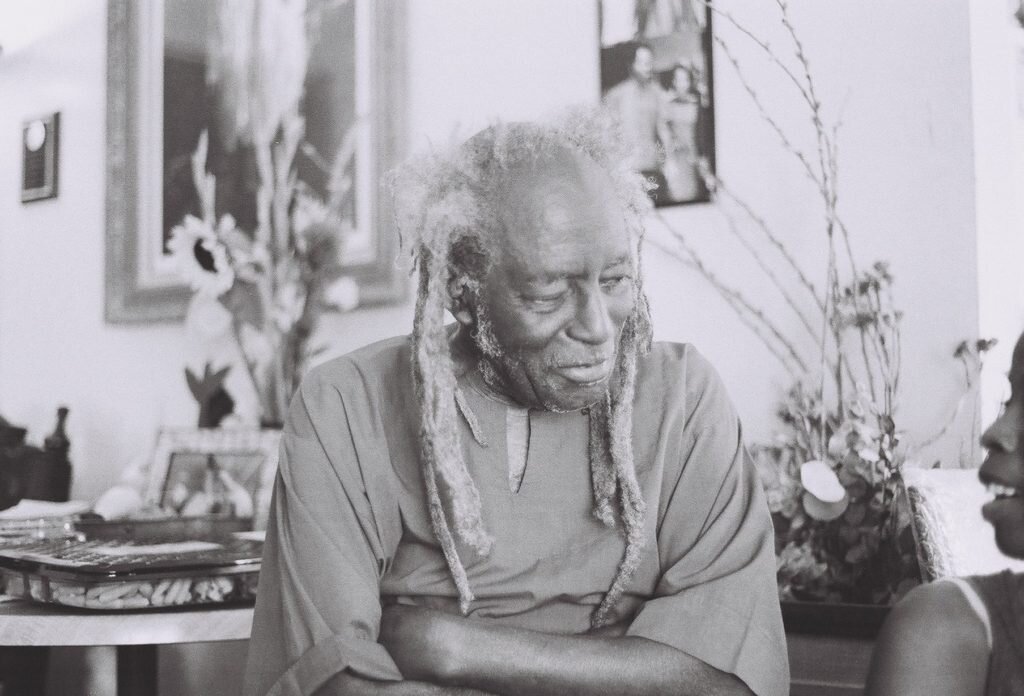
Horace Campbell reflects on the centennial of Eusi Kwayana, the social and political changes and liberation struggles that have characterized his existence and pursuit, and his ideological and intellectual contributions.
Context of the Celebrations of Eusi Kwayana
On April 4, Eusi Kwayana celebrated 100 years on the planet earth. In that period, he witnessed massive social and political changes from the struggles against colonial plantations, to the struggles for a new international order and currently the struggles against authoritarianism. In his lifetime there have been technological changes that have been transformative, particularly in communication, transportation, healthcare and artificial intelligence. Side by side with these technical changes, he has been a witness to the debasement of the human spirit, based on the outmoded ideas of eugenics, racial divisions, male chauvinism, homophobia, white supremacy and colonialism. As a frontline teacher who paid close attention to the community and the youth, Kwayana endured and is now witness to the unfolding contradiction between revolution and counterrevolution, and attempts at the establishment of permanent divisions between racial and religious groups. The massive productive capabilities of new technologies threatened the very prosperity it produced as the destructive ideas of colonialism and white supremacy collided ever more with the possibilities for new forms of human organization away from human bondage and the super exploitation of women. Kwayana is now the first to admit that the political and cultural leadership of women in advancing care for other humans and other humans is now the priority.
In the internal education session of the Global Pan African Movement on May 7, 2025, this one-hundred-year-old sage held court for more than two hours on the importance of struggle. His advice was simple, ‘struggle prepares us for what is before us.’ This straightforward message was communicated at the celebrations held in Atlanta on April 26, 2025, when scores of his former students, (now elders) testified to how this mantra of education and struggle had guided Eusi Kwayana in the village of Buxton, Guyana. His children (biological and others) had worked hard for him to celebrate his 100th birthday in his beloved village of Buxton, Guyana. There Kwayana repeated the message that he has been sending for the past fifty years, social peace must come from decent humans. This message of peace, truth and love was repeated by elder Kwayana in these celebrations, whether Atlanta, Buxton or virtually in the GPAM internal education. In the virtual celebrations, he impressed everyone present with his sharp intellect, remarkable memory, and eloquent articulation of the call for the self-emancipation of working people worldwide."
Born as Sidney King
Guyana, located in the northeastern corner of South America, is a multilingual and multiethnic society that shares deep cultural ties with the Caribbean. This former British colony is part of the territory of numerous indigenous peoples whose living spaces were torn apart by the Dutch, French, British and Portuguese. Current day Guyana is underpopulated with less than one million souls and shares a border with Suriname, which itself borders the current colonial territory of Cayenne (so called French Guiana). To the south of Guyana lies Brazil and to the southwest, the country called Venezuela. This precise geographic location resulted in colonial powers fighting since 1492 for this territory. After the defeat of Napoleon and the French by the Haitian revolutionaries in 1804, the British gained military control of Guyana (then called British Guiana) from the Dutch in 1814, after a period of British occupation and Dutch restoration. The British formally acquired the territories of Essequibo, Demerara, and Berbice from the Dutch at the London Convention of 1814. These three colonies (named after the mighty rivers of Guyana) were later unified into British Guiana. The British furthered the expansion of capital in the society pushing the indigenous peoples further and further away from the coast. Africans had fought against enslavement with the Berbice revolt of 1763 only surpassed by the Haitian uprising in terms of its massive inspiration to enslaved Africans everywhere. The Demerara rebellion against enslavement in 1823 rocked the British colonial enslavers and speeded the general emancipation process that was unfolding after Haiti in 1804. After the emancipation of 1834 and the apprenticeship system that lasted 4 years, the former enslaved Africans established free villages. The quest for emancipation by these formerly enslaved dominated the consciousness of those who organized the villages. Sidney King (now known as Eusi Kwayana) was born in one of the free villages. The village had been named after the British abolitionist, Thomas Fowell Buxton.
The colonial state was organized to support the planters when the former enslaved refused to work on the plantation after the abolition of slavery in 1834. Indentured laborers, mainly from India, were brought in to replace enslaved workers on these plantations. The British consciously sought to set the Indian indentured workers against the former enslaved Africans. During the era of monopoly capital, the Bookers Group demonstrated the ways in which militarism, the colonial bureaucracy and the educational system shaped Guyanese colonial society. Through their propaganda organs and links to the media, the myth was propagated that the sugar industry experienced steady growth throughout the 19th century, with British Guiana becoming known for high-quality specialty sugars like "Yellow" and "Demerara Crystals".
By the time Kwayana entered this world, monopoly capital had been entrenched with the Booher group controlling Bookers Sugar Estates (BSE), and other related companies: Bookers Stores, Bookers Demerara Shipping. Bookers Rum Company, British Guiana Lithographic Company, Pharmaceuticals, B.G Balata. Those who want to understand the nature of the plantations can read the rich documented history. Walter Rodney made one such compilation in Guyanese Sugar Plantations in the Late Nineteenth Century: A Contemporary Description from the "Argosy”. The oppression of the entire sugar industry was so intense that for five generations after the Second World War, Guyanese intellectuals focused intensely on this plantation system. One of those intellectuals from Guyana, Elsa Goveia was born in the same year and the same month as Eusi Kwayana. Goveia had been one of the teachers of Walter Rodney, another world class historian. Walter Rodney in his book on the History of the Guyanese Working People tells the story of the resistance to this brand of monopoly capital.
Eusi Kwayana remains a living example of the struggles of the working peoples of Guyana.
The Village Movement in Guyana
Born Sydney King in Lusignan on the East Coast of Demerara in 1925, our sage grew up in the environment of the self determination of the villagers to free themselves from colonialism. Lusignan is in the same region as the villages of Annandale and Buxton, two communities that were to shape the early years of the life of Sidney King. Our elder moved with his mother from Lusignan to Buxton in 1932 at the age of seven. Numerous internet pages will give the dates of this move. What has been stressed time and time again by Kwayana was the importance of the village space as a space for Africans and Indians to determine their livelihood.
In the internal education session of May 7, Elder Kwayana spoke on the sacrifices made by the formerly enslaved to purchase land and establish villages. He reminded the youth of the levels of social collectivism that existed in these villages. The villages were spaces to reconstruct family structures that had been fractured by enslavement, provide dwellings for these new families, teach crafts and skills to villages and above all started schools to ensure general literacy. Kwayana has written extensively on these forms of cooperation in the village and the phenomenon of the Village movement in the book, Buxton Friendship, in Print and Memory. Kwayana quoted the observation of a colonial government historian who explained that the people's attitudes to land resembled that of the West African system of communal land ownership instead of individual proprietorship. Closer examination discloses:
“In British Guiana, by contrast, communal land holding was not an end in itself, but the first step in a programme of collective farming in which each plantation was to function as a separate cooperative movement.” Page 20-21
Kwayana further quoted from the British newspaper on this village movement in Guyana.
“The London newspaper, Times, wrote two editorials on the movement in Guiana, one on 5 August 1845 and the other 19 August 1845. Very much concerned that labour was finding a way out of the plantations, the writer described the new villagers as a "little band of socialists who purchased land and lived in communities.” Pp 21
Kwayana noted that long before Karl Marx had written the Communist Manifesto in 1848, the world saw our ancestors as ‘a little band of socialists’ since they rejected the plantation and cooperated as a single joint enterprise.’ The villagers did not give themselves that name, socialists, but they had started something which was the opposite of the robbery of the plantations and something which actually gave each person an equal share and control of the agricultural enterprise.
In the book, the Morning After, Kwayana clarified the centrality of the village in the lives of the people.
“In Guyana a village is a basic community of people. Amerindian villages have a long long history and were the homes of the original peoples. They are tied to the land and see it as their mother. At the same time, it is an economic unit, a primary education unit, a social unit and a unit of government, a unit for cultural refreshment and preservation.”
In the 21st century when the violence and thuggery of the Guyanese society forced Eusi Kwayana into exile, he wrote a book about the violence that had overcome villages such as Buxton in Guyana. As a site of politics, there is a long tradition where the village had been associated with spaces of hope and spaces of freedom. Free villages in Guyana provided bases for all the major struggles against plantation conditions, against racial discrimination and colonial manipulation. The villages provided room for self-empowerment, self-organization and the kind of politics that led to the self-confidence of the population. Close knit village communities also ensured that there were restraints on masculinity and senseless violence associated with impersonal and barrack-like urban communities. The women in the villages in Guyana are now being imprisoned by this massive insecurity as the space of cultural refreshment and preservation becomes a place of kidnapping, hostage taking, murders and rape.
In the book authored by Kwayana, entitled The Morning After, I was privileged to write a preface to that time which excoriated those who introduced gunmen and divisive violence into Buxton. In his one hundred years, Kwayana had come of age in the capitalist depression, he had witnessed the Garveyites and Jordanites pushing political autonomy and as a young person had been inspired by the struggles in India for Independence. Thus, at a very young age Kwayana was associated with the activities of those who supported the Congress Party of India in the British colony of Guyana.
Growing up as Sidney King
In colonial British Guiana, as in other parts of the Caribbean, literacy was a premium for the mass of poor people. Primary school education opened up many worlds and Sidney King never looked back. Kwayana, like CLR James, did not have a formal university education, but graduated from the University of Life.
Nigel Westmaas called Kwayana ‘a writing machine.’ He described the elder in the following words:
“A “writing machine,” the Buxton sage has produced hundreds of works across multiple genres—poems, critical reviews, short stories, letters to newspapers, opinion pieces, song lyrics, obituaries, court motions, parliamentary interventions (motions and speeches), editorials, political statements, essays, press releases, and plays for both theatre and grassroots events.”
Nigel Westmaas stated: “Kwayana’s collected writings—poems, plays, reviews, screeds, theoretical expositions, etc.—will astonish the world.” And, “Kwayana has arguably written more extensively over time than any other single political figure in Guyana, and possibly in the entire Commonwealth Caribbean.”
“His writings span from poignant lyricism on culture, people, and village life to the often anguished, self-effacing critique of Guyana’s political landscape—including his own role in it.”
The tremendous self-discipline of Kwayana had placed him as a Shakespearean actor, a poet, a short story writer, an essayist, and an author of books that now illuminate the history of struggles in the Caribbean. In the war against fascism, Sidney King identified with those opposing colonialism and fascism. One of his favorite artists was Paul Robeson. He followed the spirited campaign of Robeson to oppose fascism in Spain and to promote international solidarity.
Guyanese workers had been organized by villagers and trade unionists from the uprisings and rebellions of 1905. Historians now argue among themselves whether 1905 was a riot or rebellion in Guyana. But the unmistaken fact was that the Guyanese workers undertook organized and spontaneous actions against the colonial state and the colonial companies. This tradition birthed the British Guiana Labour Union (BGLU)—the first trade union in the Caribbean. The trade Union movement did not only fight over issues of wages but also social questions such as rent control, control over canals and back dams, old-age pensions, national health insurance, and labor protections. As a teacher who labored in the village, Sidney King joined the Ratepayers’ Association of Buxton that challenged the colonial and sugar plantation control over the canals.
These struggles in Buxton brought the village to international notoriety, thus, it was not by chance that one struggle led to the next and the villagers of Buxton were at the forefront of expressing solidarity with the workers at the Enmore sugar estates who were shot down in 1948. Two years earlier, Sidney King had joined a group, the Political Affairs Committee (PAC), that became the forerunner of the People's Progressive Party (PPP). The Political Affairs Committee had been energized by the global anti colonial forces and very early supported the ideas of building socialism in the Caribbean. By 1950, when the PPP became a Party, Sidney King was one of the more prominent leaders in what was then a united front of Indians and Africans in an all-class anti colonial movement.
The British and the US government determined to break the back of this movement and thus suspended the Constitution of the colony and incarcerated Sidney King along with other leaders in 1953. The British colonial authorities accused the PPP government of pursuing a Marxist agenda and promoted the disinformation campaign that ‘communists’ in Guyana were undermining the interests of western capitalism. On October 9, 1953, British troops were deployed, the constitution was suspended, and an interim government was installed under direct British rule. Five PPP leaders - Sydney King, Rory Westmaas, Martin Carter, Ajodha Singh and Bally Lachmansingh - were on 24 October 1953 arrested and locked up in the detention camp. This history is important for younger Guyanese and Caribbean people to grasp the fact that in the anti-colonial struggles, there was a multi racial alliance which the British and the US government sought to break.
Sidney King did not neglect the village while campaigning in the PPP. In 1954, he started County High School in Buxton. The surviving pupils of County High School of Buxton continue to collaborate with Buxton/Friendship Museum Archives and Cultural Center in Guyana.
From Sidney King to Eusi Kwayana
Nigel Westmaas, David Hinds, Moses Bhagwan, and others from the political circles of Kwayana have written extensively on the life and work of Kwayana. This period in the life of the Caribbean is central to grasping the damage done to the Caribbean region during the Cold War. This damage was intensified after the victory of the Cuban Revolutionaries in 1959. Imperialism was bent on splitting the nationalist movement. This resulted in the formation of the People's National Congress under the leadership of Forbes Burham. Guyana limped towards constitutional decolonization under the carefully scripted machinations of the British, who sought to reap the benefits of racial insecurity and violence that broke out in the society in 1964. Guyana became an independent country in 1966 under the leadership of Forbes Burnham and the PNC. Kwayana maintained a healthy distance from the leadership, but in the eyes of the African people, he was an African leader. He served as Chairman of the Guyana Marketing Corporation (GMC). In the internal education session of May 7, Kwayana related his version of his journey to Ghana on behalf of the government of Burnham and the PNC.
Kwayana holds the distinction of writing the party songs for all three major political formations that arose in Guyana since 1950: the PPP, the PNC, and the Working People's Alliance.
Sidney King was one of the brains behind the African Society for Racial Equality (ASRE). Later, Sidney King co-founded with Tacuma Ogunseye, Ngozi Moses, Sase Omo, and Sybil Sargeant the African Society for Cultural Relations with Independent Africa (ASCRIA) in 1964.
It was in this period of heightened political consciousness that he changed his name from Sidney King to Eusi Kwayana, meaning Black man of Guyana. In this period, he met Ann Cook who became his partner. She took the name of Tchaiko Kwayana. Together with ASCRIA, these elements became a major force in the support for African Liberation.
The radical traditions of Guyana from Critchlow to Jagan meant that the political culture of Guyana was infused with a very high political consciousness. Guyana declared itself to be a cooperative Republic on February 23, 1970. The high levels of concentration of capital in the hands of Bookers Group ensured that worker consciousness to support the nationalization of foreign capital was very high. The People's National Congress equated nationalization with socialism, with the Burnham regime promoting cooperative socialism, emphasizing collective ownership, self-reliance, and the development of cooperatives in agriculture, industry, and commerce. The workers were not duped. The Bauxite workers, sugar growers, factory workers intensified their struggle for bread and justice. It was in this period that the PNC was branded with the label of pseudo socialism.
Eusi Kwayana, Guyanese radicals and the Working People's Alliance.
The heightened political consciousness against imperialism after 1968 inspired anti imperialists in all parts of the world. Guyana would not be left out. Student protests in Paris, USA, Jamaica and the rebellions in the Caribbean communities at home and abroad had generated a new confidence among anti imperialists. Forbes Burnham took advantage of this political climate to promote Guyana as a haven for black radicals and intellectuals from the USA. The long-awaited book of Russel Rickford documents this period of anti-imperialist consciousness in Global Africa.
ASCRIA became a force for Pan African solidarity, and it was from Guyana where the call went out to revive the African Liberation Day celebrations that had been started in Harlem by Carlos Cooks and Elomb Brath. As a young man, this author had joined in the pilgrimage to Buxton with Roosevelt Douglas in the summer of 1971. Numerous organizers from Malcolm X University in Greensboro, North Carolina, made this pilgrimage. Howard Fuller (later known as Owusu Sadauki) was one of those whose consciousness rocketed him to the forefront of the African Liberation Support Committee that did the back breaking work for African Liberation Day in 1972.
The pace of political organizing inside Guyana inspired several organizations to come together to form the Working People's Alliance. The organizations were
-
ASCRIA – African Society for Cultural Relations with Independent Africa
-
IPRA – Indian Political Revolutionary Associates
-
RATOON – A small Marxist-oriented group, primarily Indo-Guyanese, with a focus on revolutionary politics.
-
WPVP – Working People's Vanguard Party. A Marxist-Leninist group with a strong ideological foundation.
These groups, along with independent activists like Bonita Harris, Andiaye, Rupert Roopnaraine, and Clive Thomas, merged to form a multi-ethnic, anti-authoritarian, and democratic socialist movement. When Walter Rodney relocated from Tanzania in 1974 to Guyana, he joined this formation. One of the first campaigns of the organization was to defend the right of Walter Rodney to work in his profession in Guyana. The University of Guyana had hired Walter Rodney to teach as a Professor of History at the University, but the government blocked the appointment.
The refusal to hire Rodney at the university was supposed to throw Rodney and his family into disarray, but the political culture of social collectivism and the strengths of the solidarity of the people kept Rodney and the Working People's Alliance (WPA) alive. The WPA was formed to break out of the racial incarceration of the two main racial groups.
In the period while he was alive, Walter Rodney was a tireless champion of the working peoples and fought for equality among the working peoples. The leaders of the WPA were from varying political tendencies. Despite their differences, these political activists were united on the question of ending the politics of racial insecurity. How to move this proposition from theory to practice was always problematic and in the fifty years of its existence, the WPA is still grappling with this question.
Imperialism and the local PNC forces resorted to the ultimate crime, the assassination of Walter Rodney. The fact that the PNC and Forbes Burnham were responsible for the assassination of Walter Rodney has now been documented in the International Commission of Inquiry into the assassination of Walter Rodney. The full Report can be found here: https://www.walterrodneyfoundation.org/coi
Eusi Kwayana opposed the second assassination of Walter Rodney.
By 1980, imperialism had gone berserk in seeking to decapitate progressive movements in all parts of the world. The alliance of the British Prime Minister, Margaret Thatcher along with the election of Ronald Reagan had given confidence to the forces of assassination and destabilization. In this context of counter revolution, some on the left accused Walter Rodney of adventurism. This charge was reinforced when C. L. R James wrote the pamphlet, Walter Rodney and the question of Power. This presentation of James had been delivered at a lecture one year after the assassination in September 1981 at the University of California at Los Angeles. Elements in London associated with Race Today, the Bogle-L'Ouverture Publications bookshop, reproduced this lecture as a pamphlet. Many on the left started to repeat the line of James, that ‘Walter Rodney should not have been there.’ The physical assassination of Walter Rodney was now accompanied by the intellectual assassination to discredit his work. To the undiscerning reader, books such as Rodney: A Promise of Revolution, edited by Claimont Chung (Monthly Review Press), and Leo Zeilig’s Revolutionary in our time read like a critical acclaim of the work of Rodney. But it requires the insights of Kwayana and those close to Rodney such as Andiaye, Nigel Westmaas, David Hinds and Wazir Mohammed to reveal the real damage to left intellectual work by the characterization of Walter Rodney presented in these books.
Later in 1988, Kwayana wrote on "Eusi Kwavana on Walter Rodney: An essay on Self Emancipation.” Here, Kwayana spelt out the position of the WPA on vanguardism and the push of the WPA to work with the working people so that they could take themselves from one level of struggle to the next. Kwayana noted of Walter Rodney,
“And in this context of Guyana, he was the first true revolutionary of the post 1953 era. In this, he became integral in our progression to an idea of national destiny, and once again he brought to the forefront, the sine qua non of our national integrity and our sovereignty and our security and our cohesion, new conciliatory forms of government.”
Eusi Kwayana and the pulse of the people
Neither Kwayana nor Rodney could survive the onslaught of imperial violence and disruption. The ruling elements of Guyana know of the love of the people for Eusi Kwayana. Kwayana kept very close to the grassroots and was willing to learn from the women of Guyana who had started the Red Thread Movement to bring oppressed women together. His relationship to Andiaye and Selma James and the international women’s strike is still not fully documented. Kwayana was able to learn from Andiaye and Karen DeSouza and other progressive forces to overcome the rabid homophobia in the Caribbean. The depth of Kwayana’s appreciation and solidarity with the women of the Caribbean can be gleaned from his writings and his undying love for Tchaiko. It will be instructive to find these readings especially the Tribute to Andaiye (A longer version of this tribute was first carried on Pambazuka.org on June 15, 2019) in the Diaspora column, Stabroek News, June 17, 2019.
In 1993, I held long discussions with Kwayana on the question of Pan African liberation. His sense of the spiritual needs and for spiritual regeneration was his principal message. He had noted:
" the spirituality of a people speaks about those strengths of a people which cannot be destroyed, worn out, assassinated, or eliminated by other means. It is the reservoir that is closest to the mind and interflows with it, giving and receiving. In domestic, political and social life, it is the extent to which individuals and the community make and sustain an option for virtue rather than vice, purity rather than perversion, justice rather than injustice, freedom rather than oppression, plenty rather than poverty, and work for the future of universal love rather than universal greed. The spiritual dimension, therefore, permeates life and is as relevant in politics as it is in domestic life and the moral sense of a people. Spiritual health reinforces public or political morality. Spiritual health becomes diseased by tolerance without agonising and resistance of injustice, racism, gender oppression, ignorance, corruption, and all other forms of wrong, and what is not so well understood, disrespect, not only for elders, but equally of youth."
His own life remains an example of The spirit man.
When I was writing Rasta and Resistance forty-five years ago, I had asked Kwayana to write the preface. He grasped the importance of the rasta as a force for revolutionary change and wrote,
“The placing of the stamp of Babylon on the whole of official society and the wide acceptance of this description is one of the landmark achievements of the Caribbean Revolution. The more it is seriously accepted, the more the culture divides into two poles of authority: a necessary forerunner to any long term revolutionary objectives. Those members of the society who do not accept or embrace the dress, or need the religious ideas, accept the language, those who do not accept the language with the movement’s definition of the order of things, accept the music. In fact, such is the power of art that Bob Marley’s music has done more to popularize the real issues of the African liberation movement than several decades of backbreaking work of Pan Africanists and international revolutionaries.”
Kwayana and the struggles against authoritarianism and violence
Imperialism was never asleep in understanding the force of Eusi Kwayana in the Caribbean. After the killing of Walter Rodney, the military invasion of Grenada and the counter revolution of the period, it required sterling and backbreaking work to ensure that the society of Guyana was not torn apart. Kwayana and the WPA forces along with their cyclostyled bulletin Dayclean kept the political consciousness of the people ahead of those who wanted to break up the society with inter communal violence. By 2002, Kwayana relocated to San Diego to join his wife and partner Tchaiko. Kwayana had been watching the racial polarization and the mix of drugs, guns and violence that had been introduced into his beloved Village community of Buxton. I urge all those reading this column to read and digest that book, the Morning after,
In the book, Kwayana asks some very penetrating questions:
How does this multi racial democracy comes about?
What must be done?
These are the hard questions that Kwayana sought to address. The answer for Kwayana lies in the Politics of Truth and the new politics of Reparations. The Reparations posited in the book, the Morning After, is not one based on monetary compensation, but one linked to healing and truth telling of the crimes against humanity in the structures of slavery and racism. Kwayana is calling for an epistemology that supports the search for truth. This is the kind of democratic epistemology that opens room for greater understanding beyond rigid orthodoxies. Kwayana pointed to the orthodoxies that led to the implosion of the Grenadian revolution and the kind of rigidity that led to the socialist collapse after 80 years.
“The new times and the changes to the generation in the most complicated state of social life in history. Human creativity must rise to the challenge. Resources of mind and spirit seen closely in the non established faiths mostly but available in the thought and heritage of all races, should not be ignored as life resources.”
Here, Eusi Kwayana was calling for a new concept of social change that rises above the fragmentation and separation of spirit and matter.
Kwayana maintained, “Things cannot be fully examined from one angle or one perspective only. The women’s movement has long begun to understand this. A lot of what we men call ’feminine’ is highly rational and intellectual whereas we dismiss it as emotional, because women allow themselves to see with more than their eyes, whereas we, the male leaderships, think it is unmanly to deal with people’s emotions or even to take them seriously into account. except to curse them. Research and interpretation are some of the most valuable tools of scholarship, especially in racially divided societies.”
The most important aspect of the political life and work of Kwayana is the call for self emancipation. Kwayana made an explicit statement to the Afro Guyanese,
“Those who captured, stole, bought and enslaved our African foreparents are well out of the way now. Their crimes are with us in their works, the institutions and economies they created. Much more is left to be done and it includes a wise and well managed campaign for reparations. None of our redress can be obtained by attacking Indians. Chains are left dangling, from hands, feet and minds. From these we must emancipate ourselves.”
This message of self emancipation was communicated to the cadres of the Global Pan African Movement. At one hundred years old, Kwayana remains alert to the dangers of fascism but is confident that the radical traditions of anti-slavery, anti-colonialism and anti-fascism will prevail.
Eusi Kwyana agrees with Walter Rodney that the task of the progressive is to open up the appetite of the people for self discovery.
Further readings
Eusi Kwayana (2005). The Morning After.
Eusi Kwayana (2000). Buxton Friendship, in Print and Memory. Red Thread Women’s Press
Eusi Kwayana and Tchioko Kwayana (2024). Scars of Bondage: A First Study of the Slave Colonial Experience of Africans in Guyana. On Our Own Authority.
Walter Rodney (1981). A history of the Guyanese Working people, 1881-1905. John Hopkin’s University Press
Horace Campbell (2005). Walter Rodney, the Prophet of self emancipation. Pambazuka News, https://www.pambazuka.org/governance/walter-rodney-prophet-self-emancipation
Eusi Kwayana (2019). 39 years since Walter Rodney fell; Andaiye, Walter Rodney’s colleague has rejoined the ancestors. Pambazuka News, https://www.pambazuka.org/39-years-walter-rodney-fell-andaiye-walter-rodney%E2%80%99s-colleague-has-rejoined-ancestors
Andiaye (2020). The Point is to Change the World: Selected Writings of Andaiye Edited by A. Trotz. Pluto Press.