



Time Longer Than Rope: The Assassins of Patrice Lumumba on Trial
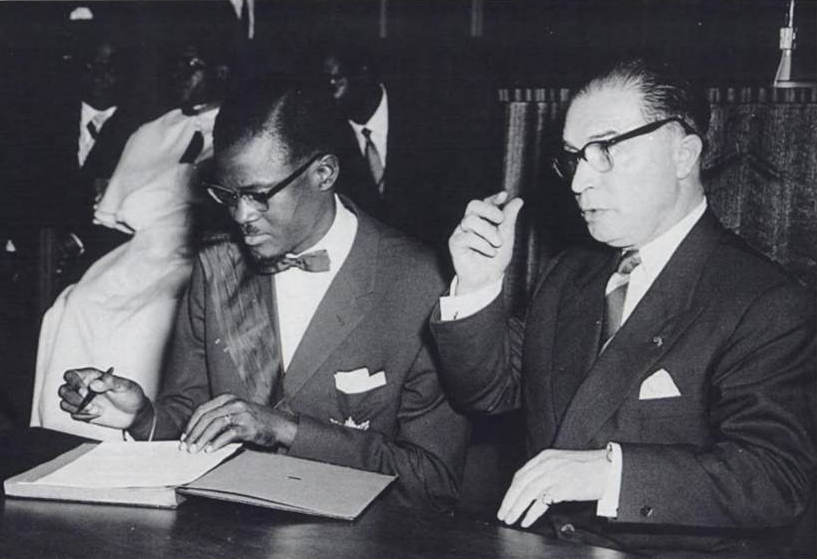
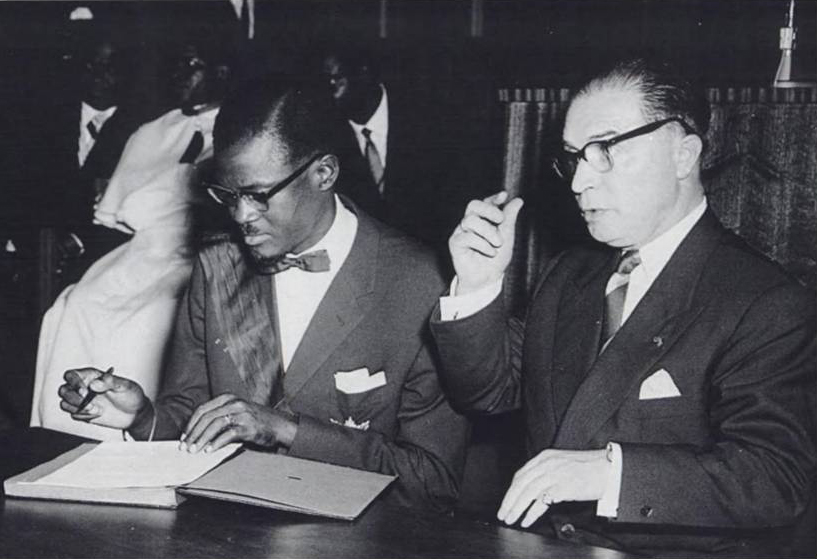
Étienne Davignon and the systems of enslavement and exploitation stand trial in Belgium and in the international arena for the gravest crime against humanity.
Introduction: The Assassination Was Part of a Recursive Process, Not an Event
Patrice Lumumba was assassinated on 17 January 1961 in the province of Katanga after being secretly transferred from detention. Western imperial interests in the Congo had engineered the secession of Katanga to break up the independent Congo even before the flags of Belgium were lowered. The transfer of Lumumba into Katanga itself constituted an illegal act, carried out with full knowledge that Katanga was controlled by forces committed to his elimination. This was not a mistake in judgment. It was part of a designed sequence.
Upon arrival in Katanga, Lumumba was beaten and tortured. ‘Katangan’ authorities carried out the violence, but Belgian personnel were present and complicit. The abuse was systematic. It stripped Lumumba of dignity and was intended to demonstrate the absolute defeat of a leader who had dared to speak of African sovereignty.
Later that evening, Patrice Lumumba, Maurice Mpolo, and Joseph Okito were executed by a firing squad composed of Katangan forces with Belgian mercenary involvement. Their deaths were not spontaneous acts of revenge but the culmination of a bureaucratically organized political murder.
After the executions, Belgian officer Gérard Soete supervised the destruction of Lumumba's body. The corpse was cut into pieces and dissolved in acid. This was done deliberately to erase evidence and to suppress the symbolic power that Lumumba's body would have held for Congolese and Africans more broadly. The aim was not only to kill Lumumba but to remove him from history. This was a conscious effort to assassinate the African self-determination project itself.
This essay traces that effort and its long aftermath across several interlocking dimensions. It begins with the immediate responses of Global Africa, from the streets of New York to the music of the Caribbean, before turning to Kwame Nkrumah's framework for understanding the Congo as the nerve center of African liberation. It then examines the 2026 prosecution of Étienne Davignon and the transnational architecture of white supremacy that made Lumumba's elimination a collective imperial project. Drawing on the scholarship of Patricia Daley, Ernest Wamba dia Wamba, and Georges Nzongola-Ntalaja, it situates the assassination within a structural analysis of genocidal state violence and its postcolonial continuities. It concludes by placing the Davignon trial and the United Nations resolution of 25 March 2026 within the same historical moment: the beginning of the end of impunity by delay, and the emergence of a reckoning that the recursive logic of imperial power can no longer defer.
Global African Responses to the Assassination
African peoples in all corners of the planet responded immediately and opposed Lumumba’s murder. African students, workers and cultural workers marched and demonstrated against Belgian imperialism. In New York City, Malcolm X, Maya Angelou, Ossie Davis, Ruby Dee, Abbey Lincoln, and Max Roach joined a broad network of Black artists, intellectuals, and activists who disrupted proceedings at the United Nations, holding the United States government and the Secretary-General as accomplices in the assassination. The protest was not spontaneous. It expressed a political clarity that had been building across Global Africa, as news of Lumumba's capture and detention spread.
Patrice Lumumba inspired music in the Congo and across Africa by becoming, almost immediately after his assassination in 1961, a symbol of betrayed independence, anti imperial struggle, and African dignity. In the Congo, leading independence era musicians such as Joseph Kabasele and L’African Jazz, Franco Luambo and OK Jazz, and Dr Nico used popular rumba to mourn Lumumba, name the violence of the postcolonial state, and inscribe his death into collective memory through songs that spoke directly of martyrdom, loss, and national disillusionment. Beyond the Congo, artists such as Miriam Makeba and later politically engaged musicians across West and Southern Africa invoked Lumumba as a pan African figure whose fate revealed the costs of challenging colonial and neo colonial power. Over time, even as later generations of Congolese musicians moved away from explicit nationalist themes, Lumumba remained a reference point, not always named but embedded in musical languages of dignity, resistance, and unfinished freedom that linked culture, politics, and memory across the continent.
From the Caribbean, reggae artists carried that grief into popular culture. Bunny Wailer, of Bob Marley and the Wailers, drew on Lumumba's legacy in his music, honoring him as a symbol of African resistance, anti-colonial struggle, and martyrdom. Jazz musicians and cultural leaders responded with the same urgency. These were not peripheral gestures. They were expressions of an anti-imperialist and Pan African political consciousness that recognized in Lumumba's death the murder of a project, not merely a man.
Kwame Nkrumah and the Congo as the Nerve Center of Africa
These artists and activists had taken their cue from a political framework articulated most forcefully by Kwame Nkrumah. Nkrumah saw the Congo not as a peripheral tragedy but as the central battlefield of African liberation. In Challenge of the Congo, he argued that the destruction of Lumumba was essential to the survival of neocolonialism. Whoever controlled the Congo would shape the destiny of the entire continent.
For Nkrumah, Lumumba's assassination revealed the structural limits of political independence without economic independence and continental African unification. Political sovereignty without economic control would be permanently vulnerable to coups, secessions, and assassinations organized from outside. The Congo Wars that followed confirmed his central thesis: imperialism had not ended but changed form, operating now through client regimes, resource extraction, and the deliberate destruction of any leadership capable of constructing genuine African self-determination. This African analysis preceded and surpassed later Western explanations that framed the assassination solely through the lens of Cold War rivalry.
Kwame Nkrumah would later confront the political risks inherent in reliance on British-trained and externally networked military personnel within Ghana’s armed forces, a dependence shaped in part by Cold War security alignments (Hutchful 1973; Rooney 1988). Ghanaian officers who participated in the United Nations Operation in the Congo during the crisis surrounding the overthrow and assassination of Patrice Lumumba were embedded in transnational command and intelligence structures that extended beyond national control. Figures such as General A. R. Alexander—associated with these UN deployments—were later implicated in the 1966 coup against Nkrumah, illustrating how circuits of military training, peacekeeping, and Cold War intervention intersected in the reconfiguration of postcolonial sovereignty (De Witte 2001; Horne 1986).
Belgium and Étienne Davignon
On 17 March 2026, a Belgian court charged Étienne Davignon to stand trial for his role in the processes that led to the assassination of Patrice Lumumba, marking an unprecedented legal reckoning with Belgium's colonial violence in the Democratic Republic of the Congo. In line with the established scholarship of Patricia Daley, Ludo De Witte, and Adam Hochschild, the case demonstrates that Lumumba's killing was not an isolated event but the outcome of a coordinated system of Belgian political, military, and economic intervention designed to eliminate African sovereignty.
The charges against Étienne Davignon must be understood within this larger machinery of European colonial state violence and white supremacy. Davignon is charged with participation in crimes including the illegal transfer of Lumumba, humiliating and degrading treatment, and the denial of a fair trial. These were not rogue acts. They were embedded in Belgian state policy toward the Congo during the period when the Bandung spirit was sweeping across the globe.
Belgian authorities supported the coup against Lumumba, worked to delegitimize his government diplomatically, and actively facilitated his transfer to Katanga. Legal rationalizations were constructed after the fact to legitimize actions that officials knew violated both Congolese sovereignty and international law. Davignon, working within the foreign ministry's Congo unit, operated inside this policy framework.
Davignon's career illustrates precisely how perpetrators of colonial violence were absorbed into the highest levels of European institutional life rather than held to account. As a senior Belgian civil servant, he shaped foreign and economic policy during the late colonial and postcolonial period, including Belgium's organized pillage of Central African resources. He subsequently rose to serve as Vice-President of the European Commission from 1981 to 1985, where he helped architect industrial policy and coordinate European access to African resources through early frameworks covering steel and energy. Beyond formal office, he remained embedded in elite transnational networks, helping to shape consensus between governments, corporations, and supranational institutions. His trajectory was not exceptional. It was the standard path by which architects of colonial violence were laundered into European respectability.
The trial scheduled for 2027 is therefore not simply a prosecution of Davignon as an individual. It is the first criminal trial that places Belgian colonial plunder itself under judicial scrutiny. By extension, it places Europe's political order on trial, exposing how colonial violence was integrated into the foundations of European respectability and institutional continuity.
White Supremacy and Transnational Collaboration in Lumumba's Elimination
Lumumba's assassination was not solely a Belgian enterprise. It occurred within a transnational system involving the United States State Department, the diamond industry, the Central Intelligence Agency, Britain, and apartheid South Africa. Each actor viewed Patrice Lumumba as a threat, not because he was a communist, as Western scholarship and media projected, but because he represented genuine African sovereignty and control over African resources. The speech Lumumba delivered on Independence Day in response to the patronizing address of the Belgian king was deemed insolent by colonialists and white supremacists internationally. That reaction revealed what was truly at stake: not Cold War alignment, but the audacity of African self-assertion.
As the center of racial capitalism and imperialism, the United States was most active in coordinating diplomatic, intelligence, military, and media resources to eliminate Lumumba. Lawrence Devlin, Chief of Station in the Congo, made no effort to conceal his role. His memoir Congo: Fighting the Cold War in a Hot Zone (2007) openly documented his participation in the operations against Lumumba. The Senate Select Committee on Intelligence, through the Church Committee report Alleged Assassination Plots Involving Foreign Leaders (1975–76), comprehensively documented CIA activities in the Congo. That record was further elaborated by Madeleine Kalb's The Congo Cables (1982), which demonstrated the close coordination of United States and Belgian policies in undermining Lumumba's government and provided a conceptual road map for tracing Belgian involvement in his execution.
Both Britain and Belgium, acting as junior partners in United States Cold War strategy, actively supported the dismantling of Congolese independence. Belgian journalists, priests, nuns, and technical workers operated as key nodes in settler colonial networks. Britain coordinated political, diplomatic, and intelligence operations with the settler-colonial authorities of Rhodesia and the apartheid regime of South Africa. The United Nations, despite its professed neutrality, failed to protect Lumumba when such protection was both requested and mandated. His assassination must therefore be understood as a collective outcome of Western imperial and Cold War interventions in Africa. Secretary-General Dag Hammarskjöld was killed in the Ndola air crash of September 1961 while attempting to engage the secessionist regime in Katanga, in circumstances that remain unresolved despite multiple subsequent UN investigations. Six decades later, the organization has yet to release its full findings regarding the death of its own Secretary-General.
Assassinating the Man and His Character
The physical elimination of Patrice Lumumba was accompanied by an intellectual campaign to assassinate his character. Academic and policy networks in Europe and the United States portrayed him as irrational, unstable, or dangerous. Malcolm X directly challenged this narrative in his Harvard Law School Forum address of March 1961, identifying Lumumba's murder as a colonial execution disguised as Cold War necessity.
This tradition of character assassination persisted in scholarship, though it was powerfully contested. Adam Hochschild's King Leopold's Ghost (1998) was a landmark intervention that broke open Belgian colonial violence for a mass international readership, documenting the Congo Free State as a system of terror, extraction, and racial domination unprecedented in its scale and deliberateness. By situating the Congo's modern political crises within this longer genealogy of genocidal state violence, Hochschild made it impossible to treat Lumumba's assassination as a Cold War anomaly. The killing was not an aberration. It was the continuation of an established institutional logic, one in which the elimination of African life and African leadership had been normalized across generations of Belgian colonial rule.
Genocidal Political Economy and the Great Lakes Region
Ernest Wamba dia Wamba's analysis of protracted political crisis and war in Central Africa and the Great Lakes situates genocidal violence and chronic warfare not in the pathologies of individual rulers or informal patronage networks but in a deeply rooted structural crisis produced by colonial domination and its postcolonial afterlives. In this perspective, developed in sustained dialogue with Georges Nzongola-Ntalaja, violence in Congo and the wider region emerges from the systematic militarization of political life and the enduring intervention of external powers that reshape state authority around destructive extractivism, coercion, and war. Rather than locating the crisis in personal rule, this body of scholarship emphasizes the failure of the postcolonial state to construct democratic and inclusive political institutions capable of confronting imperial destabilization, a failure that is actively reproduced by imperial strategies, regional geopolitical struggles, and anti-liberation interventions. These dynamics generate war economies, normalize militarism as a mode of politics, and sustain cycles of mass oppression that are not temporary breakdowns but constitutive elements of the political order itself. From this standpoint, crisis, war, and state decay are not deviations from normal politics but the normal functioning of a system structured by imperial power and the subordination of popular sovereignty.
Patricia Daley’s work on genocidal political economy extends analysis beyond Congo and gives it its most precise institutional form. In Gender and Genocide in Burundi, she develops interconnected analytical categories essential for understanding not only Burundi but the wider structures of Belgian colonial violence, of which the Lumumba assassination was a part. Daley argues that Belgium constructed not merely a colonial administration but a genocidal state, whose founding institutions were organized around ethnicization and masculinization of political space. Ethnic categories were codified into administrative and legal instruments, military hierarchies racialized, and political authority fused with masculine violence, making coercion the primary idiom of legitimacy. Genocide was not an aberration but embedded in the state’s constitution, and this logic persisted beyond independence.
From these institutions emerged what Daley terms genocidal politics: the sustained normalization and reproduction of mass violence across political periods, including elections, peace negotiations, and democratic transitions. Institutional continuity, not rupture, ensured its reproduction, transferring the culture of impunity into the postcolonial state. Key institutions—the army, judiciary, civil administration, church, and media—remained structured around ethnic hierarchy and masculinist authority, and could not be reformed at independence. Daley’s feminist political economy highlights the gendered nature of this violence, in which masculinized state power produces sexualized violence as a constitutive expression of political authority, not as a side effect.
Applied to Lumumba, Daley reframes Belgian responsibility: his assassination was not the act of rogue officials but the product of genocidal institutional culture spanning the Congo and wider Central Africa, continuing through figures like Davignon in the Belgian foreign ministry. Louis Michel’s later intervention to prevent the 2000 Arusha peace process from implicating Belgium in the 1961 assassination of Burundi’s Prime Minister Prince Louis Rwagasore reflects the same logic—protecting institutional continuity of a state whose origins were inseparable from systemic violence. Responsibility is therefore measured not by explicit orders to kill but by whether Belgium constructed and sustained the political, military, and institutional architecture in which killing became normalized. By this standard, the burden of culpability is overwhelming.
The careers of Davignon and Michel exemplify continuity between national administrative power and broader European structures. Michel’s roles as Belgium’s Foreign Minister (1999–2004) and European Commissioner for Development and Humanitarian Aid (2004–2009) allowed him to shape EU policy toward Africa, reinforcing the same structural influence that protected colonial crimes. Daley situates Michel’s intervention within a longer trajectory of structural colonial power, in which Belgian institutions, economic inequalities, and racial hierarchies continue to shape postcolonial conflict. The assassination of Rwagasore, she emphasizes, was part of Belgium’s broader political engineering, which entrenched genocidal economic relations, codified ethnic divisions, and enabled cycles of violence. Responsibility lies not in isolated orders but in the creation and maintenance of these lethal structures.
Ludo De Witte and the Breaking of Silence
For nearly forty years, Lumumba's murder was suppressed in Belgian public memory. Ludo De Witte's 1999 book The Assassination of Lumumba shattered that silence, joining the tradition of political reckoning that Malcolm X and Bunny Wailer had maintained in their own registers. De Witte demonstrated that Brussels's involvement extended from supporting Katangan secession to organizing Lumumba's transfer to his executioners.
The book was not merely academic. It forced a political reckoning and led directly to the Belgian parliamentary Lumumba Commission of 2001–2002. Yet De Witte himself criticized the commission for stopping short, for protecting institutional reputations, and for reproducing colonial apologetics under the guise of balance.
Colonial Apologetics and Scholarly Power
The resistance to full accountability appeared quickly. Figures such as Luc De Vos, Emmanuel Gérard, Philippe Raxhon, and Jules Gérard-Libois advanced narratives that diluted Belgian responsibility. Gérard's later collaboration with Bruce Kuklick on Death in the Congo cannot be separated from his institutional role within the inquiry itself.
Gérard and Kuklick's book challenges De Witte on three fronts: first, by rejecting the d'Aspremont Lynden cable as decisive evidence of Belgian state-ordered assassination, insisting on narrow evidentiary standards that exculpate the state; second, by framing Lumumba's killing as the product of contingency, confusion, and bungling rather than a coordinated international conspiracy, thereby substituting incompetence for intent; and third, by emphasizing African agency in ways that diffuse Belgian and American responsibility. The book's Harvard University Press imprimatur illustrates how institutional credibility can convert politically functional rebuttals into claims of scholarly neutrality, leveraging professional prestige to amplify conclusions that align with imperial interests. This matters because it reveals how historiography becomes a site of power. Colonial apologetics did not survive by denying facts outright, but by reframing them, dispersing responsibility, and presenting colonial violence as tragic complexity rather than crime.
Time Longer Than Rope
The assassination of Patrice Lumumba in 1961 stands as a foundational moment in the violent suppression of African political leadership, carried out within a broader structure of imperial and white settler colonial power. This act was not exceptional. It formed part of a continental and transnational pattern that included the killings of Félix-Roland Moumié in 1960, Amílcar Cabral in 1973, Samora Machel in 1986, Thomas Sankara in 1987, Muammar Gaddafi in 2011, and Chris Hani in 1993 among countless others. Across Global Africa, the assassinations of Malcolm X, Martin Luther King Jr., and Walter Rodney further demonstrated that imperial violence recognized no geographic boundaries.
These political murders did not occur in isolation. Taken together, they constitute a coherent pattern of imperial elimination directed against leaders capable of constructing autonomous political, economic, and intellectual projects. What was targeted was not simply individual charisma or nationalist symbolism, but the possibility of sovereign futures that challenged racial capitalism, extractivism, and global hierarchies of power. This accumulated record of organized political murder, long denied and actively buried within imperial archives, provides the historical ground against which the United Nations General Assembly resolution of 25 March 2026 must be understood.
On 25 March 2026, the United Nations General Assembly adopted a landmark resolution declaring the trafficking of enslaved Africans and racialized chattel enslavement to be the gravest crimes against humanity. In doing so, the world’s highest multilateral body affirmed a principle directly relevant to the assassination of Patrice Lumumba and to the judicial proceedings now underway in Belgium: historical crimes do not diminish with time. Justice does not expire. Silence does not absolve.
The resolution did more than name slavery and enslavement as crimes. It reaffirmed a foundational rule of international justice that responsibility persists where crimes were systematic, institutional, and constitutive of global political and economic orders. History does not disappear because it is ignored. Truth does not weaken because it is delayed. Crime does not erode with time.
The persistence of political violence across the cases documented in this essay can be understood through the logic of recursion that was identified at the outset: not a series of isolated events but a self-reproducing process by which the structures of imperial power regenerate themselves through repeated iterations, reinforcing the very conditions of their own persistence across time and scale. What Belgium constructed in the Congo and Burundi through genocidal institutions, ethnicized administrations, and masculinized state violence was precisely such a recursive structure. Lumumba's assassination was not an event that interrupted normal politics. It was a moment in a process that had been running since the Congo Free State, that continued through every postcolonial intervention documented here, and that the Davignon prosecution now forces into the open. Within this frame, assassination, militarized repression, and impunity are not anomalies. They are the mechanisms through which imperial order sustains itself across political transitions, peace agreements, and changes of government. The Wamba and Nzongola analysis of permanent structural crisis, Daley's genocidal state, and the long pattern of imperial elimination all point to the same conclusion: that a decisive rupture is required to interrupt this self-reproducing logic and to make possible the emergence of a genuinely different political configuration rather than a reworked version of the old. The struggles of Global Africa, from Lumumba's independence address to the March 2026 UN resolution, must be read as sustained efforts to break this recursive cycle and to construct a new pattern of politics grounded in emancipatory possibility, social and economic justice, and collective self-determination.
It is in this context that the coming trial of Étienne Davignon must be understood. This is not an isolated prosecution of a minor official at the end of his life. It is a delayed judicial reckoning with a colonial system whose crimes were long shielded by prestige, power, and geopolitical convenience. The same logic that treated enslavement as a regrettable phase of economic development treated Lumumba's assassination as an unfortunate Cold War episode. The UN resolution collapses that logic. It affirms that crimes foundational to global order are crimes against humanity, regardless of when they occurred or how long they were denied.
Seen this way, the Lumumba assassination is properly located within a longer continuum of atrocity. Belgium did not merely fail to prevent Lumumba's death. It helped construct the political, military, and diplomatic architecture that made it inevitable. That architecture was an afterlife of slavery, operating through colonial administration, imperialism and economic extraction. The destruction of Lumumba's body in acid was not an anomaly. It was a modern echo of earlier practices of erasure designed to deny Africans memory, humanity, and historical presence.
The abstention of most European states from the March 25th resolution underscores the stakes. Europe's hesitation was not procedural. It was historical. To recognize slavery as a crime against humanity is to reopen the ledger of empire and to admit that modern European prosperity was stabilized through organized violence. That hesitation extends beyond European governments and their conservative establishments. The organized European left, with few exceptions, has maintained a studied silence on reparative justice for Africa and on the crime of the slave trade, subordinating African claims to a universalism that remains, in practice, defined by European priorities and European timelines. Solidarity, in this tradition, has too often meant solidarity on European terms.
The Davignon trial now forces Belgium and Europe, its left formations included, to confront that reality not in diplomatic language but in criminal law.
Time has proven longer than rope. What could not be prosecuted in 1961 is now being prosecuted in 2027. What was banished from textbooks is returning through court records and UN resolutions. The question is no longer whether colonial crimes will be judged. That process has already begun. The question is whether Europe will accept that this reckoning flows logically from its own legal principles, or whether it will continue to resist accountability while invoking the language of human rights.
The Lumumba case and the UN resolution belong to the same historical moment. Together, they signal the end of impunity by delay. They affirm that justice postponed is not justice denied, but justice gathering force.
Horace G. Campbell is a peace and social Justice activist. He is also Professor of African American Studies and Political Science at Syracuse University and Chairperson of the Global Pan African Movement, North American Chapter. He is the author of Global NATO and the Catastrophic Failure in Libya, Monthly Review Press, 2013.
Further Readings
Primary Sources and Official Documents
Devlin, Lawrence R. Chief of Station, Congo: Fighting the Cold War in a Hot Zone. New York: PublicAffairs, 2007.
Kalb, Madeleine G. The Congo Cables: The Cold War in Africa — From Eisenhower to Kennedy. New York: Macmillan, 1982.
Lumumba, Patrice. Congo, My Country. Translated by Graham Heath. London: Pall Mall Press, 1962.
United Nations General Assembly. Declaration of the Trafficking of Enslaved Africans and Racialized Chattel Enslavement of Africans as the Gravest Crime against Humanity. Resolution adopted 25 March 2026. New York: United Nations, 2026.
United Nations General Assembly. Selected speeches and debates from the plenary session of 25 March 2026. Official Records of the General Assembly. New York: United Nations, 2026.
United States Senate Select Committee to Study Governmental Operations with Respect to Intelligence Activities. Alleged Assassination Plots Involving Foreign Leaders. Interim Report. Washington, D.C.: U.S. Government Printing Office, 1975.
Monographs and Scholarly Works
Beckles, Hilary McD. Britain's Black Debt: Reparations for Caribbean Slavery and Native Genocide. Kingston: University of the West Indies Press, 2013.
Césaire, Aimé. Discourse on Colonialism. Translated by Joan Pinkham. New York: Monthly Review Press, 1972. [Originally published as Discours sur le colonialisme, Paris: Présence Africaine, 1955.]
Daley, Patricia. Gender and Genocide in Burundi: The Search for Spaces of Peace in the Great Lakes Region. Oxford: James Currey, 2008.
De Witte, Ludo. The Assassination of Lumumba. Translated by Ann Wright and Renée Fenby. London: Verso, 2001. [Originally published as De Moord op Lumumba, Ghent: EPO, 1999.]
Gérard, Emmanuel, and Bruce Kuklick. Death in the Congo: Murdering Patrice Lumumba. Cambridge, MA: Harvard University Press, 2015. (To be read critically and alongside De Witte's primary account. The authors' framing of contingency and dispersed agency has been contested on evidentiary and ideological grounds.)
Hochschild, Adam. King Leopold's Ghost: A Story of Greed, Terror, and Heroism in Colonial Africa. Boston: Houghton Mifflin, 1998.
Nkrumah, Kwame. Challenge of the Congo. London: Nelson, 1967.
Nzongola-Ntalaja, Georges. The Congo from Leopold to Kabila: A People's History. London: Zed Books, 2002.
Reid, Stuart A. The Lumumba Plot: The Secret History of the CIA and a Cold War Assassination. New York: Knopf, 2023. (Draws on newly declassified material and provides detailed narrative of CIA and U.S. State Department operations. To be read alongside De Witte's structurally grounded account, which situates Belgian and U.S. operations within the political economy of colonial extraction rather than Cold War contingency.)
Wamba dia Wamba, Ernest. "Protracted Political Crisis, Wars and Militarism in the Regions of Central Africa and the Great Lakes." Unpublished paper. Dar es Salaam: University of Dar es Salaam, n.d.
Wamba dia Wamba, Ernest, and Mahmood Mamdani, eds. African Studies in Social Movements and Democracy. Dakar: CODESRIA, 1995.
Further Background
Campbell, Horace G. "The Journey of Wamba dia Wamba and the Struggles for Emancipatory Politics in Africa." Africa Development 45, no. 2 (2020). https://doi.org/10.57054/ad.v45i2.647.
Rodney, Walter. How Europe Underdeveloped Africa. London: Bogle-L'Ouverture Publications, 1972.