



Book Review: Defiance: Racial Justice, Police Brutality, A Sister’s Fight for the Truth
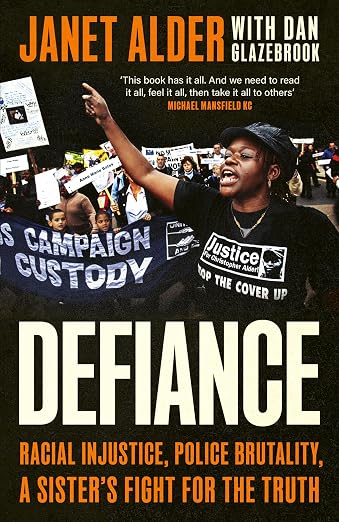
A review of a sorrowful and remarkable account of Janet Alders’ undaunted struggle for justice for his brother, Christopher Alder, who was unlawfully murdered in police custody in Hull and whose body was denied justice in death through body swap.
Among the 199 Black people who have died after coming into contact with the police in England and Wales since 1990, is Christopher Alder. However, this rather conservative statistic is challenged by the People’s Tribunal on Police Killings (PTPK) who claim that in the last fifty-five years, more than 3000 people have been murdered with impunity by the UK police.[1] The story of Christopher Alder is narrated by his sister, Janet Alder, in this book. While it is a deeply sorrowful account that foregrounds the life of her 37-year-old brother, who had been a victim of an assault, hospitalized and then left to die in the cell of Queen’s Gardens police station in Hull, it is also a remarkable narrative of Janet Alder’s relentless struggle for justice.
Between leaving the hospital with a head injury and arriving at the police station, it appears that Christopher became unconscious and incurred further injuries to his head, lower lip and eye. It was two years after his murder that the police finally released eleven minutes of video footage detailing how five police officers failed to pay due diligence to a man in distress as he lay in the cell with his trousers around his knees. Alder remarks, “Christopher had been a paratrooper for the British state, risking his life to serve its interests, and decorated for this service – but once he had served his purpose he did not even seem to count as a human being” (pp.107-108).
Over the twenty-five years of indefatigable campaigning for accountability and justice by Janet Alder, we witness in these pages the barrage of psychological violence, obfuscation, denial, obstruction – ultimately, the extraordinary state sanctioned and orchestrated coverup by the British state. In collaboration were Humberside police, the Crown Prosecution Service (CPS), the Police Complaints Authority (1985-2003), the Independent Police Complaints Commission (IPCC 2004-2017), the Independent Office of Police Conduct (2018 to present day), unscrupulous coroners and undertakers. The endemic racism of the legal system and several medical experts is also exposed. For example, a consultant anaesthetist remarked that “Negroes have larger lips and tongues and lips that significantly increase the risk of airway obstruction” which was put forward as a medical explanation for Christopher’s death in 1999 (p.72).
The ruling by the jury on 24 August 2000 of unlawful killing was followed by a trial of the police officers that took place four years and two weeks after Christopher’s death. The CPS defended the five officers – none of whom took the stand in order to account for their gross neglect of the victim in the trial of June 2002, nor at the inquest. Ultimately, “the police officers walked free without having had to answer a single question about what happened to Christopher” (p. 208).
This is a profoundly painful book to read for the catalogue of degradations, humiliations, racist treatment that was directed at Janet Alder and in the series of critical questions she raises that remain unanswered by a justice system disinterested in dispensing genuine justice. It is also agonising to read due to the emotional and psychological impact on her mental wellbeing. Not only were there attempts to psychologically humiliate Alder during the trial and in her entire engagement with the Humberside police force, but surveillance and intimidation was carried out against her (and many other families of victims of police killings). There were also attempts to smear Christopher and hold him responsible for his own death, whilst much of the evidence of what happened was deliberately destroyed by the police. As Janet Alder claims, “One of the most shocking failures, in my view, had been the CPS’s refusal to investigate the possibility that Christopher had been assaulted by the police en route to the police station” (p. 332). Neither did the CPS seem to be concerned to probe the reasons for a missing tooth and further wounds to his body that were not documented by the hospital, nor why his trousers were down to his knees.
Janet Alder’s sheer indefatigable mindset and strength of character are also shown when after 12 years of fighting for justice for her brother, in 2010, she pursues a civil case against the CPS seeking to prove that not only had an injustice been wrought but she had suffered personally from the racial discrimination of the CPS. She not only scours through a daunting 1,700 pages of documents but she valiantly interrogates the CPS on their gross errors. In March 2011 Janet Alder received the ruling that concluded that she had failed to prove that the CPS had discriminated against her.
Matters sink dreadfully into further despicable inhumanness and callous indifference when after 13 years spent fighting for Christopher, Janet Alder learns that the body of the brother she believed she and the family had buried in November 2000 was the body of Grace Kamara a 77-year-old Nigerian woman. In addition, she learns that her brother’s body had been used for “police training” for 13 years by Humberside Police. Typical of Janet Alder is her consistent questioning of police motives. She asks why the police sought to use black bodies for “sudden-death training” in a majority white town (p. 397). She appealed the CPS decision not to prosecute anyone for the body swap and requested “that the IPCC investigate the police’s apparent use of Christopher’s body for training exercise” (p. 404). In 2014, the outcome of the CPS was a refusal to press charges in relation to the swapping of the bodies and neither would they investigate the disclosures that the police had been using the body for training purposes.
Whilst this book is a detailed revelation of the deeply traumatizing experience Janet Alder endured in her long struggle for justice for her brother, the book is also extremely useful in presenting a picture of the life of her Nigerian parents; growing up in care and the enormous support she received from friends and supporters who assisted her in the fight for justice. Her recollections of the life of her parents who came to Hull in the mid-1950s adds to our understanding of how African migrants were treated in “colour-bar” Britain where signs overtly declared “No Blacks, No Irish, No dogs.” As the Black presence in Hull in the 1950s was miniscule, in comparison to cities like Manchester, Birmingham and London that had a greater black presence, African people would have been highly noticeable and therefore their alienation would have been unimaginable. Her father had been a merchant seaman. Her mother was occupied with giving birth to five children between 1958 and 1965 while falling ill with schizophrenia only to be later deported to Nigeria. This diagnosis led to the fragmentation of the family.
At the age of three years old, Janet Alder was taken into full-time care of the state. Those entrusted to care for her regularly mistreated her for bed wetting with vicious beatings. She experienced sexual abuse by a male friend of her father’s and was raped as a teenager by young boys whilst on holiday. There were attempts by her father to maintain contact with the children. His efforts to have instilled in his children some understanding of their cultural heritage failed to be appreciated by the authorities at the time. The embedded racism in the body politic of British society is reflected in the family’s history of struggle against the care system that her parents endured, in addition to her siblings. We also glimpse the acute racism of the era when Janet narrates the neglect of her Afro hair by her white uncaring carer, which was noticed by a Ghanaian woman in the neighbourhood who patiently and neatly plaited her hair. When Janet returned to the care home she was “ridiculed” by the white carer, Mrs Goodhand who ordered her to return and have the plaits taken out immediately (p. 259).
Whilst Janet’s story remains in the foreground, she gives glimpses of other similar struggles for justice such as for Dalian Atkinson, who was brutally kicked in the head by a police officer and died in August 2016, and how the family of Stephen Lawrence were also spied on. She also points out that her brother’s case drew similarities with that of Roger Sylvester who was restrained in 2003 by eight policemen in Tottenham police station in London.[2] Hence, the story of Janet Alder and her brother is not an isolated one by any means.
In October 2006 and 2007, I was part of hundreds of people who gathered in Trafalgar Square, London to march for justice as part of the United Friends and Family campaign (UFFC), set up in 1996 to bring justice for those who had died in immigration custody, mental health units and at the hands of the police in Britain. It is now a network of not only Black families but includes those bereaved from many cultural and ethnic backgrounds.
It has now been more than twenty-five years since Janet Alder waged the struggle to secure justice for her brother’s dead body being used for police training; the cover up in refusing to acknowledge this; and the eighty police officers involved in carrying out surveillance on her.
In the final chapter of the book poignantly titled ‘The Struggle Continues’, she points out that a success has been the unlawful killing verdict at the inquest of 2000, however, there have been new rules that have made it more plausible for the CPS to dismiss unlawful killing verdicts and therefore the impunity of police officers continues (p. 422-424).
On 5-6 April 2025, the UFFC took part in the first hearings of the People’s Tribunal on Police Killings (PTPK) in London. The hearings provided a space for families to indict the British state and its various colluding institutions and systems for failure to hear their narratives of pain, anguish and mistreatment of family members in their struggles for accountability and justice.[3] Whilst its focus is on narratives that continue to be silenced by the British state, the vision of the PTPK is internationalist and anti-imperialist. It is aligned with other people around the globe such as those who have lost their lives under the disappearance of the state in Argentina and formed ‘Las Madres de Plaza de Mayo’ (The Mothers of Plaza de Mayo), as well as those individuals whose loved ones met death in France and have similarly called themselves ‘Les Folles de la Place Vendome’ (The Mothers of the Place Vendome). This book is one detailed story among the many narratives of anguish given space at the PTPK.
Janet Alder connects the death of her younger brother, Stephen, who died in a psychiatric unit to the structural racism of the British state, for his postmortem revealed high levels of toxic medication in his body and that the family had not been consulted in giving permission for a Do Not Resuscitate order. She defiantly concludes with the view that “the abuse dished out to my family by the British state had begun almost from the moment my parents arrived,” but despite this, the campaign for justice for her brother, continues (p.429).
Overall, this is a book that is a testament to the unyielding incredible strength of the character of one individual for justice. The insights into the failures of the criminal justice system and how Black people were mistreated during this period are powerfully conveyed.
Ama Biney (Dr) is a scholar-activist based in the UK.
Endnotes
[1]See ‘Obstinate memory: the People’s Tribunal on Police Killings’ by Ken Fero, Jodie Bradshaw and Samantha Patterson, in Race & Class, Vol. 68, Issue 1, July 2026, pp.3-31.
[2]Further information on Roger Sylvester's murder and the inquest is documented by an article published by the Institute of Race Relations. See https://irr.org.uk/article/roger-sylvester-police-condemned-for-black-death/. The article has additional information on other unlawful killings in police custody.
[3] See ‘‘Obstinate memory: the People’s Tribunal on Police Killings’ by Ken Fero, Jodie Bradshaw and Samantha Patterson, in Race & Class, Vol. 68, Issue 1, July 2026, pp.3-31.