



The Gaza Peace Summit and Trump's 20-point Plan for Peace: A blueprint or another piecemeal attempt?
A summary of the Gaza ‘peace’ summit, the actors involved, and Trump’s plan
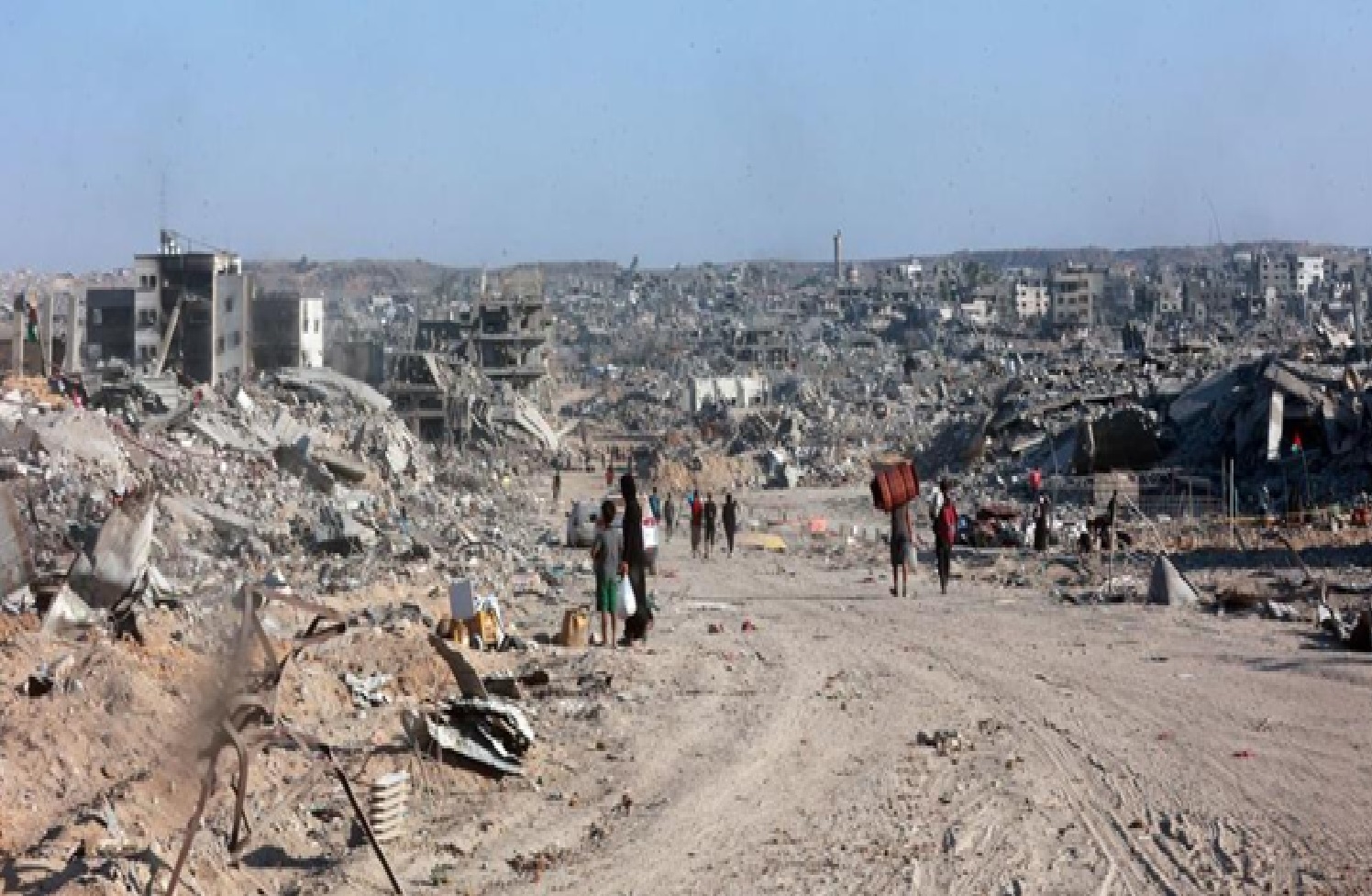
The ongoing genocide and famine in Gaza, which has been exacerbated since October 2023, has brought levels of destruction and loss unseen in the Strip’s history. Several ceasefire agreements have been declared and broken, while Palestinians bear the brunt of violence and the devastation of war. Amid the ruins, a central question persists: how can the ongoing war be permanently ended, and what kind of future might emerge afterwards?
Across regional and global platforms, a range of proposals and processes have surfaced: annexation of Gaza by Israel, the deportation of Gazans to Arab or Muslim majority countries, US takeover of Gaza, and even the transformation of the Strip into a “Riviera of the Middle East”. Amid the contested visions, an Arab League plan (Egyptian plan)[1] for the reconstruction of Gaza was pushed by powerful actors that did not necessarily represent the people of Palestine, culminating in a Gaza Peace Summit in Egypt. Central to the Summit was US President Donald Trump’s ambitious 20-point plan for lasting peace and rebuilding of the Strip.
Behind the ceremonial optimism surrounding the immediate gains of the Trump plan and the Summit, however, there is an unease. The peace is conceived by external mediation and the display of political showmanship. Can a peace so conceived deliver lasting transformation, or is this yet another piecemeal attempt to manage, rather than resolve, an enduring impasse?
Gaza Peace Summit
On 13 October 2025, world leaders from around 30 countries gathered in Sharm El-Sheik, Egypt, for a diplomatic meeting, a “Gaza Peace Summit,” to end the two-year Israel-Gaza war. The summit was co-chaired by Presidents Donald Trump of the United States and Abdel Fattah el-Sisi of Egypt.
The Sharm El-Sheikh Peace Summit, hosted at the International Conference Center in the Red Sea resort city on that Monday, witnessed the participation of kings, presidents, vice presidents, prime ministers, ministers, and other representatives from 30 countries and multilateral organizations. Among the participants were the King of Jordan, the Emir of Qatar, the Kuwaiti Prime Minister Sheikh Ahmad Abdullah Al-Ahmad Al-Jaber Al-Sabah, the King of Bahrain, the Presidents of Palestine, Turkey, Indonesia, Azerbaijan, France, Paraguay, Cyprus, and the German Chancellor.
There were Prime Ministers from the United Kingdom, Italy, Spain, Greece, Armenia, Hungary, Pakistan, Canada, Norway, the Netherlands, Iraq, and the Vice President of the UAE. Other Ministers and representatives included the Ministers of Foreign Affairs of the Sultanate of Oman and Saudi Arabia, the Minister of State for External Affairs of India, and the Ambassador of Japan to Cairo, the Secretary-General of the United Nations, the Secretary-General of the League of Arab States, the President of the European Council, and the President of the International Federation of Association Football (FIFA).
It is telling that South Africa was not invited to the Summit, nor a representation from the African Union, despite the solidarity the nation and others in Africa have shown towards the Palestinian cause and peace in Gaza.
Representatives of Israel and Hamas did not participate in the peace summit either. Presidents Abdel Fattah El Sisi of Egypt, Donald Trump of the US, Recep Tayyip Erdoğan of Turkey, and Qatari Emir Sheikh Tamim bin Hamad Al-Thani signed a comprehensive peace declaration endorsing the agreement between Hamas and Israel. The peace declaration aims to end the hostilities in Gaza, with the alleged overall objective of promoting peace and stability in Palestine and the region. Though given the conflicting interests of the national liberation of Palestine and imperialist forces, these terms must always be understood within the context of who is pushing for them and who are the major winners and losers from this alleged peace.
The 20-Point Plan
On 29 September 2025, President Trump unveiled a 20-point plan to end the war in Gaza. When the plan was unveiled, Israeli Prime Minister Benjamin Netanyahu, who was on the same podium with President Trump, said Israel accepts the terms of the plan. Among the terms of the plan, Israeli and Palestinian captives, dead and alive, are to be released by both parties; the war is to stop immediately; Gaza will be rebuilt; Gazans can voluntarily stay, immigrate, and return to the Strip; Israel will not annex or occupy Gaza; an international stabilisation force will be deployed; a Board of Peace headed by Trump will serve as the transitional authority; and recognises the legitimate aspiration of the Palestinians for statehood.
The full text of the Gaza peace plan, as published by the White House, is presented below:
1. Gaza will be a deradicalised terror-free zone that does not pose a threat to its neighbours.
2. Gaza will be redeveloped for the benefit of the people of Gaza, who have suffered more than enough.
3. If both sides agree to this proposal, the war will immediately end. Israeli forces will withdraw to the agreed upon line to prepare for a hostage release. During this time, all military operations, including aerial and artillery bombardment, will be suspended, and battle lines will remain frozen until conditions are met for the complete staged withdrawal.
4. Within 72 hours of Israel publicly accepting this agreement, all hostages, alive and deceased, will be returned.
5. Once all hostages are released, Israel will release 250 life sentence prisoners plus 1,700 Gazans who were detained after 7 October 2023, including all women and children detained in that context. For every Israeli hostage whose remains are released, Israel will release the remains of 15 deceased Gazans.
6. Once all hostages are returned, Hamas members who commit to peaceful co-existence and to decommission their weapons will be given amnesty. Members of Hamas who wish to leave Gaza will be provided safe passage to receiving countries.
7. Upon acceptance of this agreement, full aid will be immediately sent into the Gaza Strip. At a minimum, aid quantities will be consistent with what was included in the 19 January 2025 agreement regarding humanitarian aid, including rehabilitation of infrastructure (water, electricity, sewage), rehabilitation of hospitals and bakeries, and entry of necessary equipment to remove rubble and open roads.
8. Entry of distribution and aid in the Gaza Strip will proceed without interference from the two parties through the United Nations and its agencies, and the Red Crescent, in addition to other international institutions not associated in any manner with either party. Opening the Rafah crossing in both directions will be subject to the same mechanism implemented under 19 January 2025 agreement.
9. Gaza will be governed under the temporary transitional governance of a technocratic, apolitical Palestinian committee, responsible for delivering the day-to-day running of public services and municipalities for the people in Gaza. This committee will be made up of qualified Palestinians and international experts, with oversight and supervision by a new international transitional body, the "Board of Peace," which will be headed and chaired by President Donald J. Trump, with other members and heads of state to be announced, including Former Prime Minister Tony Blair.[2] This body will set the framework and handle the funding for the redevelopment of Gaza until such time as the Palestinian Authority has completed its reform programme, as outlined in various proposals, including President Trump's peace plan in 2020 and the Saudi-French proposal, and can securely and effectively take back control of Gaza. This body will call on best international standards to create modern and efficient governance that serves the people of Gaza and is conducive to attracting investment.
10. A Trump economic development plan to rebuild and energise Gaza will be created by convening a panel of experts who have helped birth some of the thriving modern miracle cities in the Middle East. Many thoughtful investment proposals and exciting development ideas have been crafted by well-meaning international groups, and will be considered to synthesize the security and governance frameworks to attract and facilitate these investments that will create jobs, opportunity, and hope for future Gaza.
11. A special economic zone will be established with preferred tariff and access rates to be negotiated with participating countries.
12. No one will be forced to leave Gaza, and those who wish to leave will be free to do so and free to return. We will encourage people to stay and offer them the opportunity to build a better Gaza.
13. Hamas and other factions agree to not have any role in the governance of Gaza, directly, indirectly, or in any form. All military, terror, and offensive infrastructure, including tunnels and weapon production facilities, will be destroyed and not rebuilt. There will be a process of demilitarisation of Gaza under the supervision of independent monitors, which will include placing weapons permanently beyond use through an agreed process of decommissioning, and supported by an internationally funded buy back and reintegration programme all verified by the independent monitors. New Gaza will be fully committed to building a prosperous economy and to peaceful coexistence with their neighbours.
14. A guarantee will be provided by regional partners to ensure that Hamas, and the factions, comply with their obligations and that New Gaza poses no threat to its neighbours or its people.
15. The United States will work with Arab and international partners to develop a temporary International Stabilisation Force (ISF) to immediately deploy in Gaza. The ISF will train and provide support to vetted Palestinian police forces in Gaza, and will consult with Jordan and Egypt who have extensive experience in this field. This force will be the long-term internal security solution. The ISF will work with Israel and Egypt to help secure border areas, along with newly trained Palestinian police forces. It is critical to prevent munitions from entering Gaza and to facilitate the rapid and secure flow of goods to rebuild and revitalize Gaza. A deconfliction mechanism will be agreed upon by the parties.
16. Israel will not occupy or annex Gaza. As the ISF establishes control and stability, the Israel Defense Forces (IDF) will withdraw based on standards, milestones, and timeframes linked to demilitarization that will be agreed upon between the IDF, ISF, the guarantors, and the United States, with the objective of a secure Gaza that no longer poses a threat to Israel, Egypt, or its citizens. Practically, the IDF will progressively hand over the Gaza territory it occupies to the ISF according to an agreement they will make with the transitional authority until they are withdrawn completely from Gaza, save for a security perimeter presence that will remain until Gaza is properly secure from any resurgent terror threat.
17. In the event Hamas delays or rejects this proposal, the above, including the scaled-up aid operation, will proceed in the terror-free areas handed over from the IDF to the ISF.
18. An interfaith dialogue process will be established based on the values of tolerance and peaceful co-existence to try and change mindsets and narratives of Palestinians and Israelis by emphasizing the benefits that can be derived from peace.
19. While Gaza re-development advances and when the PA reform programme is faithfully carried out, the conditions may finally be in place for a credible pathway to Palestinian self-determination and statehood, which we recognise as the aspiration of the Palestinian people.
20. The United States will establish a dialogue between Israel and the Palestinians to agree on a political horizon for peaceful and prosperous co-existence.
Within the 20-point plan, there are echoes of the Arab League's framework for Gaza’s reconstruction. Egypt, other Arab states – Jordan, Qatar, Saudi Arabia, UAE –, the Palestinian Authority, Israel, and non-Arab Muslim majority countries such as Turkey, Indonesia, Pakistan, Kazakhstan, and Azerbaijan, as well as Western and Eastern European nations – Germany, France, UK, the Netherlands, Australia, Italy, Spain and Russia – have all welcomed the Trump plan.[3] The broad acceptance of the proposal reflects coercion and inclusion of the aspirations of various interests around the Gaza question.
Although the 20-point plan preceded Trump’s more overtly violent pronouncements, the proximity of his threats of forced disarmament to the plan’s endorsement suggests an underlying coherence between his diplomatic proposals and his reliance on coercive, dehumanizing rhetoric.[4] This convergence shows how a discourse of violence, rather than negotiation, is shaping the pursuit of political objectives by the Trump administration.
Notably, a day after unveiling the plan, Trump told U.S. military leaders in Quantico, Virginia, that Hamas would “pay in hell” if it refused to accept his Gaza peace proposal.[5] The remark revealed the coercive logic underlying his approach to the Gaza peace process.
By the second week in October, Hamas agreed to return all 48 remaining Israeli prisoners (20 living and 28 deceased) in exchange for Palestinian prisoners and Gaza detainees, as well as hand over Gaza to Palestinian technocrats. The organisation, however, opposes disarming.
The Ceasefire, Hostage Deal, and What Next
The first phase of the Gaza ceasefire agreement took effect on Friday, 10 October 2025. The hostage deal was implemented on the following Monday, 13 October 2025, when Hamas and Israel exchanged living and dead prisoners in their respective custody.
Trump played a decisive role in the recent ceasefire and release of hostages from both sides. The overall success in the truce and the hostage swap, however, was a joint effort that included diplomatic efforts of Qatar, Turkey, and Egypt to force Hamas to accept the deal.
Within 48 hours of the success and jubilation around the release of hostages, the ceasefire is, however, manifesting signs that it lacks the necessary ingredients to see through the aspirations in the 20-point plan. Among the challenges, the Plan currently lacks clear enforcement powers, Hamas has not released all the deceased Israelis in its custody, and Hamas refuses to disarm. Trump has also vowed to disarm Hamas and the Palestinians by any means.
If the aspirations in the 20-point plan and the declarations at the Gaza Peace Summit are achieved, it will open a new era for rethinking Palestinian and Israeli relations. Since October 2023, the genocide has killed more than 67,000 Palestinians in Gaza, most of them women and children, while about 2000 Israelis have been killed by Hamas, and the Strip has been rendered uninhabitable.[6]
As it stands, the ceasefire agreement is unlikely to deliver sustainable peace. The struggle for the national liberation of Palestine will remain.
We look forward to a future where Palestinians can live in peace, and where all human lives in the region will be cherished irrespective of race, religion, or creed.
Pambazuka News Editors Email: [email protected]
Endnotes
[1] Asi et al. (2025, 7 March). An Arab Plan for Gaza: Obstacles and Possibilities. https://arabcenterdc.org/resource/an-arab-plan-for-gaza-obstacles-and-possibilities/; See also Cairo Statement and Arab Plan Adopted at the League of Arab States Summit for Early Recovery, Reconstruction and Development in Gaza – Letter from Bahrain (A/79/820-S/2025/151), https://www.un.org/unispal/document/cairo-statement-and-arab-plan-adopted-at-the-league-of-arab-states-summit-for-early-recovery-reconstruction-and-development-in-gaza-letter-from-bahrain-a-79-820-s-2025-151/
[2] See the following critique of Tony Blair and how his fostering of political celebrity identity has been detrimental to the people he allegedly serves, in Pace, M., & Bergman Rosamond, A. (2018). Political Legitimacy and Celebrity Politicians: Tony Blair as Middle East Envoy 2007–2015. Middle East Critique, 27(4), 383–398. https://doi.org/10.1080/19436149.2018.1516336
[3] Elis Gjevori and News Agencies, How Arab nations, rest of the world reacted to Trump’s Gaza peace plan, https://www.aljazeera.com/news/2025/9/29/trumps-gaza-peace-plan-welcomed-by-arab-and-islamic-countries-the-west
[4] Holland, S. (2025, October 14). Trump says Hamas must disarm or be disarmed, perhaps violently. Reuters. https://www.reuters.com/world/middle-east/trump-says-hamas-must-disarm-or-be-disarmed-perhaps-violently-2025-10-14/
[5] Reuters (2025, September 30). Trump, Hegseth address gathering of top US military leaders. https://www.youtube.com/watch?v=0Pf5D791yNI; See also full script at Speech: Donald Trump Addresses Military Leadership in Quantico, Virginia - September 30, 2025. Roll Call, https://rollcall.com/factbase/trump/transcript/donald-trump-speech-department-of-defense-leaders-quantico-september-30-2025/