



Radical Fidelity: Love in the Mau Mau Forest
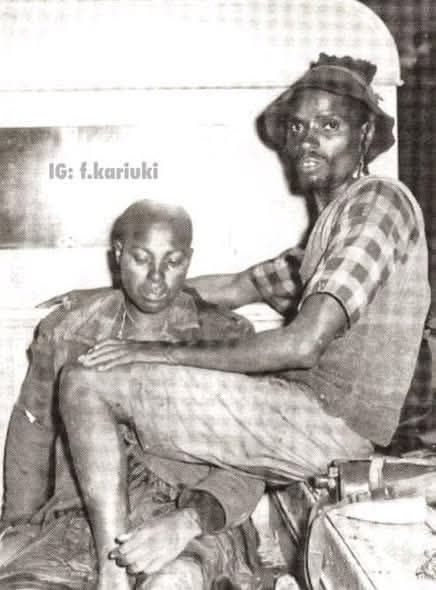
An insight into the insurgent intimacy of the Mau Mau resistance in Kenya.
The above photograph has survived by being misread. Long framed through a colonial archive trained to see deviance, weakness, or humiliation, it in fact documents a radical ethic of care forged in the crucible of anti-colonial war. Read against empire’s gaze, the image reveals intimacy as infrastructure, love as strategy, and fidelity as a mode of resistance. To encounter it honestly is to admit that liberation was sustained not only by guns and oaths, but by human bonds that colonial power could neither comprehend nor destroy.
When I first encountered the photograph of Mbaria Kaniu carrying his wounded partner, I was struck not by its historical significance, but by its emotional force. I felt it before I understood it. What held me was not spectacle or heroism as it is usually framed, but an unmistakable act of fidelity under extreme danger.
The caption disturbed me. The language used to describe the woman reduced intimacy to scandal and obscured the political weight of the bond depicted. It made me realize how deeply colonial ways of seeing still shape how we remember the Mau Mau—what we elevate, and what we dismiss.
Growing up Kenyan, I learned a history of resistance defined largely by violence, masculinity, and silence around care. Yet this image suggested something else: that tenderness, loyalty, and relational courage were not peripheral to the struggle, but part of what made survival and resistance possible.
This essay is an attempt to take that possibility seriously. To ask what changes when we understand intimacy not as a distraction from liberation, but as one of its conditions. To question why African tenderness has so often been rendered invisible, trivial, or suspect in our historical memory.
I do not offer this as a definitive account, but as an invitation—to remember more fully, and to consider that freedom has always been bound up not only in land and sovereignty, but in the bonds people refused to abandon under fire.
Love in the Mau Mau Forest
A man carries a woman. She is wounded in the thigh. Blood has darkened her clothing, but he does not pause, does not turn away, does not flee. The colonial police are closing in, their rifles trained on the forest, their commands like steel teeth. Yet he stays. He does not abandon her.
The image is black and white, but the story is not simple. For decades, this photograph has been reduced to a footnote, a sensational caption: “Mau Mau concubine rescued by Field Marshal.” The words are carefully chosen to distance, diminish, and discipline. They tell us what we are allowed to see: that she was property, that he was reckless, that love is secondary to war.
 But if we look closer, the photograph tells another story: a story of insurgent intimacy, a kind of fidelity that the colonial archive cannot process. A story where care, loyalty, and love were themselves acts of resistance.
The Mau Mau rebellion is remembered in Kenya mostly through the lens of violence: massacres, raids, ambushes, and fear. Newspapers and textbooks recite the boldness of attacks, the terror of forests, the heroism of men. Women appear only as footnotes, victims, or passive supporters. Yet the forest, the oaths, the relationships forged under the pressure of bullets and betrayal, were central to survival. The networks of care that bound fighters to one another, and fighters to women, were tactical as well as human. To care for someone in those forests was to resist the colonial script that demanded isolation, suspicion, and hierarchy.
To stay with someone wounded, vulnerable, and hunted was not sentimental. It was insurgent.
Colonial authorities did not just want to control territory—they wanted to control bodies, desire, and memory. They invented terms like “forest concubine” to delegitimize women’s presence in the struggle and to flatten their agency into something consumable and scandalous. They documented men’s heroics, but framed women as incidental. They feared tenderness. They could not measure the power of fidelity that refused to yield to fear.
But this is exactly what was happening. Fighters survived because they were tethered to one another. Oaths were more than promises—they were embodiments of relational trust.
A wounded comrade was not abandoned, a lover was not left, a network of care was not broken. The forest was not only a battlefield; it was a space of mutual accountability, where human bonds and political commitment intertwined.
In one famous attack, Mbaria Kaniu’s men trekked from Kangema in Murang’a, crossed the Aberdare range, and descended on Naivasha, raiding a police station. Hours earlier, the Lari Massacre had taken place—a violent echo of colonial fear and repression. The audacity of the attack drew attention, but the colonial press ignored another truth: the same man who led this assault had just refused to abandon the woman he loved. The same man who traversed hills and forests in combat measured his courage not only in firepower, but in fidelity.
This is the kind of intimacy that terrifies bureaucracies. Love that cannot be surveilled, regulated, or instrumentalized is inherently ungovernable. Colonial archives tried to discipline it with euphemisms and innuendo. But tenderness in the forest was an infrastructure of resistance, as vital as weapons, strategy, or oaths.
To understand this is to reframe what we call heroism. Mau Mau heroism is not only individual bravery or tactical genius. It is relational courage—the choice to remain bound to others when separation would be safer, when self-preservation would have been easier. Radical fidelity is the refusal to calculate one life as more important than another. It is the principle that a bond, a person, a life, is not disposable.
This complicates memory. Public history has celebrated male militancy, commemorated attacks, erected statues of soldiers and leaders. But it has rarely acknowledged the ethical labor of intimacy: the women who carried messages, tended wounds, fed the forest, bore the weight of oaths; the men who stayed with them, and in doing so, reshaped what courage meant.
Today, we still struggle to recognize relational courage as revolutionary. Our politics valorizes self-interest, efficiency, and symbolic heroism over care, solidarity, and fidelity. We still reduce African tenderness to a footnote or a scandal. We still ask women to perform invisibility and obedience, while praising men for risk alone.
Yet the photograph of Mbaria Kaniu and his wounded partner reminds us that there is a lineage of insurgent love in Kenya, older than the republic, deeper than the archives. There are acts of bravery that cannot be measured in weapons or territory, but in the quiet decision to remain, to stay, to carry. These acts are as foundational to freedom as any manifesto, ambush, or speech.
Let us remember, then, that the forests were not only theatres of violence, but laboratories of trust, intimacy, and mutual care. Let us refuse the colonial grammar that would reduce human bonds to property, or affection to scandal. Let us allow ourselves to see that freedom is relational, that courage is measured by whom we refuse to abandon, that love can be as radical as any rebellion.
Because they did not only fight for land. They fought so that their bonds, their loyalty, their love, would not be legislated out of existence. And in that choice, in that refusal, they teach us something urgent: to be human in the midst of terror is to remain tethered to one another.
Tafahri Theru Munjatta is a Kenyan Afrofuturist and decolonial writer exploring the intersection of politics, spirituality, and healing. His work interrogates dominant culture through ancestral cosmologies, tracing power, memory, and resistance across bodies, landscapes, and time.