



The PEACELESS Agreement Between Congo and Rwanda
Moro highlights the omissions and lack of justice in the Peace Agreement between the Democratic Republic of the Congo and the Republic of Rwanda, arguing that it is in reality a ‘peaceless’ agreement.
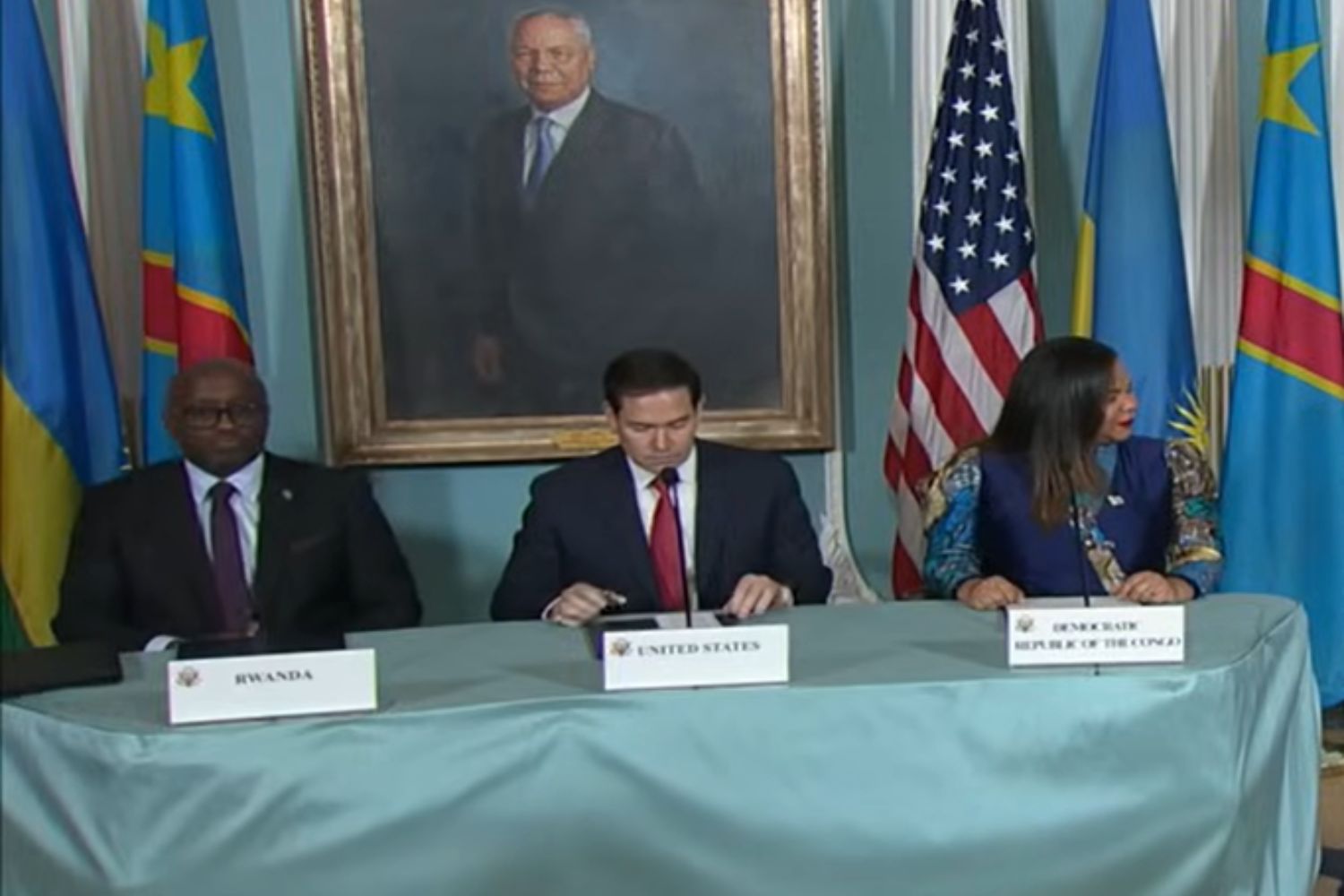
On June 27th, a Peace Agreement was signed between the Democratic Republic of Congo and the Republic of Rwanda in Washington, USA. After the signing of the “agreement", American President Donald Trump held a press conference for accredited media at the White House, surrounded by his legion of cheerleaders and the foreign ministers of Rwanda and Congo, standing like two inanimate Ionic columns on either side of Trump as he received his bath of adulation. The moment was declared “historic", but after reading the agreement in its entirety, the only historical aspect is that it is the same story repeating itself for the past 30 years. Lumumba was right in his wish to see Africa's history written in Africa, “and not in Brussels, Paris, Washington, or the United Nations.”
Notable Absences
The name of M23, the Rwandan paramilitary organization that invaded eastern Congo earlier this year—thus sparking these negotiations and the resulting agreement—appears only twice: once in the final appendix, “List of Acronyms”, and once under section 2 titled “WITHDRAWAL, DISARMAMENT, AND INTEGRATION OF NON-STATE ARMED GROUPS”.
First, it should be noted that the group is only mentioned in that chapter to state that, since negotiations are underway “between the DRC and the AFC/M23 under Qatari mediation in Doha,” this agreement does not intend to interfere. Qatar has brought Congolese President Félix Tshisekedi and Rwandan President Paul Kagame to the negotiating table. The Rwandan regime has always denied being behind the M23, and its president claims he “doesn’t know” whether Rwandan troops are on Congolese soil or not. Yet the UN has thoroughly documented Rwanda’s command of the M23 and the presence of around 12,000 Rwandan Security Forces in eastern Congo. But by recognizing the Qatar-led negotiations, is Kagame finally admitting he represents the M23?
Secondly, section 2 is another clear victory for the aggressor, Rwanda over the aggressed, Congo—a scenario repeated in many past NO-PEACE “agreements.” Terrorists who have committed all kinds of war crimes and crimes against humanity are not brought to justice but instead integrated into Congolese Security Forces. This guarantees their impunity and rewards their work in favor of the aggressor regime of Rwanda, which now no longer has to support or fund them, although they’ll continue to serve its interests from within Congo’s military infrastructure. In addition to guaranteed impunity, these "new members" of the Congolese Armed Forces and Police are promised to be deployed to the same regions they previously operated in as aggressors—places that, purely coincidentally, contain the mineral mines essential to international markets that continue to funnel resources through Rwanda without interruption.
Elsewhere, there is no mention of “Justice", nor of "Rwandan troops”. The text refers to "respect for territorial integrity”, stating that the territorial integrity of the DRC must be respected, followed immediately by the statement that Rwanda's territorial integrity must also be respected. But no one has invaded Rwanda. Rwanda has invaded Congo. The only mention of “aggression” is to say that “both parties” commit to refraining from acts of aggression —following the old playbook of equating aggressor and aggressed, which has long benefitted the Western war propaganda machine.
There is no mention of “justice", “plunder", “massacres", "war crimes" or "crimes against humanity"—not even the word "war"! Nor is there mention of “victims” or “defense”. Well, the word "defense" does appear 26 times—but only in reference to “Rwanda’s defensive measures,” i.e., the aggressor in this entire affair. It’s exactly the same situation as Israel claiming to implement “defensive measures” against Palestine.
There had been hope that the agreement would include a clause demanding the immediate and unconditional withdrawal of Rwandan troops from Congolese territory, as unanimously approved in UN Security Council Resolution 2773, passed on February 21, 2025. But this did not happen. It was also implied that respect for Congolese borders would be demanded—this, too, did not happen. Nor does the agreement uphold international law, which dictates that war crimes and crimes against humanity are not subject to statutes of limitation, cannot be excused on the grounds of "superior orders”, and must not go unpunished. In other words, impunity for perpetrators of such crimes—like members of M23, as documented repeatedly by the UN—cannot be placed on a negotiating table, for many reasons, but let’s just say: the law prohibits it.
Based on just these few points, it’s clear that once again the Congolese representatives have given up everything—even their dignity—and Rwanda’s regime has emerged victorious once more. The real losers, as always, are the peoples. The Rwandan regime, brutal delegate in the region for the United States, Britain, the Zionist entity, and their EU partners since the 1990s, will continue to kill, steal, mock its victims, and enjoy total impunity.
In recent days, the Rwandan opposition in exile has been speculating about the weakness of Kagame’s leadership at the helm of the RPF regime, in power since 1994. Victoire Ingabire, the main opposition leader, has been arrested again, and is being subjected to harassment and absurd accusations. She is being held incommunicado in prison, and her fate remains unknown. It has been suggested that this could be the result of a power struggle triggered by Kagame’s alleged illness. Whether this is true or not is of little importance. The reality is that the Rwandan regime—regardless of who is in charge—has emerged victorious from this new farce of an agreement, and has shown the world that it still enjoys the unwavering support of the United States, just as Zionism and Netanyahu do.
Unnecessary and/or Alarming Presences
Lastly, what was the Togolese Foreign Minister, Robert Dussey, doing there—representing the mediator designated by the African Union, Togo’s President Faure Gnassingbé (and thus representing the AU)?
Faure Gnassingbé is the latest in the saga of French-backed delegates who have been selling Togo to French and European interests since his father, Gnassingbé Eyadéma, killed Togo’s first democratically elected president, Sylvanus Olympio, in 1963. Faure Gnassingbé cannot maintain peace in his own country, which is in the midst of a popular uprising against the Gnassingbé dynasty. How can he possibly mediate peace elsewhere?
The African Union is a pitiful club of naked kings whose power extends only as far as their EU funders allow. How long will they continue to play the role of the emperor with no clothes? When will they start to see themselves the way their people already see them? It’s not for lack of fingers pointing at them—like the innocent, honest child in the tale who shouted that the emperor was naked, bringing the entire charade down.
An even more terrifying presence is that of the economy—specifically, the mother of all wars: the capitalist economy. The agreement’s language is carefully chosen. It doesn’t mention war, aggression, victims, invasion, the withdrawal of Rwandan troops from Congo, or justice. But it does mention “regional economic integration” twelve times. In fact, that’s the only part of the agreement that will actually be implemented: “the integrated economic development of the region,” which in practice means legitimizing Congo’s plunder through Rwanda. The uninterrupted supply of resources to international markets must continue—especially to U.S. private corporations.
And finally, the Rwandan regime once again played its eternal trump card: “defending itself from the FDLR,” supposedly composed of the 1994 genocidaires—who, in reality, no longer exist in the way Rwanda defines them. The Forces Démocratiques de Libération du Rwanda (FDLR) is mentioned 43 times in the agreement—43 times! Clearly, the narrative is designed to justify Rwanda’s occupation of Congo.
Most FDLR members were integrated into Rwanda, trained, and sent back to Congo to loot on behalf of the current Rwandan regime. According to former Rwandan Army Chief of Staff Lieutenant General Kayumba Nyamwasa, he himself was in charge of this reintegration operation (before falling out with the RPF leadership and fleeing to South Africa, where he has survived multiple assassination attempts). These mysterious FDLR members have never managed to launch even a single attack on Rwanda. Not only does Nyamwasa's confession confirm this, but multiple reports also document that the current Rwandan regime funds and maintains them in order to continue justifying its presence in Congo.
Sound familiar? Exactly! The same old Western playbook: create terrorists, fund and maintain them, then claim to be fighting them in the very countries they invade and attack. That’s exactly what Rwanda’s RPF regime has been doing in Congo—as the proxy of Western powers—for the past 30 years.
And as long as we keep believing the same old script, with the invaluable help of mainstream media propaganda, why bother changing it?
This is yet another NO-PEACE agreement. Without justice, there can be no peace.
Rosa Moro is a Spanish journalist with over 20 years of experience specializing in African affairs. She contributes to alternative media outlets both nationally and internationally, and runs a Spanish-language blog called África en Mente. She is the author of the book titled El genocidio que no cesa en el corazón de África. Una historia de desinformación (The Ongoing Genocide in the Heart of Africa: A Story of Disinformation).