



The Jason Arday Tragedy: Not a Crisis of Black Intellectualism but one of White Supremacy

Daley situates the young academic’s tragic death in the recent history of anti-Blackness and marketisation in UK higher education, amidst performative diversity and enduring white supremacy.
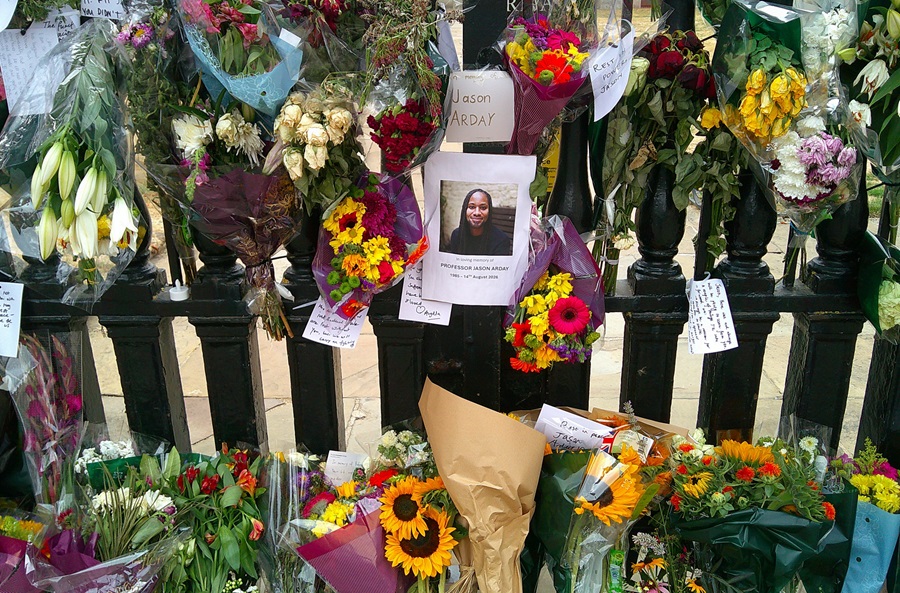
In early August 2026, an accusation of plagiarism targeting the PhD of a young Black male Professor at Cambridge University reached frenetic levels in the UK media. Right-wing journalists and keyboard warriors on social media threw their oars and ignorance into a debate they know little about in order to discredit Professor Jason Arday who was forced to resign from his prestigious chair in the sociology of education and was hounded by the media up to and after his untimely and tragic death on August 14th.
The pundits were outraged by Cambridge supporting an autistic Black academic who they had decided, based on evidence from a eugenicist scholar-activist, had plagiarised passages in his PhD thesis of 2015. The assault on Arday went to interrogating all aspects of his academic and non-academic life that was in the public domain, declaring him a fabulist, posting racist derogatory images and memes attacking his appearance, questioning his sexuality, and with many just taking the opportunity to have a racist pile-on. The accusation of plagiarism was investigated by the awarding university, which concluded that the matter was poor academic practice rather than deliberate plagiarism. Yet, the relentless attack on Arday has been justified by the right-wing as challenging what they see as the dominance of ‘woke DEI’ (US acronym of UK’s Equality Diversity and Inclusion (EDI))[1] policies in universities and resultant dilution of academic standards. If only they knew.
By positioning their attack on Arday as a challenge to EDI, they seek to extend their assault on all Black intellectuals in the academy, implying erroneously that they have been hired purely to satisfy ‘meritless’ EDI purposes. But Arday’s case is not a crisis of black intellectualism; instead, it is a crisis of white supremacy and bourgeois guilt.
Let me explain. The absence of black intellectuals within the ivory tower of the UK has been marked. In the academic year 2024/25, there were only 270 Black professors of the 26,110 professors in the UK, just 1% of the total.[2] This small number of Black professors does not signal the absence of merit amongst Black intellectuals, it is a reflection of the failure of universities to invest in the career progression of Black academics, along with nepotistic gatekeeping. The pool is incredibly small. Black students are not encouraged and funded to go on to research degrees,[3] and Black faculty’s career progression is rarely supported. There are few role models. Undoubtedly, the normative experience of Black faculty in the UK academy has been one of structural neglect: they cannot get major research funding[4], are marginalised after being appointed, and are more likely to be employed on fixed-term contracts; in effect, their careers are stunted whilst those of their white counterparts thrive.[5] In sum, the diversity drive has had only minimal effect on Black faculty.
The project of diversifying the UK faculty is not new. It began with gender and was done through indirect coercion, such as through the Athena SWAN awards (introduced in 2005). Athena SWAN awards recognised science departments that demonstrated a commitment to addressing gender inequality, but crucially the scheme also became linked to access to research funding. For example, the National Institute for Health and Care Research (NIHR) required academic partners seeking some major biomedical research funding to hold a Silver Athena SWAN award. Universities therefore had a material incentive to address gender inequality: failure to do so could mean losing access to significant research funding. There was not and has not been an equivalent compulsion to appoint Black faculty, even after the later voluntary Race Equality Charter (REC) mark was introduced in 2015 by the higher education charity Advance HE. To get the REC, universities must submit plans to address race equality but are not compelled to do anything; mainly because, in contrast to Athena SWAN, the award is given to universities at the institutional level, not to individual departments where direct action might be taken. More importantly, there are no financial implications to not addressing race equality, just potentially bad public relations (PR). Interestingly, in some cases, white women are appointed to deflect criticism of not selecting people of colour.
In the 2010s, it was political pressure from a politician (David Lammy) asking questions about racial diversity among the student body and student pressure from campaigns, such as Why isn’t my professor black? (2014) at University College London; I, too, am Cambridge (2014);[6] and I, too, am Oxford [7](2014), and the Black Lives Matter (BLM) movement protests (2020), that forced departments to address more proactively the lack of diverse scholars on their reading lists, introduce lectures on race, and the odd optional course paper. All turned out to be cosmetic dressing. Fundamentally, universities did not change the hostile culture and the structural inequalities that Black students and academics faced, and the public arena was no less accommodating.[8] Determined to show that they were not openly racist, a few, and I mean very few, Black scholars were appointed to some universities or got promotion to less significant senior management positions within their university.
Right-wing narratives often suggest that UK universities were transformed by a post-BLM diversity drive that disproportionately benefited Black academics. But does that claim withstand scrutiny? Black representation undoubtedly increased, but from an extraordinarily low base. As already noted above, Black academics account for only around 1 per cent of UK professors. The more uncomfortable question is whether the institutional response to BLM resulted in a meaningful challenge to anti-Blackness in UK higher education or merely diversified its appearance.
In the period post BLM, the number of Asian professors also increased significantly, and Asian academics became by far the largest ethnic-minority group within the professoriate. The point is not that Asian academics benefited at the expense of Black academics, but data from the Higher Education Statistics Agency (HESA) complicates the argument that post-BLM diversity initiatives produced some dramatic or disproportionate expansion of Black academic power.
Jason Arday rose rapidly through academia, gaining full professorship seven years after his PhD, followed by the prestigious chair at Cambridge. His trajectory is not without precedent. White male academics have had similar trajectories, publishing a book and then being scouted by successive elite universities. This is normally a US phenomenon. Arday, having overcome his disabilities, was a black ‘success’ story, a ‘mascot’ according to Okundaye in the Guardian,[9] that Cambridge’s public relations (PR) machine pushed to highlight the University’s achievements in EDI and to attract applications from Black British and international students. No wonder, the sociologist and journalist Gary Younge decries these “photo opportunities”[10] used by institutions to suggest change whilst hindering real structural change.
The Myth of Black Incompetence in the Academy
The central issue is the white supremacist ontology underpinning UK universities. These colonial institutions have not yet detached themselves from the racial ideologies that white Europeans have superior knowledge systems and Black people are intellectually inferior. These are ideas championed by Arday’s major critic Nathan Cofnas (the less said about him, the better). In my case, I was told by a colleague, benevolently, that I had ‘natural intelligence’ because I lacked the finesse of one who had attended a public (private) or grammar school yet could still compete intellectually. I wonder what the eugenicists would make of that. Robbie Shilliam, in tracing the history of ‘Black deficit’ in the British academy, found that it has ‘imperial provenance’ dating back to the works of colonial scholars in social anthropology and sociology, and concluded that “contra (sic) contemporary critics, the academy is not threatened by Black deficit; rather, the academy has yet to accept Black intellectual competence”.[11]
The political right’s discourse around Arday is that their esteemed institutions are diluting their traditional intellectual excellence by appointing inferior Black people because of EDI imperatives. They should read Sara Ahmed’s 14-year-old text, On Being Included: Racism and Diversity in Institutional Life,[12] in which she shows how, in the UK and Australia, the project of diversity can be used strategically to hide the lack of diversity. Or someone should explain to them the illusion of diversity that universities continue to promote. But they might already know.
Universities have sought to attract Black students because diversity is marketable for their internationalisation agenda and the income that brings. Black international students form the largest proportion of Black students in UK universities. Such students have been coming from the colonies since the early twentieth century but more so after the 1960s independence wave, when, to maintain the hegemony of colonial knowledge systems, scholarships, such as the Commonwealth (1960-) and Chevening (1983-) were made available to international students, including from Africa and the Caribbean. Chevening numbers were increased by recent Conservative governments before and after Brexit - a neo-colonial move, no doubt. Further scholarships targeting African students have manifested in recent years; presumably, to fill the perceived demand for graduate level employees in the UK as it restructures its economy post-Brexit.
In the 1980s, when I was a doctoral student, it was not unusual for African students to leave the university without completing their studies, and for PhD supervisors not to read their work. Some even approved poor quality work on the assumption that these students were returning to Africa where standards were lower. This might still be the case in some disciplines. Allegedly, Arday had the minimum of supervision for his PhD, and his thesis may have passed only due to mitigating factors. His poor academic conduct would hardly have come to light if he had stayed in a post 1992 university and if the figure of the enterprising neo-liberal scholar had not entered the academy.
Marketization of Knowledge and Race
The neo-liberalization of universities is key to understanding the Jason Arday affair. Starting in the 1980s, it led to competition for research money, for students, and for academics who could attract students. The introduction of the Research Assessment Exercise (later known as the Research Assessment Framework (REF), in particular, led to individual academics marketing their scholarship to gain high-paying positions in universities desperate for the extra government income that they would bring. A few high-profile left-leaning scholars abandoned their social justice ideals and ran to the money. Suddenly, academic knowledge, combined with certain bodies (white and predominantly male), became an attractive commodity. This practice intensified over successive assessment cycles until it was ruled against by the regulators in the last one.
In contrast, REF affected negatively the progression of Black academics in the academy.[13] According to a HEFCE[14] report in 2016, only 33 per cent of Black staff were included in the 2014 exercise, resulting in many being vulnerable to redundancy and temporary contracts.[15] Exclusion also restricted access to research funds and hence progression to senior roles, such as professorships. The BLM movement did not transform this predicament for Black scholars as a group: it just raised awareness of the severity of the problem. In 2020, BME female scientists, in an open letter to the state’s research funding body UK Research and Innovation (UKRI), asked why it had “awarded £0 of £4.3 million to Black academic leads (in a UKRI and NIHR funded study) to explore Covid-19 and its disproportionate impact on Black, Asian and Minority Ethnic ‘BAME’ communities”.[16] Having published a statement in support of Black Lives Matter, UKRI’s response was generic - let’s talk[17], rather than concrete actions to change the research culture.[18] In fact, UKRI’s own data indicate that by 2024 many Black academics appeared resigned to the fact that they will not get research grants and had stopped the time-consuming and exhausting process of applying.[19]
Universities neglect of the careers of Black academics is equalled to their failure to address the degree awarding gap of Black students within the academy,[20] even though the financial model demands more and more students. With persistent government underinvestment in higher education coupled with the increase in student fees, elite UK universities have sought to attract more bright students, especially those from state schools who would normally not apply to Russell group institutions. Special ‘access’ programmes targeting these students emerged. In 2018, Cambridge nabbed its high profile Stormzy Scholarship (funded by the rapper, and after Oxford snubbed him [21]) for Black students, but a look at the University’s faculty would have prompted, and still prompts, the question: why so few Black ones?
Most likely, Cambridge appointed Arday to silence their critics and thus presented him to the world as a ‘superstar’. Cambridge was not marketing his intellect: it was his blackness and his back story – allegedly non-verbal until 11 years and illiterate until 18 years old. There was no information about his intellectual contributions to the disciplines of sociology and education, Presumably, by appointing one Black individual, they were hoping to repair Arday’s research critique of racial inequality in the academy. Arday joined in the game, embarking on what James Esson has called ‘the social justice grift’, that is “the strategic use of progressive discourse in public forums for personal or institutional gain”.[22]He became a consultant advising numerous universities on how to do diversity.
Concerns of Black Scholars
In the western academy, addressing racism is a central focus of Black scholarship. Without this focus, we cannot understand our histories and experiences in the West from enslavement to the present. We cannot know ourselves fully without engaging with, displacing, and transcending racialized conceptions of our existence. The right-wing scholars critiquing Arday’s research, because he focused on race and used critical race theory and intersectionality as analytical frames to interpret the position of Black and neurodiverse people in UK’s higher education, are denying the fundamentals of Black existence in the West. They seek to produce unchallenged knowledge about Black people to keep us subjugated and lacking in agency. More importantly, they have not lived Black lives to understand fully the importance of the use of autoethnography as a research method.
The concomitant attack on sociology is also revealing. It was in this discipline that Black scholars, such as W.E.B. Dubois, Stuart Hall, Charles Payne, and bell hooks, developed a critique of race thinking and exposed racial inequalities, and, in so doing, provided theories to investigate and explain the conditions of Black people in Western countries.
Black scholars no longer condone the use of colonial-era race relations methods and theories as tools and approaches to explore our existence and to find solutions for the challenges facing us and the planet. These right-wing critics constitute a dying breed fighting to uphold western modernity as it destroys itself economically, socially, politically, and ecologically.
As to the charge of plagiarism, Black academics in the West and Africa are the most vulnerable to plagiarism and racial erasure in publications. Our contributions to scholarship in joint exercises are often left unacknowledged. We are not cited on topics on which we have expertise and have published.[23] We often don’t publicize incidents of plagiarism of our work. Because to be credible, we must convince white gatekeepers that we can produce original ideas that are worth stealing. I have only managed to do this twice. We do not condone plagiarism, when it is committed by one of our own. What we want is for all plagiarists to be treated equally. White scholars, who have plagiarised, are not disgraced, paraded, and driven to their death in the public arena and their failings are not extrapolated to all white academics.
For many among the white (liberal) bourgeoise, authentic Black people’s stories must be ones peppered with victimhood. It is funny how humanitarian benevolence can co-exist simultaneously with racism in the same person. The fact that a significant proportion of Black people often come out of appalling socioeconomic conditions means that we do have miserable histories and have had to overcome considerable adversity to reach a similar position that a white person may occupy. Yet, for some of us, the goal is to move beyond that story and use our progress strategically to transform the lives of our communities. Arday may have strived to move beyond what defined his existence so far and to revel in the entrepreneurial opportunity the Cambridge appointment gave. He may have thought that he had arrived at the pinnacle of UK imperial education and he could now relax, perhaps even embellish his accomplishments to fit in, to meet their expectations, and to make money. But his position was never certain and never secure.
Black people in the academy are always under surveillance, especially if they are seen to have risen too fast or to go against the norm. Ironically, we are even accused of racism, including by bourgeois white scholars, when we act objectively in recruitment. The scrutiny we are subjected to leaves its trauma. And, under those conditions, we are still expected to perform – like negro minstrels.
Arday has neither damaged the British intellectual tradition nor Black intellectualism as many on the right and left respectively would have us believe. His case has exposed the limitations of neo-liberal EDI, and the manipulatory and violent capacities of white supremacy as it functions in Cambridge, the western academy, and in the mainstream and social media. If they really cared about lies, they would be targeting those politicians whose dishonesties have had greater impacts on the lives and deaths of large numbers of people. If they want to uphold academic rigour, then they should marshal their forces to address the falsehoods of climate change deniers.
Arday’s death is not a confirmation of any guilt. It signifies the extreme lengths white supremacists will go to discredit a Black person and policies they deem, somewhat erroneously, to benefit Black people, and the abandonment of Arday by Cambridge University and those who sought to benefit from his skin colour and backstory.
R.I.P. Professor Jason Atta Kwesi Arday. A luta continua!
Patricia Daley is Professor of the Human Geography of Africa in the School of Geography and the Environment, University of Oxford
Acknowledgements: I am most grateful to colleagues whose feedback helped to enrich this article. All errors are my own.
Endnotes
[1] DEI is the American acronym. The term used in the UK is Equality, Diversity and Inclusion (EDI). The use of the American term by pundits in the UK suggests the lack of knowledge of the UK education sector and an adoption of the US anti-DEI agenda.
[2] The Higher Education Statistics Agency (HESA). Available at https://www.hesa.ac.uk/news/19-02-2026/number-academic-staff-uk-he-fall…
[3] In 2024/5, HESA data showed that only 2,200 Black students were enrolled in post-graduate research degrees, compared to 4875 Asians and 33,330 whites. Accessed at: https://www.hesa.ac.uk/news/27-01-2026/sb273-higher-education-student-s…
[5] Kalwant Bhopal (2016) The Experiences of black and minority ethnic academics: a comparative study of the unequal academy. Routledge research in higher education, 1st edn, Routledge, London and New York.
[6]Hannah Wilkinson (10 March (2014) ‘I, too, am Cambridge: Students speak out about racial discrimination in Cambridge’, Varsity. https://www.varsity.co.uk/news/7047
[7] Layla Haidrani (13 March 2014) Oxford’ students of colour speak out in powerful ‘I, too, am Oxford Campaign. The Independent newspaper. https://www.independent.co.uk/student/news/oxford-s-students-of-colour-…
[8] For example, the geoscientist Christopher Jackson was subjected to racial abuse when he was selected to co-present the Royal Institution Christmas Lectures of 2020.
[9] Jason Okundaye (6 August 2026) ‘The Takedown of Jason Arday has overjoyed the right, but is a wake up call for the left’, The Guardian. Accessed at: https://www.theguardian.com/commentisfree/2026/aug/06/jason-arday-dei-r…
[10]Gary Younge (19 May 2026) ‘Equal Opportunities not Photo Opportunities: The politics of representation in the age of 'diversity', Social Science Division Annual EDI lecture, University of Oxford.
[11] Robbie Shilliam (2017:3) ‘How Black deficit entered the British Academy’. Accessed in August 2026 at how-black-deficit-entered-the-british-academy.pdf&lang=en
[12] Sara Ahmed (2012) On Being Included Racism and Diversity in Institutional Life, Duke University Press.
[13] Royal Geographical Society, Race Research Group (2016). Accessed at ://raceingeography.org/wp-content/uploads/2016/03/race_ref_comments_final.pdf
[14] The Higher Education Funding Council for England (HEFCE)was closed in 2018 and replaced with UKRI.
[15] op. cit.
[16] Addy Adelaine et al. (2020) “Knowledge Is Power—An Open Letter To UKRI”. Research Professional. Accessed at https://www.researchprofessionalnews.com/rr-news-uk-views-of-the-uk-202…
[17] Dialoguing with individual complainants seems to be the incessant answer to criticism, but they are rarely followed by substantive change.
[18] Sophie Inge (21 August 2021) ‘Black academics hit out at UKRI’s lack of public reply to open letter’, Research Professional. Accessed at: https://www.researchprofessionalnews.com/rr-news-uk-research-councils-2…
[19] Rose Ellis (20 May 2024) “Black academics ‘give up’ on UKRI research funding: Number of black principal investigators applying to UK research councils halves year-on-year”, Times Higher Education. Accessed at https://www.timeshighereducation.com/news/black-academics-give-ukri-res…
[20] There is no space here to discuss this fully. Further information can be found at Office of Students (9 November 2021) “Degree attainment: Black, Asian and minority ethnic students” Accessed at: https://www.officeforstudents.org.uk/for-providers/equality-of-opportun…
[21] Sarah Marsh and Dan Hancox (8 November 2018) ‘Stormzy: Oxford University turned down my scholarship offer’, The Guardian. Accessed at:
https://www.theguardian.com/music/2018/nov/08/stormzy-oxford-university…
[22] James Esson (2026) “Critical Geography in the Age of the Social Justice Grift”, in Acme: An International Journal for Critical Geographies. https://www.erudit.org/en/journals/acme/2026-v25-n2-acme010800/1125149ar/abstract/
[23] Among the plethora of articles on this topic, see for example, J. Esson, T. Makuyana, B. Osundina, A. Pagliari, and E.-R. Walker (2026). “Reimagining the Politics of Citation Through Critical Curation.” Area 58, no. 3: e70131. https://doi.org/10.1111/area.70131;
Anne-Maria B. Makhulu (2022) "Citing black women: From citational refusal to recognition." Cultural Anthropology 37, 2: 214-224.
David Mills & Toluwase Asubiaro (2024) "Does the African academy need its own citation index?" Global Africa 7: 115-125;
E. N. Gichuru, & A. B. Rukooko (2026). Decolonising Citation: Epistemic Injustice, Metrics, and Building Infrastructures for African Scholarship. Social Epistemology, 1–15. https://doi.org/10.1080/02691728.2026.2700768
Jasmine L. Harris (2021) "Black on Black: The vilification of “me-search,” tenure, and the economic position of Black sociologists." Journal of Economics, Race, and Policy 4.2 (2021): 77-90.