



Egypt could soon be looking for a new economic model – one that will be different from the traditional system that has been promoted for years by international financial institutions such as the World Bank, the IMF, and the US Agency for International Development (USAID), under the reign of ousted president Hosni Mubarak. Since the mid 1980’s, the World Bank, the IMF, and USAID have sought to encourage policies that limit the role of government in the economy, cut budget deficits, and give more influence to the private sector and corporations.
Gado imagines how politicians across the continent might have taken the news about Mubarak.

Mubarak has stepped down but that is just the end of the first phase of Egypt’s revolution. What is also at stake is ‘whether the self-organisation learnt from Tahrir Square will take on a class character and whether the public political space, the democratic space opened up by the revolution, will remain open,' writes Nigel C. Gibson.

Recounting his experience of involvement in protests, Hassan Elghayesh chronicles the Egyptian revolution from a first-hand perspective.

‘The task ahead for the Egyptian people may be enormous. But the same will, determination and sense of collectivism and focus with which they triumphed over Mubarak should be drawn upon for the reconstruction phase of the revolution,’ writes Horace Campbell.

Mubarak resigns – can the feeling be described? I will try. It is as if for 10 seconds, you totally forget about who you are, what you do or where you are – it's just extreme happiness. Then it all comes back to you slowly. I am Hassan Elghayesh, an Egyptian who was part of a revolution that brought down a dictator.

Reflecting on time spent in the country, H. Nanjala Nyabola stresses than rather than simply looking east for comparison, the Egyptian people’s recent experience gives ‘an opportunity for lessons to be learnt further south’ in other parts of Africa.
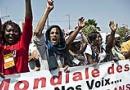
Last week’s World Social Forum (WSF) in Dakar ended up riotously happy thanks to the eviction of a universally hated Egyptian pharaoh, after near-debilitating logistical disasters at the event’s outset, writes Patrick Bond.
On Sunday, 13 February - just 48 hours after the resignation of Hosni Mubarak as president of Egypt in response to 18 days of street demonstrations - physician, novelist and former political prisoner Nawal El Saadawi welcomed 12 other women's rights activists into her Cairo apartment. They joined to celebrate and look forward and backward. 'We need to guarantee that there is no abortion of the revolution,' she told Women's eNews, adding that she had already been in touch with women and men as to how to proceed in this new Egypt. 'I have confidence in the revolution. I am optimistic by nature. I believe in the collective power of women and men.'
The UNCAC Coalition, a group of over 240 civil society organisations in more than 100 countries, including the Afro-Egyptian Human Rights Organisation (AEHRO) and NADAFA-Egyptians against corruption, is deeply concerned about public wealth illicitly transferred out of Egypt. A report by Global Financial Integrity released in January 2011 finds that Egypt is losing more than US$6 billion per year - US$57.2 billion in total from 2000 to 2008 - to illicit financial activities and official government corruption. Earlier this week, allegations were published about the wealth of Egyptian President Hosni Mubarak and his family. This wealth should be thoroughly investigated, and if illicitly transferred should be immediately frozen and then repatriated.

Whether Egypt's association with US-backed capitalism has been disrupted is a question that factory workers might yet decide, writes Christopher Carrico.
'President Hosni Mubarak has decided to step down as president,' Vice- president Omar Suleiman announced Friday night on state television. In Cairo’s Tahrir Square, the epicentre of the popular uprising that began on 25 January, some two million protesters let out a cathartic roar heard for miles across the sprawling capital. A 30-second announcement had ended 30 years of repressive authoritarian rule. But while Mubarak is out, his regime remains deeply entrenched. There are still vast networks of corrupt public servants, monopolists, party loyalists and abusive police in place.
As it now stands, the United States appears content to contemplate exchanging Hosni Mubarak for Egypt's new Vice President, Omar Suleiman, the Egyptian spy master - that is, one dictator for another - to maintain the status quo. But as this article from Mother Jones points out, Suleiman 'looks to be a nasty piece of work'.
Thousands of workers of the Mahalla Textile Company held a strike last week demanding better wages. According to the Center for Trade Union & Workers’ Services (CTUWS), 24,000 workers took part in the protest. The workers from the morning shift had joined their colleagues from the night shift and gathered in front of the company’s headquarters, where they announced their strike.
Visit this page to meet those who sacrificed themselves in the effort to overthrow Hosni Mubarak.

As Egypt’s extraordinary social and political protests against Hosni Mubarak’s regime continue, the renewed energy of those seeking a new start is ensuring that the government is forced to implement more than mere cosmetic changes, writes Horace Campbell.

With a revolutionary wave continuing across Egypt, the African Union's dubious leaders call a special session, says Gado.

http://www.pambazuka.org/images/articles/516/Mamdouh-Habashi_tmb.jpg [mp3], vice-president of the World Forum for Alternatives and board member of the Arab and African Research Centre in Cairo. Habashi explains the causes behind the recent popular uprising in Egypt, the crisis of democracy that led to its creation and its potential and weaknesses as a ‘movement without a head’. Egypt, he says, does not have a real democracy, despite the presence of unions, elections and a so-called political opposition. But despite having the biggest and most powerful anti-demonstration police in the world, the government was unable to contain the people’s movement.
