



Haiti & The Presidential Transitional Council (PTC): Redemption Failed Again
Jonathas unravels the conspiracies and illusions frustrating attempts at life improvements and transformative change for Haitian peoples, and the next Haitian revolution
With the fall of the Duvaliers in 1986, an illusion of better days covered Haiti. The nation had come to believe that the chains of misery were broken, and a new era of prosperity seemed to finally arrive. Since then, the country has faced a series of non-recurring political crises, leaving the impression of both a national and international conspiracy to thwart any attempt by the people for any basic improvement in their well-being. In 1991, the first democratic election leading Jean Bertrand Aristide to power occurred. However, it only created another illusion of change. A few months were enough for the conspirators to organize themselves to divert the momentum of change by orchestrating a bloody take over (coup d'état) in September 1991.
Nearly two decades later, the terrible earthquake of 2010 which robbed the lives of more than 300,000 Haitians provided, once more, an opportunity for collective awareness to give the country a taste of prosperity. Although the flow of global compassion towards Haiti brought more than 10 billion dollars for the benefit of the country[1], a rigged election, validated by the international community, brought the PHTK (Parti Haitien Tet Kale) party to power. As a direct result, the country sunk into unprecedented corruption characterized by the squandering of the famous Petro-Caribe fund.[2] The Haitian nation experienced only darker days throughout the period of 2010 to 2020 during which corruption, impunity, violence reigned. The culture of chaos reached its peak with the assassination of President Jovenel Moise on July 7, 2021. Since then, the country has navigated an endless transition, with each stage seemingly more tumultuous than ever before.
The country's continuous descent into disarray is knowingly led by politicians who have occupied various positions within government since 1986. These individuals metamorphose their character and behavior according to each government in power. Their practice, generally, is to find a way to make money without worrying about the real problems of the country, especially the most vulnerable, which only serves to completely destroy this country. The country's money has gone into the pockets of politicians, real needs are not addressed. Corruption is the norm for these politicians. International aid is poorly managed, embezzlement is commonplace. Bad governance, impunity... are among other things the hallmarks of the country's recent governments. They do everything to stay in power, use the most sordid strategies to sideline honest citizens who want to integrate the political sphere. Democracy is like an empty word. No elections have been organized in the country for almost 10 years. Nothing has been done to maintain the republican institutions. For 4 years, the country has been without a parliament. No authorities are legitimate, all are de facto. Then, they arm the young people in working-class neighborhoods to thwart any form of opposition. This suits them to continue this transition that never ends. Each one takes their turn to enrich themselves. The political environment is so unhealthy and perilous that few citizens participate in it.
With a governance based on violence and intimidation, certain political and economic actors have facilitated the overwhelming emergence of criminal gangs and leashed them on the working-class neighborhoods. For some time now, these same groups of gangsters used by these actors for personal electoral, political and economic needs are currently out of their control. These gangs have grown tremendously throughout the country. Today, they occupy 80% of the Haitian capital[3]. Today, these gangs are autonomous and are developing a certain independence in their operation, which makes them out of control. They (the gangs) have been a problem for the government for some years. Faced with this, the government had officially requested the assistance of a foreign force. The first United Nations intervention in Haiti dates back to February 1993, when the Joint UN and Organization of American States (UN-OAS) International Civilian Mission in Haiti was deployed. In September 1993, the Security Council established the first peacekeeping operation in the country, the United Nations Mission in Haiti (UNMIH) (MINUHA in French). However, due to the refusal of the Haitian military authorities to cooperate, UNMIH was unable to fully deploy and fulfill its mandate at that time, bringing the country more problems after their departure. Cases of human rights violations are glaring. The international community (Especially the UN, OAS, and Caribbean Community (Caricom)) has been very cautious in sending assistance. After several meetings at the UN level, they found a formula to have a foreign force led by Kenya. The image of a foreign force led by an African country seems a little more acceptable than a format led by a major foreign power or a UN mission. A strategic choice due to the fact that the Haitian community resent the past international forces. They gave us foreign soldiers who look like us: African brothers. The cup is less challenging to swallow. However, even with the presence of this force arriving in April 2024, the situation only got worse. To make matters worse, they are poorly equipped. The funding promises of the international community are not kept, once again. They are sometimes on the ground with the National Police during operations against gangs, too often they come to nothing. We see them mostly at major events, securing the perimeters for members of the government. Their presence so far is not very effective.
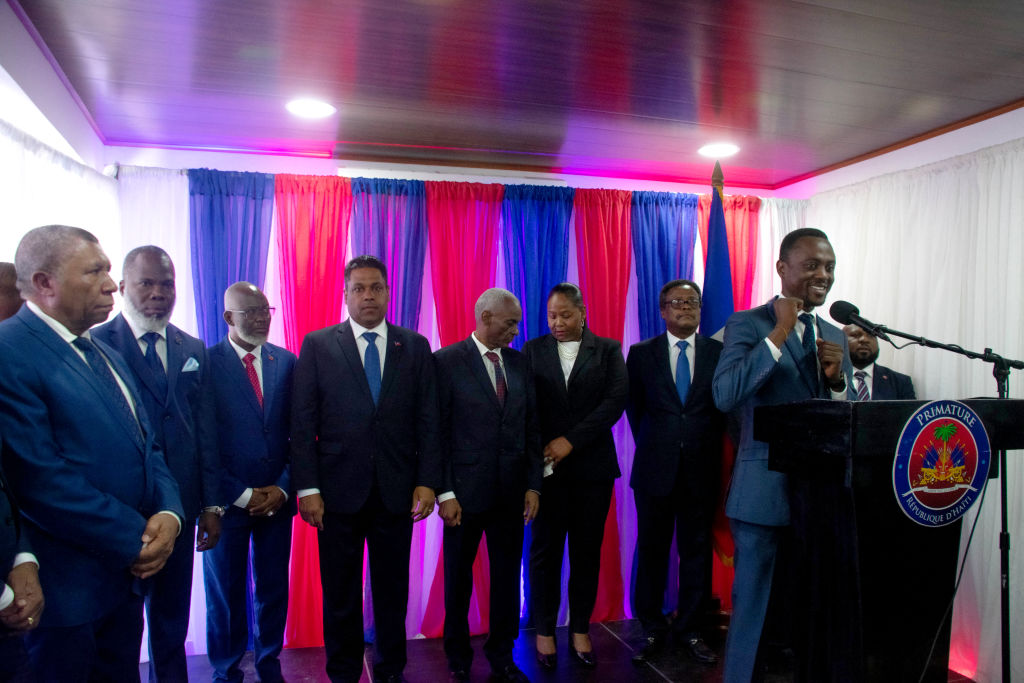
In an attempt to regain control, traditional politicians came up with an innovation in governance, with of course the blessing of their international boss and supporters. Under the dictation of CARICOM, a 9-member presidential council was set up to replace the government of Ariel Henry who came into power after the assassination of President Jovenel, in absolute disregard for the country's constitution. This presidential council reflects the representation of the most influential political parties of the moment and members of the Haitian private sector. For the first time in the country’s history, they agreed on shared governance. From these politicians emerged a magic formula with the blessing of the international community to create a coalition with the same actors who led the fall of this country since 1986. It is sarcasm indeed: Excellent opportunity one would say.
Two choices were necessary for the Presidential Transitional Council
1. Redemption: Aware of their past sins, we expected the Haitian politician to take all necessary measures to curb gang violence and put the country back on the right path, ultimately restoring constitutional order. It was time to become aware of the wrongs they have done to this country: To make their mea culpa, and to bring together all the living forces of the nation and to make a deep reform of all the governance of the country: To fight corruption and impunity, strengthen justice, and restore the country's dignity.
2. Continuing on their current path: The slim hope that these politicians can make a wake-up call was an illusion. Definitely, we cannot change the nature of these crooks. Unfortunately, they seem to excel at one thing: destroying the country.
Sadly, they opted for the easy way out. After eight months in power, this council has plunged the country into a cataclysm with no precedence.
-
Corruption: Persistent rumors about corruption within the PTC and government remain unchecked. The most glaring case involves three council members, who were directly implicated and indicted by Haitian justice in a bribery scandal exposed by a former president of the National Credit Bank[4]. Three members of the Presidential Council, Emmanuel Vertilaire, Smith Augustin, Louis Gérald Gilles, have been accused by the outgoing director of the National Bank of Credit of having demanded 100 million Gourdes each from him to keep his position as president of the National Bank. Warrants of appearance have been issued against these council members. An investigation was conducted by the country's Anti-Corruption Unit (ULCC), which brought to light the facts. The report[5] indicates that there is reason to believe that there was corruption. For the moment, the case is closed by a judge, because of the status of president of these advisors.
-
Impunity: Individuals arrested for corruption regain their freedom through the influence of new leaders. Council members refuse to appear before judges to clarify allegations, hiding behind questionable excuses.
-
Power Struggle: The sectors that initially designated members of the Presidential Council now oppose the same body. Internal infighting has escalated as members compete to seize key state positions. Notably, with the appointment of the new coordinator, we witnessed the formation of a new government—replacing the former Prime Minister, who refused to share ministerial posts. In just eight months, two governments have come and gone. Positions continue to be distributed indiscriminately. Nothing guarantees that the next coordinator will not follow the same path, given that the presidency rotates among PTC members—everyone gets a turn.
-
International Interference: Nothing in Haitian politics happens without the approval of foreign powers, especially USA, FRANCE and Canada. Certain key functions are strictly controlled by powerful external interests. Today, traditional foreign powers operate behind CARICOM to impose their directives. In January 12, 2025, some sectors responsible for creating the PTC requested CARICOM’s assistance in overhauling their governance strategy, citing non-compliance with the April 3, 2024 agreement[6]. Through this agreement, politicians will have shared governance with the creation of the presidential council of 9 members, playing the role of president and 1 prime minister for the coordination of government actions. This signal yet another reset a "transition within a transition."
The ultimate victims continue to be the Haitian population—particularly the marginalized and residents of working-class neighborhoods. In 2024 alone, over 4,000 civilians[7] were killed by armed groups, while more than 700,000 people have been displaced due to gang violence. The economy lies in ruins, exacerbating an unprecedented food crisis: 5.4 million Haitians face severe food insecurity, including 2 million on the brink of famine[8].
The Haitian people, however, have always demonstrated unmatched perseverance. They survived the revolution of 1804 when slavery was the global norm. They overthrew the Duvalier dictatorship despite international support for the regime. They found hope again after the devastating 2010 earthquake.
Today, the emergency is the resolution of gang violence. According to a UN report, 80 per cent of the weapons and ammunition come from the USA[9]. These weapons are purchased in the USA, transferred to the Dominican Republic, and then arrive in Haiti through a poorly controlled border, Or, they are transported directly to Haiti. Control at Haitian customs is very precarious. Once arrived in Haiti, these weapons and ammunition are distributed to gangs who make a whole exhibition of their arsenal. Unfortunately, we do not feel serious steps are being taken to end the weapons and ammunition trade. One of the major contributions that the international community, particularly the United States, can make is to impose strict controls on goods leaving their country for direct shipment to Haiti, or in transit to other countries (such as the Dominican Republic) en route to Haiti. This will greatly help in the fight against banditry in Haiti, by reducing the gangs' capacity for action.
Time and again, politicians have betrayed this resilience, squandering every opportunity to redeem themselves. Instead, they mock the struggles of the Haitian people. But when the next revolution comes, they will not escape the fury of a nation that has endured their wickedness for too long.
2025 promises to be a decisive year for Haiti. General elections are announced for this year. If they are held, it will be bloody, since security conditions will not be met. Also, if they are not held, should this government admit its failure and hand it over to others? Will they do it? how will the people react? Everything seems more uncertain than ever. Social forces today are weak in the face of gang violence. Especially since it's very difficult to raise awareness among the population, which is practically dispersed, leaving their neighborhoods because of gang violence. Of course, there are a few journalists, especially on social media, who are critical, but their influence in mobilizing against what is happening is weak. There are also neighborhood self-defense forces, often police officers who join young people to defend their communities. So far, they're practically the only force holding out in a small part of Port-au-Prince. For how long? We don't know.
The night has been long, but as the Haitian proverb says: “Se lè l pral fè jou, li fè pi nwa” (“it is darkest just before dawn”). At what cost will Haiti’s deliverance come? Only time will tell.
Judes Jonathas is a graduate in Administrative Sciences with specialization in Microfinance and local development. He specializes in strategic approaches to community engagement related to peacebuilding, financial inclusion, and economic development. He had led several humanitarian aid projects, economic development, governance and peace building for over 15 years in difficult neighborhoods of Haiti. He now works as an independent consultant for some international organizations and as a technical advisor for local Haitian organizations, particularly youth and women organizations. He is an executive director of R&E Hope Foundation helping people in vulnerable situations in the North and Northeast of Haiti.
Endnotes