



Dictatorships are Gender Neutral
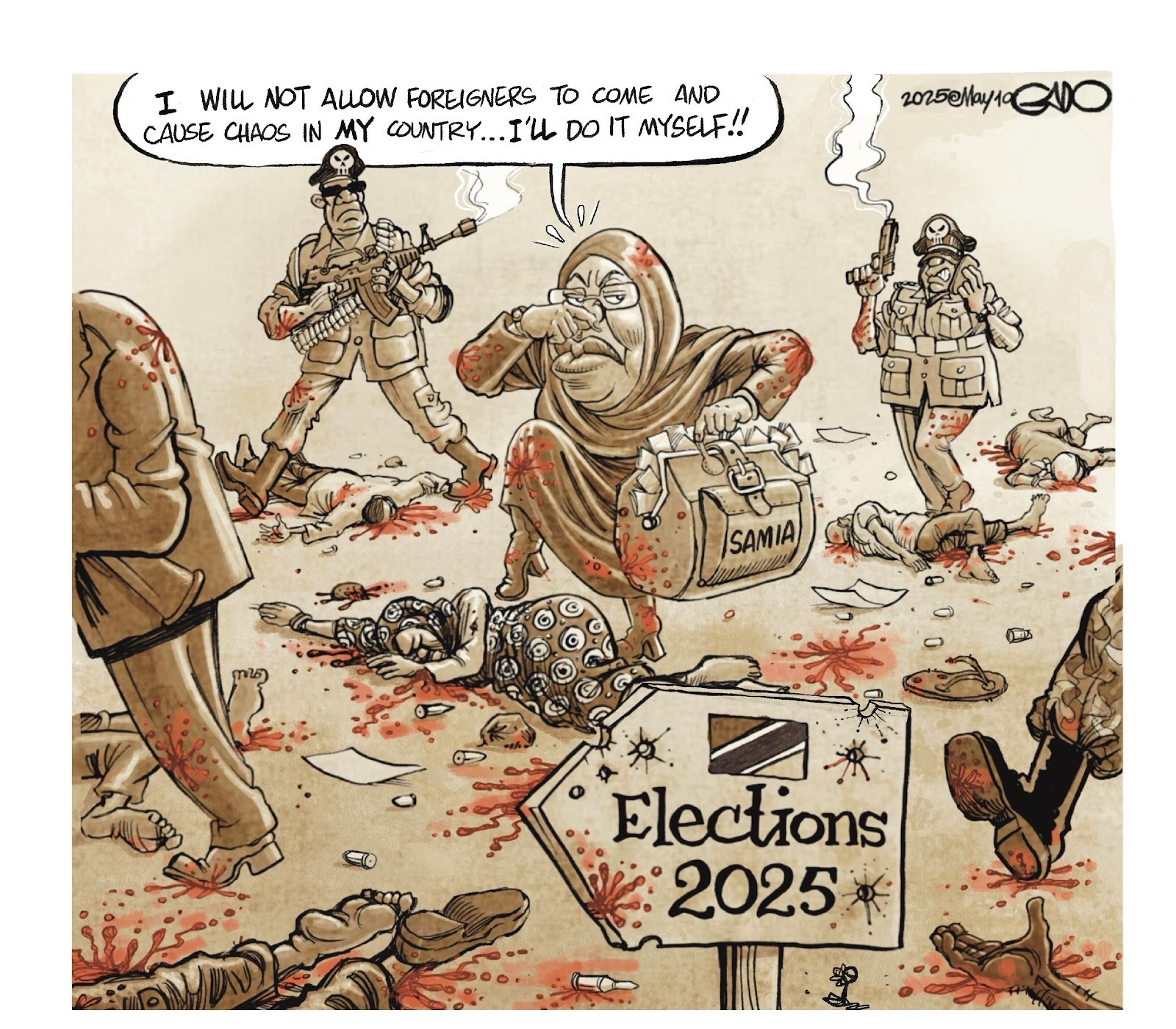
Mutunga recounts the maltreatment, suppressive and dictatorial experiences he and his colleagues from Kenya and Uganda endured under the Tanzania leadership in efforts to visit the country and solidarize with the Opposition Chadema Party leader, Lissu’s trial on alleged treason charges.
On May 19, 2025, at about 2.30 AM, I and two Kenyan comrades, Hussein Khalid and Honey Hanifa, disembarked from a Kenya Airways flight that had landed at Julius Nyerere International Airport from Nairobi. The three of us knew that three of our compatriots, including Honourable Martha Karua, had been detained at this airport earlier and deported back to Kenya. We were part of the various teams from Kenya and Uganda that were in Dar es Salaam to observe the ongoing treason trial against the leader of Tanzania’s main Opposition Political Party, Honourable Tundu Lissu.
We queued up to have our entry into Tanzania processed by the Immigration Officers. We all carried our East African Community passports. An individual who was not a uniformed Immigration Officer stood by looking at us. When our turn came to be processed the onlooker confiscated our passports, and directed us to sit on some designated chairs. He finally told us we would not be allowed into Tanzania, and that from that moment we were detained. We in unison demanded the reasons for our detention. The onlooker said there were reasons and issues about the detention that could only be communicated to us by his boss. He urged us to wait for his boss. He then disappeared after asking a uniformed police woman to take us to a restaurant for breakfast at our expense. We went for breakfast and invited the police woman to join us for breakfast, which she did, and sat at a distance that allowed us to reflect on what we could do.
We had, since 3 a.m., been very busy on social media, particularly on X. We called members of teams who had already been allowed to enter Tanzania. We also called Tanzanian lawyers whose contacts we had, including the President of the Tanganyika Law Society. We knew that come sunrise we will start getting responses. And we did. It became clear that we will be deported back to Kenya when we found out that the manager of Kenya Airways had our passports, and kindly came to see us about the times of the flights that would be landing at the Airport.
So, it came to pass we would be on a Kenyan Airways flight to Nairobi at 3.05 pm. The Kenya Airways got us boarding passes, took off and we were flown back to Kenya. The onlooker was nowhere to be seen. Through social media we knew that Comrade Boniface Mwangi had locked himself in a hotel room to resist arrest. His story, and that of a Ugandan comrade Agather Atuhaire, who was arrested and detained with Mwangi by the Tanzanian police officers is now an open secret: a story of inhuman torture, violation of the rule of law, and horrendous psychological, mental, and physical torture. Both have since returned to respective countries, but have had to go to hospitals for treatment.
Observation of political trials have become the norm where the states desire not be accused of undermining democracy by oppressing political rivals; Or states that believe they have strong cases, believe in justice, and want the rest of the world to know that they respect constitutionalism and the rule of law. There are trials that observe the rules knowing that the Judiciary will always second-guess the executive, rendering invariably the wishes of the latter. I wanted to observe which option Tanzania was taking. Besides, Hon Tundu Lissu and I have been friends for decades. I was one of the first Kenyans to see him at the Nairobi Hospital when he was flown there, his life in extreme danger after being shot 27 times. I have written a foreword for his book on parliamentary democracy which he wrote in blood, sweat, and great pain as he was recovering in Belgium. I admire his courage and determination to give East Africans the imagination that our current political leaderships are not patriotic and cannot engineer any social transformation in the national interest. Although I was not able to get to his trial, I have irrefutable evidence confirming that my dear friend knows that nobody retires or retreats when the struggle for liberation continues.
There is a personal footnote to my detention and deportation from Tanzania. I studied law in the University of Dar -es-Salaam (UDSM), 1968-71 and 1973-4. It was in UDSM, the Mecca of revolution as we called it, that my intellectual, ideological, and political positions matured. It is in this University I was taught by, and encountered revolutionary students, lecturers, and professors. It is in this University I attended lectures by leaders of liberation movements that the government of Tanzania had given bases to wage their revolutionary wars. It is in this University that discussions on the state of the planet and revolutionary Pan-Africanism were robustly discussed. Indeed, I had an opportunity to see President Nyerere from close range as he debated us students and our lecturers and professors. I joined scholars that called themselves Nyerereists. He incited and excited our brains. I knew his legacy would be that of a great individual, woman or man, that you can put in an intellectual, ideological, and political trajectory and discover you can only glorify and vilify such an individual in equal measure. In my books, that is a hallmark of greatness.
It was in UDSM that I read radical literature. As a Kenyan I knew that books published by Beijing Foreign Press were banned in Kenya. So, I read them in the University and smuggled home those I could not part with. For some reasons that were not made public, the Kenya government had no issues with books published by Moscow Progress Publishers. There was even a bookshop in Nairobi, Kenya that sold these books. That influence by UDSM has never left me and I have ever lived with it. It is part of my life and politics. I love Tanzania. I have friends and families there. Kenya detained me. I never thought Tanzania would detain and deport me. I have to quickly qualify what I mean by Tanzania. The people of Tanzania did not detain and deport me. It is the government of the Republic of Tanzania speaking, not in the name of the people of Tanzania, but in their own interests that did so.
That is one part of the background to the personal footnote. The other part is my answer to President Samia Suluhu. We the people of East Africa are not “messing” our countries. What do we gain by doing so? In East Africa there is a class that rules over the working people. It is in Tanzania that I understood who they are by their various categorization in Kiswahili: Wanyonyaji, Makabaila, Matumbo yasiyoshiba, Walalahai, Wanyapara na watumwa wa Ukoloni Mambo leo, Watumwa wa Watawala wa nje, Wadosi, Wavuna Jasho, n.k.
Madame President you belong to that class and as President of Tanzania you personify it.
We have been oppressed a great deal. We have been humiliated a great deal. We have been exploited enough; We have been tortured enough. We have been abducted enough. We have been murdered enough. Our resources have been stolen and wasted. We have been denied our material needs, namely, water, universal education and health care, food, security, housing, and our lands have been privatized and commodified. And your class has been loyal slaves of foreign interests whose commissions make your class hate us, we the people.
Tumechoka nanyi. Tumekataa. Tumewakataa. Uongozi Mpya Afrika ni Sasa.
Dictatorship of whichever gender cannot stop the African revolution. The African youth will never allow this to happen. The days of dictatorships in Africa are numbered.
Willy Mutunga was Chief Justice & President of the Supreme Court, Kenya, 2011-2016. He is Adjunct Professor in Public Law, Kabarak Law School, Nakuru, Kenya.
End Notes
[1] Exploiters
[1] Capitalists
[1] Literally “Stomachs that are never full; never satisfied.
[1] Literally, “Those who sleep alive and satisfied.” The opposite is Walalahoi, “those who sleep hungry and tired.”
[1] Agents of neocolonialism
[1] Slaves of imperialism
[1] Literally “Those who dose.” Implied is they dose because they are wealthy and do not work.
[1] Literally, “Those who harvest the sweat of those who work.” The opposite, those who work and sweat is Wavunja jasho.
[1] Literally, “We are tired of you.” Implied is that we will fight and resist you.
[1] Means “We refuse.” We refuse your leadership.
[1] Literally, “We reject you.” We reject your leadership
[1] [The struggle for] Alternative leadership in Africa is now.