



Venezuela, Global Africa, Chavista and US Intervention: Insights from Pambazuka’s Global Town Hall on The Bolivarian Revolution of Venezuela and Its Enemies, held on Zoom and YouTube on Sunday, 1 February 2026
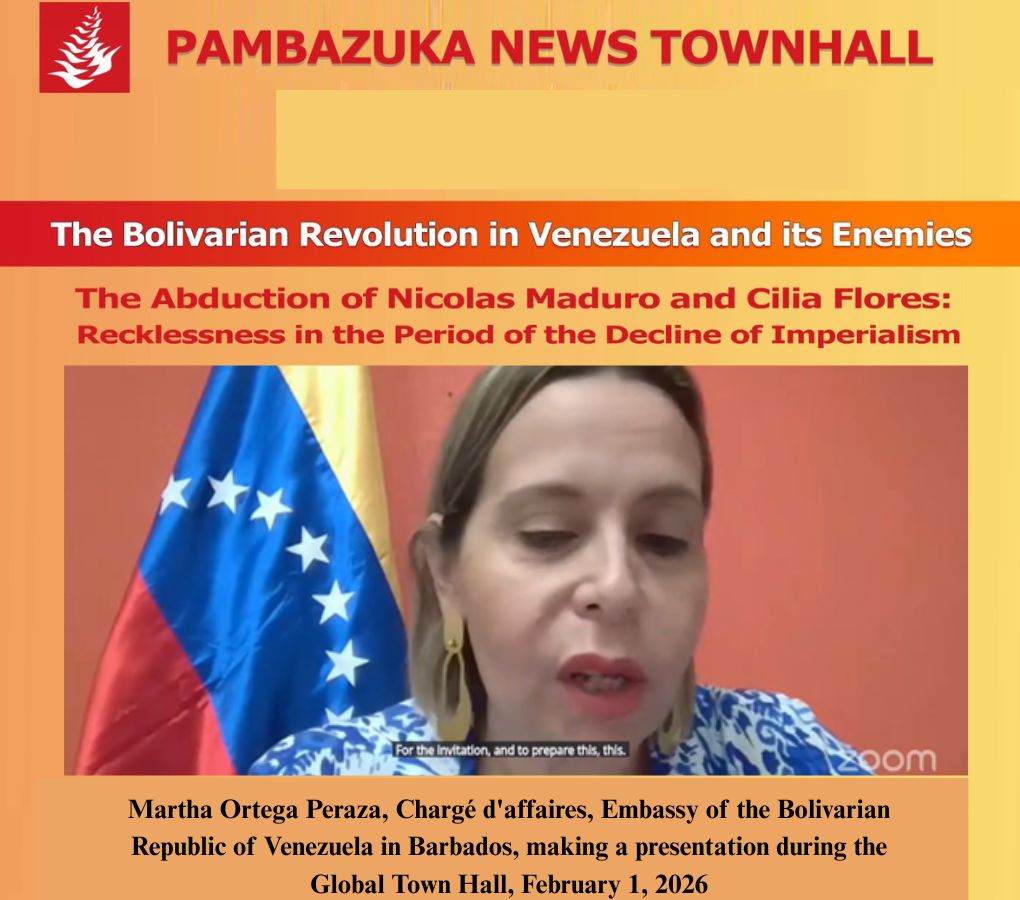
Reflections from the Second Pambazuka Town Hall highlights the implications of imperial intervention in the Bolivarian Republic of Venezuela for Global African peoples
Pambazuka News seeks to inform and raise awareness of individuals, movements and organisations on the struggles of global Africans, struggles for their political liberation, social justice and reparations.
In keeping with its mandate as a platform of information on global Africa, Pambazuka held the Town Hall on the Bolivarian Revolution in Venezuela and its implications for African descendants in Venezuela, and the Caribbean. Following the abduction of Nicolas Maduro and Cilia Flores by the US military in a period of US hegemonic decline, it was urgent that the full meaning of these developments, in all their implications, be understood. Among the issues that were discussed were an examination of the internal and external forces opposed to the Bolivarian Revolution; the socio-economic realities of Venezuela, including its internal class and racial dynamics; the history of US intervention and regime change in the global south; and the examination of empire in a period of internal crisis and loss of global hegemony.
The Town Hall was organized in association with GPAM (The Global Pan-African Movement, US). It was urgent and historically necessary, given this moment of global crisis, a period of impending global war with its nuclear implications. The Global Town Hall reached out to global Africa to centre the question of the role and place of empire in its dying days and in specific relation to the Venezuelan events and connections to wider global issues. A sub-theme of the Town Hall was to reflect on the current expressions of imperialism in the current moment of the decline of American global hegemony.
This reflection provides broad insights into the politics of Venezuela, the political economy of Venezuela, its culture, its relation to the Pan-African Movement, and its place in civil struggles.
The first subsection situates Venezuela within Global Africa, followed by a discussion on the historical contexts of US meddling in the country, the wider political economy, culture and struggles in the Bolivarian Republic.
On Venezuela as a Social Formation: Situating Global Africa
Reflections from Layla Brown, Assistant Professor of Cultural Anthropology & Africana Studies
Following her family's organizing history, Layla had spent years organizing African Liberation Day in Washington, DC. The Afro-American connection with the Bolivarian revolution stemmed from a family belief in “Venezuela at that moment, between 2005 and 2009,” in Venezuela’s potential to be for the current generation what Cuba was for the older generation - a “place where black left radicals could potentially find refuge.”
The wider African connection with the Bolivarian nation also stems from the presence of people of African descent in Venezuela and from the realization that Venezuela is a non-white nation. The majority of the population are Indigenous persons and non-white persons. Decades of white settler colonialism had sought to erase the African presence in Venezuela. The 2011 census of Venezuela became the first to count the Venezuelan population by race. By asking a question about physical features, ancestry, culture, and traditions, some Venezuelans identified as Negro or Black (2.8%), Afrodescendiente or African descent (0.7%), and Moreno (49.9%). The African ancestry of the racially mixed Moreno adds to the racial dynamics to highlight the significant African presence (around 53%) in the Venezuelan context. Thus, the events in Venezuela matter to Global Africa not only in terms of the common imperial destruction of a struggling empire but also a historical bond that links Venezuelans to African peoples everywhere through ancestry. In the era of the 2001 Durban Conference against Racism, there had been a big push in Central and South America for African descendants to be included in the census as a distinct population.
In the history of racial capitalism in Latin America, there had been an erasure of what it meant to be a person of African descent, a person who was a descendant of people who were formerly enslaved. By referencing the survey, Brown brought to the fore the Afro-Venezuelan identity and connected their struggles to the wider struggles for the emancipation and dignity of African peoples.
During the early phases of the Bolivarian Revolution in the 1990s, Hugo Chavez brought to the fore the progressive ideals that would characterise Venezuela. Hugo Chavez identified himself as an African descended human. When Chavez was overthrown by counterrevolutionary elements, it was the power of the people that ensured his continuing leadership and redirection of Venezuela in the spirit of the Revolution. Brown’s reiteration of this history should remind working peoples, progressive elites and grassroots forces about the power they wield in the defence of contrary and destructive forces that seek to undermine national self-determination and attempts towards equitable projects across the global south. Chávez’s identification as Afro-indigenous reflected in part the gains of the Afro-Venezuelan grassroots movements that served as common ground for the poor, working class, women, peasant farmers (campesinos), and marginalized of the country before the revolution. The linkages between the Bolivarian Revolution and the popular power became strengthened from 2002. Over the years, to be Chavista meant being black, indigenous, poor, and considered by the bourgeois class as the dregs of society. These social forces provided the popular front for the processes and continuity of the Bolivarian Revolution.
Layla Brown argued that blackness had become entwined with chavismo to the extent that when Orlando Figueroa was lynched during attempts to impose Juan Guaidó on Venezuela in 2017, Figueroa’s blackness was conflated with his status as Chavista. The other part of the Afro-embeddedness with the revolution can also be seen in the accusations of the perpetrators of that savage act that Figueroa was a supporter of the Bolivarian administration.[1]
Brown's presentation unveiled that the central role of the Afro-Venezuelans in the processes of the Bolivarian Revolution makes any attack on the revolution an attack on a particular kind of Afro-descendants’ sovereignty. In her view, the responsiveness of the Revolution to the needs and political aspirations of the Afro-descendant population, the Bolivarian Revolution up until the Sahel, is the only sustained state-level Pan-Africanism in the 21st Century.
The anti-racial movement that mobilised the peoples of Venezuela in support of the Bolivarian revolution can count as people-based Pan-Africanism, which could be strengthened by linking up with similar social forces within the region and elsewhere. In the final analysis, state-level Pan-Africanism will be effective beyond national boundaries if peoples across the borders of interest foreground such processes.
The right-wing and conservative forces in Venezuela attack the Bolivarian revolution in racial terms in multiple ways. Cartoons have attempted to dehumanize Chavez to the level of a guerrilla, and Maduro to a mule to highlight his person as mulatto, similar to racial slurs that seek to demean peoples of African descent.
Attempts to whiten Simon Bolivar and the liberation struggles in Latin America do not grasp the fundamental support from Haiti that aided the success of the project. During the bicentennial anniversary of Venezuela’s independence in 2011, images and controversy about attempts to whiten Simon Bolivar emerged. About this time, Brown recounts narratives about Hiplito Bolivar, an alleged African descent caregiver of Simon Bolivar, who allegedly instilled in Bolivar the liberation thoughts that would shape the ideologue he became in Latin America.
In 1815-1816, President Alexandre Pétion of Haiti assisted Bolivar twice with weapons (arms and munitions), soldiers, a fleet, food and finance in a freedom pact that directed freeing slaves in territories within Spanish America.[2] This support was crucial to the eventual success of Bolivar in the Latin American Liberation Project.
Through recount of the support of Haiti’s President of African ancestry, and narratives about Hiplito Bolivar, Afro-Venezuelans are seeking to reclaim the Global African foundations, or contributions to the Liberatory Project, from the Bolivarian Revolution of 1998, to Latin America generally – Peru, Ecuador, Colombia, Guyana, Panama, Bolivia and others.
The social programmes that supported indigenous Venezuelans and Afro-descendants were funded through oil revenue, and the sanctions on oil significantly impacted the financing of these programmes. As Brown notes, the US Government’s imposition of sanctions seeks to weaken the resolve of the population and support of the revolution. This process has been intensified against Cuba for the past seven years.
Layla’s analysis situated the Bolivarian revolution as a Pan African, global African revolution with a black, underclass, in the context of a global liberation struggle.
Pan Africanists need to understand who our friends are to work together, and who the common enemies are to protect our sovereignty and increase the gains in our struggles for liberation.
Historicizing U.S. Meddling and Intervention in Venezuela within the Chavista Revolution
Takes from Martha Ortega Peraza, Chargé d'Affaires, Embassy of the Bolivarian Republic of Venezuela to Barbados.
Her Excellency Martha Peraza put the Venezuelan intervention in a historical context. The social struggles in Venezuela mirror what is happening in the world now, the war by empire in its declining moment. While the US war on the people of Venezuela has resulted in the abduction of Nicolas Maduro and Celia Flores, Maduro remains the President of the Bolivarian Republic and the allegiance of the acting President Delcy Rodriguez and the country’s diplomatic missions to this fact will hardly wane.
Martha's presentation reiterated that poor women and Chavista grassroots organizations formed the foundational bases of the Bolivarian revolution. It was significant that the acting President is the first woman to be in such a role or near it in Venezuela. In her experience, interactions about participatory democracy during Peraza’s school days brought to the fore the unsavoury disposition of some Venezuelans towards the Chavista. Comments such as “you are too white and too smart to be a Chavista” directed towards her highlight three possible, if more calculated efforts: the first is to demean the Chavista by insulting their intelligibility; the second is to emphasize the racial dimensions of the Chavista; third, is serve the purposes of white supremacy; and separate progressive brown and white people from legitimate struggles that uplifts the material conditions of the masses of society regardless of the particular race or colour. By offering a certificate or invitation to whiteness, the delusion of white supremacy will refuse the perpetrator an education about the civilization and intellectual contributions of blacks and other coloured peoples in the world. In the worst case, it is a wilful ignorance or information warfare that seeks to present a mental image of black and coloured savagery, one that, if successful (internalised), could demoralise the innovative capacity and intellection of African people as well as offer the propensity to look up to a “white guardian” for developmental directions.
For Hugo Chavez, participatory democracy meant providing all members of society equal opportunity in key decisions, such as determining what would be included in the constitution of the Bolivarian Republic and the people’s approval of the final document. When almost 80% of the people approved the Constitution, they were making a firm statement about the sovereignty of Venezuela, and that the government and institutions of Venezuela must be the representatives of the people of the Bolivarian Republic. It also included a statement about participatory democracy that ensured indigenous peoples could have their own territory and speak their own language, and that those languages would not be treated as “unofficial.”
Many things have been attempted against the Bolivarian Republic. There have been strikes on the oil company, different Guarimbas,[3] coup d'etat, and efforts to install Juan Guaidó as President of Venezuela.
When Chavez was kidnapped in 2002, the detention was within Venezuela. The difference now in the war against Venezuela is an escalation of the kidnapping by transferring Maduro to the belly of empire.
The strike, kidnapping of the president, after three months of blockade of the Venezuelan coast, and after more than 10 years of blockade and coercive measures against the country, have presented a lot of difficulties in developing the Bolivarian Republic, including restrictions on the purchase of equipment for the subway, electricity, and related sectors.
How is it possible that the government of Venezuela is still in the hands of the vice president, now Acting President, Del Rodriguez, who is the second in authority in the government of Venezuela, and of course, a Chavista person, you know, a revolutionary person?
The opposition might have had reasons to hope that after the abduction and strikes, Venezuelans would take to the streets, and perhaps ask for Maria Corina or praise them. Venezuelans indeed protested in the streets to condemn the aggression and to demand the return of the president and wife since the first day, January 3, 2026. Venezuelans condemned the aggression and asked for proof of life of President Maduro, and asked that he be returned to the country. The peoples of Venezuela, including within the opposition in Parliament, have viewed the strikes as aggression against the homeland, and some of its elements oppose the attacks against the country’s sovereignty.
Peraza notes that Venezuela’s model and what its leadership wants to do for that country and the region represent a perspective that threatens the United States. From the inaugural speech of the Acting President, there is an emphasis on this dynamic. We have a historical confrontation between the Bolivarian point of view and the perspectives of the Monroe Doctrine. That means that Venezuela, since Hugo Chavez, has been leading a different mechanism of integration, such as ALBA, Petrocaribe, and SELA, within the belief that only with the integration of the region can the peoples in the area resist, confront and develop themselves against the attack of this imperialism.[4]
Institutions in Venezuela and the state in Venezuela are working. Venezuelans and members of the government are working really hard to create conditions for the people of Venezuela and for the country’s institutions to work. The executive, the parliament, the courts, the police, the defence forces, the council, the communal council (consejos comunales), and community organizations of the peoples of Venezuela understand that it is the power of Venezuelans that sustains the country. The people form the basis of everything in the country: the base of the Constitution and of the democracy. The state cannot work without the people of Venezuela.
Martha Peraza’s arguments anchor the Chavista revolution as a move that has ensured democratic practices and a source of political power that relies on the legitimation of the peoples of Venezuela.
The mechanisms provided by the 1999 Constitution were implemented when Delcy took over as the Acting President of Venezuela with the support of the peaceful people of the Bolivarian Republic.
Acting President Rodriguez is working to protect the peace of the country. But the peace of the country is not only the absence of war, but also the possibilities that Venezuelans have and the right to develop the country as we want it, and as we believe. Her approach to the aggression is to use diplomatic channels to protect the lives of Venezuelans, the peace of the country and the region.
Her Excellency, Martha, emphasized President Delcy’s statement that the aggression is a stain on Venezuelan-US relations. Venezuela's focus continues to be on the dignity of its peoples and guaranteeing the life and peace of its citizens and the Latin American and Caribbean as a zone of peace.
The actions of the Venezuelan government, which Peraza attributes to Bolivarian diplomacy for peace, translate into making necessary efforts to defend the interests and sovereignty of the republic through diplomacy with dignity. This form of diplomacy also means defending the right to transform Venezuela and the commitment to continue working towards regional integration.
The history and politics of Venezuela and US aggression towards the Bolivarian Republic have not been a straight path. It has been a long and difficult road, but the Bolivarian model presents a bold proposal and ideals that continue to endure and evolve. Venezuelans must persist in writing their history within the Bolivarian proposal to secure the social and infrastructural changes it envisages.
As Martha Peraza notes, the revolution is the people of Venezuela, it is not one person. The people in each community, the people working every day to develop the country and to protect what the country is doing during this time of the revolution, and the leadership they have entrusted the state with, will continue working even in difficult times. The Bolivarian diplomacy of peace, in her view, will help to achieve the goals of the revolution at this particular time.
David Abdullah Says: “Resistance Matters Even More”
One of the key contributors to the Pambuzaka Town Hall was David Abdullah, the President of the Movement of Social Justice in Trinidad and Tobago and one of the leading labour leaders and trade unionists of the Caribbean and Latin American region. His views are worthy of deep reflection.
In his contribution, Abdullah reflected on the historical experience of anti-colonial resistance and Third World solidarity which has shaped the early post-independence years in the Caribbean and the labour movements which gave rise to these movements. He identified this ethos of resistance the early labour movements, in leaders like Micheal Manley on the global stage and in the Grenada revolution under Maurice Bishop, and in for example, the decision by the Caribbean states of Jamaica, Guyana, Barbados and Trinidad and Tobago to establish official diplomatic relations with revolutionary Cuba against the interests of the United States of America and other Western capitalist powers.
A significant concern to Abdullah, was the evidence of slippage and reversal among new generations of leadership which seemed less equipped ideologically to match the consciousness of resistance of the post-1950 Caribbean. Coincidental with this ideological reversal, is the related rise of a brazen imperialism, encapsulated in Donald Trump’s so called “Donroe Doctrine” in which there are naked imperialist demands on Caribbean leaders inclusive of the cutting off of normal relations with Cuba such as the attendance of students at Cuban medical schools and the blocking of visa access of Caribbean and Latin American citizens to the USA. In Abdullah’s view, the kidnapping of President Maduro, the threats on Cuba, the squeezing of Caribbean internal policy space and the claims on the territory of Greenland, are all to be understood as part of a late imperialist aggression of a dying empire, whose actions are no less catastrophic.
In light of the openly and unprecedentedly aggressive and bold expressions of the USA Abdullah cautioned against the onset of fear and fatalism amongst oppressed populations. He warned the global working class not to accept imperialism as normal and not to be overcome by fear.
Instead, Abdullah issued a call-to-arms to progressive peoples and social movements to redouble their efforts at organization, building solidarity, deepening resistance more than ever before. In his view, just as imperialism has increased its aggression, and just as the sovereignty of third world peoples is under open attack, then similarly should the levels of organization, public education, activism and resistance be stepped up as one of the most critical responsibilities of our time.
Abdullah was confident in the victory against the current phase of imperialism since he was aware of the ongoing resistance within the US itself, to the Trump regime and its wider objectives.
The Attack on Venezuela & Imperialist Legacy in the Global South
Reflections from Essam Elkorghli, Global Pan African Movement - North American Chapter
The recent kidnapping of Venezuelan President Nicolás Maduro and his wife is not an isolated incident. It is a tactic within a decades-long imperial onslaught against the Bolivarian Revolution, a movement whose significance for the Global South—and Africa in particular—cannot be overstated. This attack must be understood as part of a coherent playbook of economic warfare, propaganda, and racialized subversion used against any nation that dares to redistribute wealth, assert sovereignty, and build independent alliances outside the imperial orbit.
Venezuela’s Project and the Imperial Counter-Strategy
The Bolivarian Revolution, since its inception under Hugo Chávez, directly challenged the pillars of imperialism as defined by political economist Samir Amin: the economic/financial leg and the military leg, both smoothed by a third leg of propaganda. Venezuela created counter-institutions like the teleSUR media network to break the imperial narrative monopoly and the ALBA alliance to foster financial independence. It strengthened sovereign defense through cooperation with nations like Cuba.
Imperialism’s response has been systematic. In 2015, it was Barack Obama that signed an Executive Order declaring Venezuela an “unusual and extraordinary threat to the national security and foreign policy of the United States.” Ever since, the United States has levied brutal unilateral sanctions—a form of economic warfare that deliberately cripples access to medicine, food, and financial transactions to manufacture suffering and destabilize society. This is coupled with relentless propaganda aimed at delegitimizing the state and dehumanizing its supporters.
The Racist and Divisive Core of Full-Spectrum Warfare
A critical layer of this attack is a deliberate campaign of de-Africanization and racist demonization. Pro-government activists, who are disproportionately from Venezuela’s Afro-descendant and working-class communities, are portrayed in opposition and Western media as “welfare queens,” “dogs,” “monkeys,” and violent “piranhas.” This racist narrative, designed to strip them of their Venezuelan identity and dignity, mirrors the tactics used against Black Libyans during the 2011 NATO intervention, where they were framed as “African mercenaries” to justify the pulling of Libya from its African-continental orbit while proclaiming the NATO, European Atlanticists as saviours.
This propaganda provides cover for shocking racialized violence. While Hesham Alshushan was publicly lynched in Libya under the pretext that he was ‘not Libyan’ and ‘an African mercenary’ (as if that justifies the lynching), the 2017 torture and burning alive of Orlando Figuera, a young Black Chavista, by opposition militants is a stark example. Downplayed by Western media, which only resorted to mystifying language without subjects, “Man set ablaze” and “The government says Figuera was targeted for being a ‘Chavista’” (emphasis added). Such violence aims to fracture the social base of the revolution and terrorize its supporters.
Libya to Venezuela: A Pattern of Targeting Unity Via Diasporic Functionaries and Regional Complicity
The parallel with Libya is instructive and chilling. Under Muammar Gaddafi, Libya was a leading force in the African Union’s project for monetary independence and continental integration. The 2011 NATO-led destruction of Libya was preceded by racist attacks on Black Libyans and fueled by propaganda that serviced imperial aims. The proposed South Atlantic Treaty Organization (SATO)—a vision of collective security for the Global South championed by Chávez and Gaddafi—was aborted by that very intervention.
Imperial hybrid warfare often co-opts diaspora communities to lend a veneer of legitimacy to intervention. During the Libya war, opposition figures and diaspora groups carrying the old monarchy flag in front of the White House were showcased as the "true" voice of the people, obscuring the imperial agenda behind a facade of grassroots demand. Similarly, well‑funded Venezuelan opposition figures abroad often advocate for harsher sanctions and intervention, their voices amplified by Western media to create a false narrative of domestic consensus for regime change.
This strategy is complemented by the complicity of regional powers such as Qatar. While often presented as a neutral mediator, Qatar played a fundamental role in the destruction of Libya, providing an “Arab” and “Islamic” facade for NATO’s intervention. Its hosting of U.S. military bases and key diplomatic negotiations aligns its interests with the imperial project, demonstrating that the assault on sovereignty is a collaborative effort that transcends a simple West‑versus‑the‑Rest binary.
Venezuela now occupies a similar position. By transacting with other sanctioned states like Iran and Cuba for oil refining and economic survival, it is smeared as part of a “coalition of terrorist regimes.” The ultimate goal is to strangle these models of independence, punish South-South cooperation, and prevent the emergence of any multipolar alternative that empowers the Global South.
The Larger Meaning: An Attack on the Future
The kidnapping of Maduro is a desperate escalation within this long war. It signals that despite comprehensive sanctions and hybrid warfare, the resilience of the Bolivarian project forces imperial actors towards more brazen, covert actions. Furthermore, media campaigns now seek to sow division within the Chavista movement itself, fabricating stories of internal surrender. The favourite propaganda of the full-spectrum warfare is the idea of “unnamed sources”, “close to decision makers”. Like the recent Guardian article that makes no mention of the sources and has the only political objective of dividing the political leadership of the country and sowing mistrust.
For Africa, the lessons are direct. The mechanisms deployed against Venezuela—sanctions as collective punishment, NGO-driven destabilization, academia and diaspora in service of the empire, and racist propaganda to divide nations—are the same tools used on our continent. Venezuela’s crime, like that of Libya, is its commitment to using resource sovereignty for domestic uplift and transnational solidarity.
The defense of Venezuela’s sovereignty is thus inseparable from the defense of African sovereignty. It is a struggle against the imperial system that seeks to keep all of us in a state of perpetual fragmentation and dependence, while using its regional proxies (like Qatar and the US gangsterite piracy of Venezuelan oil deposited in Qatar). The ongoing mobilization of the Venezuelan people in defense of their revolution is a powerful example of resistance, reminding us that the only answer to this onslaught is unwavering unity, clarity of analysis, and organized collective strength across the Global South.
Conclusion
From Layla and Ambassador Martha’s presentations, we have a sense of the internal dynamic of Venezuela and an update on the state of affairs of the Bolivarian Republic. We are assured that the revolution still stands, although it is going through a very difficult period. The demand for the President’s return continues. In the meantime, there's a legitimate government, a Chavista government still intact. There is also a recognized opposition still participating in the work of government. The Bolivarian Revolution and its constitutional and democratic bases endure.
Essam’s contribution assessed the US intervention in Venezuela and the kidnapping of Maduro in the light of the playbook used by imperialism against alternative visions in the global south. David Abdulah highlighted the necessity of resistance of oppressed peoples against fear and fatalism regardless of the intensity of imperialism’s onslaught. It was clear from that presentation that progressive peoples must increase organization, education and building solidarity towards the upcoming victory in the current phase of imperialism.
Political education, mobilization and organization are so central given that, as C.L.R James says, “the revolution comes like a thief in the night.” We must link the social movements in Africa and the Caribbean, and the anti-imperialist forces in the United States. The social forces in North America, in Canada, and in Europe must join with the social forces in the Third World.
The kind of internationalism that must go on with the social movements that we must remind our brothers and sisters in the Caribbean and in all parts of the world is the centrality of the Cuban sacrifice for the freedom of the peoples of Africa. Cubans also made ultimate sacrifices in the fight against the abduction of President Maduro and First Lady Flores.
The global African implications of the success of the Bolivarian alternative will ensure that Venezuela enjoys solidarity with African peoples and the global South in the efforts to reconstruct and transform Venezuela and its peoples using the country’s resources.
We invite the public to view the Town Hall on the Pambazuka News YouTube Page (@PambazukaNews) and other platforms.
Endnotes
[1] Jimmy Centeno, June 16, 2017. Death of an Activist in Venezuela: In memory of Orlando Figueroa. https://www.counterpunch.org/2017/06/16/death-of-an-activist-in-venezue….
[2] Chelsea Stieber, "Pétion and Bolívar" https://islandluminous.fiu.edu/part03-slide03.html#:~:text=P%C3%A9tion%20befriended%20Bol%C3%ADvar%2C%20greatly%20sympathetic,into%20Caribbean%20and%20Atlantic%20waters. See also Dady Chery, October 20, 2014. Haiti’s Betrayal. https://www.counterpunch.org/2014/10/20/haitis-betrayal/#:~:text=By%20contrast%2C%20Bolivar%20was%2033,of%20gunpowder%2C%20money%20and%20food. Melania Newton, October 20, 2009. The Caribbean and Latin America at the Rendezvous of History. https://socialistproject.ca/2009/10/b263/
[3] Guarimba(s) is a protest approach used by the right-wing opposition in Venezuela. The violent protests include roadblocks (targeting public roads and avenues), the erection of street barricades, and raiding homes. Guarimbas show a pattern of attempting to overturn democratic elections by creating chaos. The perpetrators are guarimberos. Ryan Mallett-Outtrim, & Tamara Pearson, February 16, 2015. Venezuelan Guarimbas: 11 Things the Media Didn’t Tell You. https://venezuelanalysis.com/analysis/11211/, See also Amnesty International, 2017. Night of Terror: Attacks and illegal raids on homes in Venezuela. https://www.amnesty.org/es/wp-content/uploads/2021/05/AMR5372852017ENGLISH.pdf; Dan Beeton, Violent protests in Venezuela fit a pattern. https://twn.my/title2/resurgence/2014/281-282/world3.htm#:~:text=In%20February%20of%202004%2C%20a,creating%20a%20state%20of%20chaos.
[4] ALBA, formally the Bolivarian Alliance for the Peoples of Our America, Petrocaribe, and SELA (Latin American Economic System), and CELAC (Community of Latin American and Caribbean States) unite Latin America and the Caribbean. These social, economic, and political cooperations counter US hegemony in the region. https://albainfo.org/what-is-the-alba/; See also https://www.ebsco.com/research-starters/law/alba-formally-bolivarian-alliance-peoples-our-america