



Editorial: Failed Negotiations, a Fragile Ceasefire and the Blockade of Hormuz
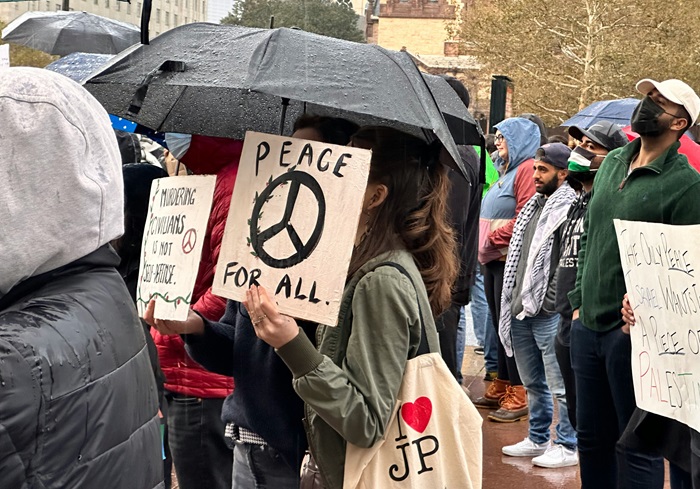
US-Iran negotiations over the last weekend reached no deal; ceasefire raises little hope amid double blockade of the Strait of Hormuz.
In the past few days, the world had been somewhat hopeful, with all observable uncertainty, that the meeting of delegations from the United States of America and the Islamic Republic of Iran might broker peace and end the ongoing US-Israeli aggression in West Asia. Following the April 8, 2026 announcement of a two-week ceasefire, not only has Israel continued its indiscriminate attacks on Gaza and Lebanon, but Pakistan’s mediated peace talks between the U.S. and Iran over the weekend concluded without any agreements.
The wider implications of the war on the global energy economy, cost of living, regional peace, and well being of peoples in the region still require actions and interventions to proffer a peaceful and negotiated solution to the war and its underlying causes.
The unrepentant determination of the Trump administration to use brute force to forge ahead with imperial objectives have reached a climax where the world’s religious figures have begun intervening: “too many innocent people are being killed. And I think someone has to stand up and say there’s a better way” said the Vatican’s first American Pope Leo XIV who recently criticised the U.S. President.[1] The U.S. President has, in turn, called the Pope “a LOSER from the Left”[2] At the same time his administration has been using salvific narratives of Christianity in a calculated manoeuvre to exploit insecurity in Nigeria for geopolitical advantage. The contradictions in the goals of pursuing war while preaching peace have revealed the divisions in the Make America Great Again (MAGA) movement in the United States itself. The waning support of the American people for Trump’s wars provides a context where the fracture in the MAGA movement might further weaken the remnants of the base supporting the current administration.
As the U.S. claims to blockade the Strait of Hormuz in an ironic effort to keep it open, the pressure on the global economy seems likely to continue as the Strait is a gateway for 20 percent of global oil supply, not to mention significant shares of liquified natural gas and fertiliser. The interdependence of food, fuel, and transportation means we are on the brink of catastrophic disruptions that will affect global scale food and energy security.[3] It is not clear whether the U.S.’s blockade is a struggling attempt on the part of the Trump administration to bring Chinese and global pressure on Iran to yield to US demands. What is clear is that the U.S. (unlike Iran) has had inconsistent objectives,[4] which may have been reflected in the goalpost changes by U.S. negotiators in Islamabad, Pakistan.
Points Apart: Different Demands on the Negotiation Table
Both the US and Iran went to Islamabad with their respective points of demand for a sustained ceasefire and a possible end to the war. The difference in these plans is both numeric and related to the expectations and concessions required by each party.
When the Trump administration introduced its fifteen-point framework, it proposed, among other expectations (that):
-
A 30-day ceasefire would halt the war.
-
Immediate opening of the Strait of Hormuz by Tehran for safe passage.
-
Iran decommissioned its nuclear facilities at Fordow, Natanz, and Isfahan, in compliance with US and Israeli goals to end Tehran’s nuclear capabilities.
-
Iran permanently committed to not pursuing or developing nuclear weapons and totally stopped any uranium enrichment, even for civilian purposes.
-
All of Iran’s existing stockpiles would be handed over to the International Atomic Energy Agency (IAEA), and the agency would be allowed to monitor its nuclear infrastructure.
-
Iran would stop arming and funding regional armed groups like Hezbollah.
-
The number of ballistic missiles owned by Iran would be strictly limited (in range and number) and would only be for self-defence.
-
The US would, in return, lift all sanctions imposed on Iran, including the “snapback” United Nations mechanism that allows the reimposition of previously lifted sanctions on Iran.
-
Ending Iranian strikes on regional energy facilities.
-
Washington to provide support for electricity at Iran’s Bushehr nuclear power plant
The war objectives for the U.S. have been as erratic as the President’s twitter feed, ranging from regime change to “unconditional surrender.” The negotiations revealed that uranium enrichment and ballistic missile capacities would be added to the list of contentious bargaining points. The U.S.’s demands did not resonate with the Iranian expectations. In Iran’s ten-point plan, the counter proposal required:
-
Fundamental commitment to non-aggression from the US.
-
Controlled passage through the Strait of Hormuz in coordination with the Iranian armed forces, which would mean that Iran retains its leverage over the waterway.
-
An acceptance of Iran’s nuclear enrichment programme.
-
The lifting of all primary and secondary sanctions and resolutions against Iran.
-
Ending all resolutions against Iran at the International Atomic Energy Agency (IAEA).
-
Ending all resolutions against Iran by the United Nations Security Council (UNSC).
-
The withdrawal of US combat forces from all its bases in the region.
-
Full compensation for damages suffered by Iran during the war – to be secured through tolls to Iran by ships using the Strait of Hormuz.
-
The release of all Iranian assets and properties frozen abroad.
-
The ratification of all these matters in a binding UNSC resolution.
In the face of an American President threatening annihilation,[5] the U.S. has been conflating the Iranian position on maintaining a nuclear programme with refusing to give up its capacity for nuclear armament. The U.S. destruction of Hiroshima and Nagasaki and the lasting devastations of that atomic bomb is a cautionary stamp to the world how the use of nuclear weapons could lead to the mutual extinction of the human species and the destruction of the environment. There are currently nine countries - Russia, US, China, United Kingdom, France, India, Pakistan, Israel, and North Korea - registered to possess nuclear weapons. These countries hold among them nearly 12,200 nuclear warheads with Russia and the US accounting for 90% of these weapons. While these stockpiles are down from the 70,000 nuclear weapons during the cold war, their estimated explosive yield is about 300 kilotons each, 20 times more devastative than the bomb America dropped on Hiroshima.[6]
Iran has not only signed the Treaty on the Non-Proliferation of Nuclear Weapons (NPT), but there is a double standard in attempting to stop Iran’s nuclear armament in a context where the war-mongering Israeli state has supposedly acquired nuclear weapons and refused to sign the NPT.[7] Most importantly, despite the Vice President of America stating failed talks had to do with Iran’s refusal to commit to not developing nuclear weapons, the U.S. and Israel have yet to show any proof that Iran’s nuclear program has made such attempts. Even before the U.S. claimed to have destroyed Iran’s nuclear capacity through the barrage of strikes that have taken the lives of over 2,000 Iranians, Director of National Intelligence, Tulsi Gabbard, confirmed in her testimony to Congress that the “The IC [intelligence community] continues to assess that Iran is not building a nuclear weapon and Supreme leader Khomeini has not authorized the nuclear weapons program that he suspended in 2003”.[8]
Pambazuka News does not support the spread or proliferation of nuclear weapons. We, however, stand firm that the unequal standards of the collapsing global order should not guide the nuclear ambitions of emerging economies. Ultimately, the world should work towards accelerating nuclear disarmament, and the two countries with the highest warheads could show goodwill by drastically reducing their stockpiles.
In the absence of such goodwill, America’s demands for limits on the range and number of Iranian missiles portended a negotiation likely to make a less armed state feel the threat of future military attack and economic coercion. The remaining leverage of Iranian resistance to imperial overreach would have been cut off, leaving the country more vulnerable to future US-Israeli attacks.
In any future peace negotiations, taking the Iranian points seriously and detangling U.S. and Israeli interests will be crucial to reach a peace deal that avoids more destructive outcomes for the US, the global economy, and Iranian peoples.
Endnotes
[1] “Pope Leo says ‘I have no fear of the Trump administration’ after president blasts pontiff” by G. Downs and S. Bhaimiya, 2026, CNBC. https://www.cnbc.com/2026/04/12/trump-pope-leo-catholic-church-iran.html
[2] “Pope Leo says ‘I have no fear of the Trump administration’ after president blasts pontiff” by G. Downs and S. Bhaimiya, 2026, CNBC. https://www.cnbc.com/2026/04/12/trump-pope-leo-catholic-church-iran.html
[3] “Strait of Hormuz disruptions: Implications for global trade and development” by United Nations Conference on Trade and Development (UNCTAD), 2026. https://unctad.org/system/files/official-document/osgttinf2026d1_en.pdf
[4] “Iran Has Been Consistent in War. Will It Be Consistent in Peace Talks?” by N. MacFarquhar, 2026. New York Times. https://www.nytimes.com/2026/04/11/world/middleeast/iran-peace-talks-demands.html
[5] “Trump uses the language of annihilation to threaten Iran ahead of deadline” by M.L. Price, 2026, Associated Press. https://apnews.com/article/trump-iran-threats-civilization-war-crimes-758eb5cd680d7d275c4e1c38b2e01e6d
[6] https://www.icanw.org/nuclear_arsenals; see also https://fas.org/initiative/status-world-nuclear-forces/
[7] “Double standards? Why Iran’s nukes are scrutinised, Israel gets a pass” by U. Siddiqui, 2026. Al Jazeera. https://www.aljazeera.com/news/2026/4/15/double-standards-why-irans-nukes-are-scrutinised-israel-gets-a-pass
[8] From “DNI Gabbard Opening Statement as Delivered to the HPSCI on the 2025 Annual Threat Assessment of the U.S. Intelligence Community,” on March 26, 2025, Director of National Intelligence Tulsi Gabbard delivered opening remarks at a House Permanent Select Committee on Intelligence hearing for the Annual Threat Assessment of the U.S. Intelligence Community. https://www.dni.gov/index.php/newsroom/congressional-testimonies/congressional-testimonies-2025/4061-ata-hpsci-opening-statement-as-delivered