



The Inhumane Treatment of Migrants: The Long Durée of Colonial Violence in the UK and Europe
An incisive analysis that reveals how anti-immigration policies and the inhumane treatment of migrants are rooted in enduring colonial and imperial forms of violence that uproot people from their homes and deny them dignity, belonging, and recognition in societies that portray themselves as havens of freedom and opportunity.
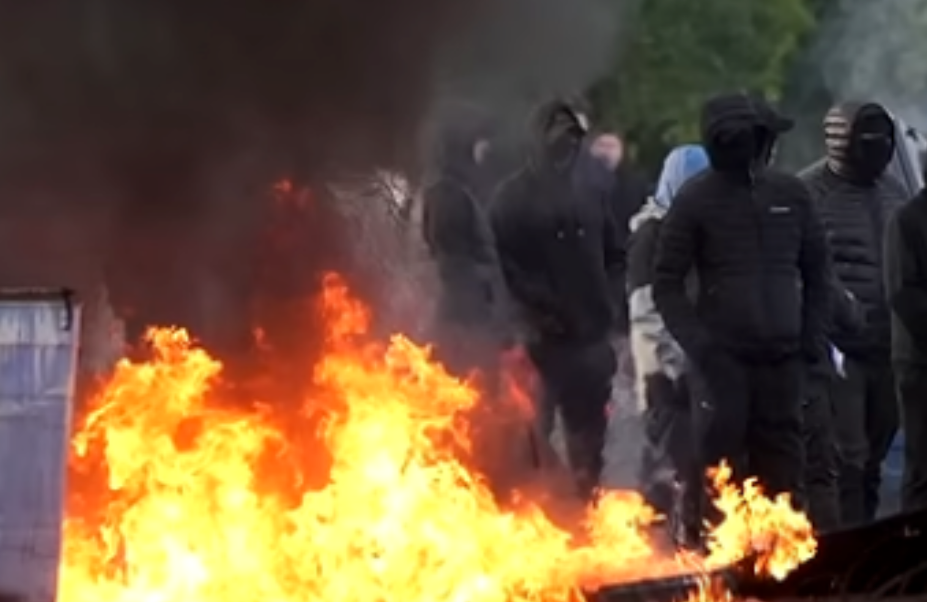
For two days, June 9th and 10th, 2026, African migrants were forced out of their homes in North Belfast, Northern Ireland, by angry racist mobs seeking retribution for the alleged violent attack by a Sudanese asylum seeker on a white man. Two Ugandan nurses fled their homes with just their passports and uniform as it was torched by the mob. Theirs was amongst 27 homes of immigrants that were set ablaze.[1] Collective retribution is now the expected response to any act of violence committed by an immigrant in the UK. The mob was spurred on by some of the wealthiest white men in the world, who would never venture near North Belfast – an impoverished area of the city.
A week before, the sentencing of a young Sikh man for the December 2025 murder of a young white man, Henry Nowak, in Southampton, led to the leader of the Reform party, Nigel Farage, calling for the public to rise up in ‘pure cold rage’.[2] In response, protesters rioted and called out what Farage described as the police’s ‘anti-white prejudice’, supposedly because a policeman at the murder scene believed the attacker when he claimed that he was subjected to racial slurs, rather than the injured Nowak. It is highly unusual for the police in the UK to believe Black and brown people who are calling out racism, equally for racism to be used by an assailant as a cover for criminal activities. Consequently, the claim of anti-white discrimination by the police had no foundation; yet, not be outdone, Kemi Badenoch, the leader of the Conservative Party attacked the 1999 MacPherson Report that found institutional racism within the police with regards to their investigation of the 1993 murder of the Black teenager Stephen Lawrence, which, she argues, has purportedly stopped the police from addressing Black crime. [3] Badenoch called for more stop and search of Black boys, despite repeated evidence showing that Black people are more likely to be stopped and searched by police than any other group.
The anti-immigrant rhetoric in Europe is being ratcheted up by fascist millionaire and billionaire supporters and members of the Trump regime in USA, with the Secretary for Defense (now named Secretary of War) Peter Hegseth, using the 7 June 2026 D-Day memorial speech in Normandy to compare the contemporary sea crossing of destitute migrants to the 1940s invasion by the Nazis. "Sadly, today different European beaches are stormed by different dangerous ideologies. In Spain and Italy and Greece and Bulgaria, boats and men arrive”, he claimed.[4] Instead of speaking out about the absurdity of such a claim, and presenting the data that demonstrate the fact that immigrants constitute a very small proportion of Europe’s population, governments, looking at potential electoral losses to anti-immigration parties, have fed the lie, sustaining it through a slew of immigration legislation. The sub-text is that the lives of Black and Brown people are fair game in political competition. More importantly, they give legitimacy to the claims of the fascists and justify the attack against immigrants.
In November 2025, the United Kingdom government published a bill aimed at penalizing and further stripping the humanity of Black and brown people who seek safety and a better life on their islands.[5] This is the latest of successive UK legislation, each more punitive, aimed at curbing asylum claims and immigration from people originating from the global South. Increasingly, the language used to describe persecuted peoples echoes that of countries where genocide has taken place. In contrast to evidence from hard data, British people are told that they are being ‘swamped’, ‘invaded’, and ‘outnumbered’. Keir Starmer, the current UK Prime Minister, even described Britain as being on the verge of becoming an ‘island of strangers’ in a speech in May 2025 to usher in more immigration cuts - a few months later Starmer expressed regret at using such emotive language.
The politicians and the right-wing media that dominate the immigration discourse in the UK have failed to fully address the question as to why the UK is one of several destinations for global migrants, some of whom have traversed other European countries. When the media does hazard an explanation, it tends to point to pull factors, such as the welfare benefit system, often referring to the measly sums that asylum seekers are given in lieu of the prohibition on them working, as if people fleeing warfare are that calculating. Another response is that the borders are wide ‘open’, forgetting that the UK now has the most draconian border regulations in its history. Anti-immigration advocates tend to avoid probing too deeply, and ignore the fact, as the former Director of the Institute of Race Relations Ambalavaner Sivanandan famously stated ‘we’re here because you were there.’[6] A statement Luke de Noronha used in title of his book, We’re Here Because You Were There: Immigration and the End of Empire[7], in which he challenged the prevailing post-war myths in Britain that sought to distance itself and its empire from the immigrants.
For scholars of world history and development, the answer is obvious and multifaceted, and are related to British imperialism and its legacies:
-
Britain’s involvement in the slave trade,
-
its colonial domination of most of the globe,
-
its transportation of indentured people across the globe,
-
its brutal suppression of people seeking independence,
-
its involvement in the destabilization of pro-people governments across the world,
-
its continued reliance on rents from so-called independent countries through extraction (be it through British corporations, or the transfers of money to British offshore tax havens),
-
its intellectual dominance through the propagation of British-style education, projected as world class, and of English as the medium of education and of global communication,
-
and its post-colonial projection as the bastion of liberal democracy and humanitarianism (aid donor and white saviourism) and human rights.
In the UK, the ruling elite ensured that the horrors of slavery and empire were banished from the public attention by selective amnesia, through an education system and media that represented the ‘benevolent’ empire through sepia-tinted glasses, sometimes with buffoonery toffs, what Paul Gilroy refers to as ‘postcolonial melancholia’, rather than a ruthless war machine bent on shoring-up the racialized economic exploitation of the colonies.[8] Denying history and the voices calling for reparations is just a continuation of this melancholia.
The UK, since the colonial period, has been implicated in the crises that have produced the current movement of people from war-torn or economically ravaged parts of the world. Contemporary forced migration is neither incidental, whimsical, nor criminal, it is a direct outcome of the political and economic policies that have been promoted by the UK and other global North countries in Africa, and elsewhere.
The colonial legacy of racialized exploitation that remains endemic in global South countries was reinforced, from the 1980s onwards, by pressures from the World Bank and International Monetary Fund for governments to retrench workers, cut wages, and increase consumer prices, making precarity a constant in people’s lives. These seemingly neutral international financial institutions were established by the West in 1944 at Bretton Woods, USA, to govern the economies of the world to the benefit of the West. In alliance with neo-liberal western governments, such as the UK and the US, they destroyed the most basic of post-colonial people-centred policies with their structural adjustment (austerity) programmes. They forced open those fragile economies to looting by extractive foreign direct investors. In addition, they ensured that warfare engulfed these countries to the point that life sustaining practices are no longer viable in many places. These are some of the reasons why young men, parents, mothers with their children, flee, and why some seek to find their way to the UK.
Austerity: The Homecoming of Structural Adjustment Programmes
The anti-immigration rhetoric and increasingly punitive legislation reflects the trend in global North countries, where immigrants are used as scapegoats for the countries’ economic woes, despite evidence to prove that the deindustrialization and impoverishment being faced by working peoples in the global North are direct outcomes of states’ alliance with the wealthy one per cent, who controls the levers of the economy, and the media. In the UK, austerity or cutbacks in state expenditure following the 2008 financial crisis represents the homecoming of Structural Adjustment Programmes that Britain supported abroad. Aimee Cesaire in Discourse on Colonialism writes of the ‘boomerang effect’ of empire, whereby violent policies and strategies tested in the colonies and the periphery of global capitalism have a tendency to rebound and appear in the metropole.
Austerity in the UK resulted in international aid being seen as free money given to people in the global South. Aid restructuring under successive Conservative governments saw its diversion to support university research at home (The Global Challenge Fund) to settle refugees in the UK, and to support private investors in the global South seeking to make a quick buck from poverty alleviation. In the US, the Trump administration, after abolishing USAID in 2025, has used its now meagre funds to exert control over Africa’s critical minerals. Pretending to address Africa’s needs is no longer of concern, but there is still a lingering attempt to dress up naked imperialism under the cover of religious wars, as with the Christian genocide rhetoric in Nigeria. That aside, the empire has finally exposed its racialized underbelly.
Undoubtedly, Cesaire’s ‘boomerang effect’ includes the migration of people to the North, fleeing countries ravaged by investors, corrupt elites sponsored and supported by external powers, and the consequences of colonizers reconstructing themselves as saviours.
The Limits of White Saviourism
White saviourism is an ideology projected by white people after colonialism, through international humanitarian and development aid, and continued Christian missionary conversions. White savourism has been internalized by some people in the global South, where racism and racial hierarchies still retain their influence.
White savourism gained momentum after the imposition of structural adjustment programmes with its reduction in state expenditure on health and other social welfare. Almost instantly, impoverished people were seemingly rescued by white people, who in their new role as NGO workers, stepped in to provide relief. This also applied to refugee camps. The cumulative effect was that for many Africans only white people could save them from their ‘poverty’ and rapacious and violent leaders – ironically, even when those leaders have been kept in power by the West. In effect, the rise of humanitarianism in the immediate post-Second World War period served to transform brutal white colonizers into white saviours, thus, purposively, obscuring the persistent exploitation and impoverishment, and the coloniality of their existence. The United Nations agency UNCTAD has stated that, since the 1970 capital flight from Africa has amounted to 2 trillion dollars.[9] The UK’s tax havens are implicated in this theft of African finance capital, depriving the continent of the funds needed for positive social and economic change.
Through aid, western governments, such as the UK, found it expedient, in the post-colonial moment, to project a humanitarian image as part of its soft power in the global South. With UK AID plastered on walls in refugee settlements, how can those fleeing war and injustices not seek to reach the source of that ‘benevolence’?
In the 1980s, when I was conducting research amongst refugees, many among them thought the United Nations and the West would come and rescue them from the brutality and inhumanity of African leaders. Their only perceived way out was to get selected for resettlement in Europe, North America, or Australia. There, they anticipated that they would find safety and security and could improve their life chances. In Tanzania, in the early part of this century, the Kiswahili slang for Europe, was majuu, meaning heaven.
This belief was not necessarily erroneous, because the international humanitarian agencies were dominated by people racialized as white, whether heading and working for Non-Governmental Organizations (NGOs), or as celebrities launching their own campaign to raise awareness and funding on behalf of Black victims. In 1995, the then secretary general of the Pan-African Congress, Tajudeen Abdul-Raheem wrote a searing piece in the Secretariat magazine, NGO Monitor:
The racial imbalance is played out every day. Every white person is perceived and received as a boss with an obeisance that will nauseate any person with a conscience. Most expatriates have their huge houses with all the conveniences, house boys, house girls and a string of people to do their bidding, most of them at the cost of less than a week’s travelling ticket on any subway in Europe. Anybody who ever wondered how the colonial staff lived should visit Kampala, Kigali or Nairobi. The colonial mentality and its lifestyle are back. Colonial plunderers and marauding pirates like Christopher Columbus, Cecil Rhodes, Lord Lugard were eulogised as adventurers and nation-builders, their heirs of today are consultants, experts and the NGO community.[10]
My scholarship at the time criticized this display of white saviourism – a belief projected by neo-colonial white people and internalized by Africans, that only white people can help them.[11] Other researchers also wrote of how white saviourism was dis-empowering, undermining and eroding the capacity of Africans to come up with local solutions to African problems. White saviourism culminated in the push of American-branded evangelical Christianity that basically promoted market individualism, self-enrichment, and a white Jesus, which one sees painted on minibuses around the continent.
Migration: The only Perceived Alternative in the Context of Impoverishment
For many on the continent, migration is now perceived as the only option for work and to have a dignified life. Even African governments are now acting as labour recruitment agencies for global North and West Asian countries, as they export their young to sustain the economies of other nations, whilst they and their families live off the spoils. African governments, such as those in Ethiopia, Kenya, Uganda, and Nigeria, have signed deals to export their citizens to be exploited elsewhere. African migrant labourers, from seasonal agricultural workers, hotel and care workers, bus drivers, domestic workers, etc., are now recruited to work in West Asia and in Europe on exploitative contracts with the full agreement of their governments, who invariably fail to defend their citizens when there is evidence of abuse abroad. The brawn drain is now added to the brain drain, which is now even more intense, as talented African students on the continent and in western universities are studying for futures outside of the continent.
Those people exported from the continent will exist in a near permanent liminal state, denied the right to family, to security, and forced to suffer even more. For refugees and asylum seekers, the liminal state increasingly includes lengthening of the years required to obtain indefinite settled status. According to the UK package of asylum reforms presented to the Parliament by the Home Secretary in November 2025, “There will be no path to indefinite settled status in the UK on core protection, until a refugee has spent 20 years in the country, an increase on the current five years”.[12]
The continued dehumanization of the Black and brown people has been fundamental to post-colonial economic and political interventions. Since the mid-2010s, the European Union (EU) has been active in pushing draconian anti-migration policies in African countries to stop the outflow of migrants to Europe. Reports of exploitation, enslavement, sexual violence, and mass death in North African states that have signed treaties with the EU have not weakened or altered the EU’s resolve to rid itself of what it must see as the African plague.
The West’s ‘war on terror’ and the EU’s border externalization policies have helped to reinforce borders across Africa to the further detriment of communities that were divided by colonial boundaries and whose existence transcend the narrow nation-state political model that has been exported from the global North. In many African countries, politicians supported by western governments and international agencies, have sought to scapegoat African foreigners as troublemakers, and to divide and categorize people into deserving and undeserving migrants and refugees. It is the West’s security agenda that has led to the existence of permanent refugee camps on the continent (see for example Kakuma in Kenya), where people suffer alienation for decades, and survive on the hope of resettlement to the West.[13] Now that this exit option has become increasingly limited, it is no wonder that young men have bravely decided to take the most hazardous route to the West.
Colonial mentality and racist assumptions about African non-humanity continues to play a role in the inhumane practices that governments enact in the West against the immigration of migrants from the global South. Appealing to Europe on moral or ethical grounds holds no sway when African people were brutally executed for opposing the domination of Europe’s (colonial) powers; when people have been forced to live in impoverished conditions whilst the resources that could improve their condition get exported to enrich people elsewhere.
There is an urgent need for more self-help in Africa, to return to, and re-enact communities of care that have existed in African societies prior to colonialism; what Cameroonian scholar, Francis Nyamnjoh, calls conviviality,[14] of which ubuntu is a part. These forms of African sociality have been mostly eroded by white savourism, aid, and neo-liberal capitalist ethics. Such forms of care led to the successful fight against the fascist invasion of Ethiopia in the early twentieth century, and the defeat of the Nazis in Europe. Such communities of care linger on in Europe despite the governments justifying genocide. In the UK, Henry Nowak’s family, of Polish heritage, recognized that it was not the Sikh religion that was at fault, and did not want his murder “to be used to create further division, hatred or tension.”[15] Similarly, in the aftermath of the Belfast riots, some 20,000 people attended an anti-racist rally in central Belfast. Good people exist everywhere, it is time once again for them to stand up in the fight against fascism, for what is right for humanity.
Patricia Daley is Professor of the Human Geography of Africa, School of Geography and the Environment, University of Oxford. She works on forced migration in Eastern Africa.
Endnotes
[2] David Hughes, ‘Nigel Farage calls for ‘pure cold rage’ in response to murder of student Henry Nowak’, The Independent, 2 June 2026.
[3] Ben Quinn, ‘Badenoch criticises Macpherson report and calls for more stop and search’, The Guardian, 9 June 2026.
[4] Assifa Kassam, ‘Pete Hegseth’s D-day speech on immigration condemned as ‘grotesque stupidity’ , The Guardian, 7 June 2026. https://www.theguardian.com/world/2026/jun/07/pete-hegseth-d-day-speech…
[5] UK Government Home Office (November 2025) Policy paper: Restoring Order and Control: A statement on the government’s asylum and returns policy. https://www.gov.uk/government/publications/asylum-and-returns-policy-st…
[7] Luke de Noronha (2021) We’re Here Because You Were There: Immigration and the End of Empire, Verso.
[8] Paul Gilroy (2005) Postcolonial Melancholia. Columbia University Press.
[9] UNCTAD (2022) ‘Debate: On the trail of capital flight from Africa’, https://unctad.org/meeting/debate-trail-capital-flight-africa.
[10] Abdul-Raheem, Tajudeen. ‘Western NGOs in Africa: Bodyguards of the Advancing Recolonization’. NGO Monitor: NGOs in Africa: Agents of Change or Change of Agents1(1). Kampala, Uganda: The Pan African Movement Secretariat, 1996
[11]Daley, P. (2013). ‘Rescuing African bodies: celebrities, consumerism and neoliberal humanitarianism’, Review of African Political Economy, 40(137), 375–393. https://doi.org/10.1080/03056244.2013.816944
[12] Restoring order and control: A statement on the government’s asylum and returns policy. November 2025. https://www.gov.uk/government/publications/asylum-and-returns-policy-st…
[13]See for example, Brankamp, H. (2022), Camp Abolition: Ending Carceral Humanitarianism in Kenya (and Beyond). Antipode, 54: 106-129. https://doi.org/10.1111/anti.12762
[14] Francis B Nyamnjoh (2017) ‘Incompleteness: Frontier Africa and the Currency of Conviviality’,
Journal of Asian and African Studies, Vol.52 (3): 253-270.
[15] UK Parliament, Hansard, Murder of Henry Nowak, Volume 786: debated on Tuesday 2 June 2026. https://hansard.parliament.uk/Commons/2026-06-02/debates/3963D88D-EDF1-…