



From Pan-African Solidarity to Afrophobia: Interrogating South Africa’s Paradox of Xenophobic Violence Post-Durban 2001
The Durban site as host to WCAR 2001 was a bold statement that reflected the honour of a country that had gained freedom from a racist, discriminatory, marginalising and violent apartheid regime. The years after Durban present complex local and international events around the country. Khamees interrogates the contradictions in South Africa’s diplomatic posturing and anti-African discrimination and violence against migrants in the country within the 25 years after the Durban Conference.
Background: The liberation paradox
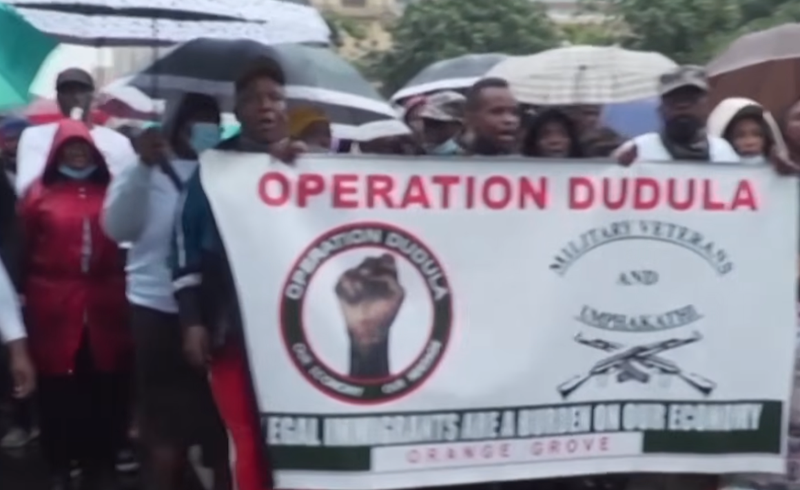
There is no example that so clearly illustrates the contradictions of post-apartheid South Africa as Durban. In 2001, the city hosted with pride the World Conference against Racism, Racial Discrimination, Xenophobia and Related Intolerance, an event arranged in accordance with a 1997 United Nations General Assembly Resolution 52/111. The conference brought together representatives from more than 160 countries and led to the adoption of the Durban Declaration and Programme of Action, reflecting a shared global determination to combat racism and intolerance. Yet only fourteen years later, Durban once again came under the spotlight, but this time for xenophobic violence, particularly during the attacks in April 2015 on African migrants, which also extended to Johannesburg. Four years after that, in August and September 2019, Johannesburg, Pretoria and the surrounding townships suffered fresh outbreaks of xenophobic violence, targeting migrants which led to at least twelve deaths.[1] By 2021, the disturbing pattern had taken on an organized character with the emergence of Operation Dudula, a movement that has since become a registered political party and operates openly and regularly.[2]
The fact that this problem keeps occurring is no accident; it highlights a continuing conflict in South Africa’s post-apartheid identity as the country attempts to reconcile its international diplomatic activities with domestic discussions about who belongs. The article first examines the symbolic significance of Durban in 2001. Then it reviews the history of anti-migrant violence from 2008 to the present, including how it has been formalized through Operation Dudula and the March and March movement. Finally, the work considers the institutional failures and diplomatic consequences that have sustained this troubling situation and ends by offering careful policy recommendations.
Scholarship on South African xenophobia offers three complementary explanations for ongoing xenophobia. Structural accounts tie violence to apartheid-era inequality, unemployment, and competition over housing and informal trade, casting migrants as rivals in underserved townships.[3] Political accounts, like Neocosmos's (2010),[4] cite an exclusionary nationalism that denies belonging to "foreign natives," similar to Côte d'Ivoire's "Ivoirité." The third, Afrophobia, which Harris (2002)[5] calls a "new pathology," says victims are targeted for being both African and foreign; white or Asian foreigners are rarely targeted. This article shows how each are inextricable, and holds that the violence is primarily due to Afrophobia rather than general xenophobia.
Durban 2001 and the Rhetoric of Pan-African Solidarity
The fact that South Africa was chosen to host the World Conference Against Racism was, in itself, a strong statement. When the General Assembly decided in 1997 to hold the conference and to select Durban as its venue, it carefully conveyed the image of a country that had recently put an end to a system of institutionalized racial discrimination. By hosting the event, South Africa had a wonderful opportunity to demonstrate its experience of post-apartheid reconciliation and to serve as a moral example on questions of racial and ethnic exclusion. This is in harmony with the African National Congress’s continued appeal for solidarity throughout the continent, a spirit that originated during the struggle for liberation, when neighboring “frontline states” such as Zambia, Tanzania, Mozambique, Zimbabwe and others bravely took in South African exiles at great personal expense.
The Durban Declaration and Programme of Action, resulting from the conference, expressed a wide and forward-looking commitment to eliminating racism, racial discrimination, and xenophobia through international cooperation. For South Africa, supporting this document reinforced the foreign-policy stance based on the idea of an African Renaissance linked to former President Thabo Mbeki, since his 1996 ‘I Am an African’ speech had previously set out a broad, continental view of South African identity. The sense of continental leadership, rooted in the obligation felt towards the rest of Africa for its solidarity during the apartheid era, is exactly the one that subsequent violence brings into question. There is thus a gap between this international self-image and the real experience of African migrants in South Africa’s townships and informal settlements.
The Cycles of Violence, from 2008 to the Present
South Africa’s history of xenophobic violence has followed an escalating, increasingly organized trajectory. It began with the May 2008 Alexandra riots, which spread across Gauteng to Durban, Cape Town, and Limpopo, leaving 342 shops looted, 213 buildings burned, and 56 people dead, mostly Zimbabwean and Mozambican nationals, including the widely publicized killing of Ernesto Alfabeto Nhamuave.[6] A second major outbreak followed in April 2015, starting in Durban and spreading to Johannesburg and Soweto, fueled in part by inflammatory remarks from Zulu King Goodwill Zwelithini; this wave triggered mass displacement and diplomatic fallout, including Nigeria recalling its High Commissioner.[7] Violence resurfaced again in August-September 2019 across Johannesburg, Pretoria, and surrounding townships, killing at least twelve people and prompting hundreds of arrests, thousands of displacements, and a wave of business looting; the unrest drew strong regional backlash, with Nigeria and Zimbabwe repatriating citizens and Nigerians boycotting South African firms, even as President Ramaphosa condemned the violence and prosecutions remained minimal.[8] Since 2021, the pattern has shifted from episodic rioting to organized, sustained anti-migrant activity through Operation Dudula, founded by Nhlanhla “Lux” Dlamini in Soweto and later expanding into a registered political party active in Durban and the Western Cape. Despite its unconstitutional tactics, including forced identity checks and denying migrants access to clinics and schools, research shows the movement’s core claims about migrant-driven crime and resource strain are largely overstated, given that migrants make up only six to seven per cent of the population.[9] This persistence of support despite weak evidence suggests that anti-immigrant sentiment in South Africa is driven more by political and structural forces than by verifiable fact.
In independent reviews of these incidents, there is a near-total lack of accountability. Human Rights Watch has recorded that nobody has been convicted in connection with previous outbreaks of xenophobic violence, including the 2015 violence in Durban, which displaced thousands, and the 2008 nationwide attacks that resulted in more than sixty deaths.[10] Again, Amnesty International’s evaluation of the 2019 violence went even further, blaming the escalation directly on “years of impunity for xenophobic crimes” and on the failures of the criminal justice system, which left refugees, asylum seekers and migrants exposed and without protection, even though there had been a clearly predictable pattern of such incidents recurring.[11]
This impunity is part of the paradox. It shows that violence against African migrants is not met with serious state punishment, even though South African diplomats assert their commitment to continental solidarity on the international stage. The government has launched various initiatives, for example the National Action Plan to Combat Racism, Racial Discrimination, Xenophobia and Related Intolerance (2019), which focus on prevention and education.[12] Yet these measures do not adequately address the accountability gap, particularly the requirement for the police to identify and investigate xenophobic attacks as such rather than simply treating them as cases of public disorder, and for political leaders at all levels to stop blaming migrants for problems such as unemployment, crime and overburdened public services.
Complicating the Afrophobia Thesis: Contrary Evidence and Its Limits
But is this claim really true? A closer look at the evidence suggests the picture is more complicated than it first appears. If the event in question had been truly afrophobic, that is, if it had affected only Black African foreigners, we should not have seen non-African migrants among those affected. Yet the evidence paints a more complicated picture. For instance, Human Rights Watch’s report on the 2019 violence refers to a Pakistani shop owner in Pretoria who, together with his African migrant neighbors, suffered repeated looting. Furthermore, traders from Bangladesh and Pakistan have in the past been attacked, particularly in areas where they directly compete with South African-owned spaza shops. In essence, Afrophobia remains the dominant ideological and political driver of the violence’s origins and its most severe, targeted, and lethal forms, but once unrest escalates into generalized rioting, the practical targeting logic can broaden to include any visibly foreign business, sweeping in Asian traders as secondary or peripheral victims of a fundamentally Afrophobic phenomenon.
This helps explain why the major riots with heavy loss of life in 2008, 2015 and 2019 mostly targeted Black African nationals from Zimbabwe, Mozambique, Somalia, Ethiopia, Nigeria and other countries. Many quantitative studies support this pattern. for instance, research carried out by the African Centre for Migration & Society (ACMS) at the University of the Witwatersrand found that during the 2008 and 2015 outbreaks more than 85% of the people who were displaced and victimized were Black Africans, while racialized migrants from outside Africa, such as Pakistanis or Bangladeshis, made up a much smaller share of those affected.[13] Moreover, political discourse (including the way in which Operation Dudula and the March the March Movement presents the situation) frequently uses the term “illegal foreigners” to refer to Africans, and this helps to explain why it is mainly African migrants who suffer violence and displacement rather than South Asian or East Asian traders, even though they operate similar businesses in the same areas.
The evidence shows that the violence stems from at least two closely linked causes, which must not be regarded as identical. The first is primarily economic resentment towards small-scale immigrant traders, regardless of origin, fueled by competition in an informal retail sector on which many South Africans rely for their livelihoods. The spaza shop sector alone employs an estimated 300,000 people and generates roughly R9 billion a year nationally,[14] while in KwaZulu-Natal alone the sector is valued at R178 billion annually, with foreign nationals owning an estimated 57.8% of shops province-wide a figure that rises above 60% in some districts and falls below 15% in others.[15] However, the picture is not uniform, South African and foreign-owned shops split almost evenly, suggesting the scale of foreign domination may be regionally specific and sometimes overstated in public discourse.
The important lesson is not that the Afrophobia thesis is wrong, but that it should be stated with precision. The most dangerous and politically organized form of anti-migrant violence in post-apartheid South Africa is Afrophobic both in its target and in its framing. Non-Black traders such as Pakistani and Bangladeshi shopkeepers do appear among the victims of xenophobic violence, but the evidence indicates they are rarely, if ever, targeted independently. Reports of the 2008, 2015, and subsequent attacks consistently place Pakistani and Bangladeshi-owned shops in the very same townships and even the same looting incidents as Nigerian, Somali, Ethiopian, Mozambican, and Zimbabwean-owned businesses. This pattern is better explained as proximity-driven spillover than as evidence of a genuinely indiscriminate hostility toward all foreign-owned businesses. Notably, even in Piper and Yu’s (2016) study,[16] which found that price competitiveness predicted violent victimization more reliably than nationality alone, Somali shopkeepers still endured markedly more violent crime than Bangladeshi shopkeepers despite comparable pricing, suggesting that Black African identity continues to carry an independent risk even after economic factors are accounted for. The paradox in the title cannot be dismissed as a colour-blind reaction to economic competition, because the pattern of who is targeted, killed, displaced, and politically blamed remains disproportionately and specifically aimed at Black Africans.
Repeated instances of anti-Black violence have noticeably affected South Africa’s standing across the continent. The 2015 attacks damaged relations with several African countries and prompted Nigeria to recall its High Commissioner. Later, the 2019 violence triggered a more serious diplomatic crisis. Nigeria summoned South Africa’s ambassador, issued threats, and organized boycotts of major South African brands. The Chairperson of the African Union publicly condemned the violence, even while acknowledging that South Africa had made arrests. These events show that the paradox is not merely theoretical; it has real repercussions for regional trade, migration diplomacy, and South Africa’s position within organizations such as the African Union and the Southern African Development Community. This is because these organizations have played a key role in shaping South Africa’s foreign policy since 1994.
Call for Action
Four main points should be drawn from the analysis. The first is that, because the root causes of violence are linked to deeper structural failures, a shortage of housing, high unemployment, and intense competition in the informal retail sector, all of which stem from a post-apartheid economic system that continues to concentrate wealth and capital rather than redistribute it broadly, relying solely on rhetorical or educational measures will not be sufficient. Such measures must be accompanied by material investment and, more fundamentally, a reconsideration of an economic model that structures both South Africans and migrants as competitors for a shrinking share of resources rather than addressing the underlying concentration of wealth. Cash-transfer and social-protection programmes offer one partial model worth examining, though their limitations should be stated clearly. Ghana’s Livelihood Empowerment Against Poverty (LEAP) programme, for instance, is designed primarily to reduce poverty through consumption-smoothing cash transfers to extremely vulnerable households, such as the elderly, orphans, and people with severe disabilities, rather than to directly generate employment or build community-level economic capacity.[17] The programme has also remained heavily dependent on donor financing, with the UK’s Department for International Development and the World Bank providing substantial and, at times, majority funding, and independent evaluations have found its cash disbursements to be inconsistent, undermining its intended consumption-smoothing effect, alongside documented irregularities that have diluted its impact.[18] Given the scale of recent reductions in international aid budgets, any South African adaptation of this model would need to be designed for domestic fiscal sustainability from the outset, rather than replicating LEAP’s reliance on external donor support, to avoid the same structural fragility.
The second point is that, because political and traditional leaders have frequently engaged in scapegoating rhetoric that triggers or aggravates violence, from King Goodwill Zwelithini’s 2015 remarks[19] to Operation Dudula’s social-media incitement and the more recent mobilization of the March and March movement, whose founder Jacinta Ngobese-Zuma publicly set a June 30, 2026 deadline for undocumented migrants to leave the country and vowed continued weekly protests until her demands were met,[20] accountability should also include public figures whose statements may have provoked or justified the violence, not just those who physically carry out the violence. This principle has already found partial judicial support in South Africa. In November 2025, the Gauteng High Court found Operation Dudula and its leadership liable for intimidation, harassment, and incitement of hate speech and violence on grounds of nationality, social origin, and ethnicity, legally barring the organization’s leaders, Zandile Dabula and Dan Radebe, from further such conduct (Kopanang Africa Against Xenophobia v Operation Dudula, 2025). However, the ruling’s practical effect remains limited. Operation Dudula immediately lodged an appeal, and its leadership publicly vowed to continue its activities in defiance of the interdict,[21] reinforcing the broader pattern of limited accountability that characterizes the state's response to xenophobic violence in South Africa.[22]
In Kenya, the National Cohesion and Integration Commission has been monitoring hate speech by leaders and taking legal action when it detects incitement, offering a possible example of how public figures can be held accountable.[23] In 2020, MPs Oscar Sudi and Johanna Ng’eno were arrested and formally charged with hate speech and ethnic incitement, while more recently, the case against MP Peter Salasya has proceeded to a full hearing after NCIC-led mediation failed, and a Garissa-based aspiring legislator was arrested in 2026 following a viral video containing alleged incitement.[24] The Commission has also opened investigations into more senior figures, including former Deputy President Rigathi Gachagua and two sitting Cabinet Secretaries, ahead of the 2027 general election, signaling that even high office does not place leaders beyond scrutiny. In practice, however, enforcement has proven weak. Of six individuals summoned over hate speech allegations since January 2025, only two appeared before the Commission, while Gachagua, Webuye West MP Dan Wanyama, and activist Jerotich Kipkoris simply ignored their summonses, and Cabinet Secretary Aden Duale later stated he would not honor his own summons unless Gachagua was also compelled to appear.[25] This offers a possible, if imperfect, example of how public figures can be held accountable for inflammatory rhetoric. The urgency of this question has only grown given recent developments elsewhere on the continent.
In September 2026, Kenyan President William Ruto himself ordered a nationwide crackdown on foreign nationals operating small-scale businesses and hawking, arguing that such low-capital trade should be reserved for Kenyan citizens, a directive that prompted hundreds of Burundians to seek emergency travel documents amid reports of threats and harassment.[26] Commentators have explicitly labelled this an emerging Afrophobic pattern. Ndole (2026) warns that Kenya risks becoming a second ‘patient zero’ for the same anti-African scapegoating dynamics that have driven South Africa’s xenophobic violence.[27] The International Trade Union Confederation’s African body also separately cautioned that Ruto’s rhetoric “must not fuel Afrophobia and division,” even as Ruto has publicly positioned himself as a Pan-Africanist committed to open borders and continental integration.[28]
Third, because Human Rights Watch, Amnesty International, and UN human rights experts have repeatedly identified impunity as a major factor in the recurrence of violence,[29] filling the gap in prosecutions for xenophobic and Afrophobic offences must become a specific policy priority, with dedicated investigative and judicial resources, rather than being folded into more general public-order initiatives. This does not require the creation of an entirely separate court system; rather, it points toward the kind of targeted institutional capacity that other states have used for chronically under-prosecuted, identity-based violence, such as specialized police units, dedicated prosecutorial fast-track teams, and sensitized magistrates, models more commonly applied internationally to gender-based violence and hate crimes than to mass-atrocity contexts. South Africa’s own 2023 Hate Crimes and Hate Speech Act provide a statutory basis on which such dedicated capacity could be built,[30] but its impact will depend on whether prosecutorial and investigative resources are actually allocated to enforce it, rather than treating xenophobic violence as a subset of general public order policing.
The fourth point is that the movements associated with Operation Dudula and, more recently, March and March show that anti-African sentiment can consistently mobilize around exaggerated but politically significant claims, from Dudula’s assertions about migrant-driven crime and resource strain,[31] to March and March’s June 2026 mobilization around an arbitrary self-deportation deadline, which drew more than 5,000 protesters in Durban alone and led to over 900 arrests nationwide despite the government’s own acknowledgment that the deadline carried no legal standing.[32] Merely correcting misinformation about the economic and demographic effects of migration is therefore not enough. Both movements have continued to grow and gain political legitimacy, with Operation Dudula formally registering as a political party and March and March meeting with several established parties ahead of the 2026 local elections, even as the underlying claims driving their mobilization remain empirically contested.[33] To achieve real change, this issue must be addressed alongside the material improvements and accountability measures mentioned earlier.
Reconciling Rhetoric and Reality
The fact that South Africa hosted the 2001 World Conference against Racism is a source of pride in its history, and its diplomatic efforts across the world and continent continue to highlight the spirit of African solidarity that emerged in the liberation period. Yet the violence directed at African migrants in 2008, 2015 and 2019, which has since been institutionalized through initiatives such as Operation Dudula, and, more recently, the March and March movement, demonstrates that this solidarity has not always resulted in real protection for migrants within South Africa’s own borders. The term afrophobia should be used rather than simply xenophobia, since it more accurately captures the racial and continental character of the phenomenon and the fact that it exists alongside diplomatic solidarity. As this article explains, it is important to be precise about this term. Filling the gap between words and actions will require more than just making promises. It will also involve consistent support for the townships and the informal economies, a cessation of political leaders at all levels from blaming migrants, and, most importantly, a genuine attempt to put an end to the impunity that enables cycles of violence to recur without any consequences.
Underlying all of these measures is a further, less tangible requirement, as this article has shown. Correcting the empirical record alone does not dislodge Afrophobic sentiment, since movements such as Operation Dudula and March and March continue to mobilize and gain political legitimacy, the former as a registered political party and the latter through direct engagement with established parties ahead of the 2026 elections, even where their central claims are demonstrably exaggerated. Addressing this phenomenon therefore also requires a deeper shift in public consciousness, away from an exclusionary politics of belonging that treats African foreignness as a marker of illegitimacy, and toward one genuinely consistent with the Pan-African solidarity South Africa claims on the diplomatic stage.
Sani Khamees is a Senior Programme Officer (Research, ICT and Climate Change) at the Centre for Information Technology and Development, CITAD, Nigeria.
Endnotes
[1] Médecins Sans Frontières. (2019, September 9). Responding to the consequences of xenophobic violence. MSF. https://www.msf.org.za/news-and-resources/latest-news/responding-consequences-xenophobic-violence
[2] SABC News. (2025, August 26). Operation Dudula registers as political party, targets 2026 municipal elections. Channel Africa.
[3] Landau, L. B. (Ed.). (2011). Exorcising the demons within: Xenophobia, violence and statecraft in contemporary South Africa. Wits University Press.
Crush, J., & Ramachandran, S. (2010). Xenophobia, international migration and development. Journal of Human Development and Capabilities, 11(2), 209–228.
[4] Neocosmos, M. (2010). From "foreign natives" to "native foreigners": Explaining xenophobia in post-apartheid South Africa (2nd ed.). CODESRIA.
[5] Harris, B. (2002). Xenophobia: A new pathology for a new South Africa? In D. Hook & G. Eagle (Eds.), Psychopathology and social prejudice (pp. 169–184). University of Cape Town Press.
[6] Bekker, S. (2015). Violent xenophobic episodes in South Africa, 2008 and 2015. African Human Mobility Review, 1(3), 1–15.
Reporter, S. (May 26, 2008). Minister: Xenophobic violence under control. Mail & Guardian.
[7] Campbell, J. (2015, April 21). Zulu king and South Africa's wave of xenophobia. Council on Foreign Relations.
[8] Human Rights Watch. (2020). World Report 2020: South Africa. https://www.hrw.org/world-report/2020/country-chapters/south-africa
Human Rights Watch. (2008, May 22). South Africa: Punish attackers in xenophobic violence. https://www.hrw.org/news/2008/05/22/south-africa-punish-attackers-xenophobic-violence
[9] Kaziboni, A., Lancaster, L., Machabaphala, T., & Mulaudzi, G. (2022, September 12). Scapegoating in South Africa: Busting the myths about immigrants (Southern Africa Report 53). Institute for Security Studies.
[10] Human Rights Watch. (2020). World Report 2020: South Africa. https://www.hrw.org/world-report/2020/country-chapters/south-africa
[11] Amnesty International. (2019, September 4). South Africa: Years of impunity for xenophobic crimes driving the latest attacks. https://www.amnesty.org/en/latest/news/2019/09/south-africa-years-of-impunity-for-xenophobic-crimes-driving-the-latest-attacks-2/
[12] South African Government. (2019). National action plan to combat racism, racial discrimination, xenophobia and related intolerance. https://www.gov.za/documents/other/national-action-plan-combat-racism-racial-discrimination-xenophobia-and-related
[13] Bekker, S. (2015). Violent xenophobic episodes in South Africa, 2008 and 2015. African Human Mobility Review, 1(3), 1–15.
[14] https://hsf.org.za/publications/hsf-briefs/foreign-nationals-in-the-informal-retail-sector. See also https://businesstech.co.za/news/government/814477/crucial-r200-billion-sector-in-south-africa-under-fire/
[16] Piper, L., & Yu, D. (2016). Deconstructing 'the foreign': The limits of citizenship for explaining price competition in the Spaza sector in South Africa. Development Southern Africa, 33(5), 658–676. https://doi.org/10.1080/0376835X.2016.1203758
[17] UNICEF. (2024). Cash transfers in Ghana: Evidence overview of LEAP and LEAP 1000 impacts 2010–2022. https://www.unicef.org/ghana/reports/cash-transfers-ghana
[18] Sackey, P. K. (2019). Ghana’s Livelihood Empowerment Against Poverty (LEAP) programme is leaking: Irregularities watering down the impact of the flagship LEAP programme. Cogent Social Sciences, 5(1). https://doi.org/10.1080/23311886.2019.1627789
[19] Campbell, J. (2015, April 21). Zulu king and South Africa's wave of xenophobia. Council on Foreign Relations.
[20] Daily Maverick. (2025, November 4). High court bans Dudula from blocking access to hospitals, clinics and schools. https://www.dailymaverick.co.za/article/2025-11-04-high-court-bans-dudula-from-blocking-access-to-hospitals-clinics-and-schools/
[21] Daily Maverick. (2025, November 4). High court bans Dudula from blocking access to hospitals, clinics and schools. https://www.dailymaverick.co.za/article/2025-11-04-high-court-bans-dudula-from-blocking-access-to-hospitals-clinics-and-schools/
eNCA. (2025, November 4). "We are not going to change our stance," Operation Dudula defiant in face of court interdict. https://www.enca.com/news/we-are-not-going-change-our-stance-operation-dudula-defiant-face-court-interdict
[22] Human Rights Watch. (2020). World Report 2020: South Africa. https://www.hrw.org/world-report/2020/country-chapters/south-africa
[23] Kenya News Agency. (2026, June 15). National Cohesion and Integration Commission response on hate speech charges. https://www.kenyanews.go.ke/cohesion-commission-team-vows-tough-action-against-ethnic-incitement/
[24] ibid
[25] Eastleigh Voice. (2026, August). All bark, no bite? NCIC 'helpless' as summoned leaders defy directives. https://eastleighvoice.co.ke/
[26] Semafor. (2026, September 9). Kenya's foreign-trader crackdown exposes an economic fault line. https://www.semafor.com/article/09/09/2026/kenyas-foreign-trader-crackdown-exposes-an-economic-fault-line
[27] https://www.africanavoice.com/all-news/rutos-xenophobic-war-on-foreign-hawkers-is-a-distraction-from-his-own-jobs-failure/
[29] DefenceWeb. (2022, July 19). South Africa slated for xenophobia, racism and hate speech. https://defenceweb.co.za/featured/south-africa-slated-for-xenophobia-racism-and-hate-speech/
Human Rights Watch. (2020). World Report 2020: South Africa. https://www.hrw.org/world-report/2020/country-chapters/south-africa
Amnesty International. (2019, September 4). South Africa: Years of impunity for xenophobic crimes driving the latest attacks. https://www.amnesty.org/en/latest/news/2019/09/south-africa-years-of-impunity-for-xenophobic-crimes-driving-the-latest-attacks-2/
[30] SAnews. (2024, May 9).President assents to law Bill criminalising hate crimes, hate speech. https://www.sanews.gov.za/south-africa/president-assents-law-bill-criminalising-hate-crimes-hate-speech
[31] Kaziboni, A., Lancaster, L., Machabaphala, T., & Mulaudzi, G. (2022, September 12). Scapegoating in South Africa: Busting the myths about immigrants (Southern Africa Report 53). Institute for Security Studies.
[32] Daily Maverick. (2025, November 4). High court bans Dudula from blocking access to hospitals, clinics and schools. https://www.dailymaverick.co.za/article/2025-11-04-high-court-bans-dudula-from-blocking-access-to-hospitals-clinics-and-schools/
[33] SABC News. (2025, August 26). Operation Dudula registers as political party, targets 2026 municipal elections. Channel Africa. https://web.sabc.co.za/sabc/home/channelafrica/news/details?id=d78d9605-2849-4d49-8af3-0b1b7c63db76&title=SA+organisation+Operation+Dudula+registers+as+political+party%2C+targets+2026+municipal+elections
Daily Maverick. (2025, November 4). High court bans Dudula from blocking access to hospitals, clinics and schools. https://www.dailymaverick.co.za/article/2025-11-04-high-court-bans-dudula-from-blocking-access-to-hospitals-clinics-and-schools/