



African Showdown in Continental and Global Football
African football is making history, breaking barriers and testing the limits of the beautiful game. But are its institutions and leaders keeping pace?
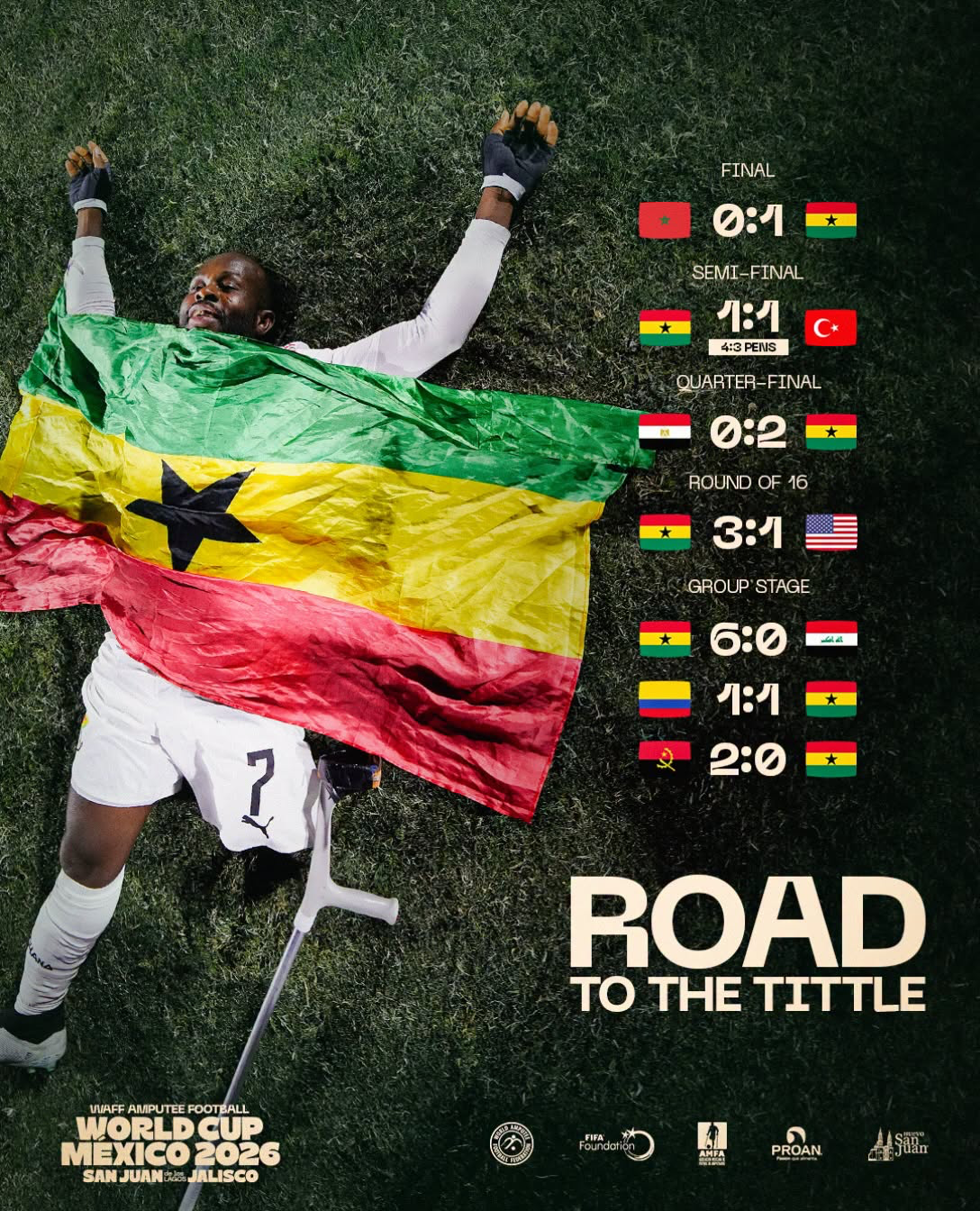
For the first time in the history of the World Amputee Football Federation (WAFF) World Cup, two teams from the African continent contested the final of a senior men's world football championship. The 2026 competition, held in Mexico, witnessed this historic encounter on Sunday, 22 November, when Ghana's Black Challenge defeated Morocco 1–0 to lift the world title.
The WAFF Amputee Football World Cup can be celebrated as one expression of football’s efforts to extend the game to people with disabilities. Beyond amputee football, the Short Stature Football World Cup taking place in Rabat, Morocco, from November 20 to November 30, 2026, offers another illustration of how the game is gradually creating spaces for equity, inclusion and diversity. At a time when opportunities for such conversations are increasingly shrinking, football provides a powerful counterpoint: a platform where people whose participation in mainstream sporting spaces is often limited can demonstrate their talent, compete and claim visibility.
Football, in this sense, is more than a game. It is also a site where the meaning and possibilities of inclusion can be actively negotiated and expanded. Yet football’s possibilities as a space for inclusion and solidarity sit alongside persistent questions about fairness, power, accountability and the institutions that govern the game.
The outcome of the 2025 (2025–2026) Africa Cup of Nations (AFCON) final had been the subject of arbitration proceedings at the Court of Arbitration for Sport (CAS) in Lausanne since early October 2026. The Senegal Football Federation had challenged a decision by the CAF Appeal Board that overturned Senegal's victory over Morocco and declared the Senegalese team to have forfeited the final. The decision had disregarded the referee's authority to resume the match after the Senegalese players returned to the pitch following their protest. The reputational damage to African football that characterized the AFCON 2025 final, will remain a subject of debate over protests against injustice and refusal of bullying in the field of play, self-confidence and sportsmanship, referee authority and institutional decisions in relation to football rules and regulations.
The events at the global footballing stage in November 2026, however, project a different image of African football. The amputee world cup showcases the dominance of African football beyond individual talents by presenting the future possibilities of all African finals in different levels of football.
In the AFCON and World Amputee competitions, Morocco was a central contender against two West African football powerhouses, Senegal and Ghana. Morocco's presence in these encounters testifies to the investments the North African country has made in football development. Its senior national team had also distinguished itself at the 2026 FIFA Men's World Cup, becoming the first African team to reach the quarter-finals of the tournament twice, this time losing to France.
Morocco came close to winning a world title in the men's amputee competition. However, Ghana's Black Challenge, despite the administrative and financial challenges confronting the team, rose to the occasion and defeated Morocco's amputee team by a goal to nil. The victory marked Ghana's first world title in amputee football and made the country only the second African nation, after Angola, to win the competition.
These encounters tell a broader story about the growing competitiveness of African football on the global stage. They also raise important questions about the institutions responsible for protecting the integrity, credibility and spirit of the game.
Senegal Confirmed Winners of the 2025 AFCON - Again.
Senegal’s Lions of Teranga had defeated Morocco 1–0 in a tense and competitive AFCON final on January 18, 2026 at the nearly 70,000 capacity Prince Moulay Abdellah Stadium in Rabat, Morocco.
The controversy surrounding the AFCON final brought into focus the responsibilities of footballers, captains and administrators in safeguarding the integrity of the game. It also raised questions about rules, power, trust, fairness and African unity. There had been legitimate questions about equal application and interpretation of rules by the Confederation of African Football (CAF). The CAF Champions League final between Wydad Casablanca of Morocco and Espérance Sportive of Tunis, Tunisia, on 31 May 2029 recorded a walk-off that the federation reviewed and ordered a replay instead of forfeiture.[1] In that game Wydad walked off the field and refused to resume play for almost the duration of an entire football match after their goal on the 59th minute, a potential equaliser to Espérance’s 1-0 lead, had been disallowed and the decision could not be reviewed amid a malfunctioning Video Assistant Referee (VAR) system.
While the referee applied the forfeiture rule of Article XI (17) of the 2018–2019 CAF Champions League Regulations and Article 148 of the CAF Disciplinary Code, and declared victory for Espérance, the CAF Executive Committee on 5 June 2019 ordered a replay of the second leg in which the forfeiture occurred. In that instance, like the contention around the final match of AFCON 2025, the Court of Arbitration for Sport came to the rescue of the integrity and sanctity of the game.
Following an appeal by both clubs regarding the order to replay the Final 2018/2019 match on a neutral ground, CAS annulled the decision on the grounds that the CAF’s executive committee did not have the jurisdiction to order a replay.[2] In the spirit of procedural integrity, CAS referred to “competent CAF bodies the questions of the replay of the final’s second leg and of the disciplinary procedure” which was then pending before CAF's Disciplinary Board.[3] While the Disciplinary Board, on 7 August 2019, affirmed the referee’s application of forfeiture against Wydad, it was the CAF Appeals Board decision of 15 September 2019 that should have sealed the award of the benefits regarding the 2018/2019 CAF Champions League title win. The CAF Appeals Board rejected Wydad’s appeal agreeing with the Disciplinary Board’s decision that the operational challenges of the VAR did not invalidate the final game.
The tenacity and competitive spirit of the Moroccan club will however not accept a loss of the cup unless the final decision about the game was made at the highest level of football arbitration. It was this lawful struggle to win by alternative means or to push the limits of justice that continues to require the intervention of CAS in African and global footballing. Morocco’s Wydad referred the matter to CAS seeking a declaration of the club as the winners of the CAF club championship and recipient of the award monies and related benefits. The seeming stalemate of who won the 2018/2019 CAF Champions’ League will persist until four months after the anniversary of the match, and a month and days after the respective decisions of the CAF Disciplinary and Appeal Boards.
In CAS’ decision on 18 September 2020, it dismissed the appeal of Wydad. Regarding the ruling on the VAR, football’s highest appeal court reasoned that:
The absence of the Video Assistant Referee (VAR) in a game does not constitute a violation of the principle of equality of chances as both teams are affected in the same way by this absence. In any event, the absence or a malfunction of the VAR does, according to the International Football Association Board (IFAB) VAR Protocol, not invalidate a match. Hence, the presence of the VAR is not a “basic condition of the game” in the sense that it is a condition to the validity of the match. [4]
It is required after the interruption of a match that the teams resume play under the circumstance in line with CAF’s disciplinary code or forfeit the game and pay a fine. CAS reiterated this requirement in its ruling:
Consequently, after the interruption of a match, the decision of a team not to resume play because of the absence or a malfunction of the VAR constitutes an abandonment in the sense of Article 148 of the CAF Disciplinary Code pursuant to which “[i]f a team refuses to play a match or to continue playing one which it has begun, it will be sanctioned with a minimum fine of twenty thousand US dollars ($20’000) and will, in principle, forfeit the match” [5]
In the 2025/2026 AFCON case, the leadership of the captain of the Senegal side who had remained on the field while the teammates had left the field in protest offers a different twist to what would otherwise have been a forfeiture, but for the silence of the referee’s last whistle.
Senegal's Sadio Mané crucial role in bringing his teammates back onto the pitch after their protest, helped to ensure that the match continued to its conclusion. His intervention was particularly important in a contest that had threatened to descend into an institutional and sporting crisis.
Morocco's captain, Achraf Hakimi, also spoke to the importance of respecting what happens on the pitch. In a statement that acknowledged the authority of football's governing institutions while questioning the implications of their decisions, Hakimi said:
I respect the authorities responsible for football, but I firmly believe that what happens on the pitch should be the most important thing of all. Senegal won that Africa Cup of Nations final through their performance, their determination, and the effort of every player, just as every player represents his country. They fought for that title, and no one can erase what those players achieved on the pitch.[6]
The decision to strip Senegal of the cup was difficult to accept by many lovers of the game. In “AFCON 2025: A Title Re-Decided Off the Pitch and What It Reveals About Power Relations in Africa,” Horace Campbell had questioned the attempt by CAF to strip the winners of the AFCON of their victory on the field.[7] Hakimi put his reservation on the CAF decision thus: “Honestly, I disagree with stripping Senegal of the title after the final has already been played. Football is decided by the players, not by decisions made weeks or months after the celebrations.”[8]
The mistakes during the match were expected to have been dealt with on the pitch, and by the final decision of the supervisory officials. “But stripping an entire nation of a title that its players fought so hard to win is something I [Hakimi] find difficult to accept.”[9]
The protestation is within the struggle for unity, fairness, accountability, and credibility that continues to characterize footballing. African football needs "unity, fairness, and credibility", and Hakimi warned, decisions which leave players and supporters questioning the integrity of the game undermine its development. “I hope the final appeal brings clarity, because this situation is bigger than Morocco and Senegal.”[10]
Eleven days after the final between Morocco and Senegal, on 29 January 2026, CAF announced sanctions against both countries. The fines amounted to more than US$1 million (€835,000), while players and officials from both teams received suspensions. The sanctions followed the disorder that had accompanied the final, including the Senegalese team's temporary withdrawal from the pitch in protest against a penalty awarded to Morocco after their goal had been disallowed. The fines were determined by CAF’s Disciplinary Board which ruled that Senegal legitimately won the trophy.
Two months later, on 17 March 2026, CAF's Appeal Board declared that Senegal had forfeited the final by leaving the pitch. It overturned the original result, awarded Morocco a 3–0 victory and declared the North African country champions. The decision came after Senegal had already celebrated its victory and paraded the trophy before its supporters. Global Africans and football lovers had celebrated Senegal’s victory as an African victory, as a victory for all peoples of Africa and all people who are standing firm in protest against bullying and for justice. An editorial in Pambazuka News captured the moment and essence of the AFCON victory on the field,[11] but the CAF Appeal Board ruling threatened the continuity of the memory and celebrations that had resounded in the streets of Dakar and the football world.
The Senegalese Football Federation (FSF) rejected the decision of the Appeal Board and appealed to CAS. arguing that the referee's decision to resume the match and allow it to reach its conclusion was within his authority. The case was heard in Lausanne in early October, and the final ruling was announced on 24 November 2026.
In its decision, CAS’ arbitrators, Gerald Simon, Ulrich Haas and Luigi Fumagalli, found that the referee's decision to resume the match in the 109th minute was within his exclusive authority under the rules of the game. Both teams had returned to the pitch and expressed their willingness to continue playing. Subsequently, the penalty was played, missed, and the game continued into extra time. The match extended beyond the standard 90-120minutes play time to nearly 150minutes from kick-off to the final whistle. It was undeniable, nonetheless that the game continued to its logical conclusion.
CAS evaluated these facts in its closed-door meetings about the AFCON 2025 title litigation. The panel reasoned that the CAF forfeiture provision would have applied had the referee blown the final whistle to terminate the match. However, since he had instead authorised the resumption of play, the conditions for declaring Senegal the losing team by forfeiture had not been met. The reasoning draws on Law 5 of the International Football Association Board (IFAB) Laws of the Game, which provides that referees' decisions on facts connected with play, including whether a goal has been scored and the result of a match, are final.[12] It further stipulates that a referee cannot change a restart decision once play has resumed. Separately, the established field-of-play doctrine in sports jurisprudence protects referees' on-field decisions in applying the rules of the game from review by CAS, except where there is persuasive evidence of arbitrariness or bad faith.[13] While the Referee made “a decision in an atmosphere of extreme tension,”[14] it was not arbitrary to provide the required exception for the field-of-play doctrine.
The decision of CAS reads in part:
By blowing the whistle to resume the match at the 109th minute, the referee considered that the conditions for resuming the match had been met -both teams were on the pitch again, and both expressed their willingness to resume. The CAS panel found that the referee’s decision fell solely within the scope of the rules of the game, and was therefore within his sole authority. The CAF rule would have been applicable if the referee had blown the final whistle to end the match which would have resulted in Senegal’s forfeit loss. But this was not the case. In conclusion the CAS panel finds that the referee did not commit any error of Law.[15]
Consequently, CAS upheld the appeal by the Senegalese Football Federation, set aside the decision of the CAF Appeal Board and reinstated the original decision of the CAF Disciplinary Board. Senegal's 1–0 victory over Morocco was restored, and the AFCON trophy was confirmed as belonging to Senegal. The unanimous decision inspires confidence in the game by affirming that justice, if not served on the field, can still be secured at the highest level of football jurisprudence. Few minutes before the announcement of the ruling, “CAS received a petition for challenge” from the Moroccan football federation, the Fédération Royale Marocaine de Football (FRMF), against Ulrich Haas, one of the panel members, alleging a phone call between the CAS arbitrator and Abdoulaye Fall, the president of Fédération Sénégalaise de Football (FSF).[16] The communication allegedly took place 48 hours before the CAS ruling, and the FRMF sought to cast doubt on the German arbitrator’s independence and impartiality, as well as the legitimacy of the final ruling. Ulrich and Abdoulaye have both denied the allegation. The ICAS Challenge Commission which reviews challenges to arbitrators, however, determined that Morocco’s evidence was insufficient to delay the final verdict at that stage.[17]
The ruling was an important affirmation of the authority of match officials and the need for football's governing institutions to respect the rules under which the game is played. It also brought an end to a controversy that had cast a shadow over one of African football's biggest competitions. The ruling is not a license for teams to walk off the pitch when referees’ decisions are displeasing, nor has it nullified the efficacy of CAF’s Articles 82 and 84. It emphasises that the final whistle settles forfeiture in cases of walk-offs, as it does in matches played to their normal conclusion.
While disciplinary actions may sometimes be determined after post-match enquiries, the results of “Football should be decided on the pitch”[18] unless the rules explicitly determine otherwise. As the CAS pronouncement had shown, CAF Appeal Board erred in stripping Senegal of the AFCON title.
The achievements of Ghana's Black Challenge and Senegal's restored AFCON victory, alongside Morocco's impressive performances in both competitions, demonstrate the depth of African footballing talent. But talent and investment alone cannot sustain the development of the game. African football also needs credible institutions, fair administration and a commitment to the principles that make competition meaningful.
In this respect, the interventions of Sadio Mané and Achraf Hakimi deserve recognition. Their actions and statements remind us that the integrity of African football is not the responsibility of administrators alone. Players, captains and football institutions all have a role in protecting the game.
Peter Bembir (PhD) is a multidisciplinary researcher at the University of Ghana. His research interests include security and development, healthcare, and Africa’s domestic and international politics, among other areas. He is an Associate Editor at Pambazuka News.
Endnotes
[1] Campbell, Horace. AFCON 2025: A Title Re-Decided Off the Pitch and What It Reveals About Power Relations in Africa. Pambazuka News, 20.03.2026.
[3] Football – Caf Champions League Final 2018/2019 The Court Of Arbitration For Sport (Cas) Annuls The Decision Of The Caf Executive Committee. https://www.tas-cas.org/generated/assets/lists/dceab111-07bc-435f-b5f9-…
[4] https://jurisprudence.tas-cas.org/search?details=000007d4-0000-0000-0000-000000000000; See also Arbitration CAS 2019/A/6483 Wydad Athletic Club v. Confédération Africaine de Football (CAF) & Espérance Sportive de Tunis, award of 18 September 2020. https://jurisprudence.tas-cas.org/pdf/6483.pdf
[5] https://jurisprudence.tas-cas.org/search?details=000007d4-0000-0000-0000-000000000000; See also Arbitration CAS 2019/A/6483 Wydad Athletic Club v. Confédération Africaine de Football (CAF) & Espérance Sportive de Tunis, award of 18 September 2020. https://jurisprudence.tas-cas.org/pdf/6483.pdf
[6] @achrafhakimi; https://web.facebook.com/Queseraserasport/posts/achraf-hakimi-on-instagram-i-respect-the-authorities-responsible-for-football-bu/2073247243591886/?_rdc=1&_rdr#;
https://www.dw.com/en/cas-reinstates-senegal-as-2025-afcon-champions/a-80021027
[7] Campbell, Horace. AFCON 2025: A Title Re-Decided Off the Pitch and What It Reveals About Power Relations in Africa. Pambazuka News, 20.03.2026.
[8]@achrafhakimi; https://www.dw.com/en/cas-reinstates-senegal-as-2025-afcon-champions/a-80021027;
https://www.instagram.com/p/DgGaW8JgNI9/; https://www.instagram.com/reel/DgID-sMKMie/
[9] ibid
[10] ibid
[11] Pambazuka Editors. AFCON 2025: A Global African View. 22.01.2026 Pambazuka News. https://www.pambazuka.org/AFCON-2025
[12] International Football Association Board/Guardians of the Laws of the Game. The IFAB Laws of the Game 2026/27. https://downloads.theifab.com/downloads/laws-of-the-game-202627-double-…
[13] TAS/CAS, Football – Africa Cup of Nations (AFCON) 2025: The Court of Arbitration for Sport (CAS) Upholds Appeal by Senegalese Football Federation (FSF). https://www.tas-cas.org/generated/assets/lists/dceab111-07bc-435f-b5f9-…
[14] ibid
[15] Senegal Regains AFCON Trophy After CAS Overturns Decision Awarding Title To Morocco. APT. 25.11.2026. https://www.youtube.com/watch?v=UqbGvm6Rw6M; See also CAS declares Senegal 2025 AFCON champions. SABC News, 25.11.2026. https://www.youtube.com/watch?v=Ejblm-v8MhA;
Part of the quote can also be found in the official media release by CAS. See TAS/CAS, Football – Africa Cup of Nations (AFCON) 2025: The Court of Arbitration for Sport (CAS) Upholds Appeal by Senegalese Football Federation (FSF). https://www.tas-cas.org/generated/assets/lists/dceab111-07bc-435f-b5f9-…
[16] Senegal Regains AFCON Trophy After CAS Overturns Decision Awarding Title To Morocco. APT. 25.11.2026. https://www.youtube.com/watch?v=UqbGvm6Rw6M
[17] ibid.