



Segregation and Systemic Inequalities in Healthcare: A Book Review
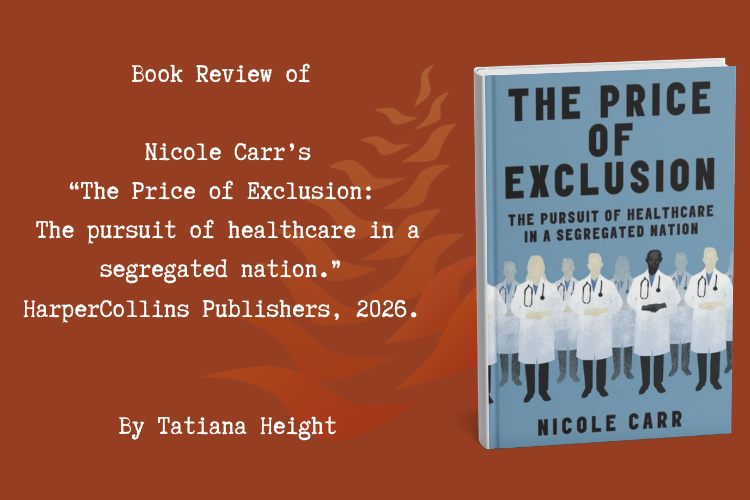
Dr. Height identifies the systemic inequalities faced and overcome by Black healthcare workers in this review of Nicole Carr’s The Price of Exclusion: The pursuit of healthcare in a segregated nation, published in June of 2026 by HarperCollins Publishers.
Healthcare is a systemic need that impacts people throughout the African Diaspora and the overall global community. This is evident in more ways than one. For example, in 2015, all of the United Nations’ member states adopted the Sustainable Development Goals (SDGs) as a shared roadmap to achieving prosperity for both people and the planet.[1] The third SDG is Good Health and Wellbeing, which considers health promotion for all ages, alongside 16 other SDGs including goal 10 (Reduced Inequalities).1 Moreover, there are the social determinants of health which invite society to consider the non-medical factors that influence public health and quality of life. One such social determinant of health is Healthcare Access and Quality.
The Price of Exclusion is a book that indirectly amplifies the importance of the social determinants of health, and SDGs three and ten, using a combination of biography, memoir, and archival research. Nicole Carr, a respected journalist, traces the legacy of her great grandfather, a Jamaican national named Dr. Lawrence St. Clair Ferguson, who made strides in the field of medicine. Dr. Ferguson (also known as Fergie) was a war veteran and is the lynch pin of the book. His story as a Black physician is positioned as a strong example of a pattern of exclusion faced by Black patients and doctors alike, in the 20th century. This pattern of exclusion is cited as evidence to explain ongoing health disparities exacerbated by a lack of representation of doctors of color. For instance, in the book’s prologue, Carr states that only about five percent of U.S. doctors are Black and this statistic has moved little in the past century.[2]
In chapter one, Carr sets the stage for the history that has contributed to the underrepresentation of Black doctors specifically. One contributing factor was the mindset of white people in the U.S. that it was impossible to educate Black people at all, let alone in medicine. She tells the story of a four year Black medical school in Raleigh, NC that was forced to close due to a biased publication called the Flexner report. This is not the first time this report has been referenced in recent literature. It was also detailed in Uche Blackstock’s (2024) book Legacy: A Black Physician Reckons with Racism in Medicine. The Flexner report simultaneously alluded to the need for more Black doctors2 while promoting the idea that Black people were unclean, that Black people should only be taught hygiene but not surgery, and that Black medical schools must abide by strict and hard to reach standards.[3] Following this report’s publication in 1910, five of the seven Black medical schools of the time closed. 3
This is but one way that Carr’s book is reminiscent of Blackstock’s. While Blackstock’s book is heavily focused on her own journey through medical school and practice, she also shares the story of her mother who too was a physician. In that way, Blackstock’s book is more heavily a memoir while Carr’s leans more towards biography.
In chapter five, Carr recounts how racism impeded people from believing that African medicinal techniques were real or true because they did not come from Europeans. One such example is that of inoculation (i.e. the process of introducing a living pathogen into the body to stimulate the body’s natural antibody generation). She tells the story of a community who tried to kill a white man and his family for practicing smallpox inoculation, a technique he had learned from an African man named Onesimus and had been using to save lives. While other treatments had not been effective as this was prior to the development of a vaccine, the inoculation was incredibly successful with many people in the area. Despite this success, not only did the community respond in violence, they built their racism into law by banning inoculation from practice in Boston. The rationale was that Black healers would attempt to use this treatment to poison white people. Practicing this technique illegally was considered a felony carrying the death penalty. 2
In chapter six, we learn about the first Black hospital in the United States which was located in the state of Georgia. While the hospital was meant to service Black patients, they initially only hired white doctors. This caused a strong sense of distrust among Black patients until the hospital finally hired a Black physician, decades after its opening. The distrust was not misplaced given that white doctors tried to claim that rates of cervical cancer were higher among Black women due to promiscuity.2 Despite the pervasive racism, the stories of many notable Black doctors of the time are shared in this and the following chapters.
While most white medical schools would not admit Black students, one man, Dr. Curtis became a rare Black doctor trained in a white medical school. He went on to be the first Black attending physician at his hospital. Combating racial discrimination in medicine, Howard University (HU) managed to enroll and matriculate Black doctors, one of whom was Carr’s great grandfather. Unfortunately, Black students in Jamaica in the early 1900s had no option for medical school on the island and had to seek training at Historically Black Colleges and Universities (HBCUs) in the United States such as HU.2 Even at HBCUs, it was rare to have Black medical school professors. The Black doctors who chose to return and practice in Jamaica resented that they had to invest in studying at American HBCUs for their training, only to return to the island for low pay and poor working conditions. One of the things negatively impacting their working conditions was tuberculosis which wasravaging the community, being spread in low quality housing. This is yet another connection to the social determinants of health, one of which is Neighborhood and Built Environment.[4]
This narrative is reminiscent of the stories shared by Digby (2013) showing the inequities in student success for Black and colored students caused by segregation under South African Apartheid.[5] Specifically, Black South African medical school students faced segregated medical schools, battled with low pay and poor working conditions post-graduation just as Jamaicans did, and experienced social factors in their home communities negatively impacting their performance during medical school.5 In that way, this book adds to a body of literature examining the impacts of racism and racial segregation on medical schooling throughout the diaspora. By 1957, the Black Medical Association was attempting to force medical integration with the support of the National Association for the Advancement of Colored People (NAACP).2 In chapter 14, a Black hospital intern from Texas was badly beaten by the police for speeding. This story, along with stories of 21st century Black people being killed by police in chapter 8, provides an entryway for Carr to draw connections between healthcare disparities and police brutality.
While this is a book about a Jamaican ancestor and the landscape of medical and medical school experiences for Black patients and doctors, it is also a southern story. Much of the educational experiences shared in this book take shape with doctors educated at HBCUs in the U.S. south. In fact, we learn of the opening of Morehouse School of Medicine in Atlanta, which became the first Black medical school to open in the U.S. in the 20th century. Moreover, we learn of a doctor in Wilmington, NC, who founded the city’s first hospital for Black patients. The southern flavor of the book recalls memories of Imani Perry’s South to America: A journey below the Mason Dixon line to understand the soul of a nation.[6] Before closing the book with a letter to her great grandfather, Carr brings us back to the present day. In modern times, a bill was introduced in North Carolina to try and limit diversity, equity, and inclusion in the state’s medical schools. There are efforts to funnel Black students to nursing school instead of medical school. Black and brown students are more likely to take the Medical College Admission Test (MCAT) repeatedly due to social structures impacting their lives, and HBCUs remain underfunded compared to predominantly white schools. Carr shares that only two percent of medical students are Black and that if HBCUs were excluded, that figure would drop to 0.9%. Additionally, only 5.7% of the physician workforce today is Black. Her call to action is for each medical school to be intentional about admitting one additional Black medical student each year.2 This would be the equivalent of opening two to three more medical schools.2
Tatiana C. Height, PhD, is a scholar-activist, hood feminist, and Assistant Professor of Africana Studies at the University of North Carolina at Charlotte. Dr. Height’s research focuses on the implementation of Multicultural Environmental Education (MEE) with urban youth and youth living in environmental justice communities, the understanding and use of MEE among environmental educators, the impacts of environmental racism on burdened communities, and approaches to sustainable community development. Before receiving a Doctor of Education degree in Agricultural and Extension Education from NC State University in 2022, Dr. Height also received bachelor and master’s degrees from the University of Nebraska-Lincoln.
Endnotes
[1] See United Nations Department of Economic and Social Affairs. (n.d.). The 17 goals. United Nations. https://sdgs.un.org/goals
[2] See Carr, N. (2026) The price of exclusion: The pursuit of healthcare in a segregated nation. Dey Street Books.
[3] See Blackstock, U. (2024). Legacy: A Black physician reckons with racism in medicine. Penguin Group.
[4] Alderwick, H., & Gottlieb, L. M. (2019). Meanings and misunderstandings: a social determinants of health lexicon for health care systems. The Milbank Quarterly, 97(2), 407.
[5] See Digby, A. (2013). Black doctors and discrimination under South Africa’s apartheid regime. Medical history, 57(2), 269-290.
[6] See Perry, I. (2022). South to America: A journey below the Mason-Dixon to understand the soul of a nation. New York: HarperCollins.