



Can We Have Universal Healthcare in the United States?
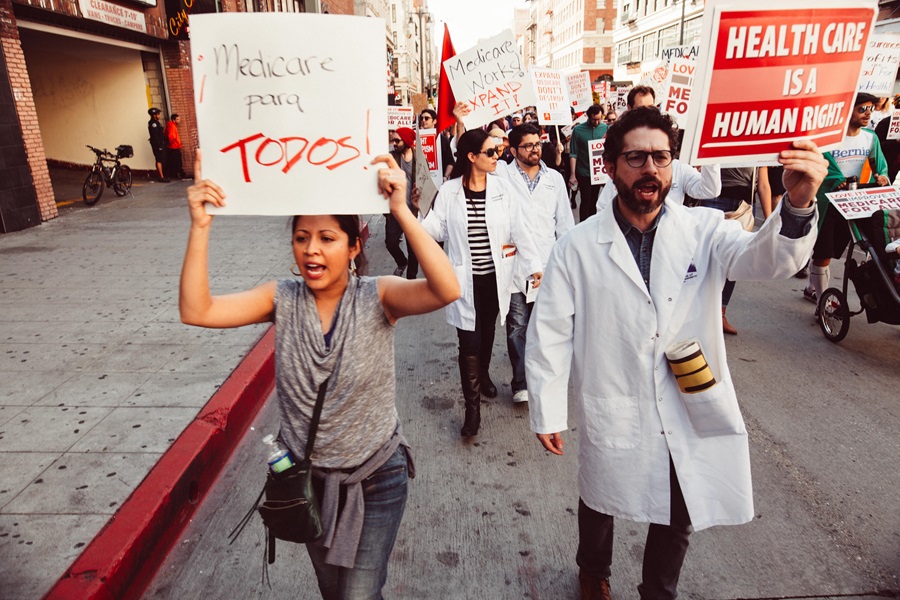

An examination of the intersecting forces that have prevented the United States from achieving universal healthcare, despite spending more on health per capita than any other country. Smith argues that cultural individualism and institutional design provide political cover that allows industry lobbying to convert democratic majorities into legislative stalemate, and that understanding their interlocking nature is a precondition for any realistic path to reform.
The United States spends more on healthcare than any other country in the world, yet many Americans do not have access to healthcare, a paradox that has persisted for decades and is worsening. In 2025, national health expenditure reached $5.7 trillion, nearly double the average of comparable high-income countries.[1] In 2025, an estimated 26.7 million Americans, approximately 7.9% of the population, lacked any form of health insurance.[2] The paradox signifies a health system organized around private profit rather than public health, and raises an urgent question, which is, can we have universal healthcare in the United States, the richest country in the world?
The uninsured population in the U.S. is not evenly distributed and uninsurance rates expose deep racial and economic fractures. In 2025, 23.6% of Hispanic adults and 11.1% of non-Hispanic Black adults lacked coverage, compared to 8.0% of white adults.[3] Among Americans living below the federal poverty line, more than one in five (20.3%) had no insurance whatsoever. Medicaid enrollment fell from 21.2% in 2024 to 20.4% in 2025, further eroding the safety net for the most vulnerable Americans.[4] And for those who nominally have coverage, insurance offers no guarantee of real access to healthcare. In 2025, 30% of insured working adult Americans were considered underinsured, meaning their out-of-pocket costs and deductibles were so burdensome that care remained financially out of reach.[5] In 2024, more than half (57%) of underinsured adults avoided necessary care because of cost; 41% reported a health problem that worsened due to delayed treatment; and 48% of adults carrying medical debt owed $2,000 or more.[6]
Other countries have confronted high healthcare costs and political opposition and still achieved universal coverage. The United Kingdom launched its National Health Service in 1948. Canada implemented its national insurance program between 1947 and 1971, over resistance from private insurers and the medical profession. The U.S. differs from comparable countries which also experienced opposition in how its economic interests, political institutions, industry lobbying, and cultural traditions reinforce each other to make healthcare reform structurally self-defeating. For example, industry backed groups like the Partnership for America’s Health Care Future fund campaigns that cast single-payer[7] health insurance system as a government takeover of medical decisions, which feeds into the American distrust of centralized authority and allows legislators to block healthcare reform. These intersected cultural and political barriers in the U.S. function as permission structures which provide the ideological and institutional cover that allows economic interests and industry lobbying to block healthcare reforms that most Americans consistently say they want.
The Economic Case Against Reform: Cost, Disruption, and the Spending Paradox
A real fiscal challenge is at the center of opposition to universal healthcare. The U.S.’ healthcare system is massive, deeply embedded in the broader economy, and structurally dependent on private financing, such that any comprehensive reform carries enormous transition costs. Proposals such as Medicare for All, the most prominent single-payer model, carry projected costs of between $30 trillion and $40 trillion over a ten-year period.[8] Even proponents of reform acknowledge that healthcare funding would require substantial tax increases across income levels. In a country where anti-tax sentiment is strong and distrust of government programs runs deep, this price tag allows opponents to frame universal coverage as unaffordable overreach rather than a rational reallocation of public expenditure.
Ironically, public spending in the U.S. occurs at rates no other country approaches. The United States spent $15,474 per capita on healthcare in 2024, compared to an OECD average of roughly $7,500 for comparable high-income countries.[9] But Americans do not receive more healthcare than Europeans, and this gap is explained by Americans paying more for similar care. Higher prices for physician visits, hospital stays, diagnostic procedures, and prescription drugs are compounded by the enormous administrative overhead of managing competing insurance plans.[10] A single-payer system would likely reduce total spending on healthcare over time through consolidated administrative costs and bulk purchasing power. But the short-term transition costs are real and are politically weaponized regardless of their long-term economic sense.
A transition to universal health coverage would also produce significant economic disruption. In 2025, the U.S. healthcare sector had a market value of approximately $11.7 trillion.[11] It employs large numbers of workers who navigate the complexities of the system. A shift to government administration would threaten those livelihoods in the short term, by consolidating administrative functions and eliminating jobs. However, in the long-term, a universal healthcare system could save money through lower administrative costs. Critics also point to efficiency concerns in single-payer systems. For example, in Canada, patients sometimes wait months for elective procedures.[12] However, the wait-time problem reflects underfunding of Canada’s health system rather than the single-payer structure itself, and Americans without adequate coverage also face indefinite wait-times.
Employer-sponsored insurance is politically consequential. Approximately 165.6 million Americans (about 60% of the population under 65) currently receive health coverage through their employers.[13] For many of these workers, their health insurance plan represents a hard-won benefit of labor negotiations or compensation arrangements. A single-payer system that eliminates private employer plans would require convincing a majority of already-insured Americans to exchange a benefit they possess for a government program they may distrust. This political calculus makes reform difficult, even among populations that would materially benefit from expanded coverage.
Political and Industry Barriers: Institutional Inertia, Lobbying, and Partisanship
In addition to the economic barriers to universal healthcare, the political system imposes formidable structural obstacles. The U.S. Constitution was designed to make sweeping legislative change difficult. For example, comprehensive health reform must survive committee review, budget reconciliation procedures, Senate filibuster threats, potential presidential veto, and subsequent constitutional challenges in the courts. These delays have historically forced healthcare reformers toward incrementalism. The Affordable Care Act (ACA), the product of contentious negotiation, $318 million in industry lobbying in 2009, and significant compromises with insurance and pharmaceutical interests, expanded coverage meaningfully but stopped far short of a universal guarantee.[14]
The organized lobbying of the healthcare industry is the single most powerful force that sustains the status quo. In 2025, pharmaceutical and health product sector lobbying reached a record $457.3 million.[15] From 1999 through 2024, the industry spent over $6.1 billion on federal lobbying, more than any other sector of the American economy.[16] This spending directly translates into legislative outcomes. Industry lobbyists helped to shape the final text of the ACA to protect private insurance markets and drug pricing structures, and worked to limit provisions of the One Big Beautiful Bill Act[17] that may have introduced meaningful price controls. The revolving door between government and industry amplifies this influence. The pharmaceutical industry routinely recruits former regulatory officials, congressional staffers, and members of Congress as lobbyists, leveraging institutional relationships to shape policy. These structural advantages are self-reinforcing, as lobbying spending generates favorable policy, which generates profits, which fund further lobbying.
The pharmaceutical industry heavily invests in shaping public opinion, recognizing that legislative outcomes partly depend on electoral consequences. Industry-backed organizations such as the Partnership for America’s Health Care Future (PAHCF) launch extensive media campaigns framing universal healthcare as a threat to patient choice and a precursor to long wait-times.[18] These campaigns are calibrated to activate the fears of Americans who are satisfied with their current coverage. In the U.S., the ten largest pharmaceutical companies spent $13.8 billion on advertising and promotion in 2023 alone.[19] The saturation of branded health messaging effectively sells specific medications, but more importantly, it reinforces the broader premise that healthcare is a consumer market in which individual choice and not collective provision is the appropriate organizing principle.
Big Pharma has also deployed structural tactics to preserve pricing power that would be threatened by a government-negotiated system. Patent thickets, which are overlapping patents filed on a single drug, block generic competition for years beyond the intended patent expiration. Industry-funded clinical trials shape which treatments receive regulatory approval and how efficacy data is presented to regulators. Most consequentially, pharmaceutical lobbying successfully blocked Medicare from negotiating drug prices directly with manufacturers. This prohibition was partially addressed by the Inflation Reduction Act.[20] Prior to this legislation, spending on drugs cost the federal government and American patients hundreds of billions of dollars.18 Drug prices in comparable countries including Canada and the United Kingdom are substantially lower, precisely because those governments negotiate directly with drug manufacturers.[21]
A partisan divide anchored in competing class interests underlies these market dynamics and prevents the construction of any coalition robust enough to pass universal coverage. Republican opposition consistently frames government-run healthcare as socialism, a threat to personal liberty, and a fiscal disaster. Democratic support, while consistent, is fractured between moderates who favor incremental expansion of existing programs and progressives who advocate for complete structural overhaul of the health system. Without bilateral consensus, any reform sufficiently ambitious to achieve universality faces the risk of reversal in the next electoral cycle, an uncertainty that dampens legislative ambition and entrenches the status quo.
How Other Countries Navigated Similar Barriers
Universal healthcare is sometimes discussed in the United States as though it is a policy option available only to smaller, more homogeneous, or historically more statist societies. The international evidence does not support this framing. Canada is instructive because its political culture and constitutional structure have some parallels with the United States. Canada’s universal health insurance system did not emerge from political consensus. It was implemented province by province beginning with Saskatchewan in 1947. Federal universal coverage was achieved in 1971, after opposition from physicians and decades of incremental provincial expansion.[22] [23] Key institutional factors in establishing universal healthcare were a parliamentary majority in a province willing to absorb short-term disruption, and an electoral system that allowed that majority to act decisively. Unlike parliamentary systems, the U.S.’ bicameral legislature with the filibuster requires supermajority consensus, and no regional jurisdiction in the U.S. has the fiscal capacity to implement single-payer coverage independently of the federal government and at a scale that could demonstrate the model nationally.
The United Kingdom offers a different, albeit equally instructive lesson. In 1945, following World War II, the Labour government commissioned Minister of Health Aneurin Bevan to build a National Health Service. Bevan faced strong resistance from the British Medical Association, whose members threatened to boycott the new system. Through political pressure and strategic concessions, such as permitting consultants to retain limited private practice while bringing hospitals under public ownership, Bevan secured the profession’s participation. The National Health Service Act of 1946 established the framework, and the NHS launched in 1948, providing free and comprehensive healthcare to citizens at the point of use, financed through general taxation.[24] [25] The British model demonstrates that universal coverage does not require prior consensus or the absence of political and professional opposition. The British parliamentary majority which was not checked by a filibuster, and the lack of a powerful private insurance lobby with decades of entrenched political relationships, contributed to the establishment of the NHS. These institutional conditions do not exist in the U.S. These international comparisons reinforce the argument that the barriers to universal healthcare coverage in the United States are political and structural, even as they are framed as administrative and technical.
Cultural Values and the Political Limits of Collective Action
A set of cultural values lies behind the institutional and industry barriers and provides the ideological environment in which opposition to universal healthcare flourishes. Americans have historically placed a high premium on individual responsibility, personal choice, and suspicion of centralized government authority.[26] These values predate the pharmaceutical industry and cannot be reduced to its influence. In the context of healthcare, these values translate into a political environment in which the fear of government ‘taking over’ medical decisions resonates with a significant proportion of the electorate, even when that characterization distorts the actual structure of proposed reforms.
This cultural disposition relates to industry lobbying. The U.S. individualist tradition is deeply rooted in its political philosophy, constitutional history, and lived experience of government failures that span the political spectrum. But the pharmaceutical and insurance industries amplify and weaponize individualism by funding messaging campaigns that deliberately connect universal coverage with the threatening cultural symbols of socialism, government bureaucrats making medical decisions, and loss of choice. While the industry does not create the cultural anxiety it exploits, it does shape the specific form that anxiety takes in healthcare debates.
The resulting contradiction is that American public opinion on healthcare is simultaneously supportive of universal goals and hostile to universal mechanisms. Most Americans believe that the federal government should ensure that no one is denied healthcare because of cost.[27] Yet when reform proposals are concretized and ‘Medicare for All’ replaces ‘universal coverage’ as the policy label, or when the tax implications are specified, the same coalitions that support reform goals fracture along lines of self-interest, ideology, and fear.
Universal coverage is the goal that everyone has health insurance, which can be achieved through models including single-payer systems (Canada), tax-funded systems (the UK), and mixed systems integrating private and public insurance (Germany, Switzerland, the Netherlands). In the U.S., ‘Medicare for All’ is a single-payer system in which a government program replaces private insurance. The gap between support for the principle of universal healthcare and opposition to its mechanism of ‘Medicare for All’ is not a failure of public reasoning. It is the predictable outcome of a political environment in which the costs of reform are made vivid and immediate while the benefits are diffuse and structural. The cultural permission structure, amplified by industry spending, consistently defeats the numerical majority of Americans.
Conclusion
The persistence of a fragmented, expensive, and incomplete American healthcare system is the outcome of self-reinforcing arrangements in which economic transition costs provide cover for political opposition. Industry lobbying translates that opposition into legislative obstruction, institutional design amplifies the power of any blocking political minority, and cultural individualism provides the ideological articulation through which opposition is expressed and legitimized. The cultural and political barriers function as permission structures that insulate the economic and industry barriers from democratic pressures (the will of the American people) that would otherwise overcome them.
The international record shows that these barriers are not insurmountable. Other wealthy democracies, with their own histories of industry opposition, cultural resistance, and institutional complexity, have achieved universal coverage through sustained political will, specific institutional conditions, and gradual shifts in public opinion. Canada took more than two decades of incremental provincial effort before achieving federal universality. The United Kingdom built a tax-funded National Health Service that made healthcare free for its citizens. Neither path required the elimination of opposition, and both required the political will capable of absorbing short-term disruptions to achieve long-term structural change.
The United States lacks that political will. The One Big Beautiful Bill Act, the most significant federal health-related legislation of the current period, moves in the opposite direction by prioritizing market-oriented reforms and fiscal contraction over expanded coverage. Public support for the goals of universal coverage remains broad,26 and the failures of the current system grow more evident and more costly each year. Without a structural shift in the political conditions that allow industry interests to convert cultural anxiety into legislative obstruction, this crisis is more likely to deepen than to produce the reform it demands.
Danielle Taana Smith is a Professor in the Department of African American Studies and Professor of Sociology (courtesy) in the Maxwell School of Citizenship and Public Affairs at Syracuse University. Her research engages global policy issues with an overarching goal of improving the social and economic environment for all, especially those at the margins of society.
Endnotes
[1] American Hospital Association. 2026. CMS projects national health spending grew to $5.7 trillion in 2025. https://www.aha.org/news/headline/2026-06-25-cms-projects-national-heal…
See also Telesford, I., Cotter, L., Wager, E. and Cox, C. 2026. How does health spending in the U.S. compare to other countries? Peterson-KFF Health System Tracker. https://www.healthsystemtracker.org/chart-collection/health-spending-u-…
[2] U.S. Census Bureau. 2026. Health Insurance Coverage in the United States: 2025. https://www.census.gov/library/publications/2026/demo/p60-291.html
[3] Briones, E. and Cohen, R. 2026. Health insurance coverage: Early release of estimates from the National Health Interview Survey, January–June 2025. National Center for Health Statistics, 2026(Jan), 1-24. https://dx.doi.org/10.15620/cdc/174644
[4] Public Health Watch. 2026. The Watch: Health Coverage Declining as Americans Struggle with Costs. https://publichealthwatch.org/newsletter/the-watch-health-coverage-decl…
[5] Collins, S. and Gupta, A. 2024. The state of health insurance coverage in the U.S.: Findings from the Commonwealth Fund 2024 Biennial Health Insurance Survey. Commonwealth Fund. https://doi.org/10.26099/byce-qc28
[6] Committee for a Responsible Federal Budget. 2019. Choices for financing Medicare for All. https://www.crfb.org/papers/choices-financing-medicare-all
[7] A single-payer health insurance system is a health financing system in which a public entity, which is typically the government, collects healthcare funds through taxes and then pays for its population’s covered medical expenses, in place of multiple competing private insurers. Patients can receive care from private or public hospitals and physicians. Medicare for All proposals in the U.S. and Canada’s provincial insurance plans are examples of single-payer insurance models.
[8] Telesford, I., Cotter, L., Wager, E. and Cox, C. 2026. How does health spending in the U.S. compare to other countries? Peterson-KFF Health System Tracker. https://www.healthsystemtracker.org/chart-collection/health-spending-u-…
[9] Rakover, J. et al. 2023. High U.S. health care spending: Where is it all going? Commonwealth Fund. https://www.commonwealthfund.org/publications/issue-briefs/2023/oct/hig…
[10] S&S Insider. 2026. U.S. healthcare market size, share & growth report, 2032. https://www.snsinsider.com/reports/healthcare-market-4062
[11] Barua, B. and Esmail, N. 2024. Waiting your turn: Wait times for health care in Canada, 2024 report. Fraser Institute. https://www.fraserinstitute.org/studies/waiting-your-turn-wait-times-fo…
[12] Peterson-KFF Health System Tracker. 2025. What are the recent trends in employer-based health coverage? https://www.healthsystemtracker.org/chart-collection/trends-in-employer…
[13] Wouters, O. 2020. Lobbying expenditures and campaign contributions by the pharmaceutical and health product industry in the United States, 1999-2018. JAMA Intern Med. 2020 May 1;180(5):688-697. doi: 10.1001/jamainternmed.2020.0146.
[14] OpenSecrets. 2026. Drug companies tied to TrumpRx boosted lobbying by 23% in 2025. https://www.opensecrets.org/news/2026/05/drug-companies-involved-in-tru…
[15] OpenSecrets. 2025. Federal lobbying set new record in 2024. https://www.opensecrets.org/news/2025/02/federal-lobbying-set-new-recor…
[16] Campaign for Sustainable Rx Pricing (CSRxP). 2025. CSRxP analysis finds Big Pharma’s direct-to-consumer (DTC) advertising costs U.S. taxpayers billions of dollars. https://www.csrxp.org/csrxp-analysis-finds-big-pharmas-direct-to-consum…
[17] The One Big Beautiful Act (Public Law 119-21) is the 2025 federal budget reconciliation law, signed on July 4, 2025. Its health provisions include work requirements and more frequent eligibility checks for Medicaid. (U.S. Congress. 2025-2026. H.R.1 - An act to provide for reconciliation pursuant to title II of H. Con. Res. 14. [Public Law 119-21, Sec. 71119]. https://www.congress.gov/bill/119th-congress/house-bill/1)
[18] KFF. (2026). Key facts about Medicare drug price negotiation. https://www.kff.org/medicare/key-facts-about-medicare-drug-price-negoti…
[19] Peterson-KFF Health System Tracker. 2024. How Medicare negotiated drug prices compare to other countries. https://www.healthsystemtracker.org/brief/how-medicare-negotiated-drug-…
[20] The Inflation Reduction Act (Public Law 117-169) is the 2022 federal law signed on August 16, 2022. Its objectives include reducing the federal budget deficit and reducing healthcare and prescription drug costs. (U.S. Congress. 2021-2022. H.R.5376 - An act to provide for reconciliation pursuant to title II of S. Con. Res. 14. [Public Law No. 117-169].
https://www.congress.gov/bill/117th-congress/house-bill/5376/text)
[21] Canadian Medical Association. 2024. Who started Canada’s universal health care system? https://www.cma.ca/healthcare-for-real/who-started-canadas-universal-he…
[22] Flood, C., Marchildon. G. and Paech, G. 2018. Canadian Medicare: historical reflections, future directions. Health Econ Policy Law. 2018 Jul;13(3-4):219-225. doi: 10.1017/S1744133118000014. PMID: 29897038.
[23] Gorsky, M. 2008. The British National Health Service 1948-2008: A review of the historiography. Social History of Medicine, 21(3), 437-460. https://doi.org/10.1093/shm/hkn064
[24] University of Warwick. 2023. The formation of the National Health Service. Modern Records Centre. https://warwick.ac.uk/services/library/mrc/archives_online/digital/heal…
[25] Saban, J. 2012. Individualism, solidarity, and U.S. health care. AMA Journal of Ethics. 14(5), 400-404. https://journalofethics.ama-assn.org/article/individualism-solidarity-a…
[26] Gallup. 2023. Majority in U.S. still say government should ensure healthcare. https://news.gallup.com/poll/637393/majority-say-gov-ensure-healthcare.aspx
[27] Ibid