



Pambazuka Town Hall on Authoritarian Control and Resistance in Africa
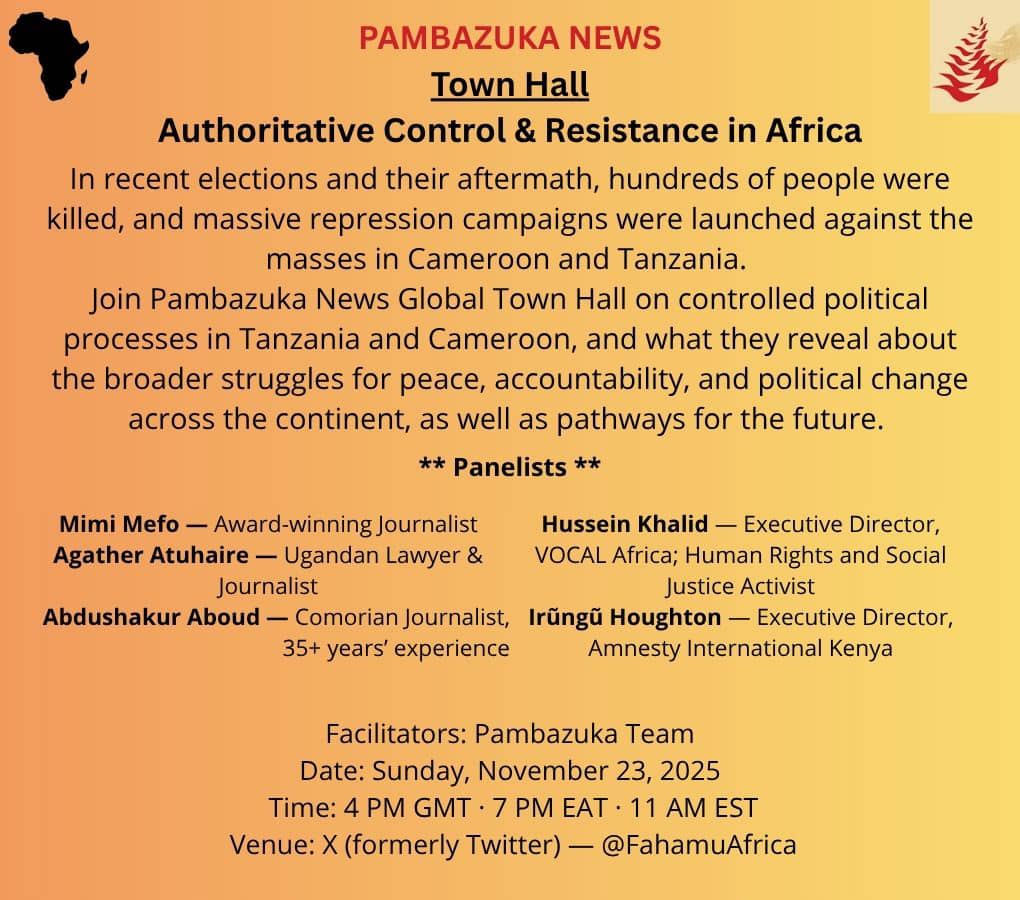
Insights from the Pambazuka Town Hall held on 23 November 2025.
In the October 2025 elections in Cameroon and Tanzania, hundreds were killed, and massive repression campaigns were launched against the masses. To unpack these crises from a Pan African viewpoint, and explore pathways for the future, Pambazuka News convened a Global Town Hall on controlled political processes and the implications for peace, accountability, and political change across Africa. The event was held on X Spaces on 23 November 2025, and featured prominent activists, journalists, and human rights defenders from East and Central Africa. The speakers comprised:
Agather Atuhaire, Ugandan lawyer, journalist, and digital activist whose investigations have exposed high-level corruption and abuses, including parliamentary overspending and the detention of opposition figures.
Irungu Houghton, Executive Director of Amnesty International Kenya, leading investigative and advocacy efforts to end human rights abuses and defend constitutional freedoms.
Hussein Khalid, Executive Director of Vocal Africa, with 15 years advancing grassroots human rights and social justice.
Mimi Mefo, award-winning Cameroonian journalist and Editor-in-Chief of MMI News.
Abdushakur Aboud, veteran journalist with 40 years in international broadcasting, reporting extensively on African democracy and development.
Elections and the Exclusion of Working Peoples from Politics in Africa
In respect to Tanzania, Cameroon or East Africa, what do the recent elections explain about the exclusion of working peoples from politics and democratic spaces in Africa?
Irungu: Systemic Repression in Tanzania
Irungu highlighted a five-year deterioration of rights in Tanzania, marked by repressive laws restricting expression, assembly, and association. “About 100 people have been abducted since 2015,” he noted, alongside arrests of journalists, opposition leaders, and working-class citizens.
He recalled the attempted assassination of opposition leader Tundu Lissu, the denial of media access, and the blocking of election monitoring. State violence, he argued, has become the “playbook,” reinforced by alliances with authoritarian states.
Irungu also cited abductions extending beyond borders, crackdowns on religious leaders, and the closure of 2,000 places of worship. He asked why the state feels so “violent and confident” in targeting journalists, religious figures, lawyers, and ordinary citizens.
Mimi: Cameroon’s ‘Legality Without Legitimacy’
Mimi described Cameroon’s moment as both “historic and painful.” Cameroon now effectively has two presidents: the legitimate one who campaigned among the people, and the legal one maintained by institutions under President Paul Biya’s control. Quoting Jesuit priest Ludovic Lado, she stressed that “legality without legitimacy is theft.”
She detailed how state institutions openly backed the incumbent, how Biya barely campaigned, and how independent media and civil society attempted parallel vote tabulation. Cameroonians voted massively for change, but fraud “on a scale never seen before” reversed the results.
The Constitutional Council, whose members belong to the ruling Cameroon Peoples Democratic Movement (CPDM) party, “confirmed what the regime wanted.” Mimi concluded that power was retained not through ballots but through force, reinforced by military repression.
Hussein: Shrinking Civic Space and a Defiant Generation
Hussein argued that Africa faces an unprecedented shrinking of civic space and rising authoritarianism. Human rights defenders, journalists, and lawyers are increasingly targeted by regimes “clinging on to power.”
He highlighted the 2024 Gen Z uprisings, particularly in Kenya, where youth demanded accountability and rejected propaganda. Similar mobilisations appear across the world, from Nepal to Bangladesh and the U.S. Hussein insisted that Africa is witnessing a continental awakening: Youth are refusing corruption, electoral theft, nepotism, and militarised governance. “Africa rising… this is our moment,” he said, though warning that change must avoid the descent into the conflict seen in Sudan or the Arab Spring.
Aboud: The Return of a Single-Party Logic
Aboud argued that dictatorship and de facto single-party systems are returning. Long-ruling parties have disenfranchised working people, especially youth, facing rising costs of living and restricted freedoms. Leaders ignore widespread grievances, instead claiming protests are “foreign-inspired.” He asked whether Western-style democracy is functioning in Africa, citing Obasanjo’s view that it lacks African grounding.
Weak opposition leadership, media repression, and disorganisation leave Gen Z uprisings vulnerable to military takeovers, as seen in Burkina Faso, Mali, and Madagascar. He contrasted this with Senegal, where youth mobilised behind a strong leader, Ousmane Sonko, producing electoral change.
Agather: Regional Authoritarian Collaboration
Agather described the East African climate of disappearances, torture, and criminalisation of dissent, recounting her own abduction in Tanzania alongside Kenyan activist Boniface Mwangi. They were kidnapped, tortured, and held incommunicado; their governments did not intervene.
She noted that similar abductions occur across borders, “autocrats working together.”
Despite lethal risks, Tanzanians still protested, revealing a society that has “had enough” of decades of repression. With Uganda’s own election approaching, she would not be surprised if regional regimes coordinated to prevent successful uprisings.
Agather emphasised that citizens, not governments, are the ones rescuing activists, signalling new forms of cross-border solidarity. East Africans, she argued, now recognise that they must collaborate to liberate themselves from entrenched authoritarianism.
Divisions in a Once-Unified Country: Tanzania
For decades, Tanzania stood as one of Africa’s most successful experiments in national cohesion. Nyerere’s vision, rooted in belonging beyond ethnicity, religion, or region, produced a political culture that many believed could withstand turbulence. Yet, the aftermath of the recent elections revealed just how vulnerable that unity has become.
What began as a civic crisis is now being reframed in dangerously polarizing terms. Reports emerged that elements within the ruling party, Chama Cha Mapinduzi (CCM) attempted to portray the protests as “anti-Islam” and coordinated by the Catholic Church. In doing so, a governance failure was recast as a communal conflict. As Irungu argues, this narrative represents not only a political diversion but a direct challenge to the very foundations of Tanzania’s social contract.
A Widening Fault Line
Irungu identifies a set of new dividing lines, Zanzibar vs. Tanganyika, Africans vs. Arabs, Muslims vs. Christians, each serving as a vehicle for political elites to displace responsibility. To allow a period marked by unmistakable infringements of civil liberties to be repackaged into a story of antagonistic communities, he argues, would be a profound mistake.
Suppressing Rights, Rewriting Reality
Testimonies from the days immediately following the Tanzanian election point to a cluster of rights violations: restrictions on assembly, arrests of peaceful protesters, force used far beyond lawful thresholds, and a systematic blocking of communication channels. These infringements were not isolated to Dar es Salaam, as early narratives suggested, but spread across multiple regions, Arusha, Mwanza, Mbeya, Songwe, Mara, Kilimanjaro, Singida, Kahama, among others.
As Irungu frames it, once the internet shutdown is fully interrogated and the imposed silence begins to lift, the scale of the crisis may prove larger than initial reports indicated. With media muted and information tightly controlled, the state has attempted to determine not only what citizens may know, but what the world may see.
An Election Without Choice
Beyond the violence itself lies another concern: the erosion of political participation. Opposition candidates were barred, parties sidelined, and administrative tools deployed to undermine the basic function of an election—the ability to choose a government. The crisis, therefore, is not merely about security forces on the streets but about the structural weakening of the democratic process.
Information Control and the Search for Accountability
Parallel conversations highlight how information control shapes public understanding. Horace raises the central questions that flow from this:
-
Which security units were deployed?
-
Where can authoritative figures eventually be found?
-
What avenues remain to pressure for accountability from outside Tanzania?
These questions underscore the essential problem: without access to verified information, accountability becomes elusive.
A Mirror in Cameroon
Mimi’s intervention draws a striking parallel. Listening to the Tanzanian accounts, she says, feels like witnessing Cameroon’s own trajectory. For decades, Cameroonians have lived under layered restrictions on assembly, on the press, and on online communication. She notes that during elections, internet censorship intensifies, journalists face detention, and citizen reporters risk arrest simply for documenting events.
The state’s control does not end at its borders. Cameroonians abroad, journalists, activists, and ordinary citizens, face intimidation, surveillance, smear campaigns, and threats that their national documents may be revoked. The diaspora, however, has become more mobilized than at any point in recent memory, playing a critical role in evidence preservation, legal advocacy, and amplifying voices at home.
What emerges is a pattern familiar across authoritarian contexts: the more citizens connect, the harder the state works to limit what can be seen, said, or shared.
The Troops on the Street
As the scale of repression in Tanzania becomes clearer, the question shifts from what has happened to how citizens are responding. What forms of civic mobilization are emerging within Tanzania, and how do they connect to the broader African landscape where governments increasingly cooperate to suppress dissent?
The conversation draws parallels between Tanzania and Cameroon, revealing how civic actors, despite intimidation, censorship, and state pressure, continue to improvise new forms of organization.
Women, Youth, and the Renewal of Civic Agency in Cameroon
Mimi begins by highlighting a striking development: women and young people are now at the heart of civic mobilization in Cameroon. Even under difficult conditions, they have taken on roles in legal education, voter awareness, and rights-based organizing.
Before the recent elections, civil society groups taught communities not only how to vote but how to verify and record results at the polling station. This empowerment is why so many Cameroonians continue to insist publicly on the outcome they witnessed.
Organizations like Diesel Le Batiso de la Nation and Project CC brought together journalists, civic actors, and political leaders for coordinated pre- and post-election strategy sessions. Their work has not stopped. Regular meetings continue today, exploring non-violent avenues for democratic change.
Symbolic, low-risk protests such as Black Friday, where citizens dress in black, stay home, or attend church services silently, have become another form of resistance. Secure messaging groups now serve as coordination hubs, offering guidance on rights, safety, and what to do if detained.
What stands out, Mimi says, is the scale of cooperation. For the first time in years, bloggers, journalists, diplomats, activists, and diaspora communities are aligning around shared objectives. Unlike past crises that fragmented public attention along regional or linguistic lines, the current moment has drawn actors from across the country and diaspora into a common push for accountability.
Civic Life Under Pressure in Tanzania
Accounts from inside Tanzania echo many of the same patterns. As Irungu outlines, civic organization is unfolding under tight constraints.
Families facing loss often treat burials as a form of quiet protest, though they struggle to obtain the documentation that would support later accountability efforts. With state-controlled media offering limited information, many Tanzanians now rely on Kenyan stations or international broadcasters such as the BBC and Al Jazeera to understand what is happening in their own country.
Despite periods of blocked connectivity, citizens continue to record and upload material, often using secure apps, VPNs, encrypted communication channels, and safety-oriented digital tools. These dispersed acts of documentation form a kind of “digital resistance,” enabling evidence preservation even in hostile conditions.
Some individuals at risk have taken “freedom corridors” out of the country, seeking refuge in neighbouring states. Meanwhile, regional solidarity efforts, especially among Kenyan civil society, have grown. Movements like Jumuiya Niyetu emphasize an East African Community rooted not in governments but in peoples, insisting that regional citizenship carries responsibilities as well as rights.
Nonetheless, Irungu notes gaps: international medical associations, journalist unions, and legal bodies have not yet mobilized enough to support Tanzanian professionals navigating pressure from authorities. Stronger global solidarity, he argues, is essential to prevent the crisis from being normalized.
Towards a Cross-Border Civic Response
Horace reminds the panel that these dynamics cannot be viewed in isolation. With mass mobilization planned in Tanzania on December 9th, the country’s independence day, the stakes are high. He emphasizes that no troops should be deployed against peaceful demonstrators and urges Pambazuka, as a platform for continental dialogue, to take a principled stance.
He also extends the horizon outward: Cameroon, Tanzania, Kenya, and Uganda are all navigating contested political climates. As Agathar earlier observed, governments often collaborate in their methods of repression. Citizens, therefore, must think transnationally too, building networks of support that travel across borders as easily as state tactics do.
A Moment of Urgency and Possibility
Irungu concludes with a call for coordinated action:
-
sustained pressure to prevent further abuses in the lead-up to the December 9 demonstrations
-
release of detained political actors
-
reopening of media space
-
meaningful constitutional reforms
-
and, ultimately, a political transition grounded in legitimacy rather than force
The conversation closes with a reflection on Pambazuka’s own legacy as a hub for African intellectual and civic engagement, one that, two decades on, still convenes critical debate and helps shape strategies for collective action.
Global Africa Support for the Democratic Process in Africa
The discussion turned to a central question: What forms of support can people in the diaspora and those who are sympathetic to the democratic process in Africa provide?
Mimi began by stressing that even this Town Hall is itself a form of support. For Cameroon, often called “the forgotten conflict” and repeatedly ranked among the world’s most neglected crises, visibility is a lifeline. Limited media access is not accidental; the government restricts international coverage, leaving many violations undocumented. Election observers were scarce during the 12 October presidential polls, and those who were present, including the African Union, offered public statements misaligned with on-the-ground realities.
What Cameroon needs most, she argues, is amplification: more reporting, more platforms like this one, and more opportunities for credible voices, not state proxies, to speak. International attention signals to governments that the world is watching, and in a context where local journalists, activists, and civil society actors face detention and intimidation, the circulation of accurate information becomes essential.
Mimi adds that Cameroonians do not seek pity but partnership. Diplomats must stop legitimizing flawed elections; global media should continue documenting abuses when local media cannot; technology companies must safeguard digital spaces where citizens share evidence; and human rights organizations should investigate detentions, disappearances, and attacks on civic actors. She also highlights a broader point: supporting authoritarian regimes in Africa ultimately drives migration pressures elsewhere. When governance collapses and countries become unliveable, people move. Backing democracy is therefore not only solidarity, but it is enlightened self-interest.
Turning to the deeper question of political systems, Abu Shakar reflects on why democracy has struggled in many African states. The issue, he argues, is not African incompatibility with democratic ideals but the absence of genuine democratic space: limited freedoms, weak accountability, corruption, and elite capture. He suggests revisiting indigenous traditions of collective decision-making and exploring how elements of pre-colonial governance, community deliberation, local justice models, and participatory mechanisms might inform a revitalized African democratic practice.
Ultimately, he says, the task is twofold: rebuild institutions grounded in fairness, rights, and freedom, and engage the diaspora in shaping reforms that protect expression, media independence, and human rights.
Together, the panel underscores a single message: global support for democracy in Africa is not symbolic; it is practical, urgent, and inseparable from the broader stability of the world.
External Exploiters amid Local Repression
In African societies, in East Africa in particular, we've heard of UAE involvement in Sudan. Are they also involved in Tanzania or elsewhere?
The speakers stressed that domestic repression in African countries is increasingly entangled with the agendas of powerful external actors. Across East and Central Africa, foreign governments and multinational interests are shaping political outcomes, often in ways that deepen local crises.
The UAE featured prominently in this discussion. Its involvement in Sudan is already well-documented: supplying arms, extracting gold, and backing military factions whose violence has devastated communities. But the pattern extends further. Similar UAE-linked deals have surfaced in Tanzania, where large-scale land acquisitions and port agreements have alarmed citizens, including the displacement of Maasai communities. These arrangements often emerge quietly, only becoming public after contracts are signed, fuelling suspicion about their impact on sovereignty and local livelihoods.
Other Gulf states, like Qatar, have also made major agricultural investments across the region, while countries such as Egypt insert themselves into Sudan’s internal conflict. Meanwhile, in West and Central Africa, the retreat of traditional Western powers has opened space for new entrants like Russia, whose influence is expanding through security partnerships and resource extraction.
The speakers noted that these external pressures often exacerbate existing tensions. In Tanzania, for example, historical religious and regional divides, between Zanzibar and mainland Tanganyika, between Muslim and Christian communities, are resurfacing in the wake of recent political violence. Grievances about unequal state support for religious institutions are becoming more vocal, and external actors can magnify these divisions, intentionally or not.
This combination of domestic repression and foreign interference raises fundamental questions about state resilience. From eastern Congo to Sudan, outside interests have shaped and intensified conflicts over minerals, land, and political control. The concern now is whether states like Tanzania remain strong enough to withstand these pressures, or whether external exploitation will deepen fragmentation and instability.
For diaspora communities, the speakers argued, understanding these entangled dynamics is essential. Meaningful support must take into account not only internal authoritarianism but also the global networks of influence that sustain it.
How do we Go Forward?
Mimi emphasized that the momentum for democratic change in Cameroon, and across the continent, is building. Citizens are increasingly unwilling to accept the old formula of “fake democracy, real dictatorship.” From Cameroon to Tanzania, Senegal, Malawi, Kenya, and Uganda, people are challenging authoritarianism and refusing to accept manipulated electoral outcomes.
A key lesson is that struggles must shift from being centred on individual leaders to being rooted in citizens’ rights. When resistance is tied to a single figure, regimes can neutralize opposition by targeting that person, but when it is grounded in systemic rights, it becomes far harder for authoritarian governments to suppress.
Strategically, cross-sector coalitions are essential. Religious leaders, youth movements, civil society organizations, artists, and legal professionals all have roles to play. When these groups act in unity, regimes face greater pressure and risk of losing control. Controlling the narrative is equally critical, citizens must document and share information in real time, as demonstrated in Cameroon, where people tallied votes independently before the regime could manipulate results.
Ultimately, democratization requires both local empowerment and international solidarity. Efforts to amplify citizen voices, defend human rights, and challenge authoritarian practices across the continent are central to sustaining momentum. Mimi concluded that the people are ready, but sustained organization, coalition-building, and strategic communication will determine whether this energy translates into lasting political change.