



2026 African Liberation Day Commemoration in Cape Coast: Global Africa, Reparative Justice and International Law
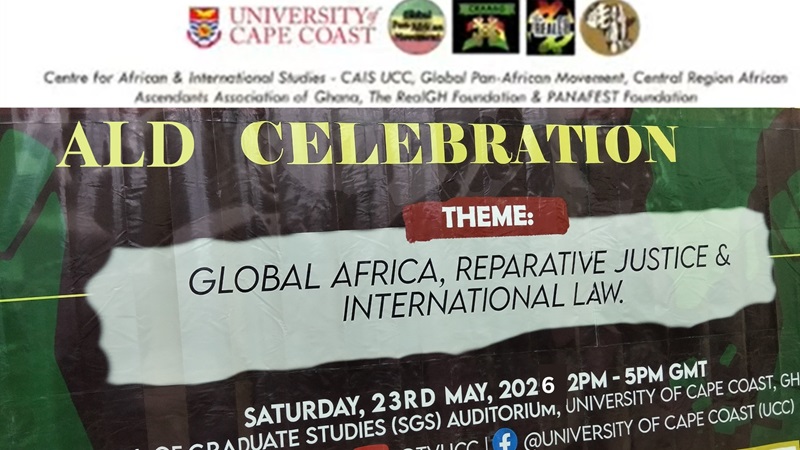
A reflection on African Liberation Day Celebration in one of the contexts where enslavement, colonialism, liberation struggles, the championing of reparative justice, and the struggle for African-centred education have converged.
On 25th May each year, Global Africans commemorate the liberation struggles of African peoples. The programmes and themes differ each year and across institutions and groups. Whether the programmes and celebrations are similar or diverse, the core component that unifies the commemorations is the stocktaking of the liberation struggles that have characterized the existence of African peoples since the encounters with other races, particularly the battle to resist enslavement, colonization, and its mutated forms. These meetings are both moments of political education and offer one of the key moments to examine the victories in the struggles for dignity and liberation, and to identify persisting and new fronts. In this process, Global Africans can formulate new methods, instruments, and strengthen solidarity bonds to mobilize and secure the emancipation and transformation of the continent and its dispersed peoples.
The genesis of the celebrations was 15th April 1958, when Ghana’s first Prime Minister and First President, Osagyefo Dr Kwame Nkrumah, convened the First Conference of Independent African States in Accra. The 15th April 1958 marked the start of the eight-day conference, and the eight independent countries – Ghana, Liberia, Ethiopia, Sudan, Libya, Tunisia, Morocco, and United Arab Republic (Egypt and Syria)– passed a resolution on 22th April 1958 to declare the first day of the convocation as “Africa Freedom Day.”[1] Africa Freedom Day was not a mere designation of a day, but a yearly evaluation moment to mark the progress of the liberation movements and a determination of Africans to expunge foreign domination and exploitation. While African Freedom Day had been declared in Ghana, Elombe Brath and Carlos Cooks popularized this Freedom Day in Harlem, United States, adapting and internationalising the Pan African zeitgeist on the continent within the traditions of Marcus Garvey.[2] Thus, Harlem had become the epicentre where Global Africans outside the African continent linked grassroots mobilization in the Americas with the liberatory front Accra had opened on the continent in the collective efforts to decolonize and improve the economic, political and racial conditions of Africans everywhere.[3]
The progress in the liberation struggle on the continent culminated in thirty-one independent African states by 1963. It was the 25th May of that year that the Organization of African Unity (now African Union) was established. The new momentum, falling short of a fully unified front for the struggle, informed the shift in date from 15th April to 25th May each year. The 25th May was thus declared African Liberation Day. With the date and name, Brath and Cooks advanced African Liberation Day (ALD) and the associated date among activists and black communities in the United States.[4] Africa Day is sometimes used interchangeably with ALD. The pushback in that usage is that the removal of ‘Liberation’ might depoliticise the urgency for liberation in name. But the usage does not alter the historicity and the necessity of inventory, planning, education, and mobilisation required for liberation in the 21st century.
ALD celebrations have been held around and on May 25, depending on whether the organisers of the commemoration in the particular community are holding the meeting during weekends or other days. The day itself is marked as a statutory holiday in Africa.
Cape Coast and the 2026 African Liberation Day Commemoration
On the 23rd of May 2026, the Centre for African and International Studies (CAIS), the University of Cape Coast (UCC), partnering with the Global Pan African Movement (GPAM), PANAFEST Foundation,[5] Central Regional Association of African Ascendants in Ghana (CRAAAG), and RealGH Foundation, held the African Liberation Day commemoration at the Graduate School auditorium of UCC.
The commemoration was CAIS centre’s first such event after Ghana’s leadership in securing the recognition of the transatlantic enslavement as the gravest crime against Africans and humanity. This reparatory gain and the relations of Cape Coast and its catchments to enslavement and British colonial administration made this landmark commemoration in the town more important. UCC and CAIS are situated at the epicentre of the transatlantic enslavement trade and in their sights two major castles – Elmina and Cape Coast Castles – served as routes where the greatest percentage of enslaved Africans passed through before enduring the evils of the transatlantic enslavement ships and the exploitations of the plantation economies in the West.[6] Continental readers might appreciate the dehumanization of Africans in slave-based plantation economies in America by understanding and exceedingly magnifying the slave-based plantation economies in the wake of the abolition of the slave trade. In Ghana, the Frederiksgave, a Danish Slave Plantation site at Sesemi built in 1832, near Abokobi, about thirteen kilometers from the University of Ghana, and other slave-based plantation centres can provide some insight into the racialized hierarchy, domination and oppression enslaved Africans faced on the continent while the struggles to abolish the transatlantic enslavement gained momentum.
Cape Coast served as the British colonial administrative capital for fifty-six years (1822-1877). The years account for the twenty years of administering British forts and settlements and the formalization of colonialism from 1844 onwards, when the bond of friendship with Fante Chiefs translated into the exertion of colonial control by the British Crown.
The historical context of the Cape Coast area thus presented the space to theorize and operationalise the gate of return and liberation through the ALD theme “Global Africa, Reparative Justice and International Law.” In engaging the theme, the commemoration embodied the education and positioning required of the students and trainees of the University of Cape Coast and other audiences to advance the struggles for reparative justice. The youth constituted the majority audience that filled the 500-capacity auditorium of the School of Graduate Studies, UCC.
The University of Cape Coast was established in 1962 as a university college affiliated with the University of Ghana, and transitioned to a full-fledged University in 1971 by an Act of Ghana’s Parliament (Act 360) and by legislative instrument of the Provisional National Defence Council (PNDC Law 278). UCC was originally mandated to train graduate professional teachers for Ghana’s second-cycle educational institutions and the Ministry of Education.[7] The focus of CAIS on African and international scholarship combined with the mandate of the UCC to ground the ALD conversation in the necessary political education of Global Africa for reparative justice.
African Liberation Day: History, an Identity and the Future
The symbolic and emotional tone was set from the start of the celebration. The master of ceremonies framed the ALD as remembrance, celebration, unity, and future-oriented empowerment of Africa. In this emphasis, the audience were invited to consider ALD as both history and the future, remembering anti-colonial struggles while envisioning Africa’s future. In Ruth Quansah words, “African Liberation Day is not just a look back at history. It is actually a powerful look forward into the future. It is a celebration of our rich cultural heritage, our unbreakable resilience, and our shared destiny as Africans.”
The audience was challenged to see themselves as inseparable from the Africans across the world, and reflect on African identity that is collective, unstoppable, and historically continuous.
The start of the ceremony with ancestral invocation and the interludes of cultural performances by the youthful Akoma Pa Cultural Group invited the audience to reflect on the spiritual and cultural identities of Africans, the sacrifices of Pan African figures such as Nkrumah, Lumumba, Fanon, Malcom X and many others whose sacrifices laid the foundations for the continuing struggles for liberation in Africa.
The Philosophical Challenge
The chairperson for the ceremony invited the audience to interrogate ethical and political questions about African identity, reparative justice, responsibility after liberation, and preparedness of Africans to transform freedom into substantive progress.
Is the African identity racial? Is it national? Or philosophical and cultural? Professor Emmanuel Tenkorang asked, “Is the fact that you have a particular skin colour enough to make you an African?” “If we say an African, what do we mean by the classification?”
These questions continue to guide conversations about Africanness on the continent and beyond. Global Africans will have clarity about the Africanness of all peoples of Africa through the interconnected histories and shared struggles regardless of skin pigmentation.
On reparative justice, the scholar asked the audience to consider reparations beyond money. The question remained whether reparative justice should mean financial compensation, restored dignity, opportunities for Africans, and institutional aspects that will involve formal measures, structural and systemic changes by governments and international organizations to redress historical wrongs and ongoing injustices against Africans. Professor Tenkorang quizzed, “In what form will the reparative justice be?” “Are we going to take it and then turn it around to improve our lot?” “Are we really prepared to put it to good use?”
The chairperson through these questions challenged the audience to consider that freedom becomes more meaningful when it is accompanied by transformation, and the conversation on reparative justice should not only be restricted to obtaining it, but also what Africans do afterwards. While colonialism and its continuities deserved blame, the remarks challenged Africans to take up the moral responsibility of building better societies. The tensions in African that have manifested in xenophobic attacks against other Africans in the country presents a Pan African contradiction that the Professor will not allow the audience to ignore. In line with Frantz Fanon’s observation that liberation movements could become tools of oppression against their people, the chair questioned the moral promises of liberation movements in Africa.
The Global African Intellectual and Historical Analysis
The director of the CAIS, Dr Mario Nisbett, offered a Global African argument that connected slavery, colonialism, capitalism, global inequality, and the climate crisis, with reparative justice into a continuing historical system.
The etymology of slavery was highlighted as associated with the Slavs (Slavic people) of Eastern Europe who had been marginalised and exploited for centuries as slaves of Arab and Byzantine merchants and transported to the Middle East and North Africa around the 8th century or the early Middle Ages. The Viking, Germanic and Frankish lords raided and acquired Slavic peoples for slave labour and sales to the merchants.[8] The English form ‘slave’ and the system built around it, slavery and enslavement, represent an evolution from the enslavement of the Slavic people to the expansion and racialization of enslavement that had begun in the trans-Saharan corridor and the Indian Ocean to the gravest crime against humanity. Mario showed that “the doctrine of Africans as subhuman was not the cause of the slave trade. It was manufactured in service of the slave trade.”
In racializing and blackening the slave trade, the transatlantic enslavement furthered anti-black racism that will underwrite most of the white supremacist thoughts that enslaved enough Africans for the industrial revolution. The Director of CAIS put it more clearly, thus: “the industrial revolution was built on the backs of enslaved Africans.” He followed in the traditions of Walter Rodney and Eric Williams to remind the audience about how Europe underdeveloped Africa. “Africa was not left behind. It was actively underdeveloped,” he argued.
The same economic model has led to the destruction of trees, forests, the environment, and other ecological disasters under an extractive logic that continues to drive environmental destruction.[9] Nisbett was clear that “the climate crisis is not a natural disaster. It is a consequence of an economic model,” the capitalist model and its modes of accumulation.
Reparative Justice
The conversations around reparative justice were grounded in the presentations of Dr Mario Nisbett and Julialynne Walker of the Global Pan African Movement, North America. The presentations were unanimous that reparative justice is beyond money. Mario emphasized that “without structural change, every other form of repair is incomplete.” Julialynne Walker presented a formulation that interrogated the philosophical challenge that framed the ALD celebration in Cape Coast. In her presentation, the audience were challenged to envisage reparative justice within the 5 key components recognised in Human rights law: Restitution – returning stolen items, and restoring victims or their descendants into the original state before the harm was done against them; Compensation – financial reparations including material payment for the asset loss, physical injuries and the emotional pains inflicted on the enslaved peoples and the continent; Rehabilitation – psychological, social, medical and legal support for the healing of the enslaved peoples; Satisfaction – officially acknowledging the guilt, rendering public apologies, and memorialising the injustices to restore the honour and integrity of Africans; and Guarantees of Non-Repetition – reforming institutions and creating structures that will ensure that the historical injustices are never repeated. In seeking repairs, the structural changes should strongly incorporate women’s health and care to prevent avoidable maternal and infant morbidity as women undertake the sacred task of reproducing human life. Julialynne emphasized the importance of women’s health and liberatory care in these structural terms.
African knowledge was also to be a central question in the reparative struggle. The role of the CAIS in educating undergraduate students at the UCC in African Studies was highlighted as one of the moments to inculcate African knowledge within the formal education set-up. This practice in the UCC is mandatory across university education in Ghana. The opening of the questions about reparative justice in that core instruction across universities in Ghana offers a space to continue the conversation beyond the 2026 African Liberation Day Commemoration in the country.
The solidarity messages from Rabbi Kohain Halevi from PANAFEST, Janna D. Bellows from CRAAAG, and Morris Biggers III of REALGH reiterated the unity required of Africans everywhere and the need to stoke the fire of reparative justice conversations to build bridges for increased interaction between the continent and its diaspora. The bridge is required for the facilitated return of the ascendants and descendants of enslaved Africans outside the continent who are repatriating or exploring alternative ways to reconnect with their ancestral homes in Africa.
Conclusion
The history of transatlantic enslavement, colonialism and the liberation struggles, the role of Ghana, Cape Coast, and the Centre for African and International Studies at the University offered one of the most appropriate spaces for commemorating this year’s African Liberation Day in an institutional and geographical space. Ghana had championed the reckoning of the transatlantic slave trade as the gravest crime against humanity, and the country has moral responsibility as one of the fronts where significant number of enslaved Africans were traded in the castles and fortes before their more humiliating experiences on the slave ships, plantations and households of European plantation owners. The Declaration of African Freedom Day in Accra provided the impetus for the continuing struggles that led to the declaration of 25 May as African Liberation Day and its celebration across Global Africa.
The 2026 ALD commemorations in Cape Coast recognised the complex history of the country, challenging Ghanaians and Africans to embrace political education around the struggles for the collective repair of Africans.
The university and other educational institutions across Global Africa must be central in providing education anchored in African knowledge that treats such knowledge on its own terms and not as an appendix or footnote.
In Ghana’s tertiary education ecosystem, all undergraduate university students are required to take courses in African Studies before graduating. Thus, ALD commemoration and the reparative justice initiatives at the CAIS promise a strong ground to correct historical injustices from one of the core locations where the gravest crime against humanity began.
The mobilization success of the meeting and contents of the theme of the commemoration must be maintained beyond the ALD. It should extend to course contents across universities in Ghana and Africa to accelerate the gains in the push for reparative justice and the restoration of African dignity.
Peter Bembir (PhD) is a postdoctoral fellow and a multidisciplinary researcher at the Institute of African Studies, University of Ghana. He is an Associate Editor at Pambazuka News.
Endnotes
[1] Parliament House. “Conference of Independent African States: Declaration and Resolution.” Parliament House, Accra, Ghana, April 22, 1958. See also All African Peoples Party, “African Liberation Day,” https://projects.kora.matrix.msu.edu/files/210-808-7413/ald30.pdf; Johnson, Carol A. “Conferences of Independent African States.” International Organization 16, no. 2 (1962): 426–29; http://www.jstor.org/stable/2705394. See also page 223 of Mulugeta, Daniel. “Continental Pan-Africanism: The First All-African People’s Conference and the Struggle for Africa’s Independence.” Critical African Studies 17, no. 2(2025): 223–40. doi:10.1080/21681392.2024.2443407.
[2] Horace Campbell, “African Liberation Day: The People Must Prevail,” Pambazuka News, 2008
[3] Ethiopia represented the next continental gathering space for governments of independent African states, and Tanzania hosted the OAU’s Liberation Committee that continued the struggle to liberate southern African countries even when the CIA orchestrated the overthrow of Kwame Nkrumah.
[4] Joseph, Terese Millet & GPAM, “Statement on Behalf of the Global Pan-African Movement (GPAM) North American Delegation in Commemoration of the African Liberation Day 2025” Pambazuka News, May 29, 2026. https://www.pambazuka.org/node/100000074
[5] PANAFEST is the Pan African Festival of Arts and Culture. The Foundations manages the organisation of this biennial festival in Ghana. See https://panafest.org.gh/ for more information on this journey of healing in Ghana for Africans, and Global Africans in the Sixth Region of Africa, and the Seventeenth Region of Ghana.
[6] The four major castles and forts where enslaved African were held in Ghana include Elmina Castle, Cape Coast Castle, Anomabo (Fort William), and Accra (Christiansborg). See https://www.slavevoyages.org/; Singleton, Theresa A. "The slave trade remembered on the former gold and slave coasts." In From Slavery to Emancipation in the Atlantic World, pp. 150-169. Routledge, 2013. Osei-Tutu, John Kwadwo. Forts, Castles and Society in West Africa: Gold Coast and Dahomey, 1450-1960. Vol. 7. Brill, 2018.
[7] About the University of Cape Coast. https://ucc.edu.gh/main/about. The University is currently among the country’s top three Universities and offers diversified programmes beyond teacher training.
[8] Graus, František. "Slavs and Germans." In The Expansion of Central Europe in the Middle Ages, pp. 149-176. Routledge, 2017. Rome and the Byzantine empire also engaged in enslavement and the phenomenon is seen as characterising in economies built on wars, conquest and raids. See Wergeland, Agnes M. "Slavery in Germanic Society During the Middle Ages." Journal of Political Economy 9, no. 1 (1900): 98-120; See also Leeper, Allen. "Germans, Avars and Slavs." The Slavonic and East European Review (1933): 117-132. Fontaine, Janel M. "Warfare and enslavement." In Slave trading in the early Middle Ages, pp. 105-142. Manchester University Press, 2025. Biermann, Felix. "Archaeological Evidence for Slavery Among the Early Medieval North-Western Slavs." In The Archaeology of Slavery in Early Medieval Northern Europe: The Invisible Commodity, pp. 141-160. Cham: Springer International Publishing, 2021.
[9] Nolan, P. “The two-edged sword of capitalist globalization.” Challenge, 61, no. 1 (2018), 92-103. Any civilization that wages relentless war on life risk destroying itself. See Nolan, P. “Governing Globalization.” Horizons: Journal of International Relations and Sustainable Development, no.10 (2018), 22-41.