



The Beautiful Game, a Reflection of an Unjust World
Since the beginning of the 2026 World Cup, Pambazuka News have been having numerous conversations about ongoing events of the tournament. Various articles on Pambazuka News have examined how the United States, one of the three host nations, has been treating the globe since the Cold War. A Pambazuka News interview with an Iranian anti-imperialist scholars and professor, Navid Farnia, and related articles discussed the hosting of the World Cup despite violent activities of the host nation such as enabling genocide in Palestine, kidnapping president Nicolas Maduro of Venezuela and his wife, blockading Cuba and denying it life-saving energy and medical equipment, anti-immigration rules, and declaring war on Iran.
Ironically, FIFA appeasingly delivered its inaugural so-called “FIFA Peace Prize” to President Donald Trump who is overseeing this violence. So much is happening on and off the field, and Pambazuka News is bringing some key reflections about the politics of the sport.
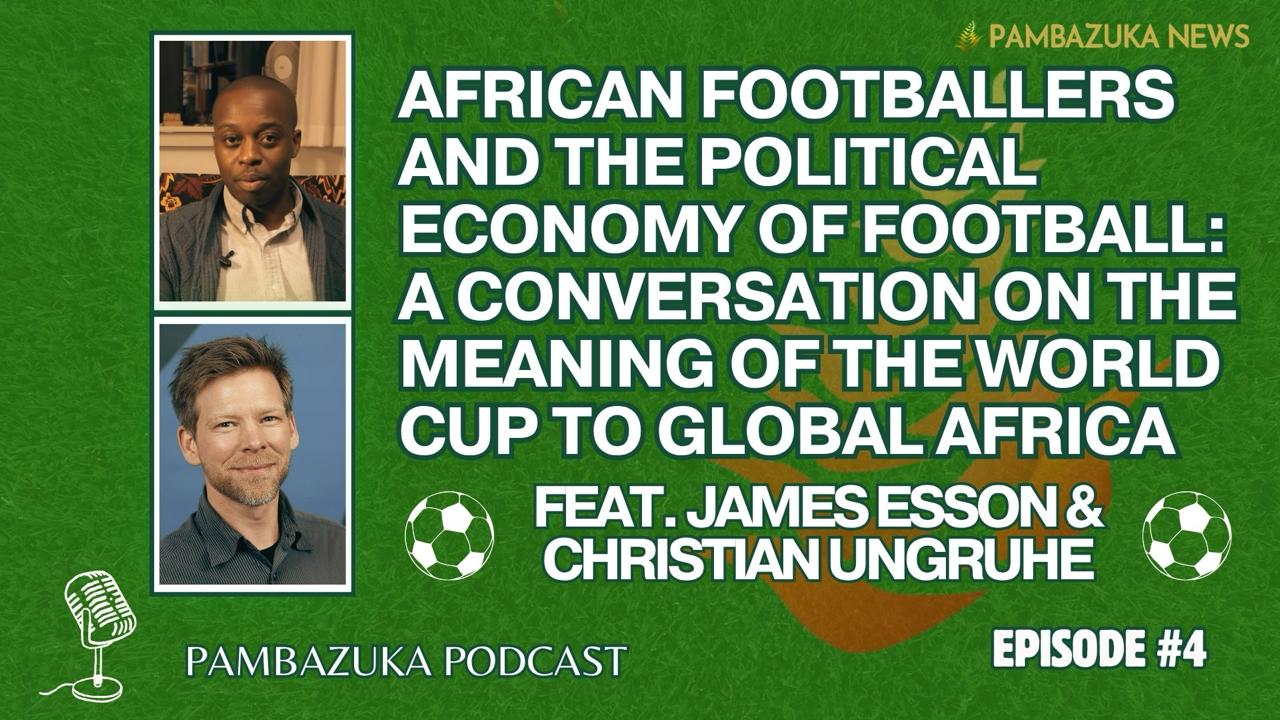
Before we share with you some of our reflections on the World Cup, we want to bring your attention to our newest episode, African Footballer and the Political Economy of Football: A Conversation on the Meaning of the World Cup to Global Africa, where Pambazuka News welcomes Professors James Esson and Christian Ungruhe – specialized in Youth, Migration, Football, Geography and Development – to discuss how football, African youth and migration intersect in a world of unequal exchange, showing how the beautiful game is a reflection of an unjust world.

Every World Cup brings with it controversies about the beautiful sport: Who is the actual winner of the tournament (e.g., in 2018, was it France or Africa that won the World Cup)? Is football in Africa a part of a larger scheme of labor extraction? How is the sport a reflection of the relationship the Global South has with the North (or the North forces upon the South)? These are some of the questions the guests address in the conversation.
Tune in on:
- Pambazuka News website: pambazuka.org/podcast
- Apple Music: https://podcasts.apple.com/us/podcast/pambazuka-podcast/id6785328734
- Youtube: www.youtube.com/@PambazukaNews
But as the beautiful game’s most watched competition comes to a close, we share with you the following 10 broad reflections on this World Cup:
1. As the US bombed Iran, FIFA placed two of the three Iranian team’s games in the hub of a reactionary Iranian diaspora, namely Los Angeles. Adding salt to injury, the US alleged that it cannot provide safety to the Iranian national team, so the team must arrive and leave on the same days of their games. Further, besides denying entry to Iranian nationals as part of the sweeping decree by the Trump regime to many Global South countries, it denied visas to the president of Iran's Football Federation and revoked visas for team administrators, journalists and media officers. These tactics are part of the psychological warfare against the Islamic Republic of Iran.
2. Historically, host nations exempted visas to World Cup attendees if they have at least one ticket to the World Cup, making their countries a hub to meet lovers of the game amid a global cultural exchange surrounding the sport and the event. But behind the facade of well-lit stadiums and commercial services for the world’s largest sporting event, lies the fact that the US has not only cast aside hospitality norms but reflected its belligerent policies on the World Cup attendees. Fans from Morocco, Egypt, Jordan and Uzbekistan have had their visa applications denied by the US — despite how obedient these named countries have been to the US and its larger policies in the Arab region and Central Asia. This is only an indication how political humiliation translates to a civil one.
3. The US denied entry to the Somali referee, Omar Abdulkadir Artan, based on fictitious links to “suspected members of terror organizations”.
4. The World Cup saw numerous cases of racism being met with Infantino, FIFA president, exclaiming, “Chill, Relax”. The Argentinian fans shouting racist slurs towards the famous TikToker, iShowspeed. The Paraguayan team, following their loss against France, was put on the spotlight as their Senator, Celeste Amarilla made racist remarks against France’s captain, Kylian Mbappe. This is not the first time a national team is questioned about their players.
Romelu Lukaku: ‘When things were going well, I was reading newspaper articles and they were calling me Romelu Lukaku, the Belgian striker. When things weren’t going well, they were calling me Romelu Lukaku, the Belgian striker of Congolese descent.’
Mesut Ozil: ‘When we win, I am German. When we lose, I am an immigrant’
Karim Benzema: ‘When I score I’m French, when I don't I’m Arab'
Furthermore, many spectators were surprised by the number of Black players among teams from Latin America, with ahistorical comments calling them immigrants. The reality is that these teams are a reflection of the local population with their demographics inherited from slavery, hence the visible number of Afro-Colombian, Afro-Ecuadorian, and Afro-Brazilian players.
5. To Red or not to Red: In the first game of Group J, Algeria played Argentina. During that game, Lionel Messi committed a horrendous foul against the Algerian defender, Aissa Mandi. Messi’s cleats stomped on Mandi’s calf resulting in twisting his ankle. The game between the US and one of Europe’s youngest nations, Bosnia & Herzegovina, saw Balogun commit the exact same foul. Whereas Messi was met with a verbal warning and no VAR (Video Assistant Referee) involvement, Balogun received a straight red card following a VAR review. The inconsistency is staggering.
6. To Red or not to Red 2.0: not a couple of days passed until we heard that Trump gave a phone call to Infantino and asked the latter to reconsider the Red Card against Balogun. The card was revoked as well as the suspension, and Balogun was able to play in the US’ next game against Belgium which they lost. Behind the curtains of power and sports, lies the fact that it was not just Trump nudging his Italian-Lebanese fan to rescind the Red Card, it was in fact a UAE official, Mohammad al-Kamali, who made the decision. Mr. al-Kamali chairs FIFA’s disciplinary committee, which consists of 17 members. He made the decision on his own without involving any of the 17 other members. Over that same weekend, the US loosened UAE’s ability to acquire advanced military equipment from the US, coinciding with the military escalation by the US and its functionaries against Iran. Quo bono?
7. The controversy against the Egyptian team is another tale that favours Argentina. The refereeing in this World Cup (and the previous one) has been on Argentina’s side, leading some to argue that the political economy of advertising and seeing Messi succeed are in tandem, such that commentators and ads glorify his skills, even when he is underperforming. This should be understood as part of the larger economic systems that makes this game operate beyond what happens in the stadium. In 2022, Messi prevented a Netherlands attack by intentionally raising his hand and obtrusively touching the ball. He received no yellow card.

Image description: Messi’s handball in 2022 against Netherlands. Source: screenshot https://www.youtube.com/watch?v=65bFQYocJWM&t=109s
8. The Argentinian legend, Diego Armando Maradona, in 2018, on the day the 2026 World Cup was awarded to the US, Canada and Mexico, predicted that given the rampant capitalism of the US, they would push for doing 4 quarters instead of two halves so that they can pump the viewers with endless consumerist ads. His predictions were true, all under the banner of hydration break.
9. The co-optation of the Congolese revolutionary, Patrice Lumumba. During the 2025 AFCON, the Congolese national, Michel Kuka Mboladinga, made an astonishing performance beyond what the Congolese national team did in the tournament. He dressed in colorful clothes resembling the DRC’s flag and stood for the whole duration of the 90-minute game like the Tower of Limete in Kinshasa (commonly known as the Patrice Lumumba Statue).

Image description: Tower of Limete in Kinshasa, Patrice Lumumba statue. Source: https://commons.wikimedia.org/wiki/File:Kinshasa,_tour_de_l%27%C3%A9changeur_de_Limete_-_20090705.jpg

Mboladinga drew worldwide attention to the extent that search engines drew tremendous traffic, as the graph below shows:


But capitalism has numerous ways to co-opt the political consciousness being raised by Mboladinga and how the CIA and Belgian intelligence worked together to stifle Pan-Africanism and clobber DRC into acquiescence for decades since Lumumba’s assasination. The beauty company, Rexona, contracted Mboldaniga to pose with the deodorant spray like the famous Lumumba statue in Kinshasa.
It is worth noting that there is a troubling history of Rexona’s parent company, Unilever and their exploitative and colonial practices in Congo. In short, the co-optation of Patrice Lumumba by Rexona should be a wake up call to all of us to understand how capitalism and imperialism go full lengths to camouflage their exploitation and portray themselves as proponents of historical anti-colonial and imperial figures.
10. In 2022, the German national team posed for the pre-game photo with their hands covering their mouths as a form of protest against the then-host nation, Qatar. This protest stems from numerous reasons including the documented grievances Qatar has committed against workers who built the stadiums yet a staggering number of more than 6500 migrant workers were killed in those precarious conditions. Whilst this is a reflection of the unjust world where a wealthy country can exploit the workers of another underdeveloped country, Germany’s history isn’t pristine either, with their hosting of the 1936 Olympics at the height of their fascist era. Sports, and particularly the most popular one, football, cannot be divorced from the material reality of this world. In fact, the imperialist capitalist order has numerous expressions and in the realm of sports and football these expressions can be very pronounced as well. Nonetheless, the labor question remains poignant. Workers at SoFi stadium in Los Angeles won the right to strike if the presence of Immigration and Customs Enforcements (ICE) was confirmed. An unprecedented victory in modern American labor history. As we return to the question of labor exploitation, and as we await for the final between the 2022 champions and the 2010 champions, we ask the questions that Bertolt Brecht left us with in his poem, A Worker Reads History.
Who built the seven gates of Thebes?
The books are filled with names of kings.
Was it the kings who hauled the craggy blocks of stone?
And Babylon, so many times destroyed.
Who built the city up each time? In which of Lima's houses,
That city glittering with gold, lived those who built it?
In the evening when the Chinese wall was finished
Where did the masons go? Imperial Rome
Is full of arcs of triumph. Who reared them up? Over whom
Did the Caesars triumph? Byzantium lives in song.
Were all her dwellings palaces? And even in Atlantis of the legend
The night the seas rushed in,
The drowning men still bellowed for their slaves.
Young Alexander conquered India.
He alone?
Caesar beat the Gauls.
Was there not even a cook in his army?
Phillip of Spain wept as his fleet
was sunk and destroyed. Were there no other tears?
Frederick the Great triumphed in the Seven Years War.
Who triumphed with him?
Each page a victory
At whose expense the victory ball?
Every ten years a great man,
Who paid the piper?
So many particulars.
So many questions.
- Bertolt Brecht, 1936
We enjoy the final game, but we do not let the world of sports distract us from the struggle, numb us, nor disorient our compass.