



A Lost Generation: Stranded Between School, Work, and Belonging
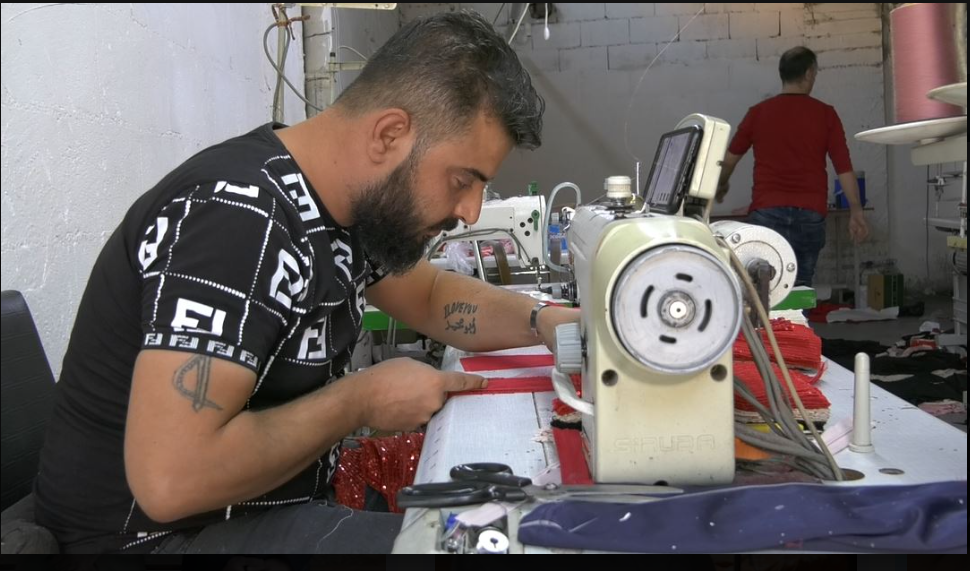

Allowing us to examine how migrants remain excluded even under the guise of inclusion, Uçkan examines the lives of Syrian refugees in Turkey, which demonstrate the structural conditions that render them invisible, stateless, and as a cheap “army of labour” without a pathway for integration and progression in their material conditions.
By 2026, around 2.9 million Syrians live under temporary protection in Turkey, and nearly half of them are children or young adults under 24. For these youth, informal work is the norm; in many cases, up to 70 percent are stuck in off-the-books jobs with no safety net. History shows us that when states treat refugees as a cheap "reserve army of labor," they stop managing a humanitarian crisis and start managing for economic efficiency instead.[1]
This report looks at the structural problems these young people face. By mixing their personal stories with human rights standards, we examine how urban poverty and bureaucracy are turning them into a "lost generation." We interviewed seven youths and one parent for this piece whose names have been changed to protect their safety. The interviews were gathered as part of the field reporting for this article.
Although the fieldwork here focuses on Syrians in Turkey, the condition it describes is not uniquely Syrian. Across refugee and migrant settings, formal admission can coexist with insecure work, conditional belonging and limited access to the institutions that make social participation possible. Patricia Daley has traced comparable forms of exclusion in the United Kingdom and Europe to longer histories of colonial bordering and racialised migration control.[2] Nicholas De Genova's work on migrant 'illegality' likewise shows how legal categories can produce a condition of everyday vulnerability rather than simply describe it.[3] Seen in that wider frame, the Syrian experience in Turkey is one case within a broader struggle over who is allowed not merely to reside in a country, but to build a future there.
For these young people, Turkey has become less of a destination and more of a massive, stalled waiting room. As Hannah Arendt once described the state of being "stateless," these youth are not just separated from their homes—they are trapped in a limbo where they are denied the right to even have rights.[4] Whether they are trying to get into university, working in factories, or just trying to survive unemployment, they live in a state of constant, unresolved tension. They can’t see a future back home, but they can’t build one where they are either.
The Barriers to Education
Muna, 18, works six days a week at a textile shop. When she isn’t at the machine, she is trying to study for university entrance exams. She’s close to quitting because her classmates constantly put her down, calling refugees uneducated.
"I go to school, then I go straight to work," Muna says. "I have almost no time to study. My grades aren't bad, and I think I can pass, but if I have to deal with the same bullying at university that I deal with at high school, I’ll have to drop out. It’s just too much to handle."
For these students, entrance exams aren't just tests—they are a fight to shed the "foreigner" label and earn some standing. But the real fight starts in the hallways. Despite the 1989 UN Convention on the Rights of the Child, which Turkey signed, the reality on the ground is exclusion. Students deal with everything from cruel jokes to being ignored in group activities, eventually making them wonder: "What’s the point? I’ll just be a foreigner in this country anyway."[5]
Then there is the language trap. Those who study in Turkish worry that if they return to Syria, their Arabic won’t be good enough for a professional career. Those who study in Arabic-language programs in Turkey struggle to find work because the local job market demands fluent Turkish. The result is more than a language disadvantage: it can make progress feel risky in both directions. Investing in Turkish may deepen the possibility of a future in Turkey while weakening confidence about return; investing in Arabic may preserve a connection to Syria while narrowing access to parts of the Turkish labour market. For some young people, this uncertainty delays education and career decisions rather than encouraging a straightforward path towards integration.
Hassen, who graduated from the business program at Mardin Artuklu University, puts it bluntly: "I studied in Arabic thinking maybe I could go back home one day, but that’s not possible now. I don’t know English, and my Turkish isn't good enough to land a job here. I feel like I wasted my time. My family just tells me I should have learned a trade instead of going to school."
Hassen's frustration shows how education can lose its promise when legal status, language and labour-market access do not move together. His degree has not failed because education lacks value; its value is being constrained by a system in which the skills that prepare a refugee for one possible future may be discounted in another. The result is a particularly sharp form of precarity: years can be invested in study without producing a stable sense of where that knowledge can be used.
Low Wages and Invisible Labor
Ahmad, 20, works as an apprentice in a repair shop. Beyond the physical exhaustion of 12-hour days, he struggles with the simple unfairness of being paid less than his local coworkers just because he’s a refugee.
Then there is Yousef. He lost a leg in the war and, because he doesn’t qualify for disability benefits or rehab, he can’t work. He spends much of his time indoors, trapped in a cycle of isolation and depression. "I don’t know how to live a life where I can’t join people, can’t work, and just feel like I’m sitting in a void," he says. His situation is a clear violation of the UN Convention on the Rights of Persons with Disabilities, specifically regarding the right to work and social protection.[6]
Yousef's account also shows that exclusion from work is not only an economic problem. For a young person living with a war-related disability, the absence of adequate rehabilitation and social protection can shrink social life itself, turning unemployment into isolation and dependence.
Since adults often can't enter the formal job market, families depend on the kids. Despite international rules against child labor, poverty forces teenagers into the same textile factories where they should be learning.[7]
For girls, the pressure is even heavier. Camila, 16, wants to be a teacher. But her family sees things differently. "Getting her into school was a battle," her mother told us. "She’s a great student, but my husband and my oldest son don't want to pay for university. They’re afraid she’ll end up with someone they don’t like, so they want to marry her off to a relative as soon as she finishes high school." For many girls, marriage is seen as a way to "solve" the family’s economic burden, effectively ending their future before it starts.
Camila's case makes clear that refugee precarity is also gendered. Economic insecurity does not simply reduce a family's choices; it can strengthen pressures that move girls out of education and towards early marriage, transferring the cost of insecurity onto their future autonomy.
Nowhere to Belong
Abdulrahman, 22, still carries the scars of the war from 12 years ago. He feels like an outsider in Turkey, yet he doesn't feel like he belongs in his memories of Syria, either.
"I’m not from there, and I’m not from here," he says. "It’s not just a feeling. Honestly, I don’t see a future waiting for me in either place."
Abdulrahman's words describe more than homesickness. They point to a crisis of belonging produced when return is uncertain and participation in the host society remains conditional. Citizenship in this sense is experienced not only as a passport or legal category, but as the practical ability to imagine a life that can continue in one place.
The Coldness of Aid
Sidra, 21, asked aid groups for help with her education. They offered her a food box. "They look at me like an object to be fed, not a person with goals," she says.
Sidra is not rejecting assistance; she is questioning a system that defines need too narrowly. Her response asks what happens when refugees are treated primarily as recipients of relief rather than as people making claims about education, work and social membership.
The aid system often focuses on "bare survival" rather than helping these young people build anything meaningful. When social workers check on school attendance, they ignore the fact that the student is spending their evening in a factory. They focus on the numbers—how many boxes were handed out, how many people were reached—rather than the person behind the file.[8] This tension also appears in Pambazuka's migration coverage,[9] which emphasises coerced movement while refusing to portray migrants and refugees as passive objects of policy. Aid can keep people alive while still leaving the structures that restrict their choices untouched. The issue, then, is not whether assistance matters, but whether refugees have meaningful power to shape what assistance is for.[10]
When you add in the fact that most refugees live in the cheapest, most isolated neighborhoods, you get a cycle that’s hard to break. They spend half their day on a bus just to get to the city center, and they face harassment just for existing in those spaces. For many of these youths their neighborhood is basically an open-air prison.
Saving this generation isn't about giving out more scholarships or increasing university quotas. It’s about letting them enter the job market without a "foreigner" label and giving them a path to work that is valued. They don't need charity; they need the right to participate in the society they are already a part of.
Rengin Uçkan holds a degree in Social Work from Istanbul University and a master's degree from Marmara University's Department of Political Science and Public Administration, where she completed the Governance and NGOs programme. She also received applied training in Family Counselling from Yıldız Technical University. She has more than nine years of professional field and specialist experience in human rights, migration management, child protection and gender-based violence. During her career, she has worked with organisations including the Turkish Red Crescent and Support to Life, contributing to and managing work on refugee rights, case management, the prevention of child labour in seasonal agriculture, and rights-based advocacy reports. Since 2024, she has worked as an independent consultant supporting civil society organisations in the field of human rights. She works professionally in Turkish, Kurdish, English and Arabic and continues her rights-based work as an independent researcher and journalist in multicultural settings.
Endnotes
[1] Karl Polanyi, The Great Transformation (New York: Farrar & Rinehart, 1944). See also Association for Solidarity with Asylum Seekers and Migrants (ASAM). “Report on Refugee Participation in the Labor Market and Informal Employment.” 2026; and Republic of Turkey, Ministry of Interior, Presidency of Migration Management. “Number of Syrians Under Temporary Protection.” 2026.
[2] Patricia Daley, “The Inhumane Treatment of Migrants: The Long Durée of Colonial Violence in the UK and Europe,” Pambazuka News, 25 June 2026.
[3] Nicholas P. De Genova, “Migrant ‘Illegality’ and Deportability in Everyday Life,” Annual Review of Anthropology 31 (2002): 419–447.
[4] Hannah Arendt, The Origins of Totalitarianism (New York: Harcourt, Brace & World, 1951).
[5] United Nations, “Convention on the Rights of the Child” (Geneva: OHCHR, 1989).
[6] United Nations, “Convention on the Rights of Persons with Disabilities” (Geneva: OHCHR, 2006).
[7] International Labour Organization, “Convention concerning the Prohibition and Immediate Action for the Elimination of the Worst Forms of Child Labour” (Geneva: ILO, 1999).
[8] Michel Foucault, The History of Sexuality, Vol. 1: An Introduction (New York: Pantheon Books, 1978).
[9] See Pambazuka’s most recent Special Issue on Migration: https://www.pambazuka.org/index.php/taxonomy/term/15755
[10] Mahder Serekberhan, “Coerced Movements of Global Africans: From the World Cup to The Book of Shame,” Pambazuka News, 25 June 2026.