



Were the Currents That Carried Migrants to Ceuta the Ripples of Unwarranted Intervention?

Parameswaran questions dominant narratives about Africa’s migration to Europe using the recent migrant crossing into Ceuta and reflects on insights from the road to London Heathrow Airport.
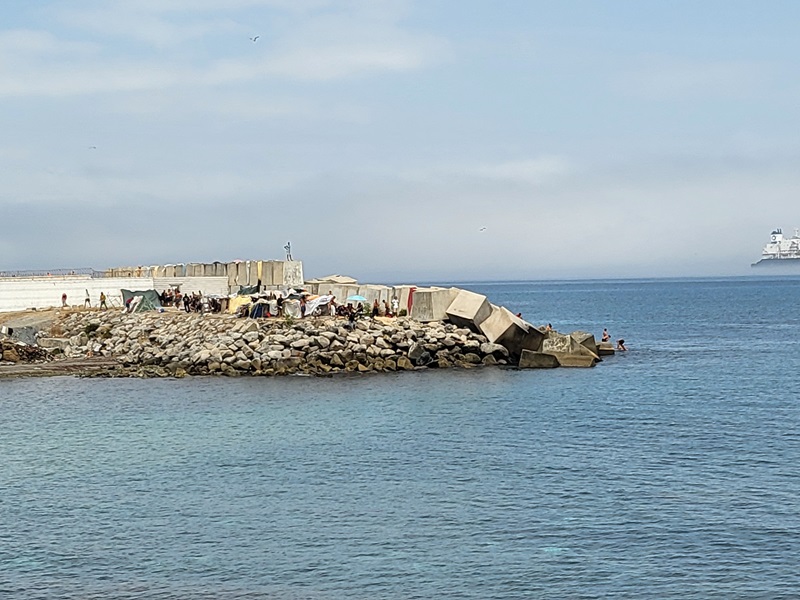
The images of the recent migrant crossings into Ceuta, a Spanish territory long disputed by Morocco, left much of the world stunned. Not a few hundred, but nearly 60,000 migrants swam from Morocco to the shores of the Spanish exclave in North Africa, with dozens losing their lives either during the crossing or in its aftermath. While most have currently been sent back or have voluntarily returned to Morocco, I still remember watching in disbelief as images emerged of countless men arriving on the shoreline - drenched, exhausted, but jubilant after the journey.
While much of Europe felt compelled to respond, with many voicing support for Spain’s military deployment, most of the world took note when a nation across the Atlantic also entered the conversation. True to form, their head of state offered his views despite the geographical distance and his limited direct stake in the matter. US President Donald Trump described the migration crisis in Ceuta as a “catastrophe” and attributed it to Spain’s “weak law” and “bad management.”[1] Given the need to approach any statement from Trump with a degree of caution, I decided to conduct some independent research into what had precipitated the sudden migratory influx. While the immediate catalyst was widely reported to be social media-fuelled rumours surrounding a Spanish Supreme Court ruling, the push-factor that drove the exodus was often attributed to “underlying economic hardship resulting from longstanding governance challenges” within Morocco.[2] Reading this led me to think more broadly about migration from across the African continent. Could it really be explained solely by governance challenges in some regions and the often-cited issue of “political instability” in others?
The question immediately transported me back to a cab ride I took two summers ago in London. After what had been both a fulfilling and eye-opening visit to a city once at the centre of the global world system, during my journey back to the airport I found myself in conversation with a Nigerian driver who was simultaneously pursuing a PhD, working as IT support at the same university, and raising a family. During the forty-minute journey from Borough to Heathrow, he spoke candidly about his experiences growing up in Africa, the circumstances that compelled him to leave, and the demands of raising a family while both he and his wife balanced multiple jobs despite high education levels - a situation that, as he pointed out, had become increasingly common in modern-day Britain and reflected the country's own domestic struggles.
I listened intently as our conversation swerved to the oft-cited issue of “political instability” in Africa and its role in many of the continent’s present-day challenges. Drawing on his own research and conversations with informed contacts, he said that certain powerful institutions in the United States, Britain, and other European countries have, even in recent times, played a role in dictating political developments in African nations to advance their own economic or ideological objectives. Just as he began expanding on this bold subject, we arrived at Heathrow and had to part ways, yet what he said lingered in my mind until long afterwards. I was already aware of the CIA’s involvement in African politics during the Cold War, but had such interference truly ended, or does it prevail in different forms even today? If so, what motivates it, and to what extent has foreign intervention contributed to the “instability” that is so frequently cited as Africa’s fundamental socioeconomic problem?
My curiosity got the better of me, and that very afternoon at the airport I began exploring the issue in depth. While many Western countries have intervened in African affairs at various points in time, France, followed by the United States and Britain, have been among the most vocal in presenting such involvement as “benevolent” and “necessary”.[3]
Perhaps the most striking example is the aftermath of the NATO-led intervention in Libya in 2011. Rather than ushering in the stability that was so confidently promised, the collapse of the Libyan state coincided with the rapid spread of insecurity across the Sahel, prompting France to launch Operation Barkhane alongside a coalition of regional partners. Yet despite the deployment of thousands of so-called “peacekeeping” troops under this operation - supported by aircraft, drones, armoured vehicles, and an extensive array of military assets - the region continued to descend into violence, experiencing repeated coups, mass displacement, and a steadily worsening humanitarian crisis.
Crucially, European border militarisation simultaneously turned the region into a nightmare for African migrants.[4] Far from a successful intervention, this catastrophe led critics to question whether such operations inherently deepen instability instead of alleviating it. Leaked email exchanges between Nicolas Sarkozy and Hillary Clinton exposed that the true intervention rationale was not stability, but rather a fear of Libya's growing autonomy and its ambition to finance African financial independence via a gold-backed currency.[5] The humanitarian and "Responsibility to Protect" (R2P) narratives have thus been exposed as mere information warfare designed to mask NATO's catastrophic strategic failure. As a UK House of Commons Foreign Affairs Committee report later concluded, this policy lacked accurate intelligence, noting specifically that the government "failed to identify that the threat to civilians was overstated".[6]
The United States followed a comparable trajectory of militarisation in the aftermath of 9/11, dramatically expanding its military footprint across Africa through a vast network of bases, operations, training programmes, drone campaigns, and special forces deployments. Yet as American engagement intensified, militant violence simultaneously spread across large swathes of the continent. Reports have further noted that several military officers who later played leading roles in coups across the Sahel had previously received US security assistance[7] - a reality that sits uneasily alongside the West’s long-standing assertion that foreign military involvement serves to strengthen democratic institutions and promote political stability. At the very least, such developments cast serious doubt on the neat and often repeated narrative that greater military engagement necessarily produces stronger governance.
Many of these purportedly “remedial” efforts have been coordinated through AFRICOM, the United States Africa Command established in 2007 to oversee military cooperation, security partnerships, and crisis-response operations across the continent. From Nigeria to Somalia, AFRICOM has remained heavily engaged in operations targeting extremist organisations. In Somalia alone, US airstrikes rose dramatically under both the Trump and Biden administrations, reaching unprecedented levels in recent years.[8] Yet despite this sustained escalation, militant groups such as al-Shabaab remain active, Islamist violence-related fatalities have surged, and insurgent forces continually strike close to strategic centers. This persistent deadlock suggests that the true objective of external intervention may not be conflict resolution, but rather the deliberate maintenance of a managed crisis - one designed to sustain foreign control, evade accountability, and secure cut-rate access to the region's resource markets.
Even as AFRICOM’s leadership continues to justify these campaigns as necessary measures to protect American interests and combat extremism, uncomfortable questions persist regarding their long-term effectiveness, their unintended consequences, and whether they have meaningfully contributed to stability. Indeed, after decades of military engagement the persistence of the very threats these operations were designed to eliminate raises an inescapable question: if the strategy has been successful, why does the problem of weak governance or political instability in Africa appear more entrenched than ever?
It is important, therefore, to recognise the inconsistencies that often shape such narratives, as well as the public relations frameworks through which we are encouraged to interpret and judge complex geopolitical events. At first glance, the sight of numerous people arriving on Spanish shores may instinctively evoke more sympathy for Spain than for the mostly male migrants who crossed over illegally. Yet it is equally important to consider if there are broader forces at work, including the role that sustained foreign interference has played in destabilising parts of the continent and contributing to the migration pressures that ultimately drive people towards Europe.
Ideally, we should emulate the intellectual curiosity of the Nigerian gentleman who drove my cab two years ago in London, remaining conscious of the fact that, time and again, powerful Western states and the interests aligned with them have involved themselves in the affairs of countries across the developing world - a pattern visible not only in the African case, but also in Latin America, with the recent example of Maduro’s kidnapping, and even closer to home for me, in South Asia[9] and China[10]. In Ceuta’s particular case, it is worth questioning the ease with which the United States passed judgement on Spain by citing “weak law and bad management” as the source of the crisis, while overlooking the extent to which the broader migration phenomenon has been shaped by policies and interventions in which it has itself played a role.[11]
Samyuktha Parameswaran serves as a Research & Content Associate at the Hong Kong-based pan-Asian think tank, the Global Institute For Tomorrow (GIFT). With policy project experience across Asia and Africa, her work focuses on global governance and shifting regional dynamics. She has previously collaborated on civic and human rights advocacy with the UNFPA and Equal Justice, alongside various cross-border sustainability initiatives in the Asia-Pacific.
Endnotes