



Why South African Students Must Speak Out Against Scholasticide in Gaza
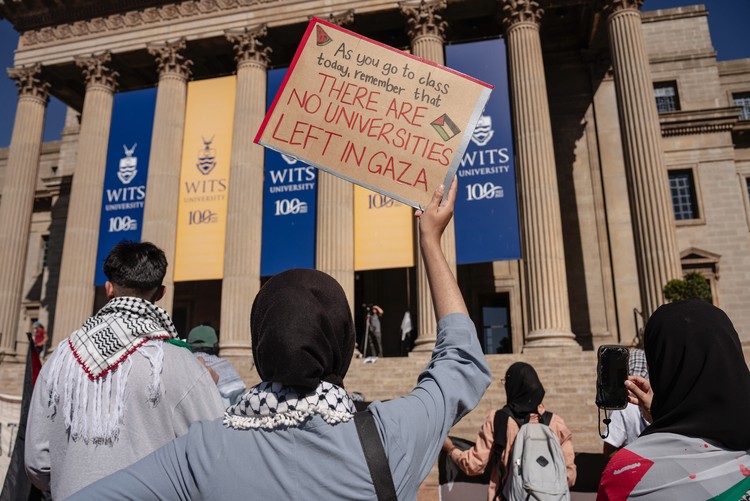
South African students call the world's attention to the destruction of educational institutions in Gaza and demand an end to the silence.
Buried beneath the rubble of bombed schools, burnt textbooks, and slaughtered teachers lay the shattered dreams of young Palestinians. Classrooms, playgrounds, whiteboards and desks. The moments in between classes, building friendships and learning from teachers, are submerged under the rubble. Practising soccer after school, performing in the school play, going on field trips and graduating with your friends have suffered similar injustice. For most students, these things are mundane constants that consistently shape our everyday routines. But while we take these ordinary moments for granted, students in Gaza dream of having an ounce of the normalcy we accept as a given.
Israel has demolished all 12 universities and more than 90% of schools in Gaza[1], Palestine. This wholesale destruction of educational institutions is known as scholasticide.[2] Countless museums, libraries and heritage sites have also been destroyed, thereby annihilating crucial knowledge about the history and culture of the Palestinian people.[3] As Humanities students, we know education is so much more than learning. It is a crucial weapon against oppression. Education is a tool of liberation that provides hope to those shackled by systems of injustice. It is for this exact reason that Israel, since its founding, has sought to dismantle the education system of the Palestinians[4] and has now escalated to scholasticide in Gaza. The goal is not merely to destroy the connection Palestinian youth have to their history and culture and to suppress their empowerment, but also to shatter their dreams of freedom from settler colonialism and apartheid in the land of their birth. When all knowledge of what makes a people is lost, what is left to fight for? When your very identity and heritage are stripped from you, what remains? We contend that scholasticide in Gaza is not merely a consequence of the genocide but rather aimed at weakening Palestinians’ social fabric.
How can students and educational institutions around the globe turn a blind eye when our brothers and sisters in Palestine are being stripped of their most valuable weapon— education?
Education is integral to colonised people’s struggle for political, economic, and cultural emancipation. Through generating new ideas, values and identities, education stimulates transformation. Unfortunately, the opposite can also be true. Education can also be used to oppress. Because of its emancipatory power, colonisers have throughout history sought to exercise epistemological control over the native populations[5] they colonised. Steve Biko’s assertion that “the most potent weapon of the oppressor is the mind of the oppressed”, in I Write What I Like[6], perfectly exemplifies this. In Palestine, Israeli forces have a long history of controlling how Palestinian textbooks are written and how Palestinian history is taught.[7] Israel is using education as a weapon to create false narratives to keep Palestinians oppressed.
As South African students, we know all too well that this story of colonial subjugation to prevent the development of the oppressed youth is nothing new. We have learned how the deliberate engineering of education was instrumentalised to oppress Black people, specifically through the Bantu Education Act of 1953[8].[9] More significantly, we have directly experienced how this education system has created a vicious cycle of inequality that far outlived Apartheid. Millions of Black South Africans, especially black Africans and Coloureds, remain trapped in intergenerational poverty.
Through its attack on Palestinian education in the West Bank[10] and scholasticide in Gaza, Israel seeks to inflict the same cruel fate upon Palestinians. Long after the schools have been rebuilt, the sociocultural and economic consequences of this scholasticide will persist, haunting many generations of Palestinians to come.
One of the fruits of the South African national liberation struggle is that Black youth in our country can now access education at any institution of their choice, even though racial income and wealth inequalities continue to undermine access, as the Fees Must Fall movement has shown. Thus, as South African students who are the beneficiaries of a national liberation struggle against settler colonialism and apartheid, we must recognise the privilege we have to pursue an education, and more importantly, to speak up for those who don’t.
We have a responsibility to understand what is happening in Palestine and, more importantly, to speak up against it. Many students hide in our ivory towers, justifying their silence by believing that the university should be neutral. However, as Humanities students, we know that knowledge is never neutral and silence is always political. When people remain silent and quietly accept the atrocities happening around them, it favours the oppressor. Empathy has been squeezed out of us, and many people feel too far removed to care. Staying silent has never changed anything. Apathy is regressive, while action is transformative.
Things change because people care. Your voice matters. Downplaying our role as students by avoiding politics only benefits those in power.
As stated above, education is the most lethal weapon against oppression; it can break one free from the shackles of injustice. Therefore, the destruction of countless schools, universities, libraries, museums, heritage sites and sources of knowledge in Palestine should concern every single educational institution across the globe. Every institution that claims to value human rights, dignity, and justice should view scholasticide as its enemy.[11] While we sit comfortably in our classrooms pursuing the careers we chose, the futures of young Palestinians are being demolished.
We have been conditioned to believe that being passive bystanders is acceptable; that silently watching the destruction of human life and means of life unfold from the sidelines is a valid response. Ignorance is bliss, right? In reality, this notion could not be further from the truth. You don’t need to be actively involved to inflict damage; your silence is compliance, and it is condoning violence. You might not be directly supporting Israel’s genocide and scholasticide in Palestine, but your refusal to stand up for what is right speaks volumes. To everyone hiding behind the guise of neutrality: your silence is deafening. We need your voice now more than ever. In a world where compassion is scarce and detachment is the norm; empathy is a radical act. We cannot let the Palestinian people’s suffering fall on deaf ears.
Our voices have power. Let us use them!
Thabelang Chabane, Faith Mohoho, Lenaé Robin Neels, Hannah Schreiber, and Miya Wood are final-year sociology major undergraduate students in the Faculty of Humanities at the University of Pretoria. They are writing in their personal capacity.
Endnotes
[1]Al Jazeerah. 2024. “How Israel has destroyed Gaza’s schools and universities”. January 24, 2024, https://www.aljazeera.com/news/2024/1/24/how-israel-has-destroyed-gazas-schools-and-universities.
[2] Atallah, D. George. 2025. “Resisting the "Empirical" Empire: Reclaiming Palestinian Knowing in a Time of Scholasticide.” Psychology in Society 67(1): 62-87, https://doi.org/10.57157/pins2025Vol67iss1a7295.
[3] Hamamra, Bilal M. 2026. “Scholasticide in Gaza: Targeting Education, Memory, and Futurity.” Changing English 33(4):476-489, https://doi.org/10.1080/1358684X.2026.2631732.
[4] Shlaim, Avi. 2025. “Scholasticide in Gaza.” Journal of the British Academy 13 (1):1-10, https://journal.thebritishacademy.ac.uk/articles/13/1/a16.
[5] TRT World. 2026. “Colonising education via classrooms of empire – In the name of civilisation: EP1,” YouTube video, https://www.youtube.com/watch?v=DxwTVA5uVpQ&t=33s.
[6] Stubbs, Aelred. 1987. Steve Biko 1946-77 – I write what I like. London: Heinemann, p.92.
[7] Naser-Najjab, Nadia. 2020. “Palestinian education and the ‘logic of elimination’.” Settler Colonial Studies 10 (3): 311-330, https://doi.org/10.1080/2201473X.2020.1760433.
[8]The Bantu Education Act (Act No. 47 of 1953) was a South African apartheid law that centralised control over Black people’s education and enforced racially segregated, unequal schooling. Effective from 1 January 1954, the aim of the inferior education was to train Black children for the manual, subordinate labour that the government deemed suitable for them. It was explicitly intended to promote the notion that Black people should accept their inherent inferiority to white South Africans (South African History Archive n.d.).
[9] South African History Archive. n.d. “The Future is Ours”. https://www.saha.org.za/the_future_is_ours.htm.
[10] Ritz-Jack, Charlotte. 2026. “The War on Palestinian Schools.” Jewish Currents, https://jewishcurrents.org/the-war-on-palestinian-schools.
[11] Ibrahim, Hiba B. and Heleta, Savo. 2025. “Scholasticide in Gaza and Palestine as a Portal: A Duoethnography on Silence, Silencing and the Struggle for a Better World.” Journal of Global Higher Education 1(1): 39-68, https://www.jghe.org.