



The Debt is Unpayable (2008) La Deuda es Impagable*
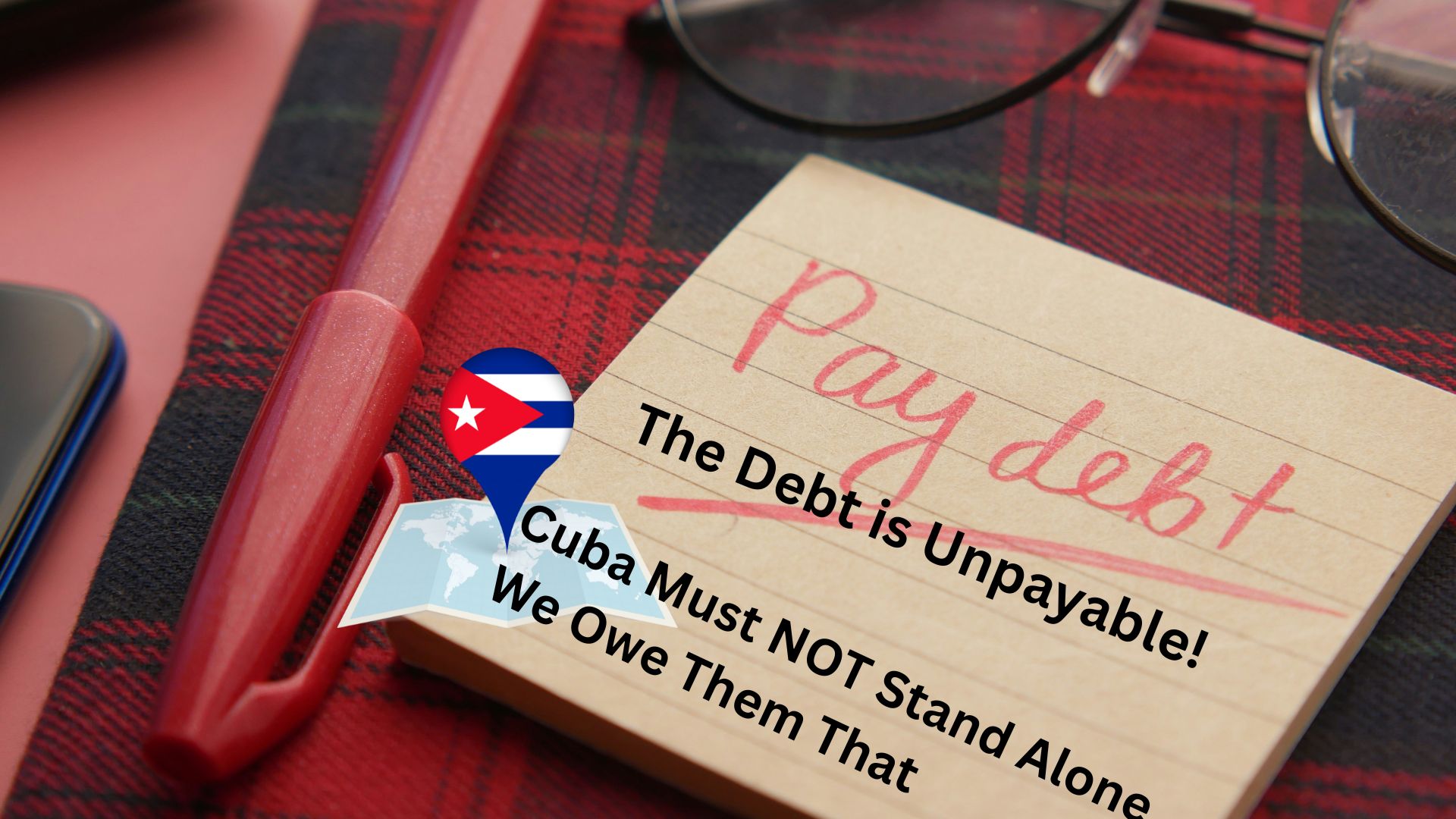
In a 2008 speech at The University of the West Indies, Girvan outlined the importance of post-revolution Cuba to the Caribbean and Africa
Following the abduction of Venezuelan President Nicolas Maduro and First Lady Cilia Flores, the United States has set its sights on Cuba, announcing a fuel embargo – on top of a brutal embargo more than six decades in the making – and threatening economic penalties on any country that sends oil to Cuba. The Mexican government has announced that it will be sending over 800 tons of humanitarian aid to Cuba. And the Caribbean? Shamefully missing in action. Here’s what’s being reported: Caribbean countries are quietly ending their medical partnerships with the Cuban government (Guyana was the most recent Caribbean country, according to the Stabroek News report yesterday). No reports of regional heads coming together to deliberate, strategise. There is a distinct sense that countries are being picked off one by sorry one. CARICOM feels like CARI-GONE.
On December 3, 2008, the late Jamaican economist Norman Girvan gave a remarkable speech at the Great Hall of the University of Havana on receipt of the degree of Doctor of Economic Sciences, Honoris Causa. We carry an excerpted version, to underscore what we owe Cuba, to urge us to consider what Caribbean unity and solidarity mean in these times, to remind us of Cuban José Martí’s call for “Nuestra América,” an anti-imperialist vision of hemispheric unity, independence and regional pride. In the midst of this vicious embargo and the unilateral bullying of any country that seeks to reach out, what does it mean to come to a sister country in need, one that has held so many of us up for so long – that is the question we should be asking, and the answer will tell us what kind of Caribbean people we are.
…I was a child of 12 when Fidel and his comrades stormed the Moncada Barracks. As teenagers, we would tune our radio dials to the Miami stations to get the latest in rock and roll. Sometimes we hit on Radio Rebelde, broadcast from the Sierra Maestra. Radio Rebelde was my introduction to the Cuban Revolution.
At the time of the Triumph of the Revolution I had just left High School and started my first job. The events of 1959—the trials of the criminals of the Batista dictatorship, the Urban Reform, the Land Reform—were followed with great interest and mounting excitement by my generation in Jamaica.
Our imagination was captured by the literacy programme by which young Cuban boys and girls left the cities to teach poor peasants in the countryside; learning as much or more from their host families as they were imparting to them.
I listened to the First Declaration of Havana during my first year at the University in Jamaica, courtesy of a recording of the address obtained by a fellow student. Fidel’s passionate denunciations of Yanqui imperialism—the profits of American corporations obtained at the price of undernourishment and infant mortality in Latin America—are still ringing in my ears.
The image of a million Cubans, assembled in one place as the National General Assembly of the People of Cuba, expressing their approval of the social and economic measures taken by the Revolution, and declaring their independence of foreign domination, was a transformative experience for me, a young man of eighteen. It helped to shape my view of the world.
Jamaica and the other West Indian territories were then preparing for national independence. The Cuban Revolution was a source of inspiration to many of us on the ability of a small Caribbean country to chart its own course of social justice, economic transformation, and national independence by relying on the mobilisation of the entire population, by relying on the will and energy of its people; with a leadership that trusted the mass of the population and refused to bow before threats, intimidation, economic punishment and counter-revolutionary violence from the greatest military power on the planet; just 140 kilometres from its shores…
During Playa Giron, I moved a resolution in the University Students Council condemning the shameless attempt to crush the Revolution by an illegal invasion launched from the territory of the United States. My collaborator in that Resolution was a young student from Guyana by the name of Walter Rodney. As you know Walter visited Cuba several times and was profoundly affected by the Revolution. You also know that he was victim of political assassination in 1980.
At the time of the Cuban Missile Crisis, I had just arrived in London to commence graduate studies. Some of us, like myself, were dismayed at the way in which Cuba had been drawn into a confrontation between the two super-powers, one that could end with a nuclear holocaust of global scale. Others argued that Cuba had no choice but to secure an alliance as a means of protecting its Revolution and its national sovereignty. The debate continues to this day.
In the late 1960s I was a member of the New World Group, founded by Lloyd Best…In a famous essay entitled “Independent Thought and Caribbean Freedom”, Lloyd Best argued that Cuba’s turn to the Soviet Union was a symptom of the failure of the rest of the Caribbean to provide moral, political and economic support for its struggle for self-determination.
In 1959-1960 Dr Eric Williams of Trinidad and Tobago was campaigning for the return of the Chaguaramas Naval Base from the United States to the Government of Trinidad, to be the site of the capital of the newly formed West Indies Federation. In the end Dr Williams made an agreement which left the US in control of the base. Lloyd Best argued that an historic opportunity had been missed for a linkage of anti-imperialist issues across the Caribbean, from Trinidad in the east to Cuba in the west; to forge an ‘integration of the regional consciousness’. He challenged us to:
“Consider what might have happened if the Government of Trinidad and Tobago had declared the (Chaguaramas) base nationalised, proclaim independence and joined Cuba in taking over the sugar industry. The colonial answer is to say that the marines would have come and that the other Caribbean governments would have sold out as they did in 1953 when the PPP ran into trouble in Guyana. But…Castro’s movement (and) the PNM … had struck their roots in a Caribbean consciousness and it would not have been easy to cut them down.
“And even if the marines had come. Would we not have fought them as the Cubans were in any case to do against their agents at the Bay of Pigs and the Constitutionalists, in Santo Domingo in 1965? How much territory could they have held if they had had the whole Caribbean roused against them? And even if they did hold territory – for a while – they would never have enjoyed any moral conquest and the satisfaction of seeing Cuba turn to another imperialism for support. And the Caribbean would have emerged from the struggle as morally and politically integrated as it has always been culturally...”
“If the opportunity was missed then, it was largely for lack of political experience. But the time will come again.”
The time will come again! That vision of a united and independent Caribbean was central to the motivation of the New World Group in the 1960s, a vision that was deeply rooted in the consciousness of a common history of colonialism and metropolitan rivalry, of the plantation system, of slavery and indentureship, of resistance and rebellion, of continuous assertion of an indomitable human spirit, of humanity in the face of brutality, of love of freedom and of life itself, of a Caribbean aesthetic permeated by a sense of the natural beauty of our islands and mainland, infused with the rhythms of our people and our music and our language, which are often so closely intertwined, and with their creative imagination.
And Cuba is an integral part of that Caribbean consciousness, of the Caribbean family.
I want to say that we in the Caribbean, especially those of my generation, will never forget the contribution made by Cuban men and women to the liberation of southern Africa from the scourge of apartheid.
I want to say that we will never forget—or we ought never to forget—the 70-odd young men and women of Cuba, Guyana and other countries who were taken to their deaths off the coast of Barbados in 1976, victims of one of the most heinous acts of terrorism in the history of our region.
I want to say that we will never forget the support provided by Cuba to the people of Grenada during their revolutionary process in 1979-1983; nor the unequivocal condemnation by Cuba of the murder of Maurice Bishop and several others when that process came to a tragic end, and the Cubans who gave their lives in the invasion that followed…
But the thing that stands out most of all, the quality that want to mention above all, is the internationalism of the Cuban people.
The Guyanese revolutionary Walter Rodney, whom I mentioned earlier, is reported to have said once that “West Indians live more in time and than in space”…
What did he mean by this? I believe he was saying that the West Indian sense of himself, of his place in the world, is governed more by a consciousness of the historical forces that have shaped us than by the geographical confines of our existence.
It cannot be an accident, for instance, that Marcus Mosiah Garvey, the first person from the English-speaking Caribbean to create an anti-imperialist mass movement, was a Pan-Africanist. His political organization took in most of the English speaking islands, with branches in Cuba, Central America and the Continental United States. Garvey lived more in time than in space.
He helped to inspire Mandela, Kenyatta and Nkrumah.
He was followed by outstanding Pan Africanists from our islands and mainland, like George Padmore, CLR James, Sylvester Williams and Walter Rodney.
People could not understand how Michael Manley, leader of a tiny nation of 2 million people, could have the audacity to campaign for a New International Economic Order.
Bob Marley called for “World Citizenship, and the Rule of International Morality”.
And Jose Marti spoke not only of ‘Nuestra America’. He proclaimed “Patria es Humanidad”—the Fatherland is Humanity—the message of welcome that greets visitors to Cuba arriving at the airport in Havana that bears his name…
And that sense of internationalism, dare I suggest, is a psychic bond between us as Caribbean people. And the practice of international solidarity that flows from it is the one I think of most, when I think of the Cuban Revolution.
In 1985 I attended a Conference here on the External Debt of Latin America and the Caribbean. Fidel proclaimed ‘La Deuda es Impagable’—‘The Debt is Unpayable’!
…I want to acknowledge to Cuba that la deuda es impagable.
But I do not mean the debt that is owed to the banks by the people of the Latin America and the Caribbean, and is measured in United States dollars. I mean the debt that is owed to the Cuban people by the rest of the Caribbean and indeed by all humanity, that is measured by their sacrifices and their solidarity and the unshakeable resolve of their leadership.
For the 185,000 Cuban medical personnel who have served in 103 countries in the last ten years alone, la deuda es impagable.
For the nearly 350 million visits carried out by Cuba’s Global Health Programmes in poor communities abroad in the past seven years, for the one million four hundred thousand lives that have been saved, and for the 327,000 persons who have had their sight restored under Operation Milagro, la deuda es impagable.
For the 2,451,000 persons in 13 countries who have learned to read and write through Cuban literacy programmes, la deuda es impagable.
For the 27,000 students from 120 countries studying in Cuba and for the thousands of scholarships granted the sons and daughters of the Caribbean to gain a higher education, la deuda es impagable.
For the 330,000 Cubans who served in Angola from 1975 to 1991, and for the blood of 2,000 of them who gave their lives in the struggle against the racist regime, and for the families whom they left behind, la deuda es impagable.
For doing all this, while withstanding an economic embargo for nearly half a century from the mightiest power on the planet, that cost an estimated $93 billion dollars, equivalent to 12 times the foreign debt of Cuba, for the material sacrifices and hardship you have endured, providing hope and inspiration to the rest of the world, la deuda es impagable.
For invoking the immortal words of your National Hero Jose Marti, that ‘Patria es Humanidad’, and for living it, day by day, month by month, year by year and decade by decade, la deuda es impagable.
For giving universal meaning to the ‘Patria’ in the pledge, ‘Patria or Muerte, Venceremos!’, la deuda es impagable.
Norman P. Girvan (28 June 1941 – 9 April 2014) was a Jamaican professor at the University of the West Indies and Secretary General of the Association of Caribbean States between 2000 and 2004. He was a member of the United Nations Committee on Development Policy from 2009-2014, and in 2010 was appointed the UN Secretary-General Ban Ki-moon's personal representative on the Guyana-Venezuela border controversy.
* The article was first published on Stabroek News