



Haiti and Cuba in Global Pan African Liberation and the Struggle Against Imperialism

Address on May 24, 2026, delivered at the African Liberation Day celebration in Barbados, themed Haiti & Cuba: Defending Pan-African Unity Against Imperialism, and organized by the Global Pan African Movement in association with the Ministry of Pan African Affairs and Heritage of Barbados.
Chair; Honourable Trevor Prescod, Minister of Pan African Affairs and Heritage; former Minister of Culture; Ambassador David Comissiong, Ambassador of the Republic of Cuba, Yanet Stable Cardenas; Ambassador of the Bolivarian Republic of Venezuela, Martha Ortega; distinguished discussants; sisters and brothers who are here with us in person and online; members of the media.
A very good afternoon! Firstly, I would like to sincerely thank the Global Pan African Movement and Brothers Mwalimu Horace Campbell, Tennyson Joseph and Rodney Worrell for their kind invitation to me to deliver this address. I have known Mwalimu Horace for many decades since the mid 1970’s – he was a young lecturer in the Department of Government at The University of the West Indies, St. Augustine and I, a student leader and emerging political activist - Tennyson and Rodney for not as long. But they honour me with their invitation. Secondly, and not less important than the first, I wish to thank the Minister of Pan African Affairs and Heritage, Honourable Trevor Prescod and his staff, especially Sister Renee Best, for facilitating my presence in Barbados and for the excellent arrangements for my stay. I have known Trevor since 1992 when he, David Comissiong and David Denny came to Trinidad for the Preparatory Conference that led to the formation of the Assembly of Caribbean People. Our friendship and collaboration since then have not wavered.
The theme of today’s African Liberation Day’s rally is very appropriately “Haiti and Cuba in Global Pan African Liberation and the Struggle Against Imperialism” which centres the Caribbean in the struggle against imperialism. Why appropriately? For two reasons which I will focus on in this address. Firstly, the history of the Caribbean in global Pan African Liberation and the struggle against imperialism; and secondly the current conjuncture in which what happens in Cuba and Haiti will impact on, if not determine, global developments.
The history I’m sure that everyone here is very familiar with, so I will not go into details, but instead will lay down some markers.
But before I do that, we must reflect on the significance of the last few days. May 19th was the 101st anniversary of Malcom’s birth. Not only is this of significance because of his role in the global Pan African Movement and the struggle against imperialism but because of his Caribbean roots. Malcom’s mother – Louise Langdon Little was born in the village of La Digue, Grenada and was a very active member of the Universal Negro Improvement Association (UNIA) from her early 20’s after she moved to Canada and then for a number of years in the United States when she and her family moved there.
In an act of absolute cynicism, the Trump regime, on May 20th announced that it had indicted Army General Raul Castro, a historic leader of the Cuban Revolution and former President of the Republic of Cuba. Why was this cynical? Because May 20th is the date on which under US military occupation, the US installed a President of the Republic. Rubio’s speech on May 20th was in keeping with US imperialism’s desire to restore its control over Cuba, control which it hasn’t had since the Cuban Revolution of January 1st, 1959. He has demonstrated the arrogance of imperialism. I also understand that in Cuba if you want to say something is bad you use the phrase – Veinte de Mayo! But Rubio is ignorant of the views and beliefs of the Cuban people. What of Cuba does Rubio know, when he only knows Miami!
I also need to invoke the ancestors, as my friend Brother Rawle Gibbons encouraged me to do with his message to me this morning. There are many worthy ancestors of course, but I invoke the spirit of CLR “Nello” James, who I had the honour to know. Who better than CLR James to establish the historical markers given him being a West Indian, his own role in the global Pan African Struggle, his unique theoretical insights and the sheer breadth of his writings which he left for us. The Appendix of CLR’s 1963 republished seminal work “The Black Jacobins” is entitled “From Toussaint L’Ouverture to Fidel Castro”. Note the difference from Williams who wrote a major book “From Columbus to Castro”. CLR was always focused on the revolutionary movements of the people. In explaining the Appendix, CLR wrote this in the Preface “The Appendix, “From Toussaint L’Ouverture to Fidel Castro”, attempts for the future of the West Indies, all of them, what was done for Africa in 1938. Writers on the West Indies always relate them to their approximation to Britain, France, Spain and America, that is to say, to Western civilisation, never in relation to their own history.”[1]
Then CLR makes this simple but penetrating analysis:
“Castro’s revolution is of the twentieth century as much as Toussaint’s was of the eighteenth. But despite the distance of over a century and a half, both are West Indian. The people who made them, the problems and the attempts to solve them, are peculiarly West Indian, the product of a peculiar origin and a peculiar history. West Indians first became aware of themselves as a people in the Haitian Revolution. Whatever its ultimate fate, the Cuban Revolution marks the ultimate stage of a Caribbean quest for national identity. In a scattered series of disparate islands, the process consists of a series of spurts, leaps and catastrophes. But the inherent movement is clear and strong.”[2]
Chair, I want us to remember this. This is the key to our understanding of where we are today: the link between Haiti and Cuba in establishing who we are and what our identity is and why US imperialism, in particular, supported by other colonial powers are doing their damndest to destroy all that these Revolutions have meant and mean.
But what of global pan African Liberation? I’m going to rely again on “Nello” who can speak first hand to the role of the Caribbean in the global Pan African struggle for liberation. His Appendix is really a must read - almost as important as the Black Jacobins itself.
“Today (remember this is being written in 1963) the emancipation of Africa is one of the outstanding events of contemporary history. Between the wars (1st and 2nd WW) when this emancipation was being prepared, the unquestioned leaders of the movement in every public sphere, in Africa itself, in Europe and in the United States, were not Africans but West Indians. First the unquestioned facts. Two Black West Indians using the ink of Negritude wrote their names imperishably on the front pages of the history of our time. Standing at the head is Marcus Garvey”[3]
We know of Garvey’s UNIA. We know the connection between the UNIA and Malcolm. But James relates an interesting story. He says “Garvey’s voice reverberated inside Africa itself…Jomo Kenyatta has related to this writer how in 1921 Kenya nationalists, unable to read, would gather round a reader of Garvey’s newspaper, the Negro World, and listen to an article two or three times. Then they would run various ways through the forest, carefully to repeat the whole, which they had memorised, to Africans hungry for some doctrine that lifted them from the servile consciousness in which Africans lived”.
The second person who James referred to was the Trinidadian George Padmore and cites the unique work of the African Bureau led by Padmore and which also published a journal which James edited. The historic and, many agree, the most impactful Pan African Congress was the Fifth, organised primarily by Padmore, and which was held in 1945 in Manchester, England. That Congress set out the agenda and the tasks for ending colonialism. We know that Nkrumah and Kenyatta participated in that Congress but what is often not mentioned is that there were many West Indian trade union leaders who also participated, including John Rojas, the then President General of the Oilfields Workers’ Trade Union, as they were returning from a Conference of the World Federation of Trade Unions.
James then refers to Aime Cesaire of Martinique. To all these, we have to add:
-
CLR James himself
-
Henry Sylvester Williams who organised the First Pan African Conference in 1901
-
Frantz Fanon of Martinique
-
Any number of West Indians – Ulric Cross, Dudley Thompson, George Busby to name but a few – who went to Africa to work and contribute to the anti-colonial struggle
-
And the later generation: Kwame Ture and Walter Rodney who were political activists and, in the case of Walter an important teacher of the liberation movements
The relationship between the West Indies and Africa was defined this way by James: “The first step to freedom was to go abroad. Before they could begin to see themselves as a free and independent people they had to clear from their minds the stigma that anything African was inherently inferior and degraded. The road to national identity lay through Africa”. And West Indians contributed in this dialectical way to the liberation of Africa.
CLR says that Cuba is West Indian. Today we would say Caribbean as James and his generation defined themselves as West Indian. It is therefore no accident that Cuba would undertake a defining intervention in the liberation of Africa. That intervention began with Che in the early 1960’s when he went to Africa. Che’s African Diaries reveal the extent to which Cuba was committed to support the struggle against colonialism and imperialism in Africa. He engaged with Nyerere and with the progressive movements in the southern African region. Africa was at a critical moment: Ghana had won its independence in 1957 but Nkrumah was under attack from the reactionary elements and imperialism; Lumumba had been assassinated and the Belgians firmly re-establishing imperialist control in the Congo. In southern Africa, Angola and Mozambique (and Guinea-Bissau) were under Portuguese colonialism; Zimbabwe was a British colony; and of course apartheid South Africa was the colonial power of Namibia while internally in South Africa the apartheid regime had increased its vicious repression. This reality was an affront to Cuba as a sovereign West Indian nation, now pursuing a revolutionary path.
The historic First Tricontinental in Havana in January 1966 was held shortly after Che went to Africa. At that Conference Amilcar Cabral of Guinea-Bissau, one of Africa’s greatest revolutionary leaders gave an address that we know as “The Weapon of Theory”[4] which gave us a foundational approach to applying a dialectical and historical materialist analysis for non-European societies. Interestingly, just as John Rojas as President General of the OWTU had attended the 1945 5th Pan African Congress, his successor George Weekes attended the First Tricontinental Conference in Havana in 1966.
The West Indies was again centrally involved in global Pan African liberation and the struggle against imperialism! So we ought not to have been surprised that Cuba under Fidel’s leadership decided to intervene militarily in southern Africa a decade later. And let’s not make any mistake about this. Cuba acted as a revolutionary Caribbean nation, as a people who had fought not one but several wars for their independence and sovereignty. Contrary to western imperialist narrative, Cuba was not a proxy for the Soviet Union. In fact, the leadership of the USSR had no prior knowledge of Cuba’s decision to send troops to fight in Angola. Cuba acted on the basis that the defence of Angola’s independence and the ending of colonialism in Africa and apartheid in South Africa was not simply a revolutionary duty and act of solidarity but an affirmation of Cuba’s own struggles against colonialism and the history of the resulting genocide of the First Peoples, the enslavement of Africans and the exploitation by imperialism. Cuba was given logistical support for their military intervention by two CARICOM nations – Guyana and Barbados – which facilitated their planes’ refueling. Trinidad and Tobago did not support this.
But Cuba’s support for global Pan African liberation is not measured only by its military intervention when it defeated the South African army in the famous battle of Cuito Cuanavale[5]. And here, it would be remiss of me not to state that while Fidel, as Commander in Chief, even though he was in Havana, gave leadership to the Cuban troops in that battle; Raul was the Army General. So when the US indicts him, what they are in fact doing is to attack Cuba’s role in global Pan African Liberation!
Cuba’s contribution to global Pan African liberation must also be measured by the thousands of scholarships provided by Cuba to the African liberation movements and governments so that the massive educational, technical and professional deficits that resulted from the systemic exclusion of Africans from tertiary education by colonial and apartheid policies could be overcome. Cuba’s contribution to the development of Africa’s human resources was vital in enabling the post-colonial process of liberation to be undertaken. This contribution has also been evidenced throughout the Caribbean. This is Pan African solidarity!
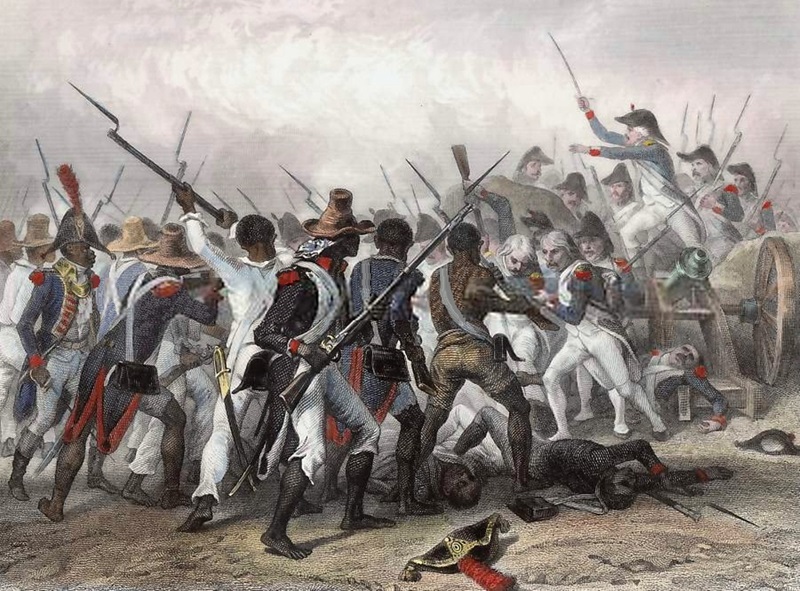
And what of Haiti? There is no doubting the significance of the Haitian Revolution. Persons who were enslaved and treated in the most inhumane way possible, subjected to being defined as chattel, as less than human, then organised themselves and defeated the three most powerful imperialist countries in the world – France, Spain and Britain; ended enslavement and won their independence. I’m not sure if today’s generation comprehends the magnitude of the Haitian Revolution. It’s as if today there is a country that is controlled by a foreign power and its people subjugated, but then defeats the US, Britain and France. The closest that we have come to see this was perhaps the Vietnamese in the 60’s and 70’s and Afghanistan more recently.
The Haitian Revolution was important because, as James told us “West Indians first became aware of themselves as a people in the Haitian Revolution”. But it has been important to global Pan African liberation for other reasons as well. Firstly, the newly independent nation of Haiti then contributed in a very tangible way to the liberation of Latin America from colonialism. Simon Bolivar, the Great Liberator, had suffered defeats in his war against Spain. He found sanctuary in Haiti. This was not only for his personal recovery but also to enable him to regroup. Haiti provided troops, arms, finance and a printing press: all of these enabled Bolivar to re-engage the colonial power of Spain and its local allies, eventually defeat it and usher in the independence of what we now call – Colombia (which then included what we know as Panama), Venezuela, Bolivia, Ecuador and Peru. Central to Haiti’s support were two issues: Haiti’s own history of fighting against colonial powers, Spain included; and secondly their experience of slavery. Haiti’s support for Bolivar was conditional on his agreement to end enslavement on winning independence. This was done and so Haiti, in the infancy of its nationhood, understood it had a Pan African duty.
But this is not the only contribution of Haiti to Pan African liberation. It is manifest in the life of the Haitian people: their culture; their religion; their language; their system of peasant agriculture; the existence of micro-businesses; and, of course in their fierce pride in being Haitian, pride not born of arrogance of power but rooted in their knowledge of the Haitian Revolution. It is about self-hood, of self-emancipation, of being the only people to have ended their enslavement by defeating the enslavers and removing them from the territory. It is about identity.
This is why there has been a relentless process of counterrevolution waged by imperialism against the Haitian Revolution. This counter-revolution has been waged on many levels and fronts, some of which are:
-
Economic: the hundreds of billions of dollars (in today’s currency) that France extorted from the newly independent Haiti to pay for it daring to end colonial rule and the enslavement of Africans; the extraction of resources and wealth by US multinational companies and the exploitation of Haitian workers; the forceful change to the system of peasant agriculture that resulted in Haiti having a significant security of food for its people to one today of being dependent on imports and so-called “food aid”; the imposition of neo-liberal policies that made Haiti more dependent on foreign capital and which increased its debt
-
Political: the constant destabilisation and frustration of the Haitian people’s political will through coup d’etats; dictatorships; US and foreign military occupation; the funding and arming of criminal gangs;
-
Cultural/information: constant peddling of the narrative that Haiti is a poor country, when it is in fact wealthy; that Haitians are backward; that Haiti is a failed state – all to discredit the position that Haitian independence was a huge victory and that black people – Africans are inferior and incapable of creating a modern civilisation.
Chair, I return now to CLR’s treatise: “West Indians first became aware of themselves as a people in the Haitian Revolution. Whatever its ultimate fate, the Cuban Revolution marks the ultimate stage of a Caribbean quest for national identity.”
US imperialism is hell bent on reversing all the gains of the struggle against colonialism. It wants to ensure that we no longer are aware of who we are as a people; they want to ensure that there is no longer a national identity. Rubio said it explicitly when he spoke at the recent Munich Security Conference. He boldfacedly stated:
“But in 1945, for the first time since the age of Columbus, it was contracting. Europe was in ruins. Half of it lived behind an Iron Curtain and the rest looked like it would soon follow. The great Western empires had entered into terminal decline, accelerated by godless communist revolutions and by anti-colonial uprisings that would transform the world and drape the red hammer and sickle across vast swaths of the map in the years to come.”[6]
Anti-colonial uprisings! And how was the United States formed 250 years ago? By an anti-colonial uprising! But we in the global south and in the Global Pan African world should not have fought for our liberation from colonialism! How does Rubio and the right wing in the US and Europe justify this monstrous denial of our humanity? Again read his speech at Munich.
“For the United States and Europe, we belong together. America was founded 250 years ago, but the roots began here on this continent long before. The man who settled and built the nation of my birth arrived on our shores carrying the memories and the traditions and the Christian faith of their ancestors as a sacred inheritance, an unbreakable link between the old world and the new.
We are part of one civilization – Western civilization. We are bound to one another by the deepest bonds that nations could share, forged by centuries of shared history, Christian faith, culture, heritage, language, ancestry, and the sacrifices our forefathers made together for the common civilization to which we have fallen heir.. It was here in Europe where the ideas that planted the seeds of liberty that changed the world were born. It was here in Europe where the world – which gave the world the rule of law, the universities, and the scientific revolution. It was this continent that produced the genius of Mozart and Beethoven, of Dante and Shakespeare, of Michelangelo and Da Vinci, of the Beatles and the Rolling Stones. And this is the place where the vaulted ceilings of the Sistine Chapel and the towering spires of the great cathedral in Cologne, they testify not just to the greatness of our past or to a faith in God that inspired these marvels…”[7]
Do you understand the rewrite of history? European civilization is not the only civilization. And it is not the oldest! Mathematics and science were in Asia, Persia, Africa long before Europe. In fact, Europe got science from other civilizations! The pyramids of Egypt, the Temples of the Incas were built long before Europeans knew about engineering.
And Rubio said not a word about how Europe and the US became wealthy from the transatlantic slave trade and the enslavement of Africans to produce sugar, cotton and other commodities. Not a word about how Europe developed by under-developing Africa. And how the US exploited the Open Veins of Latin America. Not a word about how the European settlers – all goodly Christian people according to Rubio – engaged in the genocide of the First Peoples and the seizure of their lands. No, all of that wealth was created by the sweat of hard-working Europeans all by themselves! Such are the lies of the imperialists today. But I need not say more. My point has been made.
There is a new thrust by imperialism today. It is not just about having its multinational companies operate in the global South to make profits by exploiting our resources and labour. It is about destroying anything that stands in opposition to this false idea of western civilization. Here Rubio again:
“we embraced a dogmatic vision of free and unfettered trade, even as some nations protected their economies and subsidized their companies to systematically undercut ours – shuttering our plants, resulting in large parts of our societies being deindustrialized, shipping millions of working and middle-class jobs overseas, and handing control of our critical supply chains to both adversaries and rivals.”[8]
That free trade was not to our benefit in the global South. The neo-liberal capitalist policies that Rubio criticized enriched the global North, created multi-billionaires, and the greatest income and wealth inequality in the last 100 plus years. Just look at the stock markets of the world and read all the studies about how neo-liberal globalization is about greed and the concentration of wealth and power in fewer and fewer hands. But this is not enough for Rubio. He and others in the think tanks like the Heritage Foundation which came up with Project 2025 want to reshape the world in their own image and likeness. This is partly driven by the challenges to US hegemony by the rise of China as an economic and technological power and to developments like the BRICS. The US fears a multipolar world.
It is about creating a unipolar world in which only the “values” of so-called western civilization exist. This is no different in reality from Nazi Germany and the objective of creating a Europe controlled by the Aryan race. That is why this agenda by Trump and Rubio is racist and fascist. They go hand in hand. They have to appeal to racial superiority in order to control their white base. This explains the issue of redistricting. And don’t forget that two of the richest men in the US – Elon Musk and Peter Thiel are white South Africans. The right-wing fascists have to demonise others – especially Africans – in order to whip up support. That is why the anti-immigrant policies predominate whether in MAGA US, Reform UK or in Germany, France or Austria, where the extreme right is gaining ground.
That is why Trump says Haiti and other African nations are shit-hole countries; why Vance can campaign saying that Haitians eat pets; why Somalians are demonized; why Trump said that white South Africans are being killed and tried to demonstrate that President Ramaphosa is a failed leader; why he sent in troops to Nigeria to stop Christians from being massacred. Of course, all of these are lies. But as Goebbels[9] said – tell a lie many times and it becomes the truth.
And today the lies are:
-
Cuba is a failed state, a failed country
-
Haiti is a failed state, a shithole country.
These lies are to justify US imperialist intervention. In this false narrative, you will hear nothing about the facts - that the more than 60-year-old blockade that has been strangling Cuba is the real cause of Cuba’s economic crisis and the huge problems that it has to maintain its health and education systems, among other services to its people; that the criminal blockade of fuel has created an unprecedented humanitarian crisis.
We have to consistently counter the lies of imperialism. The attack on Venezuela was never about narco-trafficking. It was to get control of Venezuela’s oil and to stop Venezuela from providing oil to Cuba. Cuba was always the primary target. The US agenda for this region is explicitly stated in its National Security Strategy. I quote – “one objective of which is to “restore American pre-eminence in the Western Hemisphere… We will deny non-Hemispheric competitors the ability to position forces or other threatening capabilities, or to own or control strategically vital assets, in our Hemisphere…This ‘Trump Corollary’ to the Monroe Doctrine is a common-sense and potent restoration of American power and priorities.”[10]
And we have to be clear about what has been and still is the intention of the blockade against Cuba. In the words of the 1960 Memorandum by the Deputy Assistant Secretary of State, Lester Mallory, “The only foreseeable means of alienating internal support (from the government) is through disenchantment and disaffection based on economic dissatisfaction and hardship (…) every possible means should be undertaken promptly to weaken the economic life (…) denying money and supplies to Cuba to decrease monetary and real wages, to bring about hunger, desperation and overthrow of government.”[11]
Cuba and Haiti have to be destroyed because once Haiti remains a nation with a proud people capable of resisting foreign military occupation and fighting for its independence; once Cuba remains a nation that is sovereign in every respect, then Global Pan Liberation is assured and the struggle against imperialism will again be on the move.
Here’s CLR again to guide us and to give us hope, even in what seems to be a very dangerous moment. And, make no mistake about it, we are in a very dangerous moment. Cuba is facing the greatest threat to its Revolution. James said “In a scattered series of disparate islands the process consists of a series of spurts, leaps and catastrophes. But the inherent movement is clear and strong”.
I believe that there are positives. Globally, there has been an awakening of consciousness, especially and most importantly among young people. This has been around international solidarity with:
-
the Palestinian people and against the genocide in Gaza and the apartheid policies in the Occupied West Bank by the Zionist state and this is continuing as for example with the flotillas;
-
Venezuela and against the military attack on Venezuela and the kidnapping of President Maduro and First Combatant Celia Flores;
-
The countries of the Sahel – Burkina Faso, Mali and Niger – as they engage in militant decolonisation; and now
-
With Cuba and against US imperialism
And these were preceded by the Black Lives Matter Movement and now ongoing struggles against racism and fascism in the US – the No Kings Movement; the anti-Ice protests.
Here in the Caribbean, I have seen, at least in Trinidad and Tobago, a rise in consciousness among sections of the youth. They are coming forward to engage in progressive activities. And the reality of seeing US destroyers docked in our port and a radar installed in Tobago has enabled us to once again express issues in terms of imperialism as this is not an abstract concept. It is real, in your face.
We therefore have to seize this moment to build movements. The truth is that the progressive movements that we had in the past – be they political or social movements either do not exist or are much weaker now. It is not enough to issue statements. Those have to lead to doing the work of raising consciousness and building organisations that are strong enough to confront the right wing. Political education is where we must begin. This is how we can do our part to avert the catastrophe that we face from imperialism today.
Let me now turn to another Ancestor, Fidel. In his 1999 Lecture entitled “A Revolution can only be born from culture and ideas” delivered in Caracas following the electoral victory of Commandante Chavez, Fidel offered this wisdom: “However, it (imperialism) was unable to defeat a united people, a people armed only with ideas, a people endowed with great political consciousness because that is most important for us. We have resisted everything and are ready to continue resisting for as long as need be thanks to the seeds planted throughout those decades, thanks to the ideas and the consciousness developed during that time…And trenches of ideas – forgive me for quoting Marti again – are worth, as he said, more than trenches of stones.”[12]
So we have to build trenches of ideas because we will never have the same military capacity as that possessed by imperialism. Fidel went on to state “Today, there is not one particular people to liberate. Today there is not one particular people to save. Today, a whole world, all of mankind needs to be liberated and saved. And it is not our task, it is your task.”[13]
Cuba has indeed done more than its revolutionary duty in the process of global Pan African liberation. It is now our task today to engage in concrete solidarity with Cuba and so contribute what we can to ensure that Cuba’s revolution is not defeated by imperialism. CLR in 1963 opined “What will happen to what Fidel Castro has brought new to the world no one can say”. We can say today what Fidel brought to the world – and that is the value of humanity above profit and greed; the value of solidarity; and, of course, a commitment to the struggle for social justice, global Pan African liberation and against imperialism.
We therefore have a duty to defend Cuba! To defend Haiti! We must say with a loud voice: US imperialism - Hands off Raul! No military attack against Cuba! End the Criminal and Illegal Blockade against Cuba.
Cuba Is Not Alone! Let us therefore go Forward Ever and Backward Never! Thank you!
David Abdulah is a Trinidad and Tobago trade unionist, economist and politician. He served as the General Secretary of the Oilfields Workers' Trade Union (OWTU), and is the current leader of the Movement for Social Justice (MSJ). He also served as president of the Federation of Independent Trade Unions and Non-Governmental Organisations (FITUN).
Endnotes
[1]James, C. L. R. 1963. The Black Jacobins : Toussaint L’Ouverture and the San Domingo Revolution. 2d ed., rev. Vintage Books.
[2] Ibid
[3] Ibid
[4]Cabral, A. (1966, January). The weapon of theory. In Address delivered to the first Tricontinental Conference of the Peoples of Asia, Africa and Latin America held in Havana in January. https://marxistnkrumaistforum.wordpress.com/wp-content/uploads/2013/12/amilcar-cabral-the-weapon-of-theory.pdf
[5]Campbell, H. (1989). The military defeat of the South Africans in Angola. Monthly Review, 40(11), 1-16.
[6] Rubio, M. (2026, February 14). Secretary of State Marco Rubio at the Munich Security Conference [Remarks]. U.S. Department of State. https://www.state.gov/releases/office-of-the-spokesperson/2026/02/secretary-of-state-marco-rubio-at-the-munich-security-conference
[7] Ibid
[8] Ibid
[9]Paul Joseph Goebbels was a German politician that became the Reich Minister of Propaganda for the Nazi Party.
[10] The White House. (2025, December 4). National Security Strategy of the United States of America. https://www.whitehouse.gov/wp-content/uploads/2025/12/2025-National-Security-Strategy.pdf
[11] Mallory, Lestor. (1960, April 6). The decline and fall of Castro [Memorandum, Document 27400]. U.S. Department of State. National Security Archive, George Washington University. https://nsarchive.gwu.edu/document/27400-document-1-state-department-memorandum-decline-and-fall-castro-secret-april-6-1960
[12] Castro Ruz, Fidel. (1999, February 3). A revolution can only be born from culture and ideas [Master lecture, Central University of Venezuela]. Cuban Government Official Website. http://www.cuba.cu/gobierno/discursos/1999/ing/f030299i.html
[13] Ibid