



Between Translation and Resistance: Frantz Fanon’s Psychiatric Writings and Decolonization
Focusing on his psychiatric writings and Wretched of the Earth, the article illuminates Fanon’s revolutionary methodology relevant to contemporary decolonization processes of knowledge production in psychiatry and beyond.
The recent publication of previously unpublished psychiatric writings of Frantz Fanon has attracted significant attention[1] and brought to reconsideration the theoretical foundation of his oeuvre in the light of his uninterrupted medical practice.[2] These writings add to Black Skin and White Masks, a self-proclaimed clinical study, the last, ‘psychiatric’, chapter of the Wretched of the Earth[3] and a chapter on medicine and colonialism in A Dying Colonialism. [4] It is in these writings that we find key methodological insights that are central not simply to the decolonization of modern psychiatry, but also to broader decolonization processes. These writings present two modalities of opening to alternative forms of medical knowledge production, and knowledge more generally: the first one, emerging from his reflections on diagnostic and therapeutic practices in Algeria, is a form of non-assimilatory translation that employs an interdisciplinary method to read and understand mental illness. The second one, displayed in the last chapter of the Wretched of the Earth, is a form of resistance to the validity of dominant psychiatry. Traversing both is a question of imagination as key to the decolonization of colonial models, but also the predicament of being caught in cultural systems influencing each other, albeit unequally.
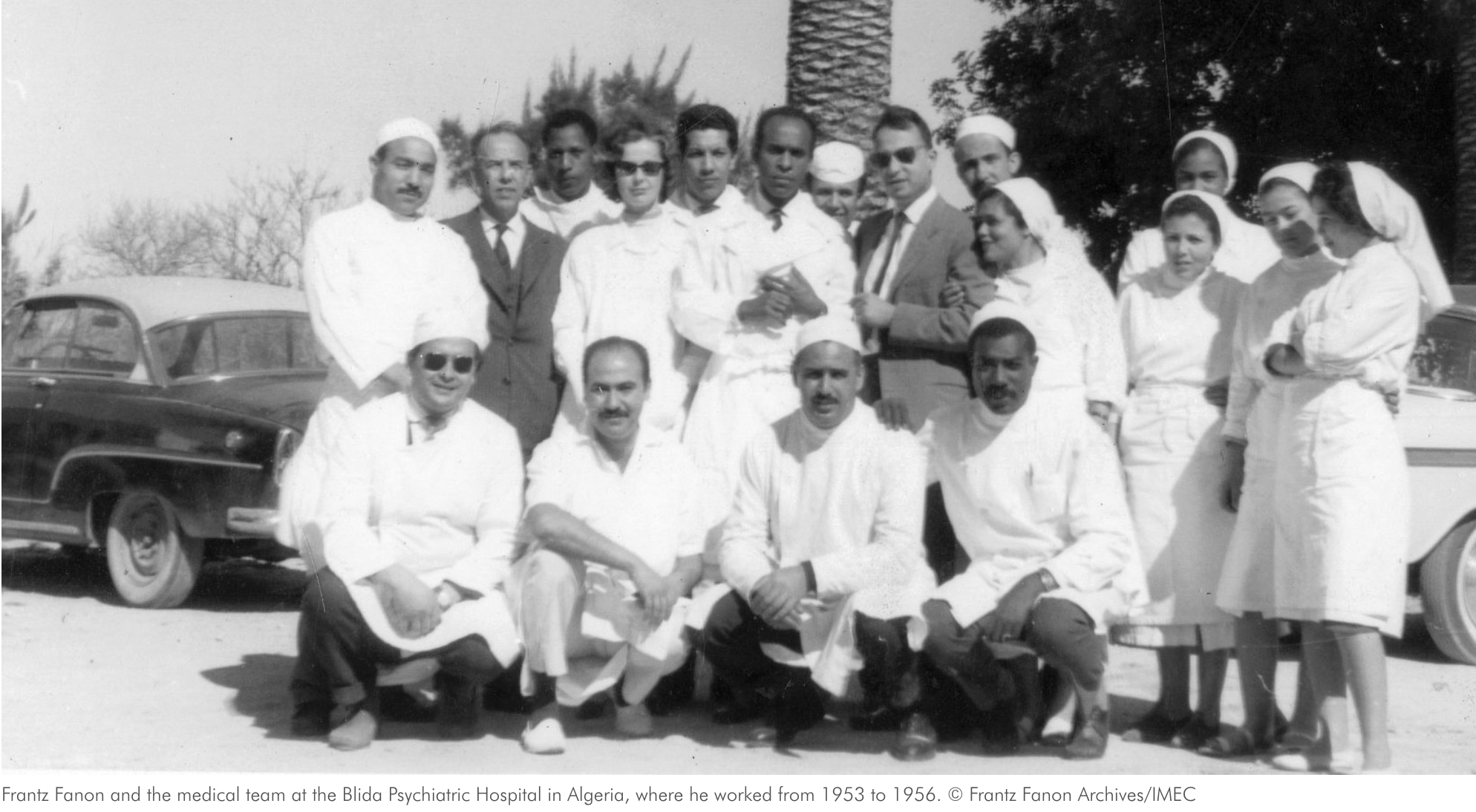
As recent publications have highlighted, Fanon operated in North Africa, mostly Algeria, between the 1950s and 1960s, heading the Psychiatric Hospital at Blida between 1953 and 1956 until his resignation in 1957, when he moved to Tunis.[5] It is in this period that, and in collaboration with junior colleagues, he produced short reflective pieces on a variety of issues. Of particular relevance are his methodological considerations with regard to medical interpretation and the possibilities of disalienation in colonial contexts. His starting point of analysis is an understanding of the colonial situation. For him, colonialism is an individual and socially alienating phenomenon producing an “absolute depersonalization”, with madness becoming a means through which individuals lose their freedom.[6] A key contributor to this process of alienation is modern colonial psychiatry, particularly the Ethnopsychiatry practiced by the Algiers School of Psychiatry and the works of Antoine Porot in North Africa, and further adopted by Carothers in Global Africa. For Fanon, the problem with Ethnopsychiatry is both cultural and methodological. [7] Informed by racial assumptions that informs views of Africans as primitives and criminals and as affected by mental retardation allegedly evidenced by neurophysiological differences, Ethnopsychiatry proceeds through a bio-medical framework of assimilatory translation grounded on an alleged scientific certainty and neutrality. Through a “policy of assimilation”, this model forcefully translates into a racialized framework different manifestations of mental health issues of culturally diverse colonised subjects. The issue with this approach, which affects also in part the social therapy Fanon practiced at Blida,[8] is not simply that because it relies on and imposes the “supremacy of Western culture”, it “does not presuppose a reciprocity of perspective” so that it “is up to one entire culture to disappear in favour of another.[9] It is also that it separates the object of analysis, the colonized subject, from her context, thereby proceeding by abstracting the patient from her cultural background on the one hand, and the cultural context of medical theory and practice, on the other.[10]
In opposition to this model, Fanon mobilises the significance of his clinical observations about the nature of mental illness, namely it taking different historical forms and being shaped by the broader context – political, material and cultural – of its occurrence. Concurrently, and proceeding from a perspective inspired by cultural reciprocity, he calls for a revolutionary method that enables the grasping of the “totality” of the social reality studied. Fanon calls this method “transmutation”, as a sort of methodological “leap” “from the biological level to the institutional one, from natural existence to cultural existence”.[11]
So framed, transmutation can be understood as a form of creative translation, a movement across (from the Latin trans, across, and latus, carried) different disciplinary fields, while changing (mutation) the attitude towards the hierarchical relation between cultures and towards the relevant analytics of medical interpretation.[12] Taking distance from the primacy of biology, this shift opens psychiatric interpretation to history, culture and society. This is what Fanon himself practiced at Blida, integrating medical theory with ethnography, sociology and political economy, to investigate issues such as land dispossession, politics, religion and ethnicity affecting Algerian patients.[13]
When conceived as a form of translation, transmutation appears in all its decolonizing potential. By adopting interdisciplinary, culturally and historically sensible analytical lenses, transmutation challenges the abstract method and colonial division of knowledge into disciplines that can only partially attend to the totality of the object of investigation. Further, by proceeding from the epistemic equality of all cultures, it maintains a critical vigilance about the role cultural presuppositions play in modern (medical) epistemology, despite its hegemonic representation as scientific and neutral.
If, in the writings at Blida, Fanon advocates for transmutation as a form of translation, in the last chapter of the Wretched of the Earth entitled “Colonial Wars and Mental Disorders” he proceeds somehow differently. As if interrupting the social analysis of violence and the possibilities of decolonisation of the preceding chapters, Fanon presents “notes on psychiatry” through which he reflects on the mental and somatic scars of colonial violence, but also on medical interpretation. He does so through the exposition of cases that focus on both individuals and groups displaying such clinical symptoms as aggressive and violent behaviours, major depression, paranoid delusions, anxiety, anorexia and psychosomatic disorders, among others.[14] Though using technical psychiatric language and focusing on psychiatry, these notes take a certain distance from it, particularly the pathologizing impetus of Ethnopsychiatry. As Fanon says, “our approach here is not that of a scientific work, and we have avoided any semiological, nosological, or therapeutic discussion. The technical few terms used here are solely meant as a point of reference”.[15] Further, while staying within the search of a “triggering factor” as in traditional psychiatry, the notes resist looking for precise organic causes or offering a diagnosis. Instead, they generally identify the triggering function performed by the colonial “atmosphere, the generalisation of inhuman practices” occurring in Algeria as the “triggering factor” and limit themselves to reconstruct stories, while invoking the imagination to support alternative reading of patients’s symptoms that would respect their context and the historicity of mental illness. [16]
This approach has been interpreted as a refusal of modern psychiatry.[17] Yet, it might be more prudently read as a form of resisting the validity of psychiatry’s epistemology while working at its margins through non-assimilatory forms of intercultural interpretation and thus translation that do not take Western medical concepts as paradigmatic. Indeed, this approach resonates with the principles animating transmutation: attention for the specificity of the object investigated in its own context, an appeal to the imagination and the rejection of inequality of cultures that would legitimize medical policies of assimilation. Like transmutation as translation, the approach is an attempt that leaps but does not fully break from colonial models. Indeed, Fanon acknowledges the dependence, however instrumental, of his notes to the inadequate terms of psychiatry and the importance of the “liberation struggle’s rehabilitation of man”, which he had considered in previous chapters of the Wretched of the Earth as illusory, if thought in total break from modern forms.[18] The importance of this suspension and the appeal to the imagination rests both on an act of self-critical awareness and vigilance about the terrain from which one proceeds, what Valentine Mudimbe has called the colonial library - which does not however need to be seen as totalizing but only all-encompassing - and on the attempt to break with its universal applicability, in view offering novel understandings.
While in tension, these two methodological responses to medical interpretation do not need to be mutually exclusive, nor pointing to an unequivocal evolution of Fanon’s thought. Granted that in his writings at Blida and in his reflection on medicine and colonialism Fanon affirms a certain superiority of Western medical understanding,[19] and in the last chapter of the Wretched of the Earth, he questions that very superiority, there is a sense in which the possibility to break with the colonial library is both grounded in its general necessity and its alleged concrete impossibility, given the contamination and inequality between colonial models and colonized cultures in both colonial and postcolonial contexts. What remains of critical value for decolonization of psychiatric knowledge and decolonization processes more generally, however, is that both approaches center questions of epistemic sovereignty and cultural relevance in the understanding and articulation of objects of analysis. Additionally, they affirm the irreducibility and methodological significance of cultural equality, imagination and resistance to assimilatory translations for processes of knowledge production that seek to break with the authority of the colonial heritage. Inheriting the methodological insights emerging from Fanon’s writings on psychiatry might lead to both directions, translation and resistance, without however going so far as to stay in a refusal mode. While the creation of a shared social consciousness and different imaginaries so central to the liberation struggles illuminated in the Wretched of the Earth would probably demand, at some point, more than refusal, they would continue to demand to creatively translate otherwise.
Andrea Cassatella is Senior Research Fellow at Makerere Institute of Social Research, Makerere University, Kampala, Uganda. His current teaching and research interests concern the intersections between the political, cultural and psychic domains. His recent book is Beyond the Secular: Jacques Derrida and the Theological-Political Complex (2023).
Endnotes
[1] Khalfa and Young, 2018; Khalfa, 2018; Khan, 2019; Robcis, 2020.
[2] Khalfa, 2018.
[3] Fanon, 2004.
[4] Fanon, 1965.
[5] Khalfa, 2018; Robcis, 2020.
[6] Fanon, 1964: 53.
[7] Fanon, 2018a.
[8] Learnt under his mentor Francois Tosquelles in France, this therapy is based on the idea that the rehabilitation of patients is possible only in and through social relationships.
[9] Fanon and Azouley, 2018: 204.
[10] Fanon and Sanchez, 2018.
[11] Fanon and Azouley, 2018: 205.
[12] Cassatella, 2026.
[13] Fanon and Azouley, 2018: 205.
[14] Fanon, 2004: 181.
[15] Fanon, 2004: 183.
[16] Fanon, 2004: 183. See also, Ventura, 2024.
[17] Ventura, 2024.
[18] Fanon, 2004: 161.
[19] Fanon and Sanchez, 2018: 275; Fanon,1965:143.
Bibliography
Cassatella, Andrea. “Translation as Healing” Cultural Critique, 130, 2026.
Fanon, Frantz. [1951]. 2018a “Mental alterations, characters modifications, psychic disorders
and intellectual deficit in spinocerebellar heredodegeneration: a case of Friedrich’s
Ataxia with delusion of possession”. Frantz Fanon: Alienation and Freedom. Khalfa, Jean and Robert J.C. Young, eds. Trans. by Steven Corcoran. London: Bloomsbury.
[1956] 1964. “Letter to the Resident Minister.” In Towards the African Revolution.
[1959] 1965. “Medicine and Colonialism.” In A Dying Colonialism. Translated by Haakon Chevalier. New York: Grove Press.
[1961] 2004. The Wretched of the Earth. Translated by Richard Philcox. Grove Press.
[1952] 2008. Black Skin White Masks. Translated by Richard Philcox. Grove Press.
Fanon, Frantz, and Jacques Azoulay. [1954] 2018. “Social Therapy in a Ward of Muslim Men: Methodological Difficulties.” In Frantz Fanon: Alienation and Freedom.
Fanon, Frantz, and Francois Sanchez. [1956] 2018. “Maghrebi Muslims and Their Attitude to Madness.” In Frantz Fanon: Alienation and Freedom.
Khalfa, Jean. 2018.“Fanon, Revolutionary Psychiatrist.” Translated by Steven Concoran. In Alienation and Freedom, edited by Jean Khalfa, and Robert J. C. Young. London: Bloomsbury Academic.
Khan, Azeen. 2019. ‘The Subaltern Clinic’. Boundary 2, 46 (4): 181–217. Robcis, Camille. 2020.“Frantz Fanon, Institutional Psychotherapy, and the Decolonization of Psychiatry.” Journal of the History of Ideas 81. no. 2: 303–325.
Ventura, David. “Refusing pathology: Black redaction in Fanon’s The Wretched of the Earth” Philosophy and Social Criticism (2024): 1–24