



Power changed hands in Sierra Leone, but has not meant improvements in the quality of life of ordinary people in terms of access to the basics of life. The people must not relent in demanding services

In honor of International Women’s Day the achievements of some remarkable African women in politics, business and literature are celebrated in defiance of the stereotypical depictions of African women
Louis Bankole Jones, a medical doctor, points his homegrown radar toward a new vision and perspective in a collection of poems on Sierra Leone.
Patricia Jabbeh Wesley, professor of English and Creative Writing at Penn State University, prize-winning poet and vocal survivor of the Liberian civil war, speaks to Roland Bankole Marke about her work.

Life for the mentally ill in Sierra Leone is ‘incredibly hard’, writes Roland Bankole Marke, and even for those incarcerated in the psychiatric hospital, there is little to look forward to. Who is to blame for the situation and what should be done to improve access to good clinical care?

Recent tragedies of domestic violence from within the African community in the United States leave Roland Bankole Marke posing the question: ‘Are Africans losing out on their community-based cultural and spiritual values in pursuit of the American dream that is fast becoming a myth and nightmare rather than a reality for many?’ Marke raises fears that a separation from Africa has weakened the resonation of African culture in the lives of those who have chosen to live outside the continent. Marke warns that the deterioration of African culture is resulting in such societal devastation and must be stopped in its tracks.
Roland Bankole Marke reviews 'Weh Dehn Say? Dehn Say Kapu Sehns Nor Kapu Word', a collection of Sierra Leonean literature which he regards as 'a priceless addition to any library'.

With Sierra Leonean President Ernest Bai Koroma seeking to respond to the recent upsurge in armed robberies in the country's capital Freetown, Roland Bankole Marke discusses efforts at crime prevention in the country.
Roland Bankole Marke reviews 'The Candy Girl' by Marcella Camara-Macauley, a book he would recommend 'to every child around the world, and adults too'.
Roland Bankole Marke makes a very pertinent and relevant call in this week's Pambazuka News to support African media organizations, not only through reading their articles and moral contributions but by giving more financial support to them. This call does not only come amid a financial crisis that threatens much larger media cooperations but also in relation to the long term sustainability of all free African media organizations. As he points out information is power however, the running of a news website costs money, and this money does not come out of thin air.
http://www.pambazuka.org/images/articles/448/58800_think_pink-S_Leone_t… Marke speaks to Cremelda Pratt, the founder of Sierra Leone's , about the need for greater awareness about breast cancer and the future of her foundation.
http://www.pambazuka.org/images/articles/447/58608_barefoot_students_tm… is the engine of freedom, Roland Bankole Marke tells Pambazuka News, but with Sierra Leone’s public schools in a state of decay, the country’s poorest children are unlikely to break their way out of a life of deprivation. Given the lifestyles of politicians and their cronies, writes Bankole, the argument that the ‘government has no money to fund education in this donor driven economy, is bogus’. ‘If education is cumbersome or expensive,’ says Bankole, ‘who wants to try ignorance?’
Fusion of Tabule, Balangi and Milo Jazz music regenerates accord at
Awojoh feast. I muse at crossroads, a communion of ancestral spirits:
sharing assorted kola nuts, drinking palm wine from gourd of peace.
Titans of unity: Clifford Fyle and John Akar were patriots of mettle,
glaring humility, steadfast nationalism, and integrity as selfless love.
Homegrown fowl savor fangadama: happy-clutching chicks roaming.
Teary-eyed folk embrace each other, tropical breeze hones a melody.
Sacrilege of alabaster balm of love: shrapnel pierced nation’s psyche.
Compatriots return home; to where their umbilical cords are rooted.
Christian or Muslim pray for healing, sharing, caring: God forgives.
Church bells toll: abiding gratitude hallows unerring artisan’s craft.
Salone is a heartland not wasteland: inspiration ripens genius in me
National Anthem unites us; renaissance to love peace blooms like a
baobab tree on one foundation. A fallen elephant is taller than grass.
Ignorance, curry-peppered fame ruined homeland. Tenacity as mental
prowess weather storms: rising motherland blazes into Star of Africa.
Papa, you’re the apple of my eye
Clothed me in love like happiness:
Worked hard striving to nurture me
Papa, I’m honestly so proud of you.
I cherish him with child-like passion
Oh papa, papa you’re innately cool
So awesome, wonderful, cool to me
What a blessing, you raised no fool
Our bond is as solid as igneous rock.
Some kids wished they had my dada
Dada personifies my precious jewel
His love runs deep like Sewa River
Today, tears of joy saturate my life
Thank you God: for my caring papa.
From infancy, he loved and cared
Proudly, championed my fragile life
Without him life would be chaotic
A bond anchored as the baobab tree.
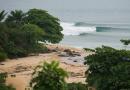
Massive rural-urban migration into Freetown is putting pressure on the city’s capacity to provide clean, safe drinking water for all its residents, writes Roland Bankole Marke. In a country whose infrastructure is ‘obsolete’ and nearing ‘breaking point’, Marke calls for the nation to make an overhaul of its structural water supply system its ‘top priority’. At present water shortages leave the city vulnerable to outbreaks of disease, while the poorest cannot afford water sold privately. Solutions discussed by Marke include organisation at community level to raise funds for securing water provision, and the construction of a dam on the Orugu River.
The war in Sierra Leone has been over for five years. However for thousands of amputees 'their personal battles with trauma have exponentially and vicariously intensified as the years have passed'. The amputees’ experiences and nightmares are more emotional and psychological than physical.
The decade long harrowing civil war endured by Sierra Leone might be over as far as the Sierra Leone government and top United Nations emissary Carolyn McAskie responsible for peace-building are concerned. The latter states: 'The war has been over for five years the peace has held, I think that’s a gold standard...there is still a lot to do though.'
President Ahmed Tejan Kabba has publicly told the nation his government is overwhelmed by national priorities. He is therefore unable to address the individual needs of his people therefore they must begin to help themselves.
However for the thousands of amputees living in this tiny nation barely the size of Maine this is an impractical and impossible task. Their personal battles with trauma have exponentially and vicariously intensified as the years have passed. The amputees’ experiences are more emotional and psychological. They suffer a nightmare than their physical wounds can communicate.
Presently, the government is busy with its pending presidential and parliamentary elections just a few months away, and the routine of running the machinery of government.
However these elections are not going to be curative for the thousands of Mamsu Thoronkas and Tamba Ngaujahs that are still languishing in the mundane and elusive wilderness of Sierra Leone, plagued and handicapped in destitution and despondency. They cannot fend for themselves in a country where unemployment is astronomical and finding a job and a home are extremely difficult.
http://www.pambazuka.org/images/articles/297/40501_1.jpgThe disturbing and graphic poster images of mutilation and amputation germinated from the seeds of the 1991 civil war that were sown in the eastern border town of Bormaru.
Sierra Leone shares close proximity and commonality with neighbouring Liberia. There, the demonic and diabolic foetus of dehumanisation and shocking brutality were born. Although the rebels, who migrated to Liberia to execute heinous crimes with the aid of Charles Taylor of Liberia, were discounted by the government as mere rabble rousers.
But facts have proved quite the opposite as warnings of possible violence were ignored. Although the Government assured the nation that the dire situation was under control the truth was that innocent and peaceful Sierra Leonean civilians would encounter a bizarre and innovative barbarism seasoned with surgical nightmares.
The psychology behind the amputation of limbs, tongues or ears is a terror wedging campaign to instil phobia and panic on the government and all its citizens. In a previous election the people had voted overwhelmingly for President Kabba. Since they used their hands to vote, dismembering their limbs would prevent them from casting another ballot for a democratic government. Rebel propaganda of fear and panic was to impose their will on the people of Sierra Leone, just like terrorists across the world.
http://www.pambazuka.org/images/articles/297/40501_2.jpgMamsu Thoronka - 41 year-old trader, shown in the pictures is among thousands of amputees living in Freetown, Sierra Leone today. She is struggling to support her family of six children on her own. Her husband is in a transition into another relationship and is distant from the family. Welfare services do not exist and no form of help comes from the government:
'On 22 January, 1999 when the capital city Freetown was attacked by rebels, I attempted to take refuge in a building to escape the vengeance of the rebels. But they found me, and put my hand on a table and ready to cut it off with a machete like a butcher would sever animal meat. I begged for mercy asking them to respect God and me being His child.
They told me to point to God with my right hand which they also tried to chop off. They tried three times but failed, the hand of God probably helped or saved me. I still can’t use three fingers on my right hand. The rebels said, “I should get another hand from President Kabba, who has several hands to spare.” I was in agony and the thought of death crossed my mind. I was later taken to hospital but the doctors too had fled for their lives. Freetown was infested with hundreds of corpses scattered all around its perimeter. My dangling left hand held by a film of skin had begun to decay. It took a week before I was able to see a doctor who treated only my wounds.
My husband is still distant, I’m sure he has another wife without my knowledge. I persevere to support my children by buying produce like palm-oil in the countryside to resell in Freetown. My responsibility is too much for me. I cannot afford to pay school fees for my six children, as school fees are beyond my reach. I’m appealing for help from the international community, as my two oldest children have dropped out of school.'
But with her resilience and tenacious spirit Mamsu refuses to give up her fight for survival or self sufficiency. She continues cross border trade between Guinea and Sierra Leone. In Guinea goods are cheaper. But a recent embargo put on Guinean goods could paralyse her main source of livelihood. She still sells vegetables and beans to enable her to buy clothes and household necessities for her large family. Goods and services are now being sold at cut throat prices upcountry than in Freetown. She rears a few chickens for subsistence and sometimes sells some.
'Rebels have threatened to end our lives. They say, if government will not stop talking about amputees and the rebel atrocities that created them, they will get rid of us all. I fear the advent of another war.'
For Mamsu the welfare of her children is paramount in her mind. She is not seeking vengeance or retribution towards her assailants (rebels). She has offered forgiveness to them, despite the institution of the War Crimes Court in Sierra Leone to help bring justice to people like Mamsu. 'I want someone to take care of my children', she prays.
'The former rebel fighters are being well looked after with skills training and free education for their children. The Truth and Reconciliation Commission said, we amputees should get a pension but we have seen nothing.'
A Norwegian charity that helped house her. There is discrimination against amputees at all levels. 'I cannot cook for myself; I have to direct my daughter Bonki to do the cooking for me. When my children run into disagreement in school their peers tell them, “Your mother is a half-person.” It is so demeaning and painful for me since I’m a victim of mere circumstance. We amputees are really discriminated against in Sierra Leone.'
http://www.pambazuka.org/images/articles/297/40501_3.jpgTamba Ngaujah has a similar story to tell the world about his destitution and abandonment by the society that he once served. He had enlisted in the Republic of Sierra Leone Military Forces (RSLMF) to defend his country against all internal and external aggressions, serving his country diligently and honestly to the best of his ability.
While other soldiers deserted from the army, he stayed on to defend his country and people. It was during his line of duty that he was captured by the rebels, at the beginning of the war in 1991. Tamba suffered double amputation in captivity, becoming the first among thousands of amputees. After surviving his ordeal he was kicked out of the Wilberforce barracks where he lived in the military quarters during the heavy rainy season when massive flooding is common. His condition did not prevent the military officials from evicting him from his living quarters.
He is now homeless languishing on the streets with his family parading as beggars. No plans have been made to provide him with alternative accommodation. He is appealing to the international community at least to provide him with shelter considering his current status. Help for amputees is a deplorable and pathetic situation and in fact does not seem to be moving at all.
Despite the numerous NGOs in the country, aid is slow to reach the amputees. Even the Human Rights Declaration and The Truth and Reconciliation testament does not seem applicable to them, although a recent UN assessment gives the country high marks for keeping the peace.
What we do to the least of those among us, we have done it to our creator. How long will this peace last that is held by a thread? A nation that does not take care of its disabled or less fortunate subjects is doomed.
A comprehensive reading of the Sierra Leone civil war and its effects on ordinary people can be found in my book: Harvest of Hate- Stories and Essays: “Fuel for the Soul” - published by Publish America 2006. Visit: to read an extract - Harvest of Hate- Mary’s Saga.
*Roland Bankole Marke is a Sierra Leonean writer living and writing in Florida, USA. He is the author of three books: Teardrops Keep Falling, Silver Rain and Blizzard and Harvest of Hate; Stories and Essays – “Fuel for the Soul.” His work has appeared in several publications including World Press.org and Free Press.org. Reach him at [email][email protected]
* Please send comments to [email protected] or comment online at www.pambazuka.org