




Will the spirit of the Egyptian revolution travel along the Nile to Ethiopia, asks Meraf Nebiyu. Perhaps not immediately, but the conditions for a popular uprising exist.

Recounting his experience of involvement in protests, Hassan Elghayesh chronicles the Egyptian revolution from a first-hand perspective.

‘The task ahead for the Egyptian people may be enormous. But the same will, determination and sense of collectivism and focus with which they triumphed over Mubarak should be drawn upon for the reconstruction phase of the revolution,’ writes Horace Campbell.

Mubarak resigns – can the feeling be described? I will try. It is as if for 10 seconds, you totally forget about who you are, what you do or where you are – it's just extreme happiness. Then it all comes back to you slowly. I am Hassan Elghayesh, an Egyptian who was part of a revolution that brought down a dictator.

Reflecting on time spent in the country, H. Nanjala Nyabola stresses than rather than simply looking east for comparison, the Egyptian people’s recent experience gives ‘an opportunity for lessons to be learnt further south’ in other parts of Africa.

Fed up with dictatorships, self-serving elites and totalitarianism, Africa’s youths are on the march, says Alemayehu G. Mariam, inspired by events in Egypt.
South-South trade is growing fast, but barriers among developing countries are still up to seven times higher than those imposed by the developed world, a representative from the Organisation for Economic Cooperation and Development (OECD) said. Speaking at a Frontier Advisory seminar at the JSE, OECD Development Centre director Mario Pezzini said that South-South trade had experienced tremendous growth in recent years, with exports from developing countries now constituting 37 per cent of global trade, of which about 50 per cent related to South-South trade.
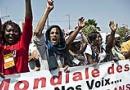
Last week’s World Social Forum (WSF) in Dakar ended up riotously happy thanks to the eviction of a universally hated Egyptian pharaoh, after near-debilitating logistical disasters at the event’s outset, writes Patrick Bond.

With Black History Month underway in North America this month, Ajamu Nangwaya laments the move away from political engagement and militancy to mere celebration.
In an unusual move, West and Central African civil society organisations have participated in the negotiations between their countries and the European Union on the economic partnership agreements (EPAs). The organisations stress developmental concerns while assisting under-resourced African governments with trade expertise. Civil society organisations (CSOs) have also taken to the streets to persuade governments not to sign interim EPAs, for example in Mali.
Bloomberg reports that Djiboutian authorities released three opposition leaders as opponents of President Ismail Guelleh clashed with police in the second day of protests against his rule, a party head said. Mohamed Daoud Chehem, head of the Djibouti Party for Development; Ismael Guedi Hared, president of the Union for a Democratic Alternative; and Aden Robleh Awaleh, leader of the National Democratic Party, were detained yesterday morning (18 February), Awaleh said in a telephone interview from the capital, Djibouti.
The Communication Initiative (The CI) and the BBC World Service Trust (WST) invite entries for their first contest on the role of media in democratic development. This contest solicits persuasive critiques and encouraging discussion on the relationship between media, communications, and international development policy. CI Network members from around the world (as well as those who wish to become CI Network members) are requested to submit their opinion pieces to the collaborative blog at Communication, Media, and Development Policy.
Libya has handed out more than $2 billion in loans to dozens of governments across the globe, according to an internal document that shows the oil exporter's diplomatic ambitions and its struggles to recover its debts. The biggest debtor mentioned in the document is Libya's neighbour Sudan with an outstanding balance of $1.287 billion, part of Sudan's debilitating external debt of almost $40 billion.
One thousand eight hundred women and men, members of Women and Men of Zimbabwe Arise (WOZA) turned out for the ninth edition of the Valentines Day protests, the biggest protest since WOZA began these protests in 2003. The huge mass of singing protestors completely closed off 9th avenue for over 30 minutes.
On 21 December 2010, a third landmark resolution calling for a universal moratorium on the use of the death penalty received unprecedented votes at the United Nations General Assembly (UN GA), reports Penal Reform International. 109 countries voted in favour of the resolution, 41 voted against, 35 abstained, and 7 were absent. This is a significant vote in that it reaffirms the continuing trend towards international abolition, PRI says.

Reactions to events in Egypt, the experiences of women protestors and the limitations of Nigeria’s ‘democracy’ feature in this week’s round-up of the African blogosphere by Sokari Ekine.
As a wave of social protests started on 14 February in Malawi, the impoverished country's main donors are withholding aid over repressive media and anti-gay laws. The long announced anti-government protests kicked off in Malawi's capital Lilongwe and in the northern town of Mzuzu. The main demand was for government to address high fuel prices and shortages, causing a large black fuel market in Malawi.
As further protests in Djibouti are announced, government is cracking down on civil society and the opposition. There are fears foreign police forces may be used against protesters. Since 29 January, Egypt and Yemen-inspired protests have been noted in Djibouti, calling for Djiboutian President Ismaïl Omar Guelleh to respect the country's constitution and not seek a third term in office in the upcoming April elections.
The African Union Commission is opposed to elections in Zimbabwe this year and is now trying to persuade President Robert Mugabe to postpone them to 2013 to allow for necessary reforms that can ensure violence-free, credible, free and fair polls, top officials in the commission revealed this week. In separate interviews with the Zimbabwe Independent, senior officials in the Political Affairs’ Department of Human Rights, Elections and Peace and Security of the AU Commission, who preferred anonymity because they are not authorised to speak to the media, said the commission was planning to send an AU assessment team to Zimbabwe to find out if conditions were right for elections.