



From Durban to Now: Twenty-Five Years of Struggle for Reparative Justice
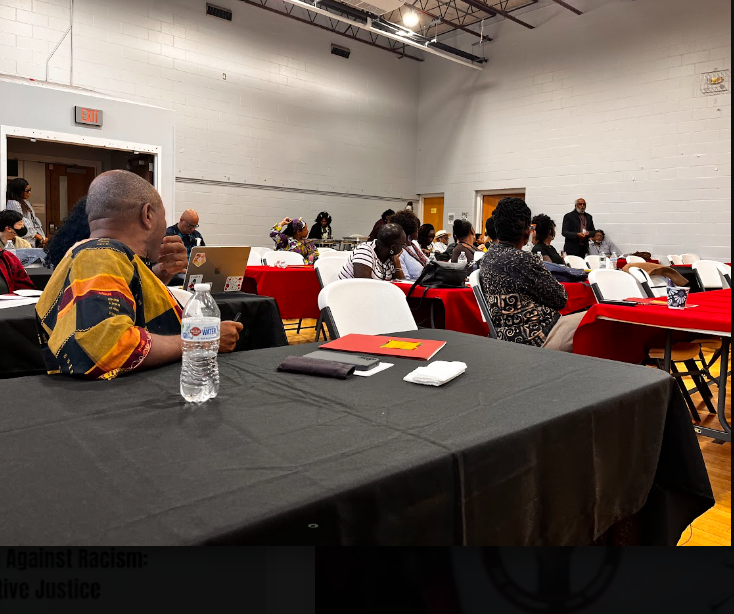
Serekberhan covers a half-day symposium packed with former Durban attendees, guerilla intellectuals, and the Syracuse community to commemorate 25 years since the Durban Conference. From how Durban was built and functioned to ongoing struggles for reparations in New York state and within the global context, the conference threaded many themes relevant to our fight for reparative justice.
On 25 September 2026, about seventy people gathered at the Dunbar Center, a community center in Syracuse, New York, to mark twenty-five years since the World Conference against Racism, Racial Discrimination, Xenophobia and Related Intolerance. That conference was held in Durban, South Africa, from 31 August to 8 September 2001. The half-day symposium, "From Durban to Now: 25 Years of Struggle for Reparative Justice," was hosted by the Africa Initiative at Syracuse University and cohosted by the Pan African Community of Central New York and the African Graduate Students Network. The conference held four sessions that explored not only the road to Durban and its aftermath, but also the global context of reparations and the reparative movement in New York state.
It opened with opening remarks by the Director of Africa Initiative, Horace Campbell, followed by drumming from Aigbokhan Aloja Airewele, a medical doctor and an environmental sustainability advocate. Dr. Mario Nisbett then spoke about his own homecoming to Ghana, where he chairs the Center for African and International Studies, at the University of Cape Coast. He described the university’s responsibility to teach and to repair. From returning archival documents from abroad, to carrying out institutional and pedagogical repair, Cape Coast, site of one of the slave-trade forts, must also become a site of repair. Cape Coast's significance, he said, should be measured not only by visitor numbers but by the seriousness of the work done in its name. The speakers that followed not only gave us a sense of what it took to organize a global conference that changed the world, but highlighted the ways in which the struggle for reparative justice [must] endure.
Before Durban
All speakers returned repeatedly to one point: Durban was not where the story began.
Author, mathematician, and former Black Panther, Sam Anderson said the reparations movement in the United States started with the first enslaved African who resisted. He described reparative and restorative justice as a multigenerational process taken up by Africans around the world, particularly taking shape through the 1980s and 1990s. Cikah Thomas, member of the Global African Congress and Durban Conference attendee, repeated that the story should not begin in Durban at all. It began with communities, trade unions, and numerous grassroots organizations across Global Africa, and no single event made Durban. He placed the first UN world conference against racism as early as 1978, whereas Julialynne Walker, another Durban Conference attendee and member of the Global Pan African Movement – North America (GPAM), likewise described a series of world conferences beginning in 1978.
Walker traced the institutional lineage. She said UNESCO was founded after the Second World War to address the ignorance that fed the Holocaust, though it never addressed the German government's first genocide in Namibia against the Herero and Nama. She said the 1960 Sharpeville massacre in South Africa prompted the UN to create a day of commemoration and, about five years later, the machinery against racial discrimination was borne. That machinery produced the International Convention on the Elimination of All Forms of Racial Discrimination and its monitoring committee, the Committee on the Elimination of Racial Discrimination (CERD). More than 185 countries, she said, ratified or signed the convention, though it has not been effectively carried out within countries.
CERD and the anti-racist mechanisms that emerged were built on decades of struggles. Anderson highlighted how a delegation led by civil-human rights champion Paul Robeson presented a petition form the Civil Rights Congress to the United Nations in 1951, entitled “We Charge Genocide: The Crime of Government Against the Negro People”. Signed by over a 100 US intellectuals and activists, the document was presented at the United Nations (UN) HQ in New York as well as a UN meeting in Paris. Anderson also described how little preparation some grassroots organizers had for the UN and international bureaucracy. Roger Wareham, then a young lawyer with the December 12 Movement, was sent to the Geneva conference that preceded Durban not knowing much of its procedures. Cuban diplomats, Anderson said, took him on as an apprentice. Cuba in more ways than one played a significant role in the conference.
How Durban was Built
Walker, who served two years on the local organizing committee and took part in a technical experts' meeting in South Africa, laid out the machinery. Each world conference came with a UN declaration and, Walker said, a groundswell of community action, on a roughly two-year build-up. An international preparatory committee within the UN solicited participation and started meetings on the ground. There were various regional preparatory conferences, each different in tenor and outcome. Santiago, Chile hosted the Americas, whereas Africa and Asia were hosted in Dakar and Tehran, respectively. Then there were technical meetings of experts, which prepared documents to steer specific issues through the UN process. For the main conference in 2001, there were two parallel tracks for everything. Governments ran one process through their foreign ministries and human rights bodies, whereas NGOs and grassroots organizations ran another. Walker said the NGO forums were largely controlled by what she called GONGOs, government-organized NGOs, often set up by first ladies and led by prominent figures, with funds not reaching communities. As the process went on, she said, people insisted the forum was theirs to control. On the NGO side, there was a three-tier organizing structure that made bottom-up challenge possible: an International Steering Committee of NGO representatives, a local organizing steering committee beneath it, and implementing groups beneath that.
Roughly speaking, the conference drew more than 2,300 representatives from 163 countries, including 16 heads of state and 58 foreign ministers. About 4,000 NGO representatives were accredited, whom Walker described as primarily GONGOs. The NGO Forum, run by the committee she was a part of, drew more than 6,000 participants. Thomas confirmed that over 7,000 NGOs took part in networking and preparatory work. Walker also said about 1,000 unofficial side events also took place outside the official conference site. Organizations could apply to host them through the South African government or through their own affiliated organizations. She said all of this ran for multiple days, and made the Durban Declaration and Programme of Action (DDPA) possible.
The preparatory committees, CERD, and other UN bodies were all sending instructions to the International Steering Committee, which relayed its own instructions to the local committee. She said there was "so much confusion" that the Steering Committee fired the local committee at 2 a.m. and reinstated it hours later. She summed it up as "the level of contention and people thinking that they could control the conference by actually disbanding the structure of the conference itself."
All this meant that governments did not create Durban; peoples organizations did. Organizers from all parts of the world built organizations and participated in the UN processes, and recognized they needed a political voice. For Black people this political voice was expressed through the African and African Descendant Caucus, where Barbados, Cuba, Jamaica, Nigeria, and Algeria became important voices.
Who was Against the Durban Conference?
The Canadian government, much like the US government, did not want reparations on the global stage. The conference not only challenged genocidal states like the US, Canada, and Israel, but also the Church of England, and regressive African states. The contention of these actors went beyond struggles within the conference and was exhibited in the US’s attempt to penalize former President of Ireland and then United Nations High Commissioner for Human Rights (1997 to 2002), Mary Robinson, from being re-elected as the High Commissioner.
As others confirmed, Walker said the “Israeli lobby” fought “tooth and nail” against recognition of slavery as a crime against humanity, and against support for Palestine, insisting on the view that the Holocaust could be the only crime against humanity that should be discussed. Israel fought to prevent adoption of language concerning Palestinians and to avoid being categorized as an apartheid state.
The ongoing attempts by the US and Israel to discredit international intuitions, from the ICC and ICJ to the UN, was further historicized by Essam Elkorghli, member of the GPAM. During his presentation, Elkorghli held up a book, Zionism and Racism: Proceedings of an International Symposium, which was published in Libya in 1976, by the International Organization for the Elimination of All Forms of Racial Discrimination. He reminded us the book followed the UN General Assembly’s adoption of Resolution 3379 in 1975, which declared “Zionism is a form of racism and racial discrimination”. The rescinding of the resolution in 1991, demonstrated not that Zionism is not a form of racism, but how Israel continuously lobbies international platforms to silence its crimes.
What Durban Did, and What Followed
“Durban should be seen as a beginning and not an end.” - DDPA
The speakers called Durban a political achievement and a global blueprint for the fight against racism, built by people organizing across political differences and borders. The Conference marked a new phase of struggle, not an end. Every country had to look at its own history, including countries that had assumed racism was an American or African problem. Walker said South America, starting with the Santiago meeting, made the most progress afterward, particularly paving the way for 200 million people in the Americas that now identify as Afro-descendants. The conference also raised up the Dalits and the Roma, expanding our understanding of systematic racism, and declared for the first time on the international stage that slavery was a crime against humanity. Gender was also raised throughout the discussions and that health tied it together, as women of African descent in the Americas receive the poorest health care and suffer further harm as a result.
On the aftermath, Walker listed the UN bodies that now form what she called the racism mechanism: the Special Rapporteur on contemporary forms of racism; the Working Group of Experts and the Permanent Forum on People of African Descent; the International Independent Expert Mechanism on law enforcement; and, after Durban, a group of independent eminent experts and an intergovernmental working group on implementing the Declaration. The AU’s sixth region also came out of the Durban process. Governments and state-led NGOs pushed a financial reading focused on Africans living abroad and the remittances they send as a major source of revenue the governments cannot control. Others insisted it must include the historic diaspora. Now we understand, the region’s geographic, linguistic, and cultural diversity must be respected and celebrated. “The pieces are in place,” Walker said, asking us, however, to analyze what it will take to make them work.
Her closing pointed to Ghana. On 25 March 2026, the UN General Assembly adopted a Ghana-proposed resolution recognizing the transatlantic slave trade as the gravest crime against humanity. It passed with 123 votes in favor, three against (including the United States, Israel, and Argentina), and 52 abstentions (including the United Kingdom and EU states). The EU and the US voiced concern that it could imply a hierarchy among crimes against humanity.
Reparations Movements Now
Wunpini Fatima Mohammed, from Cornell University, shared the importance of building sincere relations among Global Africans, while critiquing Ghana’ "Year of Return" as marketed to the diaspora. Its current form, she said, it has become extractive and capitalist, and asked how it could be reimagined as a meaningful reconnection beyond tourism. Mohammed pointed to an earlier model of reconnection, which she called the Nkrumah-Du Bois model, and to the pan-African ethos it brought to media. Her example was Shirley Graham Du Bois, who became the first director of Ghana Television. A writer, playwright, composer, and activist, Graham Du Bois moved to Ghana with her husband, the scholar W. E. B. Du Bois, at the invitation of President Kwame Nkrumah, and remained there after his death in Accra in 1963.
Graham Du Bois was the first director of the Ghana Broadcasting Corporation's television service, then called GBC TV and now Ghana Television. Mohammed said she shaped how Ghanaians' histories were represented after independence and worked to build an African ecosystem around television that would serve the Ghanaian public. She insisted that television be tied to indigenous forms of communication and culture, and she traveled to Asia to study a socialist model of television before returning to Ghana. Mohammed used the example to argue for reparative justice work that is committed to rebuilding knowledge, collective memory, pedagogy, and public engagement in ways that bring in people usually excluded from public conversation.
Chevy Eugene, from Dalhousie University, called for a decolonial approach to reparations, which necessitates creating a new humanity, delinked from the US-Western imagination, and transforming institutions. Considering his works with the International Coalition for People of African Descent, which he described as an amalgamation of grassroots movements from Colombia, Brazil, the Caribbean, the US, and Europe, including the Frantz Fanon Foundation, decolonial reparations in practice meant that UN Permanent Forum sessions are built on bottom up methodologies. He described a three-part “triangulation methodology.” The first part is a new humanity and a new consciousness, following Fanon, and delinking from Eurocentric ideas of repair, and drawn from African-descended knowledge systems such as Rastafari. The second is transforming institutions, citing Robin Kelley on connecting reparations with decolonization. The third method is "groundings," a concept he credited to Walter Rodney, which means going into communities to learn how people understand reparations, even when they don't call it that. Chevy highlighted how the Caribbean reparations movement has become state-led and that people who worked on reparations the longest have been marginalized, a criticism that echoed Tennyson Joseph. Joseph, who is from North Carolina State University and member of GPAM, said the Rastafari came long before state-led reparations movements. He described three broad strands of the Caribbean movement, including the CARICOM Reparations Commission, an "open door" approach, and a legal approach, as he criticized elitist and top-down approaches that have deduced the movement to asking Europe for money to reproduce state government.
My own contribution to the conference was that we treat reparative justice as a dimension of revolutionary consciousness. One that allows us to travel from the past to the future with care and intention, as we repair the systematic harms on humans and nature unleashed by those invested in white supremacy and domination. I urged the audience to not only reflect on the harms of the past but the ongoing imperialism in Africa that sustains crimes against humanity. We must charge NATO’s destruction of Libya and the EU’s continued mobilization of militias, which has reduced the country to Europe’s external border and made it a site for ongoing slavery and racist discrimination. We must charge the United Arab Emirates for the ongoing genocidal war in Sudan, and the war posturing in the Horn of Africa. As we call for reparations for past crimes, we must be astute in understanding the struggles that await.
Introducing the panel that covered the ongoing struggles in the US and particularly in New York was Paula Johnson, from Syracuse University. Dr. Johnson herself directs a project called the Cold Case Justice Initiative, at the College of Law, which works to “investigate unsolved racially motivated murders and disappearances that happened primarily during the civil rights era.” From the university to the state offices, reparations is about justice. Covering the struggles from New York state, Seanelle Hawkins, chair of the New York State Community Commission on Reparations Remedies, described the bill (S.1163-A/A.7691), sponsored by Senator James Sanders Jr. and Assemblymember Michaelle C. Solages and signed by Governor Hochul on 19 December 2023. The commission is charged with examining how the state benefited from slavery and the effects since, and with recommending action. It is not authorized to provide reparations, but is meant to report to the governor and legislature in January 2029. Having the bill pass has meant nine volunteer commissioners work with $5 million, but state procurement rules limited whom they could hire, which has made it difficult to hire those really working on the reparations issue. Hawkins said the commission held 21 public hearings around the state and heard that New York was deeply entrenched in slavery. Residents asked for more than checks, including tax relief, free education, green space, and health care. Hawkins said the commission wants lasting policy “beyond the check,” and that the community must champion its recommendations or they will go nowhere.
John Torrey, from SUNY Buffalo State University, not only reinforced the modern reparations movement in the US begins with the grassroots and those like Queen Mother Moore. Echoing the Commissioner’s comments, he asserted, reparative policy cannot rest on a check alone when money is likely to flow back out through fees, fines, and bail unless the structural realities behind those costs change. Torrey placed the Durban Conference as a prism that showed how damaging the experience of Blackness has been worldwide. Whereas Sam Anderson highlighted that there have always been two broad tendencies that seek reparations through monetary means or comprehensive approaches, Jessica Mitchell Aiwuyor, of the National Black Cultural Information Trust, said repair must depend on the harm. She described NCOBRA's five injuries of slavery: peoplehood or nationhood, education, criminal punishment, wealth and poverty, and health. The NCOBRA/NARC ten-point plan includes a formal apology, a Maafa institute, repatriation rights, land, and cooperative enterprise funding. She said coalitions, including Why We Can't Wait and First Repair, seek reparations covering three eras of harm: slavery, Jim Crow/apartheid, and modern systemic racism.
She then laid out the objections to “lineage-based” reparations, which would require proof of descent from the enslaved in the US. Stating she is inclined to agree with Ron Daniels who holds that every Black person injured by America deserves repair from America, she explained why. Lineage-based reparations may seem like ancestry led reparations on face value but 1) it would impede redress for other harms, such as Tulsa, Rosewood, or police brutality, 2) it will likely divert funds to ancestry-testing firms and expose DNA to prosecutors, as she said attorneys in Tulsa feared; and 3) it would wrongly exclude Black immigrant families from communal or direct repair for Jim Crow-era and present-day harms. She cited a reparations case in Palm Springs, California as an example that demonstrates how struggles for reparative justice are inextricable. She explained how after decades of struggle, Black residents in Palm Springs, California recently won a lawsuit for about 20 something million dollars because the fire department burned down their house without warning or compensation. It was technically an Indian reservation where they let the Black families live on the land, with some Mexican families also living on the land. She asked and answered, “Do you think the Black families turned to the Mexican families that were on the same reservation as them and said, you know, you weren't a descendant of US chattel slavery, we don't want you to be a part of our claim? No, they did it together because they were living on the same land together and all their homes were burnt down together.”
Aiwuyor explained how the Durban Conference is consistently referenced in the US reparations movement. She credited Kamm Howard, former co-chair of N’COBRA with teaching many about Durban. Beyond that the language of "Afro-descendant" that came out of the conference, Durban made reparations a "world-making endeavor," – a phrase she attributed to Olúfẹ́mi Táíwò. The US reparation movement becomes even more important when considering US state opposition to the Durban Conference and reparative justice as a whole.
From History to the Classroom and Public
The closing panel took up how to bring reparative justice into teaching and curricula, and what to do next. Its moderator, Peyi Soyinka Airewele, from Ithaca College, called this one of the most critical moments in recent history for Black people. She said, in the US, universities face fines for diversity work, and that more than a dozen US colleges and universities, including Indiana University and the University of Texas at Austin, have reduced, merged, or eliminated Black, African, Caribbean, or African American studies programs. Others, she said, have closed programs geared toward reparative justice. She added that schools and universities on the continent face xenophobia, economic pressure, and the erosion of history, and that Nigeria once swapped history for photography in its curriculum.
Ed Baptist, Cornell professor of history and author of The Half Has Never Been Told (2014), spoke to the crowd about two African Americans. The first was John Hope Franklin, whom Baptist called one of the greatest US historians of the 20th century. Franklin served as the chairman of the advisory board for President Bill Clinton’s commission on race, One America Initiative (1997-1999). Baptist said Franklin pushed for measures that today would fit a broad definition of reparations, and was increasingly sidelined, sometimes literally left out of meetings and pressured to cut material from his writing. Baptist wondered whether Franklin foresaw reparations struggling for air over the next twenty-five years, and said Franklin would be pleased by how much activity there has been despite attempts of reversal.
The second was Timothy Charles Pigford, the plaintiff in Pigford v. Glickman, who Baptist said died in the past week. Pigford was a North Carolina farmer who sued the US Department of Agriculture for systematic discrimination in grants and loans, and won. The decision covered Black farmers discriminated against from 1981 to 1997 and though Pigford never benefited financially because the IRS stripped almost everything he won, he kept fighting for Black farmers. Much of what was proposed or enacted then has not come to pass, he said, but the department was reshaped at the ground level, and while the number of Black farmers has kept falling, especially in the South, new Black farmers have appeared elsewhere in the country. He linked this to calls to the New York commission for land, noting that some people want it in order to farm in New York State. What we do now and what has been done since 2001 has made and continues to make a significant impact.
Horace Campbell, director of the Africa Initiative and GPAM member, closed the symposium. He called for engaging the New York State Department of Education and the SUNY system on reparative education, saying the university must help develop knowledge, curriculum, and pedagogy around reparative justice. There is a contradiction in the Jamaican government pressing England on reparations while leaving its own school curriculum unchanged, and that the same applies to SUNY, Syracuse’s schools, Ghana, and Global Africa at large. Campbell looked ahead twenty-five years to artificial intelligence, quantum computing, fusion, and biologics, saying these technologies must not be left to a class that denies Africans' humanity and that universities must not become instruments of capital.
The commemoration of Durban took place at the Dunbar Center, which is at the heart of the Black community in Syracuse, New York – a community that has been destroyed to build highways and pushed back into segregation; and instead of reparations has been met with a County decision to fund the building of an aquarium in a city with one of America’s highest child poverty rates. The act of having the conference there, organized with no institutional budget but with community labor and donations, is itself an act of repair. A stand that we will convene in our communities to continue our struggles.
Mahder Habtemariam Serekberhan is the Vice Chairperson of the Global Pan African Movement (GPAM). She is a PhD candidate in political science at Syracuse University, New York, and serves on the editorial board of Pambazuka News.