



Ifi Amadiume: A Living Legend
Legends are to be celebrated, especially when they are alive. Agozino furthers this tradition by celebrating the prolific intellectual, author, poet, and activist, Ifi Amadiume.
Probably the first African woman to be tenured and promoted to full professorship at an Ivy League institution, Dr. Ifi Amadiume is a tenured full Professor of Religion and African and African American Studies at Dartmouth College, USA. She started there in 1993 and has taught interdisciplinary courses in the Department of Religion and the African and African American Studies Program. She has taught introductory, intermediate and advanced level courses cross-listed in many departments and programs such as the Women and Gender Studies Program, and the Anthropology Department. Additionally, she has served as Chair of the African and African-American Studies Program at Dartmouth. She received a University of London BA with honors in Social Anthropology and Hausa (African language), as well as a PhD in Social Anthropology. Holding the positions and titles of researcher, lecturer, professor, and academician, she is also an award-winning writer and poet, writing her own books and contributing to chapters in books, encyclopedias, journals, reviews and poetry anthologies.
Her double major in Anthropology and Hausa for her first degree says a lot about the historicity of this eminent intellectual who is of Igbo origin. She was born in Northern Nigeria a few years after the Igbo were massacred in Jos because the colonizers blamed Igbo traders and union strikers as being responsible for the scarcity of goods and high prices imposed by the colonizers during World War II. She was a child when the Igbos were massacred in Kano in 1953 following a campaign statement by a Yoruba politician that the Northerners said was offensive to their own leaders.
She was a teenager when the pogrom against the Igbo was carried out by government troops and ordinary civilians following the first military coup in the country that was falsely called an Igbo coup when officers from all over the country were involved. This background is important to drive home the point that if there were no mass killings in the history of Nigeria, there would have been many more eminent intellectuals like Ifi Amadiume to pioneer new paradigms in different fields of study. See the poem, ‘A Conversation at Night with a Cockroach’ in A Shuttle in the Crypt by Wole Soyinka (who was thrown into solitary confinement throughout the genocidal war that claimed 3.1 million people, mostly Igbo), to understand the brutality visited against the Igbo by fellow Nigerians.
See also Soyinka’s novel, Season of Anomy and his more recent Chronicles from the land of the Happiest People on Earth for the eye-witness accounts of the genocidal killings that Ifi Amadiume survived to become a historical figure today. See also Chimamanda Ngozi Adichie’s Half of a Yellow Sun, Chinua Achebe’s There Was a Country: A Personal History of Biafra, and Herbert Ekwe-Ekwe’s The Longest Genocide Since 1967 for scholarly accounts of how much Africa lost by allowing the mass killing of some of the best talents on the continent. Amadiume appears to remain traumatized by the memory of her youth, for she is yet to write about how she was personally impacted and how she managed to survive. There may be clues to this story not fit to be told in her poetry. Similarly, Nigerian intellectuals have remained largely silent on the opportunistic roles they played to facilitate the genocide against the Igbo. Readers of this brief background on Ifi Amadiume should challenge the Nigerian intellectuals who were old enough to know the difference between good and evil, what they were doing or writing during the genocide against the Igbo. Perhaps, her fluency in Hausa and her lighter skin tone may have allowed her to pass as Hausa, but she probably lost close relatives as most Igbo people did. I urge Amadiume to publish her memoirs soon as a monument to the value of education for girls rather than kidnaping them in their busloads and forcefully ‘marrying’ them to their kidnappers who turn them into sex slaves or kill them for trying to escape or keep them for ransom; in a country where education is deliberately underfunded. She demonstrates that many more flowers like herself could have blossomed if the trees were not wasted by desertification.
Amadiumeism
The huge contributions of Ifi Amadiume to knowledge deserve to be defined with one word, Amadiumeism, denoting the development and application of theory to activism for a better world. I first met her in 1987 when she gave a talk to journalists at the Press Club, Enugu, Nigeria. She spoke on the need to raise awareness about the treatment of widows in the society. The lecture prompted me to write one of my first conference papers on widowhood as a form of double oppression. I also went on to join Women in Nigeria to campaign for women’s rights as human rights. Finally, I completed my doctoral dissertation on Black Women and the Criminal justice system with indirect influences by Amadiume.
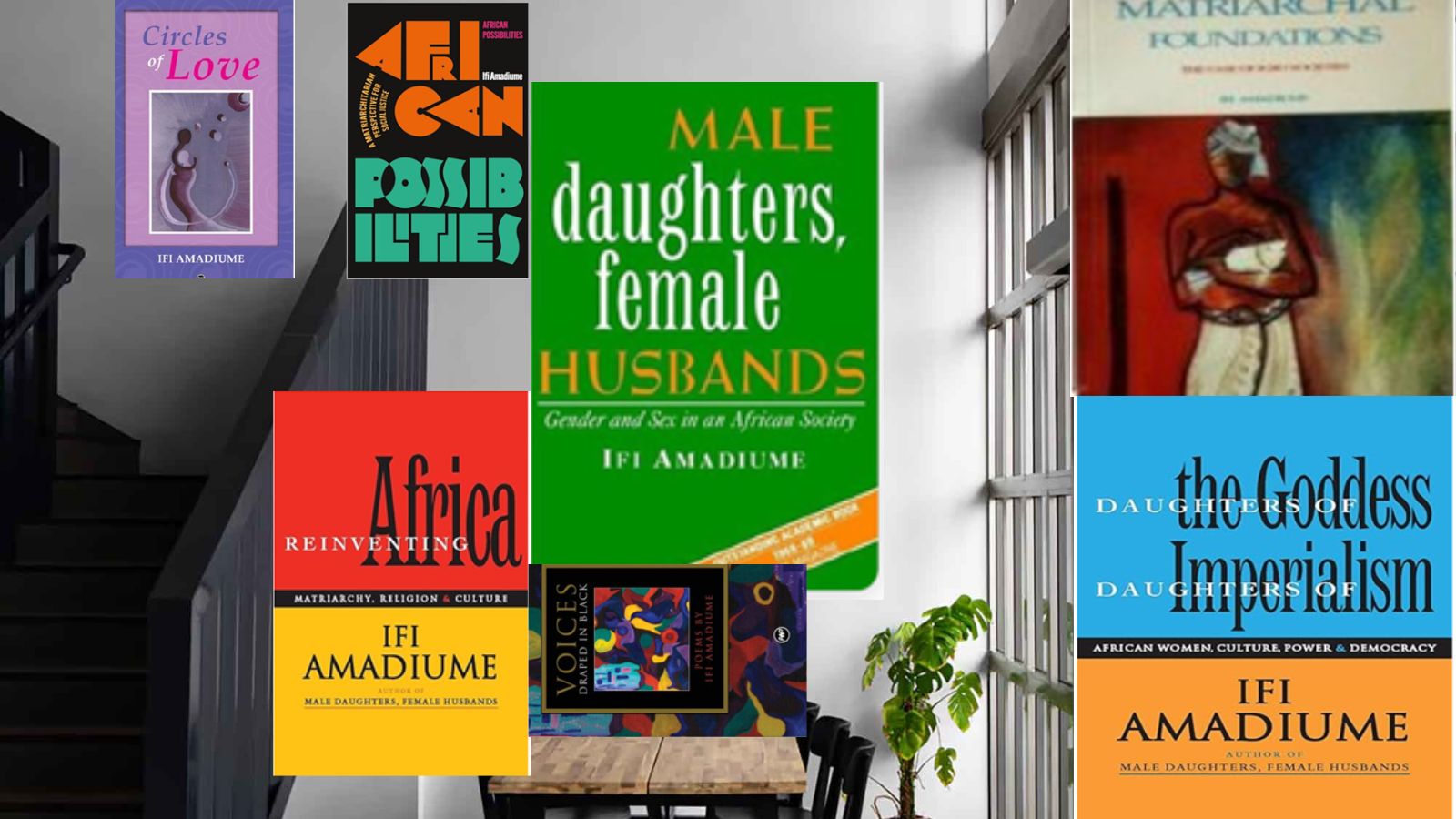
Dr. Amadiume is the author of multiple books and articles, including the classic book, Male Daughters, Female Husbands (Zed Books,1987, 1988, new edition 2015) that won the Choice Outstanding Academic Book of the Year award in 1989 and listed as one of the Best Africa’s 100 Books of the 20th century. Amadiume was one of twelve authors cited for scholarship in the non-fiction category. The book reflects on the fact that African traditional practices were not completely wiped out by colonialism given that the Igbo and the Kikuyi continue to allow women to marry other women or remain at home as male daughters to procreate in the names of their fathers in search of male heirs. This may still privilege maleness as the Igbo have always done in a patrilineal society that also values women and mothers. The book applies this empirically-based theory to the problem of the exclusion of women from leadership in neocolonial Africa. She concluded that Africa is paying dearly for this exclusion that would not have been allowed in the traditional society where the women won the Women’s War of 1929. They won the right not to be taxed without representation and they are still not taxed directly today. When tax collectors come, women do not flee into the bushes unlike the men. See Obinkaram Echewa, I saw the sky catch fire, for a narration of this.
More of Amadiumeism can be found in other publications of hers that include Daughters of the Goddess, Daughters of Imperialism: African Women, Culture, Power and Democracy, (Zed Books & St. Martin's Press, 2000). This book harps on the theme of the wastage of human resources by patriarchal practices that allow child marriages and the amputation of the limbs of a 12 year old Hausa child who tried to run away from a ‘marriage’ to a sixty year old man. The book also analyzes the agency of women who organize to raise funds for the equipment of schools, hospitals and clinics in their areas, indirectly taxing themselves as they have always done among the Igbo. However, the book also suggests that the women could mobilize their votes to elect representatives who could be held accountable for government funding of hospitals and schools.
Other contributions to Amadiumeism can be found in African Matriarchal Foundations: The Igbo Case, (Karnak House London, 1987 and Red Sea Press, 1995, 1999, 2000); Reinventing Africa: Matriarchy, Religion and Culture, (Zed Books & St. Martin's Press, 1997); Ifi Amadiume and Abdullahi An-Na'im (editors) The Politics of Memory: Truth, Healing and Social Justice, (Zed Books and St. Martin’s Press, 2000.). Her contributions in these publications highlight the limitations of the radical leftwing French Economic Anthropologists who specialized in looking for class explanations in West Africa. Economic anthropologists did not always realize that they were often dealing with matrilineal societies where descent is traced along the mother’s line and inheritance is traced along the mother’s line. This was probably put in place by Africans to reduce domestic violence because if the children do not belong to the father and the mother still lives at home with the mother’s brother to whom the children really belong, a husband who tries to beat his wife may have to pass through the brother first.
This is called the matrilineal puzzle in anthropology – why do the children never belong to their mothers in neither patrilineal nor matrilineal societies? Easy puzzle from colonial anthropologists, children are not objects that belong to individuals as such, children are the children of all in a shared community where everyone walks on the same land, drinks the same water, and breathes the same air with shared interest in the future of our fractal-holistic interconnected selves living under the roof of the same Mbari house that elected representatives symbolically construct and reconstruct from time to time, according to Chiunua Achebe, or the Great World House that the beloved community inherited from the ancestors, according to Martin Luther King Jr., where we are guided by the philosophy of Ubuntu or bundle of humanity, according to Desmond Tutu and Mpho Tutu. By contrast, the Eurocentric worldview tries to subject the global beloved community to epistemicide by unsuccessfully seeking to impose the mythology of the nuclear (armed) patriarchal family, isolated private profiteering, and the imperialist genocidal state, according to Friedrich Engels.
But it is not at the childhood level that crude economism begins to bite the dust from Amadiumeism. Frantz Fanon had warned in The Wretched of the Earth that the practice of allowing Africans from other countries to work only as guest workers on the cocoa farms was wrong and he predicted that unless full citizenship rights are granted to other Africans in Ivory Coast, for example, the search for a national identity could lead to a pitfall into which brothers push brothers and sisters push sisters in search of people who are purely of the desired nationality. The people of Ivory Coast called it Ivorite and went to war, slaughtering one another for years over who was qualified to run for president. The fact was that the mother of one of the candidates came from Burkina Faso and was married to a man from Ivory Coast, making the children Ivorian under the law imposed by colonialism. But, in the consciousness of the people, there was the expectation that the children belonged to the mother’s brother in Burkina Faso and not to the father in Ivory Coast. War! If the combatants had read Amadiume, perhaps they would have avoided some of the bloodshed by recognizing the basic fact that matrifocality is not contradictory to patrifocality, they are co-existent, in the African mode of production and mode of reproduction where people interchangeably refer to themselves as umunne na umunna (children of mother and children of father) in Igbo language, for instance. Cheikh Anta Diop theorized this in his book on matriarchy as one of the cultural bases of African unity. If they had listened to Frantz Fanon, Africa would have been reunited to eliminate the colonial boundaries and emphasize re-education in a People's Republic of African States.
Amadiumeism as Intellectual Activism
Ifi Amadiume is an established poet and has participated in many local, national and international poetry readings and festivals, winning awards. She has published four books of poetry, three of which are award-winning books: Passion Waves (London: Karnak House, 1985, winner of a Commonwealth Poetry Prize nomination); Ecstasy (Longman Nigeria, 1995, winner of the Association of Nigerian Authors 1992 Cadbury Literary Award for Poetry); Circles of Love (Trenton, NJ: Africa World Press, 2006, winner of the 2006 Flora Nwapa Society Award, African Literature Association, USA, for outstanding achievement in African Religions and African Women and Gender Studies); and Voices Draped in Black (Trenton, NJ: Africa World Press, 2007).
See www.PoemHunter.com for some of her more recent poems. Readers of the poetry, even if they could not pronounce the name of the author correctly, may find that echoes of Amadiume’s own childhood in Nigeria could be gleaned in contrast to the ‘Boundless’ youth who happily rode London Buses with tickets to nowhere and without a care of what they were going to become. The poem was written in the US but set in London, as if imagining the boundless energy the people of Africa would experience once the conflicts imposed by imperialism are resolved nonviolently. But still in London, she wrote ‘Cut Down Too Soon’ as if she was talking about flowers but she was probably memorializing personal losses of children cut down too soon by ‘city people’ who acted ‘like a cunning tortoise’, pretending to be civilized while orchestrating the genocide against the Igbo. Ancestral drums sound the message of revival or survival in the poem and a new beginning emerges, despite the initial despair. The people are waiting to read the memoirs of Amadiume line by line.
Her essays entitled, “Other Ways of Fighting War to Fight and Live For Another Day,” and “Kamala (A Dialogic Epic Poem)” are published in Paideuma, Vol. 47 2022, Literature and War. She also has three manuscripts of unpublished books of her new poetry, and a book manuscript of essays and letters. She is currently working on books on themes in anthropology and issues of gender, and feminist perspectives. Ifi Amadiume’s recent articles include:
Ifi Amadiume, “Discourse, Imagination and Models of Resistance: Re-reading Arrow of God.” Igbo Studies Review, No.7, (2019): 1-28.
Ifi Amadiume, “Gender Field Experience, Method and Theory,” Journal of West African History, Vol. 3, Iss. 2 (2017): 131–138.
Ifı Amadiume, “Of Kola Nuts, Taboos, Leadership, Women’s Rights, and Freedom: New Challenges from Chinua Achebe’s There Was a Country: A Personal History of Biafra,” Journal of West African History, Vol. 1, Iss. 2 (2015): 119–146.
In addition to her many journal publications, there are two special journal editions about her work. The first is the special issue of the Journal of Contemporary African Studies, Volume 39, Issue 4 (2021), whose introduction is titled, “Thirty Years of Male Daughters, Female Husbands: revisiting Ifi Amadiume’s questions on gender, sex and political economy.”, and the second in the Conversations section of the Journal of West African History, Vol. 3, 1ss. 2 (2017). This section is devoted to critical essays about her work. The collection of articles recognizes that Amadiume pioneered the theory of gender as a social and not a biological relation long before most western feminist theorists realized this. Invited to endorse her 2024 publication, African Possibilities, I was quoted on the blurb as saying the following:
Contrary to feminist theories that presuppose an almighty patriarchy that is hegemonic globally, Ifi Amadiume has been theorizing, over and over again, the reality that white supremacist imperialist patriarchy never succeeded in wiping out indigenous knowledge systems and women’s agency in toto. Rather, wherever there is patriachiality, careful research methodologies are bound to reveal oppositional matriachiality and vice versa. Drawing from her background in the cultural studies of religion, the inspirational poet-activist intellectual reminds us in African Possibilities that the world would be a more humane place when the marginalization of the immense contributions from poor women and Africans is ended to make way for the democratization and decolonization of economic, political, educational, technological, family, and spiritual institutional leadership in the interest of all.
Africa should normalize the principle of parity in the representation of the people to allow more women like Amadiume the space to take leadership roles at every level of the society on equal bases with the men.
Dr. Onwubiko Agozino is a Professor of Sociology and Africana Studies at Virginia Tech. He is the author of Black Women and the Criminal Justice System, and Counter-Colonial Criminology, among other publications. [email protected], Department of Sociology, Virginia Tech, 644 McBryde Hall, 225 Stanger Street, Blacksburg, VA 24061, USA.