



Reparations in the Caribbean 25 Years After Durban – A Critique
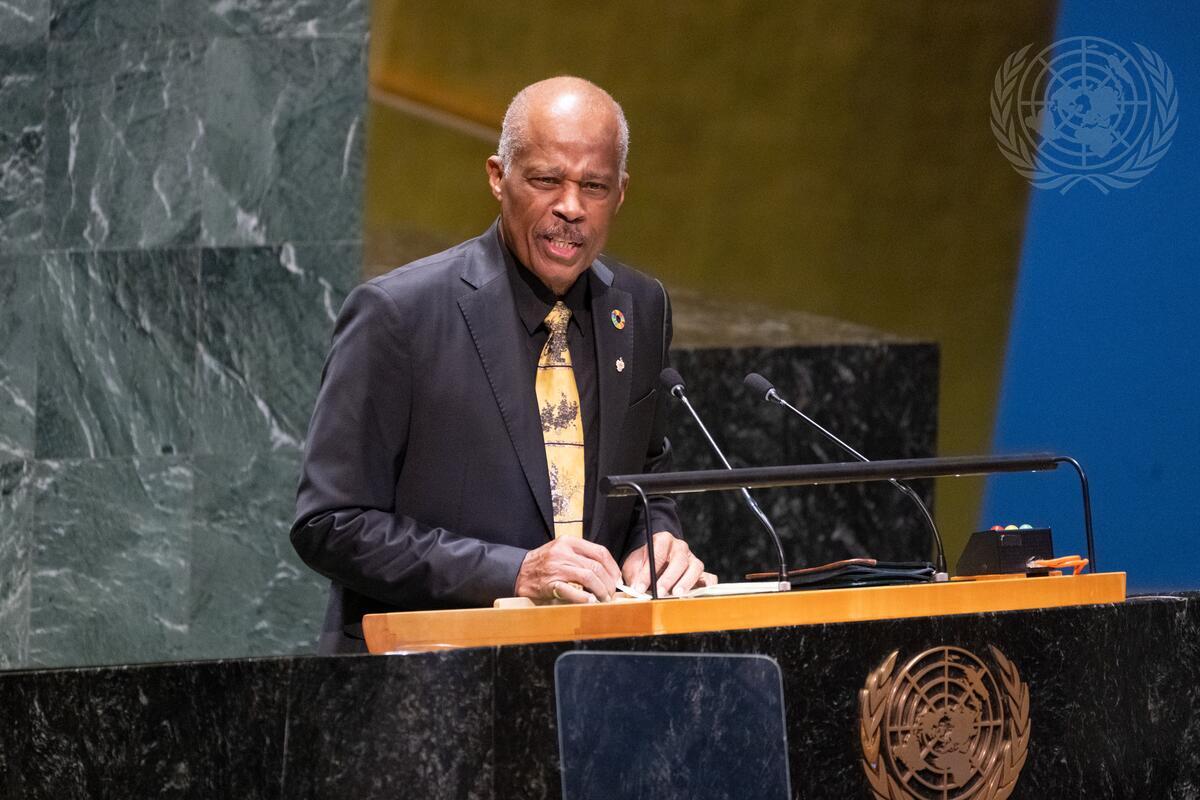
Reparations was one of the central questions at 2001 Durban Conference against racism and related intolerance. The Caribbean has been one of the Global African regions at the forefront of the struggle for reparative justice since the conference. Tennyson clinically examines the evolution, successes, and contradictions in the reparations movements in the Caribbean in the 25 years after the conference.
The occasion of the 25th anniversary of the World Conference against Racism and related intolerance, held in Durban, South Africa in September 2001 (the Durban conference), presents a timely opportunity for reflection on the state of the global reparations movement, since, to a large extent, it was the Durban conference which ignited the spark for the formal adoption of reparations as a formal pillar of foreign policy engagement between states in Global Africa and Europe. Given that the deliberate construction of a formal adoption of reparatory aspirations by reparations movement in the Caribbean can be traced to the Durban conference, this submission offers a critical reflection of the Caribbean experience of reparations, twenty-five years after, as a guide to charting future possible directions for the global reparatory movement.
This paper therefore has three main aims. First, it will offer an update of how the reparations question, and the Caribbean reparations movement have evolved since the Durban conference. Secondly, it will offer a critique of some of the key contradictions and pitfalls which have become evident in the Caribbean reparations movement and highlight their dangers and lessons for the future evolution of reparations movements globally. Finally, the paper will conclude by offering some insight into some problems that need to be addressed to avoid future irreparable harm to the reparations project.
The Caribbean Reparations Movement Since Durban
It is safe to say that the beginnings of a formal and official Caribbean Reparations Movement can be traced to the publication of Hilary Beckles’s Britain’s Black Debt (2013). It was published in 2013. Much of the energy for defining what has emerged as the main outlines of the formal, state-led elements of the decolonisation project can be traced directly to Beckles’s multiple roles, as the author of Britain's Black Debt, as member of the Barbados and St. Vincent delegation of the Durban Conference, as the Chairman of CARICOM’s Reparations Commission as Pro-Vice Chancellor of the University of the West Indies, under whose leadership the Centre for Reparations Research was inaugurated.
Indeed, Beckles, identifies explicitly a link between the publication of Britain’s Black Debt and his conscious intention to initiate the formal organisation of a civil society-based reparations movement with links to the various independent states in the Caribbean. In his own words, the book “embraces and continues the post-Durban reparations discourse. Caribbean governments have been urged by their civil society leaders to press ahead with the pro-reparations positions they adopted at Durban”. He concluded his foreword with a declaration that since “the seventeenth-century Caribbean was positioned in the vanguard of the economic process that led to the mass enslavement of Africans. Perhaps the Caribbean has a vanguard duty to the twenty-first-century global movement for reparations”.[1]
These observations by Beckles, his own centrality in initiating the formal processes of Caribbean reparations organisations, and his claims to Caribbean “vanguardism” in black liberation projects, in many ways point to some key contradictions in the Caribbean reparations movement since Durban. One of the major contradictions which emerged as particularly problematic in the Caribbean context, has been a version of reparations as largely a state-led post-colonial “economic development” project, not materially different from the earlier demands for “special and differential” treatment in the 1980s-1990s period when Caribbean diplomats toured European capitals seeking relief from the emerging world of global trade liberalisation which was threatening the major export industries in the Caribbean. Given Beckles’s historical awareness of an organic grass-roots, black proletarian underclass demand for reparation centuries before Durban, he was very deliberate in acknowledging that the existence of reparations demands could be in the struggle of the Rastafari movement for repatriation and for racial, economic and social justice, in the struggles of indigenous peoples for the preservation of their nations, expressed in Eric William’s Capitalism and Slavery and explicitly stated by WA Lewis’s in Labour in the West Indies where Lewis argues that Europe owes the Caribbean a development debt for the unpaid labour of generations of Caribbean people.[2]
Despite Beckles’s acknowledgement of these grass-roots pre-Durban demands for reparations, upon which he might have been leaning to legitimize the formal movements which he was committed to initiating, there were several features of the post-Durban movements which severed the link between the leadership and the masses. Indeed, the Caribbean reparations movement have repeated all the errors of the earlier elitist, neo-colonial, black-marginalising, state-centric independence projects which had occurred between the 1950s and early 1980s, and if left unchecked, will result in the negation of any potential of the reparations movement for the qualitative transformation of the lives of Caribbean people.
A general description of the main features of the Caribbean reparations movement may be necessary, to facilitate a deeper critical analysis. This is provided below.
Pitfalls and Contradictions of the Main Institutional Bases of Caribbean Reparations Movement
There have been three broad organisational and programmatic features of the Caribbean reparations movement since the Durban Conference. These are:
- The CARICOM Reparations Commission as the overarching body of National Reparations Councils, and the articulation of a Ten-Point Plan
- An “open-door” approach to “all persons of goodwill”, through which individual European families, select institutions like religious bodies, universities and NGOs have been allowed to frame their own actions of reparations. This has opened up spaces for wealthy and well-placed European NGOs playing an outsized role in the Caribbean Reparations movements, thus reinforcing neo-colonial dependency, with direct consequences for the effectiveness of reparations as a liberatory exercise.
- The formal Legal route, where the validity of Caribbean reparatory justice claims are tested in court. One of the most recent iterations of this is the formal petition to the British Monarch, Charles III by the Government and people of Jamaica.[3]
- CARICOM Reparations Commission, CARICOM 10-Point plan and National Reparations Committees.
The Caribbean’s main institutional vehicle for the pursuit of reparations has been the CARICOM Reparations Commission, chaired by Professor Hilary Beckles. Supporting the work of the CARICOM commission are the separate country national reparations commissions. Among the tasks expected of the national reparations commissions included, conceptualizing and articulation of strategies and frameworks for the acceptance and management of resources through reparations, identifying projects of “self-repair” at the community level, and the development of a long-term strategy to coordinate a regional approach for reparations (Joseph and Worrell.[4]
These commissions are largely government appointed, with varying degrees of efforts made to select the leading pan-Africanists, Rastafari, cultural activists and intellectuals as commissioners. In theory these commissions are supposed to be “non-partisan” and are expected to serve in an advisory role to the governments, engage in public education and sensitisation. And they are supposed to be the main conduit between the CARICOM commission and the national government, while also being the main conduit between the public and the government. One of the formal working institutions of the CARICOM reparations commission is the CARICOM Regional Conference on Reparations. To date three such regional conferences have been held with the last held from September 17-19, 2026. Buttressing these arrangements have been CARIOCOM’s formal adoption of the Ten-Point Plan, outlined as follows, in the most recently revised CARICOM “Reparations Manifesto”:[5]
- A Full and Formal Apology
- An Indigenous Peoples Development Programme
- Repatriation And Resettlement
- Restitution Of Cultural Heritage and Cultural Reconnection
- Remedying The Public Health Crisis
- Capacity-Building and Development Through Education And Training
- Compensation For Gender-Based Violence and Assault on Family
- Psychological Rehabilitation
- The Right to Sovereignty and Development: Technology, Innovation and Entrepreneurship
- Debt Cancellation, Monetary Compensation and Decolonisation
Several weaknesses and contradictions can be identified in the formal CARICOM reparations arrangements.
-
First, there has been a charge of elitism. It has been accused of top-downism with agendas and approaches determined from the apex and imposed upon the bottom and accepted as the universal Caribbean position on reparations.
-
Caribbean laypersons feel disconnected from the CARICOM reparations agenda, with many persons holding markedly different meanings of what reparations entails from the official CARICOM position.
-
The Ten-Point Plan has been accused of being no different from the traditional “begging for aid” in a context where the shift to global trade liberalisation had removed the “special and differential” treatment claims through which the Caribbean had begged Europe for aid and special trade arrangements during the era of trade liberalisation in the 1990s into 2000s. The 10-point plan’s confinement to state-led policy arrangements around education, health, physical infrastructure, has not distinguished the reparations agenda from the everyday government policy agenda for which advancement assistance is being sought from Europe. Indeed, except for points 1 and 8, which call for an apology and for psychological repair respectively, the Ten-point plan is not materially distinguishable from the standard “line ministries” around which government departments are arranged. Thus, post-colonial pleas for special development assistance from Europe have simply been replaced by a moral claim for reparative development.
-
There is no real policy or programmatic substance to the work of the various country commissions. Many of them receive no funding, and are entirely ad hoc in their functioning. Beyond serving as resource persons on the reparations questions, there is little evidence of any direct link between the work of the Commissions and specific policy outcomes of the governments. Many of the commissioners are “friends” of the ruling governments.
-
The CARICOM-led commissions have “sucked the air out of the room” of the Caribbean reparations movement. By their very existence, the National Reparations Commissions have assumed positions of “hegemony” over the reparations discourse. This mirrors the experience of the Caribbean independence movement in which a mass labour movement of the 1930s into the 1950s became canalized into political parties and trades unions under petite bourgeois political leadership which has brought us to the compromised neo-colonial independence that we have today.
In perhaps one of the most clearly articulated criticisms of the CARICOM Reparations movement, Ajamu Nangwaya (2017)[6] has argued that CARICOM cannot achieve reparations without putting capitalism on trial. Nangwaya has complained that,
we are witnessing the unconscionable, but politically understandable behaviour of the neocolonial states in the Caribbean Community (CARICOM) in divorcing their call for reparations from measures aimed at throwing capitalism into the cesspool of history. These member states of CARICOM are all committed to the implementation of social, economic and political policies that have enshrined capitalism in the region. They are interested in reparations as a way to deal with their balance of payment, budgetary and development challenges as seen in the call for debt cancellation, technology transfer and a formal apology and not statements of regrets in this regional body’s Ten-Point Action Plan for Reparatory Justice…We should expect the liberal petite bourgeois or middle-class reparations advocates to not indict capitalism. Their class interests and aspirations are totally immersed and dependent on the continued existence of capitalism.
These observations highlight the failure of the Caribbean Reparations movement to link the quest for reparatory justice with the pursuit of “true decolonisation” in the region.
- The Open-Door “All Persons of Goodwill” Approach: A Critical Analysis
Once the popularization and public education of the Caribbean Reparations Movement had occurred, the Caribbean witnessed a flurry of “offers of reparations” from individuals and families seeking to make reparations with Caribbean states from whom their ancestors benefitted. Closely related to these instances of individual European family voluntary acts of slave-property return to Caribbean governments, have been university to university initiatives where Western universities which have been shown to have benefitted from slavery, through direct ownership of enslaved persons, engage in specific reparatory initiatives with the University of the West Indies.
In terms of the critical assessment of these open-door reparatory efforts, we can identify some positives.
-
For the first time since the articulation of an official reparations discourse, there was evidence of concrete “successes” of the reparation demand. This helped to fortify the champions of reparations in the face of popular doubts about the “futility” of the reparations movement.
-
These individual family reparatory land returns appeared to present a crack in the obstinate denial of Europe. That is, it could no longer be said that Europe had no “responsibility” for reparations when individual slave-holding descendent families were demonstrating concretely that they did and that they were willing to take concrete steps.
-
The return of slave property offered a simple, concrete and measurable model of “reparatory” justice. Identify the families, tie the families to property. Families return the property. Reparations thus moved from the abstract to the concrete.
However, while on the surface a positive development, these returns of slave-tied wealth have raised several contradictions in the Caribbean reparations movement.
-
First, by taking the initiative in returning their slave-based property, the European families seized the reparatory initiative from Caribbean governments and appeared to be calling the shots and determining for themselves what is the appropriate settlement. They also insulted their own governments from state responsibility for reparations.
-
These “return the slave lands” initiatives also presented the possibility of a “minimalist” interpretation of reparations, against which future reparatory efforts would be measured.
-
The University-to-University acts of reparatory justice also evoked a complaint from Caribbean reparations that “only the university” form reparations. The multiple roles of the UWI Vice Chancellor, Hilary Baeckles, in the CARICOM reparations strengthened such negative perceptions.
Similar weaknesses can be seen in the role of European-based NGOs in the Caribbean Reparations movement. One notable case is that of The Repair Campaign, founded by Denis O’Brien the founding entrepreneur of Telecommunications provider DIGICEL, which appears to be playing an outsized role, due to the financial resources at its disposal, in influencing the Caribbean Reparations Movement. While the work of the Repair Campaign has assisted with identifying some critical projects, through research, around which reparatory work can be undertaken in several Caribbean states, there has been a great degree of paternalism in the conduct of the work of the NGO. Rather than contributing to the funding of the CARICOM reparations movement, the Repair Campaign has positioned itself to exist alongside or indeed, above CARICOM in determining its own framework for reparations. One of The Repair Campaign’s central visions is for the creation of a CARICOM Reparations Fund through which Caribbean reparatory projects would be financed. The source of the finance envisaged would be the major European capitals. The question of the management and distribution of the fund, and the prioritizing of the project remain unclear.
The potential weaknesses and contradictions in the Caribbean reparations movement being defined and dominated by a European-based NGO are immediately apparent.
-
First, the main principals of Project Repair appeared to be offering an alternative vision to the CARICOM Commission, and appeared to be seeking to eclipse, rather than complement the CARICOM effort. Project Repair has positioned itself as a master of the CARICOM reparations project, rather than its servant.
-
There is a strong element of European paternalism in how Project Repair has positioned itself over the heads of the Caribbean governing classes.
-
It sought to accommodate the reparations mission to neo-liberal capitalist financing mechanisms.
-
Project Repair has not allowed for the mass of the Caribbean populations to feel an ownership stake in the reparations movement.
- The Formal Legal Route
In addition to the above expressions of reparations in the Caribbean since Durban, the one other area around which Caribbean reparations has been identified is the possible pursuit of reparatory justice through the formal court system. This area of reparations has, to date, remained largely under-developed, given the Caribbean emphasis on building national movements around reparations. However, in late September 2026, a decision was taken by the Jamaican government to formally submit a petition calling for reparations to the visiting British Monarch, King Charles III.[7] The British Head of State has since submitted the petition to the British Privy Council for a decision on the legality of the claim.[8]
Despite the appearance of action on the reparations question which formal legal challenges to European governments may convey, there are some potential pitfalls associated with the legal route. The main risk with pursuing reparations in the formal court system is significant capacity which it gives to institutions of the offending colonial countries to determine the outcome of the reparations question. Put bluntly, the reparations case can be easily closed by the European court system. Once a decision is taken to pursue a matter in court, one almost tacitly agrees to accept the court’s decision as final. It would therefore serve the Caribbean well to emphasise that the pursuit of the legal option does not signal the demobilisation of the mass movement. The legal option should be pursued as an appendage to the mass movement, not as a substitute for it.
Exorcizing the Demon-Elephant in the Room: The Way Forward
In the spirit of moving beyond Durban twenty-five years after, there are three broad concerns which may be considered in thinking about how the Caribbean reparations may avoid the identified pitfalls and how it might be strengthened.
The first pertains to the much-heralded claim of the Caribbean being in the “vanguard” of the global reparations movement. Coming out of Durban, there was a nagging debate about a split between the Caribbean and some African delegations on reparations, and there were raging accusations that certain African states were siding with European powers to oppose reparations. This question featured very strongly in Beckles’ account of Durban in the chapter entitled “Sold in Africa” in Britain’s Black Debt.[9]
In order to strengthen the global reparations movement, these assumptions of Caribbean vanguardism in global liberation struggles, should be categorically rejected and studiously avoided. It should never be forgotten that these assumptions of Caribbean vanguardism are rooted in European civilisational assumptions in which the Caribbean is often privileged in the European civilisational hierarchy in relation to mainland Africa. According to this racially-based civilisational hierarchy, Westernised blacks in the American, Caribbean and European diaspora are placed above citizens of mainland Africa. These hierarchical civilisational assumptions were evident in the Liberian state-building project, in Garveyism, in the Pan-African Movement, and unfortunately, they are evident in the assumptions of the Rastafari movement and they also evident in today’s reparations movement. Many prominent Caribbean radicals, sadly, have subconsciously internalised these civilisational claims and have acted accordingly. It should be strongly urged that as Global Africa thinks about Durban 25 years on, that this demon-elephant in the room be decapitated and exorcised. The recent success by the Government of Ghana in playing a leadership role in having the trans-Atlantic Slave trade designated as the greatest crime against humanity via a UN resolution, and in hosting the next-steps conference, is an important step towards erasing any lingering assumptions of Caribbean vanguardism in global black liberation projects.
A second major issue which needs to be addressed is the Caribbean’s failure to sufficiently pursue a robust project of self-repair. While the Caribbean has pursued reparations as a foreign policy agenda objective aimed at forcing sovereign European states to accept responsibility for slavery and genocide, the Caribbean has not pursued as robustly all the domestic options available as sovereign states, to engage in a comprehensive process of self-repair. For instance, the Caribbean has not decolonised its place names and public buildings and institutions. The Caribbean has not decolonised its education curriculum. Nor has the region engaged directly the local planter and commercial family interests who were the direct beneficiaries of European power and who continue to enjoy the advantages of the slave and colonial system. The Caribbean has also failed to address the full range of demands for the repair of the damage done to the indigenous populations. For example, recent calls by the Kalinago Council of Dominica for greater degrees of autonomy, including its own internal tax regime and project development initiatives, as well as the demands for the change of name of the country from Dominica to the indigenous name of Wai’tukubuli, have largely been ignored by the government of Dominica. Another major failure of the Caribbean Reparations movement is its silence on lingering colonialism in the Caribbean region. The independent states of the Caribbean cannot successfully pursue reparations, while turning a blind eye to the continued direct control by European powers of black majority-islands in the Caribbean basin.
Finally, the Caribbean reparations movement must seek to develop the correct relationship between the masses and the leadership. There are many negative parallels between the independence movement in the Caribbean between the 1930s to 60/70s and the current reparations movement. Without consciousness, the Caribbean may repeat the errors of the independence movement. While Caribbean independence movements began as organic popular uprisings of the working class against the conditions of colonialism, these movements were later hijacked by elite, western educated personalities who eventually assumed managerial control of the political parties and trade unions. It is largely for this reason that the Caribbean independence project quickly ossified into the formal Westminster model of liberal democratic electoral competition to manage neo-colonial neo-liberalism, with the black working class largely alienated from the process.
Unfortunately, a similar trajectory is being pursued with the reparations movement. It is widely acknowledged that the earliest demands for reparations can be found in the Caribbean grassroots anti-slavery and anti-colonial movements decades before the Caribbean ruling elites had appropriated reparations for their development strategies. However, once the Caribbean elite had adopted reparations as a viable project, the ground was now laid for a hijack by the elite and the excision of the masses from the process. The dangers associated with these tendencies must be struggled against.
However, there is one major respect in which reparations is very different from independence. It can be argued that independence, despite its many flaws, at least had a measurable end point, however minimal. A government, elected on universal adult suffrage, enjoying sovereign power, vested in a cabinet led by a prime minister or president who assumes full executive authority, and is not a vassal of an external power, was the measurable minimal goal. In contrast there is no easily recognizable minimal goal around which reparations is being pursued. There are as many views on reparations as there are victims of colonialism. It may be a useful task of global reparations, to define for each of its regions, or as a collective, a minimum program around which the struggle for reparations can be fought. It will also be the task, of future reparations movements, to determine for themselves, what the minimum should entail from generation to generation. The most important task, 25 years after Durban for the global reparations movement, is to collectively agree on a universally accepted minimum imperative around which we can mobilise our actions and our purpose.
Endnotes
[1]Beckles, Hilary. 2013. Britain’s Black Debt: Reparations for Caribbean Slavery and Indigenous Genocide, Kingston: UWI Press. Page xii
[2]Lewis, W. A. 1977. Labour in the West Indies: The Birth of a Workers’ Movement. Reprint, London: New Beacon Books.
Williams, Eric. 1944. Capitalism and Slavery: Chapel Hill. University of North Carolina Press.
[3] Grange, Olivia. Jamaica’s plea to the king: use your authority to ensure colonial slavery is examined. The Guardian. September 9, 2026.
https://www.theguardian.com/news/2026/sep/09/jamaica-slavery-reparation…
[4]Joseph, Tennyson and Rodney Worrel. Forthcoming 2026. “Black Power in Barbados and St. Lucia: Radical Ideas and the Independence Project” in Circuits of Black Power: Global Networks of Caribbean Activism, edited by Kate Quinn, Gainesville: University of Florida Press, pgs. 171-197. Page 190.
[5] CARICOM 2026. The CARICOM 10-Point Plan for Reparatory Justice: A Manifesto for the Coming Enlightenment. Georgetown: Caribbean Community Secretariat.
(https://caricom.org/wp-content/uploads/CARICOM_ReparationsManifesto-D_2…)
[6]Nangwaya, Ajamu. 2017. “Caribbean Reparations Must Put Capitalism on Trial”. In Black Agenda Report 19, April 2017. https://blackagendareport.com/reparations_for_slavery_and_capitalism
[7] Grange, Olivia. Jamaica’s plea to the king: use your authority to ensure colonial slavery is examined. The Guardian. September 9, 2026.
https://www.theguardian.com/news/2026/sep/09/jamaica-slavery-reparation…
[8]Duncan, Natricia. 2026. “Jamaica hails King’s decision to refer slavery reparations petition to privy council as ‘really big deal’” in The Guardian (Online), September 22, 2026. Downloaded on September 29, 2026.
https://www.theguardian.com/world/2026/sep/23/jamaica-king-charles-to-r…
[9]Beckles, Hilary. 2013. Britain’s Black Debt: Reparations for Caribbean Slavery and Indigenous Genocide, Kingston: UWI Press. Pages 172-193